| November 10, 2025

Solve Connectivity’s Biggest Problems: Introducing Speedtest Pulse

Key Takeaways

  • The Era of Connectivity Has Changed: As customer expectations increase and high-speed internet access matures, the new No. 1 battleground for ISP customer satisfaction and retention is the “last 50 feet”—the in-building Wi-Fi experience. For enterprises, the move to wireless-first has made Wi-Fi the backbone of employee productivity and operational continuity.
  • There is a Massive Market Gap: The industry’s current two-tiered support model relies on either low-visibility guesswork without specialized tools that leads to costly repeat truck rolls, or unscalable expert devices that are too expensive and complex to deploy fleetwide.
  • Speedtest Pulse™ Fills This Gap: We built Speedtest Pulse to solve this specific, costly problem. Pulse is a new, professional-grade diagnostic tool, precision-engineered at a disruptive price point. It empowers every frontline technician—for the first time—to definitively validate installs, resolve Wi-Fi issues on the first visit, and provide proof of performance.

The Connectivity Landscape Today

Wi-Fi is now the primary lens through which residential and business customers experience and judge their internet service. For Internet Service Providers (ISPs), controlling the quality of that experience has become a critical battleground for customer satisfaction and retention. For enterprises, Wi-Fi is the backbone of employee productivity and a critical component of core operations.

The internet’s evolution is driven by a constant cycle between infrastructure and applications. When ISPs build faster networks, they create new capacity. Application developers fill that capacity with more demanding experiences, such as the shift from standard-definition to 4K streaming. These new, richer applications quickly become the standard, raising user expectations and creating demand for even more network speed and quality. This virtuous circle in which infrastructure enables innovation, innovation raises consumer expectations, and together those create demands for better infrastructure, is the engine that pushes our digital world forward.

For the last two decades, ISPs have viewed their greatest challenge as the last mile—the final leg of the network connecting their infrastructure to the subscriber’s premises. This became the industry’s primary focus, the biggest driver of capital expenditure (CapEx), and the main competitive battleground.

And now, that last-mile challenge is fundamentally changing, largely becoming a problem of execution and investment—not capability. The industry has multiple, powerful paths to deliver speed—from fiber and DOCSIS 4.0 to innovations in low-Earth-orbit (LEO) satellite and fixed wireless access (FWA). While the competition to deploy these solutions is immense, the raw speed to the doorstep is less of a problem for a majority of customers in advanced markets.

For an increasing number of ISPs and their customers, the challenge is no longer about getting the necessary speed to the building, but about what happens once it gets inside. By delivering all that speed to the modem, ISPs have also shined a massive spotlight on a new bottleneck: the in-building Wi-Fi experience—the “last 50 feet.” The entire digital experience, from the enterprise to the living room, is now wireless. For example, the average U.S. internet household has about 17 connected devices, and the Macbook Pro hasn’t had an ethernet port in over a decade.

Rising Consumer Expectations

This new in-building bottleneck—where weak Wi-Fi coverage, interference, congestion, or device issues can cause slow speeds or other issues—hasn’t just created a technical problem; it has exposed a massive gap between what customers now expect and what most ISPs efficiently deliver. While Ookla data confirms broadband speeds are rising, the customer sentiment of fiber customers is actually declining. New benchmarks from the American Customer Satisfaction Index show every single one of 14 key satisfaction metrics—from reliability to streaming quality—declined from 2024 to 2025 among fiber customers.

Consumer expectations have fundamentally changed, shifting away from just speed and towards whole-home or business connectivity. In fact, consumers now see their ISP as the single point of responsibility for their entire connected experience. The proof is in the data: a 2025 Techsee report based on a survey of nearly four thousand U.S. households found that 77% of consumers expect providers to test coverage during installation and verify that every room is connected. They don’t just want a promise of speed; they want trusted proof of coverage.

This new expectation comes with a severe, high-stakes penalty for failure: customer churn. Customer loyalty is no longer tied to the last-mile cable, but to the quality of the in-home experience. The same Techsee study found that 51% of consumers would switch providers if their Wi-Fi issues aren’t resolved quickly. This is the new battleground for customers, fought across the entire in-home experience, from the living room to the back bedroom to every corner where users expect flawless connectivity.

The problem is that ISPs are being held accountable for an environment they can’t see, which poses a significant reputational risk. This gap between customer expectations and reality is already at a breaking point.

  • 68% of households reported Wi-Fi problems in the past 12 months. 
  • 39% of those households required a technician to be dispatched, a process commonly known as a “truck roll.” 
  • Worse, about 20% of those costly truck rolls failed to resolve the issue on the first visit—a classic “No Fault Found” scenario where the tech proves the speed to the modem is good, but the customer’s problem remains unsolved.

Based on these figures, common connectivity issues can cost a typical ISP with one million subscribers up to $140 million annually in customer churn and technician costs.

This crisis of rising expectations, however, hides a massive opportunity. Data shows that customers aren’t unreasonable; they just want proof. In fact, 56% of consumers said they would purchase additional equipment, like mesh systems, if a technician presented them with clear evidence of coverage gaps.

The findings from the Techsee study create a clear mandate for ISPs: solve the top customer complaint (in-home Wi-Fi issues), reduce repeat truck rolls, stop churn, and turn a costly service call into a new revenue stream by giving technicians the proof they need to recommend upgrades or additional equipment that improve the in-home experience.

Gap in Current ISP Solutions

The industry has been actively trying to gain visibility into the in-home experience for years. The problem is that the available tools were either not purpose-built or not scalable for this new, complex, and highly variable environment. This critical mismatch has forced providers into a largely broken, two-tiered operational model.

The first tier is the default model for the vast majority of subscribers, and relies on low-visibility guesswork. When a customer calls their ISP with a Wi-Fi complaint, the ISP’s diagnostics stop at the modem, providing an “inside-out” view, using CPE-embedded tools. This approach, which Ookla also provides, is valuable for getting a performance baseline from the router, or for proving service levels to the router. However, it cannot measure the true customer experience, which happens on a device two rooms away. This inside-out view is also completely blind the moment a customer plugs in their own router, leaving support teams with little or zero visibility.

This process inevitably results in a “No Fault Found” truck roll. A frontline technician is dispatched—at significant operational cost—without the tools needed to definitively diagnose the in-building problem. Instead, the technician is limited to confirming whether the service to the home is working, leaving the customer’s problem unsolved and increasing the risk of churn.

The second tier is the expert escalation model, reserved for high-value accounts where the cost of failure is too great to risk customer loss or reputational damage. When all else fails, the ISP is forced to escalate. This requires dispatching an expert network engineer equipped with highly specialized, enterprise-grade hardware.

While this specialist approach can eventually find the root cause, the model itself is operationally and financially unsustainable. These specialized devices cost thousands of dollars each and require significant training for thousands of ISP troubleshooting technicians and installation teams, making them economically unfeasible to deploy at scale. More importantly, they are what we call ‘data-rich, but insight-poor.’ Many of these tools provide complex RF data that requires an expert to interpret—not a simple, actionable recommendation.

Furthermore, these tools are not designed for autonomous testing of network performance; they are only useful when a technician is physically on-site, making it nearly impossible to diagnose the intermittent problems that frustrate customers and generate the most repeat truck rolls.

The fundamental challenges of large enterprise connectivity

ISPs aren’t the only ones struggling with the in-building connectivity problem. Enterprise faces a parallel challenge, where the stakes are measured in operational continuity and employee productivity. For large enterprises, this connectivity challenge is no longer just an IT issue—it’s a C-suite business problem, with a recent study finding that 70% of CEOs claim their network is slowing business growth.

Wi-Fi is now the backbone for enterprise environments. New network installations have moved to either wireless-first or wireless-only. This move concentrates all operational risk onto the Wi-Fi network, which is why visibility into the end-user experience is absolutely vital. This isn’t just about employee laptops and video calls; it’s about mission-critical systems: logistics scanners in a warehouse, medical devices in a hospital, and point-of-sale systems in retail. When Wi-Fi fails, business stops.

The shift to wireless-first and wireless-only networks has created a set of immense operational hurdles for IT leaders, both for their internal teams and their external partners:

  • The Scale Challenge: Managing network performance across hundreds or thousands of distributed sites is an immense operational challenge.
  • The Visibility Challenge: Central IT teams lack visibility into the real user experience at each site.
  • The Expertise Challenge: IT directors face a constant, unsustainable choice: pull their highest-skilled network engineers into routine troubleshooting, or let frontline problems pile up and drag down productivity.

This leaves IT leaders and their partners grappling with critical, unanswered questions. They are left struggling to ensure a consistent quality of experience across all their locations and service providers. Without objective, real-world wireless throughput and RF performance data, enterprises are forced to guess which locations to prioritize for network upgrades. All the while, they must reckon with the true, and often uncalculated, cost of pulling their senior engineers—both internally and at their partner organizations—away from strategic projects.

Introducing Speedtest Pulse™

This new era of connectivity, rising consumer expectations, and the gap in current solutions is precisely why we built Speedtest Pulse. Pulse solves these fundamental industry challenges at a disruptive and scalable price point.

To bring that vision to life, we at Ookla looked to the unique combination of core capabilities across our business and solutions. We’ve combined the unmatched Wi-Fi expertise of Ekahau—the creators of the market-leading Sidekick 2 Wi-Fi diagnostic device—with the powerful performance and experience validation, and iconic ease-of-use of Speedtest.

We packed decades of network intelligence into a single device that fits in the palm of your hand. The result is Speedtest Pulse, a professional, pocket-sized device and software application built for ISP technicians and Enterprise IT teams who need a simple way to validate network installs, resolve Wi-Fi issues, and guarantee network performance.

  • For ISPs, Pulse makes every technician their first line of defense against churn. It validates new installs and provides trusted proof to close trouble tickets on the first visit. This results in drastically reduced operational costs, fewer repeat truck rolls, and new sales opportunities.
  • For IT teams across large enterprises, hospitals, universities, and more, Pulse provides a simple way to validate network health across complex environments without immediately escalating to specialist teams.

We built Pulse from the ground up as a next-generation diagnostic platform, precision-engineered for today’s Wi-Fi-centric environment. Our goal is simple: to provide technicians and IT teams with simple, actionable recommendations that help them quickly identify and fix in-home and enterprise Wi-Fi performance issues—all at a price point that enables fleetwide adoption.

Active Pulse: Validating New Installs and Resolving Trouble Tickets

Active Pulse mode is the technician’s primary tool for guaranteeing performance on every site visit, whether it’s a new installation or a service call. Active Pulse provides one-tap, smartphone-based validation that translates complex network data into clear, actionable recommendations. The workflow is designed to eliminate guesswork and provide definitive proof of performance:

Step 1: Verify the inbound service

Before assessing the customer’s Wi-Fi, the technician’s first step is to isolate the service delivery from the local network. The technician is guided to connect the Speedtest Pulse device directly to the customer’s modem or router using an Ethernet cable.

The technician then runs an initial test to verify the performance of the inbound wired connection, up to 1 Gbps. This establishes a trusted performance baseline, confirming the inbound ISP service is functioning properly before any potential Wi-Fi issues are investigated.

Step 2: Test the wireless network performance

Once the wired service is validated, the technician disconnects the Ethernet cable and uses the Pulse mobile app to verify and/or diagnose the Wi-Fi environment. The technician can verify wireless performance in multiple areas of a home or business.

Using the app, technicians tap to initiate a test that measures key wireless throughput performance metrics using the trusted Speedtest server network. Then, Pulse scans the RF environment to identify common Wi-Fi problems like channel congestion or weak coverage and can analyze client-specific connectivity issues.

Step 3: Receive simple, actionable recommendations

Instead of showing raw data, the Speedtest Pulse app provides easy-to-understand results and recommendations.

If an issue is detected, the Pulse software analyzes the network’s KPIs holistically and provides clear instructions for improvement, such as, “Reduce Wi-Fi Contention. Your network is on Channel 36, which is crowded…Action: Change radio setting to channel 149.”

This empowers technicians to diagnose and fix problems on the spot—quickly and efficiently, even for those without Wi-Fi expertise.

Step 4: Provide definitive proof of install performance or issue resolution

After addressing a customer’s issues, the technician can generate a standardized install performance or issue resolution report to provide the proof that consumers today are seeking.

For new installs, this report serves as an internal “Day-One Performance Baseline” and provides data-driven confidence that the network is deployed consistently. It also directly addresses the growing number of customers who expect providers to prove whole-home or whole-business coverage, building customer trust and creating a positive first impression.

For troubleshooting tickets, this report provides definitive, trusted proof that the source of the customer complaint has been pinpointed and the issue has been resolved. It equips the technician with the actionable data needed to close the ticket in minutes, ending costly disputes  and validating for the customer that their network is now performing correctly.

A technician can typically complete a full diagnostic workflow—which includes an initial wired test to baseline the inbound service and multiple subsequent Wi-Fi tests in key locations—in approximately 5-10 minutes.

Continuous Pulse: Autonomous Testing Capabilities

When a technician visits a home or business to troubleshoot connectivity, that visit captures only a single moment in time. This leaves ISPs and IT teams struggling with a two-part visibility gap: they lack the real-world data to proactively assess long-term network health, and they struggle to diagnose problems they cannot replicate on site.

This gap has forced the industry into a reactive, “squeaky wheel” support model, where resources are only dispatched after a customer is already frustrated. This drives up costs with repeat truck rolls, leaves tickets unresolved, and damages customer confidence.

Intermittent issues that can’t be reproduced during a site visit are among the toughest challenges ISPs and IT teams face. They drive repeat truck rolls, unresolved tickets, and lead to even more frustrated customers. Historically, there hasn’t been a cost-effective way to capture and resolve these elusive problems. 

Speedtest Pulse’s Continuous mode, slated for release in 2026, solves this problem directly. As an affordable leave-behind testing tool, Pulse’s Continuous mode captures performance data over time and provides the conclusive evidence needed to finally close lingering tickets and restore customer confidence. Unlike internal monitoring tools that only show the network’s perspective, Pulse measures performance from the client device’s perspective, providing the trusted real-world data needed to measure service quality. With Continuous Pulse, organizations can:

  • Leave the device behind: Continuous Pulse is a “leave-behind” mode that operates as a standalone device for long-term, autonomous data collection without requiring a mobile app for ongoing operation.
  • Capture long-term trends: Continuous mode establishes clear performance baselines and makes it possible to detect degradation before it impacts end users.
  • Diagnose elusive problems: By running consistent tests over time, Pulse provides the evidence needed to identify and address intermittent problems that traditional tools can miss.
  • Integrate with existing systems: Data from Continuous Pulse feeds directly into Speedtest Insights™ and can be incorporated into existing network performance and assurance platforms.

Continuous Pulse mode provides the long-term, client-side visibility needed to catch intermittent issues early and cut down on repeat visits. In effect, Speedtest Pulse acts as the canary in the coal mine to identify underperforming networks. For large organizations, this allows IT leaders to stop guessing and deploy their expert resources (like senior engineers and specialized tools) only to the locations where their expertise will have the greatest impact. For customers using Speedtest Certified—our data-driven network certification for properties—Continuous mode will further enrich the certification by providing ongoing performance measurements.

The Power of the Ookla Ecosystem

The launch of Speedtest Pulse marks the start of a new chapter in how organizations approach network troubleshooting and validation. For ISPs, Pulse provides the scalable, easy-to-use, and insight-driven tool they need to fix the broken, two-tiered operational support model currently in place. Pulse empowers every technician to solve top wireless complaints on the first visit and drastically lower operational costs. And for Enterprises, Pulse delivers the outside-in visibility needed to solve scale and expertise challenges, empowering frontline IT personnel to validate network health across distributed sites.

Data from Speedtest Pulse will seamlessly integrate with Speedtest Insights, our centralized network intelligence platform, and/or can be integrated with existing experience and performance management systems. To build a truly comprehensive picture, data from Pulse can be used in conjunction with other products, including:

  • Speedtest Certified: The data-driven network certification for properties that proves on-site network excellence.
  • Speedtest: Leverage insights from 11 Million daily consumer-initiated tests.
  • Downdetector: Real-time problem and outage monitoring for early alerting on service issues.
  • Speedtest Embedded: Integrate Speedtest functionality into on-premise CPEs and other connected devices for network monitoring.
  • Speedtest SDK: Integrate Speedtest testing into any mobile application for performance insights.

Speedtest Pulse is the new, crucial piece of our holistic vision to collect and analyze data from all sources in the Ookla data ecosystem. Together, they provide a 360-degree view of the connected experience that is unmatched in the industry. Contact us to learn how Speedtest Pulse can help your organization.

Ookla retains ownership of this article including all of the intellectual property rights, data, content graphs and analysis. This article may not be quoted, reproduced, distributed or published for any commercial purpose without prior consent. Members of the press and others using the findings in this article for non-commercial purposes are welcome to publicly share and link to report information with attribution to Ookla.

| December 15, 2025

U.S. FWA Providers: Seasonal Slump or Victim of Their Own Success?

T-Mobile is the FWA speed leader with a median download speed which is approximately double that of AT&T.

5G fixed wireless access (FWA) is a popular and growing broadband option in the U.S. with the top three U.S. FWA providers —T-Mobile, AT&T and Verizon —  adding 1.04 million new subscribers in Q3 2025 bringing the total number of FWA customers to 14.7 million, which is slightly more than 12.5% of the 117.4 million U.S. households with broadband, according to the U.S. Census Bureau’s 2024 American Community Survey. 

In Ookla’s March 2025 U.S. FWA report, we tracked download and upload speeds from Q1 2023 to Q4 2024 and found that overall FWA speeds were on the upswing over time with T-Mobile leading its peers in both median download and upload speeds.

According to recent Ookla Speedtest Intelligence® data, T-Mobile maintains its FWA leadership position with median download speed of 209.06 Mbps for Q3 2025, which is approximately double that of AT&T’s median download speed of 104.63 Mbps in the same quarter. 

However, there was a noticeable decline in all three providers’ download and upload speeds during Q2 2025 and Q3 2025, which may be a seasonal pattern as we saw a similar decline in median upload speeds for all three operators in Q2 and Q3 2024 and a decline in download speeds for AT&T and Verizon in Q2 and Q3 2024. It’s also possible that this may be an early indication that strong uptake in FWA is starting to impact performance. 

Key Takeaways

  • Speedtest users from all three U.S. FWA providers—T-Mobile, Verizon and AT&T—experienced declines in both their median download and upload speeds during Q2 2025 and Q3 2025. 
  • T-Mobile is the FWA speed leader. T-Mobile’s median download speed of 209.06 Mbps in Q3 2025 is approximately double AT&T’s median download speed of 104.63 Mbps in the same quarter.
  • AT&T and T-Mobile customers in the 10th percentile of users are experiencing speed declines during peak hours in the late afternoon and evening. Verizon subscribers in the 10th percentile don’t have the same sorts of declines, indicating the operator’s enforcement of speed caps may be helping it deliver a more consistent experience to those customers.
  • AT&T Internet Air’s latency is higher than its peers but it’s improving. In Q3 AT&T’s median latency was 67 milliseconds (ms) compared to Verizon at 54 ms and T-Mobile at 50 ms. However,  AT&T’s latency is improving every quarter from a high of 78 ms in Q3 2024.

Seasonal dip in speeds or network congestion?

Verizon, T-Mobile and AT&T all experienced a decline in median download speeds in Q2 and Q3 2025. T-Mobile’s median download speeds dipped from 221.65 Mbps in Q1 2025 to 209.06 Mbps in Q3 2025, Verizon’s declined from 167.30 Mbps in Q1 2025 to 137.81 Mbps in Q3 2025 and AT&T’s dropped from 114.34 Mbps to 104.363 Mbps over the same time period.  

Ookla Speedtest data saw a similar trend for Verizon and AT&T during Q2 and Q3 2024. FWA users from both operators experienced a decline in median speeds during these two quarters but T-Mobile does not. Verizon Speedtest users experienced a decline in their median download speeds from 140.14 Mbps in Q1 2024 to 115.68 Mbps in Q3 2024 before bouncing back to 150.47 Mbps in Q4 2024. 

AT&T Internet Air users also saw a decline from 141.28 Mbps in Q1 2024 to 130.13 Mbps in Q3 2024. However, unlike Verizon, AT&T’s median download speeds didn’t bounce back up. In fact, users of AT&T Internet Air service experienced a steady decline from Q1 2024 median download speeds of 141.28 Mbps to 104.63 Mbps in Q3 2025. AT&T doesn’t guarantee speeds for its Internet Air service but says that users can expect download speeds from 90 Mbps to 300 Mbps and upload speeds from 8 Mbps to 30 Mbps. 

Upload speeds also declined with T-Mobile’s median upload speed dropping from 24.03 Mbps in Q1 2025 to 15.49 Mbps in Q3 2025. Likewise, Verizon’s median upload speed declined from 15.23 Mbps in Q1 2025 to 11.40 Mbps in Q3 2025 and AT&T’s dropped from 13.13 Mbps to 9.25 Mbps during the same time period. 

It’s not clear that these fluctuations in speeds that we are seeing are due to seasonality or if it’s an indicator of network congestion. 

The impact of foliage on FWA speeds is common knowledge among RF engineers. The signal loss typically occurs during the spring and summer months (Q2 and Q3) when deciduous trees are filled with dense leaves that can weaken FWA signals. While this phenomenon is more evident with FWA signals in higher bandwidth spectrum such as millimeter wave (mmWave), it also causes degradation in mid-band spectrum in areas with a lot of trees, such as suburban and urban neighborhoods with tree-lined streets. 

However, network congestion could also be a factor. There have long been concerns from the investment community and others about traffic from FWA subscribers causing congestion and impacting the performance of both mobile and FWA customers because the same 5G spectrum is being used to deliver both services. We will continue to monitor the network speeds of FWA subscribers to see if this is an ongoing pattern. 

A Comparison of AT&T, T-Mobile and Verizon's FWA s Median Download and Upload Speeds
Q3 2023 through Q3 2025
A comparison of FWA providers median download and upload speed over time.

90th percentile showcases rise in AT&T’s download speeds

 Although AT&T Internet Air’s median download speeds have declined over time from a high of 134.77 Mbps in Q2 2024 to a low of 104.83 Mbps, when we look at the experience of Speedtest users in the 90th percentile (those that get the best user experience) AT&T’s download speeds climb from 351.93 Mbps in Q2 2024 to 411.38 Mbps in Q3 2025.  

We may see more improvements to AT&T’s Internet Air performance in the coming months. The company cut a deal with EchoStar to pay $23 billion to purchase a 20MHz swath of 600 MHz spectrum and a 30MHz chunk of 3.45 GHz spectrum licenses. Together the licenses cover 400 markets across the U.S. The deal isn’t expected to close until mid-2026, but AT&T said in mid-November that it has already outfitted 23,000 cell sites with gear that can use the 3.45 GHz spectrum and is expecting both its 5G mobile and Internet Air FWA customers to benefit from that additional spectrum quickly.

With AT&T’s acquisition of EchoStar’s spectrum the company is expected to be more aggressive in its expansion of the FWA service but its overall strategy hasn’t changed. During its Q3 2025 earnings call with investors company executives said they still consider FWA as a flexible broadband option that will be used to capture market share in areas where fiber is not yet available.  

Like AT&T, T-Mobile’s 90th percentile users see their speeds increase dramatically from 402.49 Mbps in Q1 2024 to 482.36 Mbps in Q3 2025. 

The 90th percentile data also shows that Verizon is still enforcing its FWA data speed caps at 300 Mbps for download speeds and 20 Mbps for upload speeds, which the operator spells out in its 5G Home broadband price plan disclosures. We first wrote about this in our March 2025 report. 

T-Mobile and AT&T may not be enforcing data speed caps like Verizon, however both providers disclose in their Terms of Service that they will temporarily slow speeds during times of network congestion and it appears that they may be doing that during peak hours (see below).

U.S. 5G FWA 90th Percentile Download and Upload Speeds
Q3 2023 through Q3 2025
A comparison of FWA providers 90th percentile download and upload speed over time.

T-Mobile, AT&T FWA users see speed variations during the day

When looking at the download speeds of the 10th percentile of Speedtest users by hour of day in Q3 2025, we see that AT&T and T-Mobile customers, in particular, are experiencing speed declines during peak hours starting in the late afternoon and progressing through the evening with the lowest speed occurring between 8 p.m. and 9 p.m. 

However, it’s interesting to note that Verizon’s 10th percentile Speedtest users are not experiencing the same speed variations during those peak hours. As part of its network management, Verizon caps its speeds at 300 Mbps download and 20 Mbps upload and this network optimization scheme may be allowing them to better allocate network resources so they can deliver a more consistent customer experience. 

It’s also likely that some of the AT&T and T-Mobile speed declines that we see during the peak hours may be due to the operators temporarily reducing the speeds of their FWA users during periods of heavy network traffic.

U.S. 5G FWA Customer Download Speeds by Hour of Day
Q3 2025
10th percentile download speeds (Mbps)

AT&T’s latency is higher than peers

AT&T’s median multi-server latency is consistently higher than its peers. In Q3 AT&T’s median latency was 67 milliseconds (ms) compared to Verizon at 54 ms and T-Mobile at 50 ms. However, it appears that AT&T’s latency is improving every quarter from a high of 78 ms in Q3 2024. Latency is a key measurement for FWA subscribers and higher latency will impact real-time applications such as online gaming and video conferencing. 

AT&T was a late entrant to the FWA space, having launched its Internet Air service in August 2023. The company says it only deploys the service in areas with enough wireless coverage and capacity to deliver FWA service without impacting its mobile service.

U.S. 5G FWA Median Multi-server Latency
Q3 2023 through Q3 2025
A comparison of FWA providers Median Latency over time.

Urban FWA users are more likely to receive 100/20 Mbps broadband speeds

A higher percentage of urban FWA users across all three providers are experiencing the FCC’s minimum standard for broadband of 100 Mbps download speed and 20 Mbps upload speed than rural FWA users. Ookla uses the Census Bureau’s urban-rural classification to determine which users are urban vs. rural. 

We compared the percentage of urban vs. rural FWA users from each provider that experience speeds of 100/20 Mbps in Q3 2025 and found that 42% of T-Mobile’s urban FWA subscribers experience speeds of 100/20 Mbps compared to 26.9% of its rural FWA customers. 

In addition, 25.7% of Verizon’s urban FWA subscribers experience the FCC’s minimum standard for broadband compared to 14.7% of its rural FWA customers. 

AT&T also has more urban FWA subscribers experiencing the minimum broadband speeds with 21% compared to 16.7% of its rural customers.

It’s important to note that the lag in median upload speeds is the primary reason that FWA users are not meeting the FCC’s minimum standard for broadband service. As noted above, median upload speeds for all providers in Q3 2025 were below the 20 Mbps threshold. 

The higher percentage of urban FWA users experiencing broadband speeds than rural users is likely due in part to urban users having closer proximity to cell sites than rural users. In cities FWA cell sites are much closer together due to the density of the population which means signals don’t have to travel as far to reach customers. In rural areas homes are more spread out and FWA signals have to travel farther which means the signal is degraded and speeds are slower. 

The Percentage of Urban vs. Rural FWA Users that Experience the FCC's Minimum Standard for Broadband
Q2 2025 vs. Q3 2025
The percentage of FWA Speedtest users that are able to get the FCC's inimum standard of broadband of 100 Mbps download and 20 Mbps upload speeds in the U.S.

Upper C-band auction may supercharge FWA

While those 1.04 million FWA subscribers that the big three operators added in Q3 is up slightly over Q2 2025 when AT&T, Verizon and T-Mobile added a total of 935,000 in the quarter, analysts at New Street Research predict a slight slowdown in FWA subscriber additions in 2026 to around 3.6 million for the year, down from the 3.7 million to 3.8 million that the U.S. has experienced over the past three years. New Street said it expects Verizon and T-Mobile’s subscriber additions to slow but AT&T’s will hold steady since it’s a newer entrant in the market. 

This slowdown in subscriber additions will happen as fiber buildout accelerates and more fiber subscribers are added and as the total number of broadband households nears saturation. 

Both T-Mobile and Verizon have increased their long-term FWA targets to 12 million customers by 2028 for T-Mobile and 8 million to 9 million FWA subscribers by 2028 for Verizon. However, New Street did note that the FCC’s proposed auction of the upper C-band spectrum could provide additional capacity for the mobile operators and result in another four million FWA subscribers beyond those original goals. That C-band spectrum auction isn’t expected to occur until 2027 so the impact of this new spectrum may still be several years away.  

Besides the possible auction of upper C-band spectrum, there are other notable developments in the FWA space:

  • Verizon announced in October that it is purchasing fixed wireless ISP Starry, which currently delivers broadband to about 100,000 subscribers in multi-dwelling units (MDU) in five markets. The deal is expected to close in the first quarter of 2026. Verizon plans to integrate Starry’s mmWave technology with its own mmWave spectrum assets and leverage its fiber footprint for backhaul so it can deliver broadband to more MDU environments.
  • Besides AT&T’s acquisition of spectrum from EchoStar that was mentioned above, the company also received approval in early December from the FCC for its $1 billion purchase of 3.45 GHz mid-band and 700 MHz low-band licenses from UScellular. This additional 3.45 GHz spectrum is particularly valuable for 5G and FWA and will likely allow AT&T to expand its FWA service into new markets. 

We expect U.S. operators to aggressively pursue the FWA market in the coming year and we will continue to monitor the FWA customer experience as these operators expand their offerings. 

To find out more about Speedtest Intelligence® data and insights, visit our website.  

Ookla retains ownership of this article including all of the intellectual property rights, data, content graphs and analysis. This article may not be quoted, reproduced, distributed or published for any commercial purpose without prior consent. Members of the press and others using the findings in this article for non-commercial purposes are welcome to publicly share and link to report information with attribution to Ookla.

| September 24, 2025

Winning 5G FWA Network and Commercial Strategies: Lessons from du, Three, and T-Mobile

Fixed wireless access (FWA) continues to be popular in different regions of the world thanks to its performance, affordability, and ease of installation compared to cable or fiber. FWA was used by challenger operators worldwide to gain fixed broadband market shares and challenge the incumbent’s position. Mobile-centric challenger operators globally leveraged FWA to win fixed broadband market share, contest the incumbent’s position, and create cross-selling opportunities. This article analyzes the network, commercial, and pricing strategies of three operators: du (U.A.E.), Three (UK), and T-Mobile (U.S.A.). These players demonstrated technological and service innovation, which helped them achieve commercial success with FWA.

Key Takeaways:

  • du leveraged 5G FWA to expand its fixed broadband market share in the U.A.E. Customer numbers increased by nearly 50% from 2022 to 2025, doubling du’s share of the broadband market to 30%. The operator aims to reach a 40% broadband market share by 2027, driven by FWA, with continued network investments in 5G SA (Standalone) and 5G Advanced, while differentiating through extensive content selection, a dedicated gaming package, and offering advanced customer premises equipment (CPE).
  • Three UK’s FWA strategy is to disrupt the fixed broadband market by leveraging its 5G spectrum advantage, targeting urban and rural markets where fiber is lacking. As part of its recent merger with Vodafone, Three aims to become an even more effective challenger to traditional ISPs by accelerating the availability of FWA with more spectrum and sites, and complementing Vodafone’s fiber base with nationwide converged offers. It differentiates its FWA services by offering low prices, a custom-designed outdoor 5G antenna combined with an internal Wi-Fi 6-based mesh router system, and competitive speeds compared to UK entry-level cable/fiber packages.
  • T-Mobile has rapidly become a leader in the U.S. FWA market. It leveraged its expansive 5G network to deliver home broadband, targeting cable switchers in urban/suburban and underserved households in rural areas. The converged operator uses spare cellular capacity to ensure that FWA customers get the best experience without negatively impacting its mobile services. The company’s FWA strategy is marked by aggressive subscriber growth targets, a focus on network performance, and a hybrid approach to fiber deployment to attract new customers and use fiber assets for FWA backhaul.

du taps into 5G to boost fixed broadband market shares and expand reach beyond its legacy fiber coverage areas in the U.A.E.

du was the first operator in the country to offer 5G FWA to households and businesses. It leveraged FWA to compensate for the limited coverage of its fiber network and provide fixed broadband services in areas that the market incumbent, e& UAE, had historically exclusively covered.

du’s comprehensive 5G coverage (99% of the population at the end of 2024) helped to attract new fixed broadband customers, which increased by nearly 50% in three years, from 473,000 in Q2 2022 to 706,000 in Q2 2025. This growth was driven by the strong adoption of fiber and home wireless offerings, which doubled its fixed broadband market share to 30% between 2021 and 2023. The FWA segment also recorded an 18% increase year-on-year in 2024, and currently, 70% of mobile and FWA traffic runs over 5G infrastructure.

du aims to increase its broadband market share to 40% by 2027 through continued investment in the network and the introduction of more specialized consumer and enterprise products. For example, in 2023, it launched 5G SA, which promises better voice quality, higher speeds, and lower latency than 5G NSA (Non-Standalone). The 5G SA network is available nationwide and is supported by modern handsets and FWA CPEs.

du has also been trialing 5G Advanced in Dubai since October 2023. The company launched the service commercially in January 2024 and aims to achieve national coverage by 2026. This evolution of 5G promises even better performance and enables the support of advanced applications and services that take advantage of network slicing functions.

Since du operates the same 5G network to serve both mobile and FWA customers, it has developed separate optimization strategies for each service, taking into account each service’s specific traffic profile. For example, FWA users tend to use more video streaming services, where latency and jitter can be nuisances. According to Ookla’s Speedtest Intelligence®, du’s median download speed increased by 60% between Q2 2024 and Q1 2025, and the 90th percentile speed (representing the fastest 10% of samples) more than doubled during the same period.

To position itself as a more affordable alternative to fiber, du has decreased the price of 5G FWA over the last three years, waived the upfront one-time payment for the CPE, and shifted to unlimited data usage by default for at least the first year. It offers three packages that vary in terms of the number of bundled content subscriptions and the quality of the CPE. FWA packages start from AED229 ($62) per month, reduced from AED299 ($81) at launch, compared to AED389 ($106) for a fiber package.

du took steps to address consumers’ concerns and negative perceptions of FWA pricing and network quality:

  • Provide high-quality CPEs. du refreshed its CPEs with new models that support Wi-Fi 6 and provide better reception (for example, by using MIMO technology), and have more stable software. Higher-priced plans include a more capable CPE to reduce latency for services such as gaming.
  • Bundle FWA services with content subscriptions to help differentiate from fiber offerings. Du offers a selection of video streaming and gaming packages with its FWA plans. These bundles could help it justify future price increases to raise its ARPU.
  • Leverage its digital sub-brand. du sells FWA packages through Virgin Mobile, allowing it to target younger, tech-savvy consumers and offer competitive pricing, such as 50% discounts if a yearly subscription is paid upfront.

As du continues to expand its 5G SA network and FWA service portfolio, it is well-positioned to achieve its ambitious target of 40% market share by 2027 and consolidate its presence in the fixed market.

Three leverages its 5G spectrum to position FWA as a flexible and cost-effective alternative to cable and fiber in the UK

The Vodafone UK and Three merger was finally completed in June 2025, three years after being announced. It created the largest mobile operator in the UK, under the brand VodafoneThree, with 27 million fixed and mobile customers. The new operator pledged to invest £11 billion ($15 billion) to expand and improve its 5G network, provide 5G SA coverage to 99.95% of the population by 2034, and exceed 95% 4G geographical coverage by 2027.

Three UK launched its 5G network in August 2019, starting with a home broadband service in London. The operator then expanded to 25 other towns and cities by the end of that year. It uses its extensive 5G spectrum holdings (including a unique 100 MHz-wide contiguous block), especially in the 3.4–3.8 GHz bands, to power its FWA service.

In June 2025, it requested that the UK’s telecommunications regulator, Ofcom, offload 5G FWA traffic from 3.4-3.8 GHz to dedicated 3.9 GHz. Three has a license to use the 3.9GHz spectrum, but it is currently used as a shared access band (3.8GHz to 4.2GHz) that prevents it from utilizing standard equipment for any 5G deployment. Three argues that using 3.9 GHz with fewer restrictions would help boost speeds and capacity for its home broadband offering, especially in dense urban environments.

There is limited public data on the number of Three’s FWA customers in the UK. However, the operator has been vocal about strong demand from customers in urban areas, switching from DSL and cable operators, and in rural areas with limited access to copper or fiber. The newly formed company aims to leverage Three’s FWA business to increase the number of fixed broadband subscribers from the current 2 million subscribers to 4.3 million customers over the next 8 years.

Three offers multiple packages: a one-month rolling plan starting from £21 ($29) and 24-month contract options starting from £28 ($38), with no usage caps or throttling; both one-month rolling and include a 5G home router. FWA packages are positioned as more flexible compared to fiber or cable, for example, no waiting and no need for a landline or a technician for installation. The advertised headline average download speed is 150 Mbps (applicable to at least 50% of Three’s 5G broadband customers between the peak hours of 8 pm and 10 pm), which is in the same range as entry-level cable/fiber packages offered by other ISPs such as Virgin Media, BT, Sky, and TalkTalk, at a slightly higher price point £24 ($33) to £35 ($48), and longer counteract terms, usually 18 to 24 months.

Three was the first operator to offer a self-install ‘5G Outdoor Hub’ solution to address the coverage constraints of an indoor antenna. It was custom-designed in collaboration with its CPE partners and incorporates a digital display to indicate received signal strength. The ‘Outdoor Hub’ can be installed in different ways: wall mounted, pole mounted, window mounted, or placed in a temporary stand. The external antenna is then connected to a Wi-Fi 6 mesh router system via a power over Ethernet (PoE) cable.

By prioritizing flexibility and customer convenience, Three is positioning its FWA service as a compelling choice for consumers seeking reliable internet access without the constraints of conventional broadband installations. It is available nationwide and complements Vodafone’s fiber base.

The merged entity, VodafoneThree, will be able to serve 22.5 million with broadband services by combining Vodafone’s fixed infrastructure and Three’s FWA services. With 526 MHz of spectrum to use post-merger (over 40% more than the closest competitor EE), it will also be able to substantially increase the capacity and headline performance of its FWA solution.

Post-Merger Spectrum Holdings by MNO (MHz)

Post-Merger Spectrum Holdings by MNO (MHz)

T-Mobile has ambitious growth targets for fixed broadband in the U.S.A., supported by FWA and rapidly expanding fiber assets

T-Mobile’s FWA has emerged as a strong competitor in the U.S. broadband market. It positions its FWA service, 5G Home Internet, as a simple, contract-free alternative to cable and DSL, targeting urban/suburban and rural customers. Its FWA subscriber base has grown significantly, reaching 7.3 million by Q2 2025, a significant increase since the service’s launch in 2021.

T-Mobile was the first US operator with a nationwide 5G SA network. It began its 5G SA rollout on the 600 MHz band in 2020 for broader coverage and has since expanded to include the 2.5 GHz (2600 MHz) band for high-capacity.

T-Mobile has revised its long-term FWA target to 12 million subscribers by 2028, up from an earlier goal of 7–8 million by 2025. This optimism appears to be supported by consumer interest. A January 2025 Recon Analytics survey indicated that 44% of Americans would prefer an FWA provider for their next broadband connection, surpassing both fiber and cable options. However, T-Mobile is not the only national US provider with an FWA solution. Both Verizon and AT&T also have an FWA offering, as does regional provider C Spire and other smaller service providers throughout the country.

T-Mobile has a dual strategy to expand its fixed broadband subscriber base:

  • Expand fiber broadband footprint, partly by establishing joint ventures to acquire fiber providers such as Lumos in April 2024. As of June 2025, T-Mobile is serving 500,000 households in 10 states. In doing so, it is building high-capacity backhaul, which could be used to provide FWA services where extending fiber directly to homes is not cost-effective. It could also eventually migrate FWA customers to fiber.
  • Provide FWA services in areas where it has spectrum and excess capacity. T-Mobile only offers FWA services in areas where its network has sufficient excess capacity, determined by modeling each cell tower’s load and projected mobile usage. This ensures that FWA usage does not negatively impact the performance of mobile customers or degrade overall network quality. T-Mobile claims that its 5G network will have the capacity to support FWA services, covering about 50 million people based on its internal network capacity modeling.

The company employs sophisticated algorithms to monitor and predict capacity demand and approve new FWA customers only where there is enough surplus bandwidth. If a certain number of FWA customers sign up in a neighborhood and capacity is reached, T-Mobile temporarily stops accepting new FWA customers until more capacity becomes available. It reported having more than 1 million customers on the waitlist due to capacity constraints.

T-Mobile has made significant strides in network performance, with median download speeds increasing over 25% year-on-year, from 166.87 Mbps in Q2 2024 to 209.08 Mbps in Q2 2025, after reaching its peak of 221.73 Mbps the previous quarter. The fastest 10% samples approached a download speed of 500 Mbps in Q1 2025 before slightly dropping in Q2 2025 to 475.81 Mbps.

Upload speeds have also improved, with median upload speeds reaching 24 Mbps in Q1 2025 before falling slightly to 17.87 Mbps in Q2 2025. Over that period, the fastest 10% samples experienced much higher speeds, peaking at 76.47 Mbps in Q1 2025. 

Median and 90th percentile 5G FWA Download and Upload Speeds, T-Mobile USA
Source: Speedtest Intelligence® | Q2 2024 – Q2 2025
Median and 90th percentile 5G FWA Download and Upload Speeds, T-Mobile USA

T-Mobile highlights simplicity, competitive pricing, and value-added perks (such as bundled streaming and advanced cybersecurity services) to attract customers. It offers three distinct FWA service tiers:

  • All-In Home Internet: $70/month ($55 with voice line), offering 133–415 Mbps speeds, including streaming bundles.
  • Amplified Home Internet is $60/month ($45 with voice line) and provides 133–415 Mbps speeds.
  • Rely: $50/month ($35 with voice line), with speeds ranging from 87–315 Mbps.

Another distinction is that T-Mobile does not impose strict speed limits but prioritizes data for heavy users during peak times.

T-Mobile’s strategic focus on enhancing its FWA offerings is not only about expanding subscriber numbers but also about delivering a superior customer experience. By leveraging its 5G SA network assets and advanced network management techniques, T-Mobile ensures that its FWA service remains reliable and efficient, even as demand grows.

Challenger FWA operators are investing in optimizing their network performance and bundling powerful CPEs and content packages to maintain their competitiveness. These differentiators will likely drive the growth of FWA services, increase service innovation, and enhance their ability to compete against emerging low-earth orbit (LEO) satellite solutions. We will continue to monitor the evolution of 5G FWA and its adoption globally and share best practices. For more information about Speedtest Intelligence data and insights, please contact us.

Ookla retains ownership of this article including all of the intellectual property rights, data, content graphs and analysis. This article may not be quoted, reproduced, distributed or published for any commercial purpose without prior consent. Members of the press and others using the findings in this article for non-commercial purposes are welcome to publicly share and link to report information with attribution to Ookla.

| February 18, 2025

Comparing 5G Wireless Rural/Urban Connectivity in the 50 U.S. States

Having reached much of their 5G coverage and capacity goals in the urban and suburban areas of the U.S. in 2023, the big-three national U.S. wireless operators have turned their attention toward expanding their 5G networks into rural markets. This strategy is intended to help operators acquire new subscribers, particularly as growth in the urban and suburban markets has slowed.

But the big three U.S. wireless operators have taken very different approaches when it comes to expanding their 5G networks into less-densely populated areas. Of course, much of their strategies have been dictated by their spectrum holdings – particularly how much mid-band spectrum they were able to acquire.

Key Takeaways

  • T-Mobile has the largest percentage of 5G users spending the majority of their time on its 5G network in both urban and rural markets.
  • Nevada and Illinois are the only two states to make the Top 10 list for T-Mobile, AT&T and Verizon when it comes to high urban 5G availability indicating that these states, and their large cities of Chicago and Las Vegas, have been a 5G focus for all three operators. 
  • 5G service is scarce in remote Wyoming, which makes the Top 5 list for T-Mobile, AT&T and Verizon for having the lowest rural 5G availability. This isn’t particularly surprising as Wyoming ranks 49th in population density among all 50 states.

For this analysis, we used Ookla®’s 5G Availability metric, which shows how likely a user, on average, is to have 5G service available. 5G Availability is impacted by 5G network coverage, but also the network policies of each mobile provider, which determine the conditions under which users access its 5G network. For example, some providers may prioritize 4G-LTE for less data intensive tasks. Ookla Speedtest® data provides a consumer-centric view of 5G Availability — recording the percentage of 5G active users connected to 5G a majority of the time, based on when the 5G icon is displayed on the device.

T-Mobile leads the way

T-Mobile has been the most vocal about its rural market expansion targets. During the company’s Analyst Day in 2021 T-Mobile executives said they estimated the company had about 13% share of households in small markets and rural America and they set a goal of reaching 20% by the end of 2025. The operator also has said it is committed to providing coverage to 90% of America’s rural population by 2026. 

We compared Speedtest® users on 5G networks from the top three nationwide operators from 2019 to 2024.  Our analysis shows T-Mobile’s growth and its lead in the number of 5G users spending the majority of their time on its 5G network in both urban and rural markets followed by AT&T and Verizon. 

To determine urban vs. rural areas we used US Census Bureau’s urban-rural classifications. The Census Bureau’s urban areas represent densely developed territory, and encompass residential, commercial, and other non-residential urban land uses. Rural encompasses all population, housing, and territory not included within an urban area.

T-Mobile’s lead here is not particularly surprising. In our Speedtest®Connectivity report for the second half of 2024, T-Mobile recorded the highest 5G Availability score in the U.S. with 89.4% of its users accessing its 5G network the majority of the time. 

Speedtest® users on 5G networks from 2019 until 2024 

Speedtest® users on 5G networks from 2019 (when the first 5G markets came online) until Q4 2024. 

T-Mobile: The Back Story

T-Mobile first started to deploy 5G in 2019 in its low-band 600 MHz spectrum, which it calls its Extended Range 5G. In September 2023 T-Mobile said its Extended Range 5G covered 323 million people and today the operator says the Extended Range 5G covers 98% of the U.S. 

In 2020, not long after T-Mobile closed on its acquisition of Sprint, the company started deploying 5G in the 2.5 GHz spectrum. When T-Mobile purchased Sprint it acquired 150 MHz of Sprint’s 2.5 GHz spectrum in the top 100 markets. One condition for getting the approval from the Federal Communications Commission (FCC) for T-Mobile’s merger with Sprint was that the company was required to deploy 5G service to 97% of the U.S. population within three years and 99% of the population within six years.

When combining that 2.5 GHz spectrum with T-Mobile’s existing mid-band spectrum, the company gained control of 319 MHz of sub-6 GHz spectrum. Today T-Mobile refers to its 5G in the mid-band spectrum as its Ultra Capacity 5G and it now covers more than 300 million people in the U.S. with it. 

T-Mobile’s 5G expansion is far from over, however. In May 2024 T-Mobile announced plans to purchase around 30% of regional operator USCellular’s spectrum holdings and all of its 4.5 million customers and retail stores for $4.4 billion. The deal is expected to close later this year. 

Mike Sievert, T-Mobile CEO, discussed the company’s expansion into rural markets during its Q3 2024 earnings call. In that call, Sievert told investors that T-Mobile grew its share of customers in both top 100 and smaller markets and rural areas. He also said that the company believes it has lots of room to grow in underpenetrated areas.

Delving deeper into the data 

We took a deeper look at our 5G Availability data to determine the percentage of users in each state with 5G-capable devices that are spending most of the time connected to 5G networks. The remainder of the users are those that have accessed the 5G network but spent the majority of their time connected to LTE.  We specifically looked at Ookla Speedtest Intelligence® data from Q4 2024 to see which states recorded the largest share of users spending a majority of their time on 5G in both urban and rural areas. Once again, we used US Census Bureau data for our urban-rural classifications. 

Top 5 States with the Highest Rural 5G Availability from T-Mobile (2H2024)

State% of Users on T-Mobile 5G
Florida 83.58
Connecticut 80.62
Illinois80.49
Delaware 80.39
Georgia 80.18

Top 5 States with the Highest Urban 5G Availability from T-Mobile (2H2024)

State % of Users on T-Mobile 5G
Illinois91.86
Nevada91.78
Oklahoma91.77
Florida91.57
North Dakota91.30

AT&T benefits from FirstNet for rural expansion

AT&T’s rural expansion has primarily focused on its building of FirstNet, the nationwide public safety network for first responders that uses Band 14, which is a 10 MHz block of spectrum in the 758–768 MHz and 788–798 MHz ranges. 

In 2017 the U.S. Department of Commerce awarded AT&T the FirstNet contract and essentially gave the operator access to Band 14 700 MHz low-band spectrum so it could build a nationwide wireless network specifically for first responders. 

But one of the key components to this agreement was that Congress wanted to ensure first responders even in remote areas of the country could have access to the network so it required that AT&T expand the FirstNet into rural areas that previously had little to no wireless coverage. 

AT&T finished its buildout of FirstNet’s Band 14 700 MHz network in April 2023. That buildout entailed putting 700 MHz FirstNet radios on thousands of AT&T cell towers across the country, as well as deploying more than 1,000 new FirstNet cell towers in locations earmarked by state and public-safety officials.

AT&T’s FirstNet buildout was part of the company’s “One Touch” strategy, which referred to the company’s upgrading of multiple technologies — 4G LTE, 5G and FirstNet— at a single cell site during a single visit and essentially “touching” each site once in order to provide those upgrades and avoiding repeated visits. 

Although initially FirstNet supported 4G LTE connections, in 2021 AT&T upgraded its FirstNet core to support 5G and in February 2024 the FirstNet Authority agreed to invest $8 billion over 10 years to enhance FirstNet’s 5G coverage and upgrade the network, giving it a dedicated 5G core.

AT&T said in October 2024 that the FirstNet network supports more than 6.4 million connections and 29,000 public safety agencies. 

Besides its reliance on FirstNet, AT&T also has deployed 5G across its low-band spectrum and is building out its mid-band 5G network. The operator spent roughly $37 billion on mid-band spectrum licenses in the FCC’s C-band and 3.45 GHz auctions.

Top 5 States with the Highest Rural 5G Availability from AT&T (2H2024)

State% of Users on AT&T 5G
Texas78.17
Florida75.24
Alabama74.77
Louisiana74.76
California72.81

Top 5 States with the Highest Urban 5G Availability from AT&T (2H2024)

State% of Users on AT&T 5G
California92.47
Florida 91.1
Nevada90.92
Texas 89.91
Louisana89.45

Verizon relies on C-band and acquisitions 

Unlike AT&T and T-Mobile, Verizon didn’t have a slew of low-band spectrum for its 5G deployment so the company deployed a technology called Dynamic Spectrum Sharing (DSS), which allowed it to run 5G on the same spectrum bands as LTE, effectively letting 4G and 5G users take turns using the same chunk of spectrum via 1 millisecond increments. AT&T also used DSS in some of its low-band spectrum. 

However, DSS proved to be a bit of a disappointment and didn’t provide much of a boost to customers’ download speeds. 

Besides its efforts with DSS, Verizon deployed 5G in its C-band spectrum, which it acquired in a spectrum auction in 2021 for $52 billion. The company has an average of about 161 MHz of mid-band spectrum across the U.S. 

But to cover rural America, Verizon primarily got access to spectrum through several acquisitions and effectively purchased many of its roaming partners. In 2020 Verizon purchased Bluegrass Cellular, which operated in 34 counties in Kentucky, and Chat Mobility, a wireless operator in Iowa. It also purchased Blue Mobility, a small wireless carrier that operated in New York and Pennsylvania. In 2021 Verizon acquired the assets of Montana-based Triangle Mobile and Chariton Valley Communications Corp., which operated a 4G network in Missouri. 

However, all of these acquisitions primarily just expanded Verizon’s already strong 4G LTE network into more rural areas and didn’t help it expand its 5G network. 

Because of this, most of Verizon’s rural 5G coverage hinges on its C-band deployment.

In its Q2 2024 earnings CEO Hans Vestberg said the company was expanding its C-band 5G network in suburban and rural areas. The company also revealed in October 2024 that it will spend around $1 billion to purchase a combination of 850 MHz, AWS and PCS spectrum licenses from UScellular. Although it’s unclear where those licenses are located, it’s likely that Verizon will use this spectrum to supplement its suburban and rural 5G coverage. 

Top 5 States with the Highest Rural 5G Availability from Verizon (2H 2024)

State% of Users on Verizon 5G
Ohio56.07
Arkansas44.51
Texas43.09
New Jersey41.8
Delaware40.56

Top 5 States with the Highest Urban 5G Availability from Verizon (2H 2024)

State% of Users on Verizon 5G
Ohio 73.86
California67.76
Nebraska67.45
Arkansas66.26
Arizona66.01


5G service is scarce in rural Wyoming

The state of Wyoming has the distinction of being the only state to have the lowest 5G Availability for all three operators: T-Mobile, Verizon and AT&T.  Of course, Wyoming is known for its low population density.  Wyoming is the 10th largest state in the U.S., spanning 97,813 square miles but its population is concentrated in just a few cities: Cheyenne, Casper, Laramie and Gillette. 

Based on Speedtest Intelligence® data, T-Mobile clearly has made the most inroads when it comes to customers having access to its 5G network. Verizon, meanwhile, with just 9.8% of users on its 5G network still has quite a bit of catching up to do. 

Rural 5G Availability in Wyoming (2H 2024)

Operator% of Users on the 5G Network
T-Mobile59.29
AT&T29.73
Verizon9.8

Nevada, Illinois benefit from 5G focus

On the opposite end of the spectrum, Nevada and Illinois both appear to have benefited from a strong 5G focus from all three operators in their urban areas. Of course, Nevada is home to Las Vegas which hosts hundreds of high-profile conventions and sporting events, making it a perfect venue for showing off the latest in wireless technology. AT&T announced in 2019 that Las Vegas was one of the cities where it would be deploying low-band 5G. Likewise, Verizon in August 2023 announced that Las Vegas was its first market where it was able to use a full 160 MHz of its C-band spectrum to triple the available bandwidth for its 5G Ultra Wideband network. And T-Mobile touted its 5G coverage in Las Vegas in advance of the Formula 1 Las Vegas Grand Prix and the Super Bowl at Allegiant Stadium in February 2024. 

Chicago is also a key market for wireless players with its Magnificent Mile and United Center events venue. AT&T made Chicago a priority by deploying 5G in its mid-band spectrum in the city in late 2020. And similar to Las Vegas, Chicago also benefitted from Verizon’s C-band 5G deployment.  


Urban 5G Availability in Nevada (2H 2024)

Operator% of Users on the 5G Network
T-Mobile91.86
AT&T90.92
Verizon63.38

Urban 5G Availability in Illinois (2H 2024)

Operator% of Users on the 5G Network
T-Mobile91.78
AT&T85.27
Verizon62.5

Promise for more rural 5G is on its way

Although some states boast fairly strong 5G availability in rural areas, there are more efforts underway to improve rural 5G coverage throughout the U.S. In particular, the Federal Communications Commission (FCC) recently established the 5G Fund for Rural America which will enable it to distribute up to $9 billion to wireless service providers to bring 5G service to more than 14 million rural homes and businesses. 

The FCC has been collecting mobile coverage data to identify and target rural areas that may not otherwise receive 5G coverage if not otherwise subsidized. In August 2024 the FCC adopted final rules for the 5G Fund but the agency didn’t set up a timeline for the program.  It’s set to be a reverse auction in which operators bid to serve areas with the lowest level of government support. 

We will continue to monitor the status of urban and rural 5G coverage in the U.S. and track improvements that operators are making to their 5G networks. For more information about Speedtest Intelligence data and insights, please get in touch

Ookla retains ownership of this article including all of the intellectual property rights, data, content graphs and analysis. This article may not be quoted, reproduced, distributed or published for any commercial purpose without prior consent. Members of the press and others using the findings in this article for non-commercial purposes are welcome to publicly share and link to report information with attribution to Ookla.

| January 12, 2026

5G in Latin America: Pockets of Progress

Some countries in the region show clear 5G advancements, while others haven’t yet made much forward movement.

Spanish/Español

More than five years after the technology first hit Latin America’s shores, 5G is now floating through many of the region’s countries. In some leading areas, 5G speeds are rising and 5G signals abound.

But Latin America’s steps into a 5G future have been uneven. In some countries – like Brazil – the technology has managed to spread far and wide, and download speeds have reached impressive milestones. Users’ satisfaction often tracks with these improvements. In other countries – like Mexico – the rollout of 5G has been a stutter-step affair, with some operators making progress while others fall behind. And in some countries, like Peru, 5G remains in its early days.

Still, there are some hints that advanced 5G services are now making their way into the Latin American region. 5G Standalone (SA) connections are beginning to pop up. 5G private wireless networks are multiplying. And 5G fixed wireless access (FWA) is paving a way for mobile network operators to move beyond the smartphone opportunity among consumers.

Key takeaways:

  • Brazil shows clear leadership in many 5G metrics. The country’s median 5G speeds reached 430.83 Mbps in the third quarter of 2025, according to Ookla Speedtest® data, the highest in the region. And 38.5% of the country’s 5G users spent a majority of their time connected to 5G networks, placing Brazil third in this metric, behind Uruguay and Puerto Rico (an unincorporated territory of the United States considered part of Latin America).
  • Not surprisingly, spectrum contributes directly to operators’ 5G performance. 5G providers with 100 MHz of spectrum in the 3.5 GHz band – such as Personal Argentina, Claro Brasil, and Vivo Brasil – generally offer 5G speeds above 300 Mbps.
  • There are some signals that more advanced technologies are on their way. In the third quarter of 2025, 5G SA connections showed up in Brazil (1.6% of all 5G connections) and Puerto Rico (41.1% of all 5G connections). Moreover, FWA is now available to a growing number of customers in countries like Brazil, Colombia, Mexico, and elsewhere. And 5G private wireless networks are beginning to pop up too.

The tangled history of 5G and Latin America

Uruguay’s state-owned operator Antel, along with vendor Nokia, claimed the first 5G network in Latin America in 2019, using short-range millimeter wave spectrum. The move reflected Uruguay’s ambition to be a technological leader in the region. At just 68,037 square miles, Uruguay is one of the smallest countries in Latin America, making extensive 5G networks there somewhat easier to deploy, at least from a geographic coverage perspective.

But Uruguay’s 5G efforts since then have been somewhat symbolic of the region’s wider struggles to deploy speedy 5G connections on a widespread basis. In 2025 – more than five years after its first foray into 5G – Antel deployed a total of 500 5G cell sites, each with 100 MHz worth of midband 3.5 GHz spectrum. This kind of spectrum supports the speedy, widespread connections often associated with 5G. It was released to Antel in 2023.

Perhaps Latin America’s biggest 5G launch came a year after Antel’s first 5G announcement, in 2020, when Brazil’s three big mobile network operators launched 5G with Dynamic Spectrum Sharing (DSS) technology. Like Antel in Uruguay, this launch too was mostly symbolic, considering DSS allows 5G signals to piggyback on existing 4G LTE spectrum. It generally doesn’t support the snappy speeds available through fat chunks of midband spectrum. Brazil’s real 5G inflection point occurred the following year, in 2021, when the country’s regulator released wide swathes of midband 3.5 GHz spectrum to operators.

Some of Mexico’s operators also stepped into 5G around this same time. For example, AT&T Mexico launched 5G services in the 2.5 GHz band in 2021. And América Móvil’s Telcel used its existing 3.5 GHz holdings for a 5G launch in 2022, eventually expanding the service to 125 cities and 10 million subscribers by 2025.

These launches helped unlock a wave of spectrum auction activity in other leading Latin American countries like Argentina and Colombia in 2023. Other markets continue to trail, however. For example, Costa Rica completed its own 3.5 GHz auction at the beginning of 2025, while Peru wrapped up its 3.5 GHz auction in September 2025.

Speedy connections, if you can get them 

The results of all this 5G activity are now clear:

5G Speeds Across Latin America
Speedtest Intelligence | Q3 2025

Brazil’s performance was good enough to place it fourth globally in the latest issue of the Speedtest Global IndexTM for mobile performance, behind only the United Arab Emirates, Qatar, and Kuwait.

But commercial 5G launches don’t necessarily equate to widespread 5G connections. Ookla’s Speedtest Intelligence tracks 5G availability, which measures the percentage of 5G active users connected to 5G a majority of the time, based on when a 5G icon is displayed on their device.

Here’s how leading Latin American counties shake out in this ranking:

5G Availability Across Latin America
Speedtest Intelligence | Q3 2025

Map of 5G Availability in Select Latin American Countries | Speedtest Intelligence® | Q3 2025

To put this into perspective, Canada’s overall 5G availability rating clocked in at 73.2% in the third quarter of 2025, while the U.S. sat at 75.2%.

These results are also noteworthy given the relative popularity of fiber networks in Latin American countries like Peru and Chile. Fiber typically supplies the internet piping that powers high-speed 5G cell sites.

To be clear, these broad 5G results in Latin America are due to a confluence of factors. First, operators must get access to suitable spectrum. For 5G, that typically involves large blocks of midband spectrum between 2.5 GHz and 4 GHz. Then, they must invest into the equipment and cell towers necessary to broadcast 5G signals across their spectrum license territories.

And then, of course, they must also sell enough 5G devices and service plans to make that investment worthwhile.

Measuring the importance of spectrum

Spectrum is often described as the “lifeblood” of the wireless industry, and certainly it’s a critical starting block to any successful 5G offering. In Latin America, it’s clear that some regulators not only share this view but have also put it into action.

For example, Brazil’s 2021 spectrum auction was notable in its scale. Major operators in the country – América Móvil’s Claro, TIM Brasil, and Telefônica Brasil’s Vivo – each acquired massive spectrum blocks (100 MHz per operator). Those fat chunks of spectrum – coupled with the speed that Brazil’s regulator, Anatel, free up the spectrum for commercial use – are main reasons why Brazil tops Speedtest charts for the Latin American region.

Other countries have made various efforts at matching Brazil’s lead. For example, Chile, Colombia, Argentina, and Peru have all aligned on the 3.5 GHz band for 5G. Specifically, Colombia’s 2023 auction released four blocks of spectrum in the 3.5 GHz band – each of them 80 MHz wide – to each of the country’s four operators. And Argentina’s 2023 auction released 100 MHz blocks to América Móvil’s Claro and Personal in the 3.3–3.6 GHz range.

This symmetry in spectrum and timing helps ensure economies of scale for 5G equipment across the region, particularly for operators with systems in multiple countries.

Broadly, these spectrum allocations – particularly the breadth of spectrum allocated to each operator – track directly to network performance:

Another important factor in this discussion of spectrum is the manner by which regulators free up spectrum for 5G operators. For example, Brazil’s 2021 auction wasn’t solely designed to funnel auction revenues into government coffers. Instead, Brazilian telecom regulator Anatel allowed auction winners to pay for a portion of their licenses through investment obligations. Meaning, operators can pay for their spectrum by deploying it. Regulators in other countries like Peru have employed a similar strategy, waiving a portion of operators’ annual spectrum fees for 5G deployments in rural or unserved areas.

Meanwhile, Mexico’s approach to spectrum allocation may stand as a cautionary tale. According to the GSMA, Mexico’s spectrum costs are established every year by the country’s Congress, and “this yearly approval process creates uncertainty, as it is impossible for mobile operators to anticipate how these fees will evolve,” the trade association wrote. Indeed, Telefónica’s Movistar in Mexico returned its spectrum holdings to regulators in 2022 in order to become an MVNO on AT&T Mexico’s network. More recently, Mexico’s telecom regulator cancelled a spectrum auction due to a lack of resources.

Broadly, the average amount of spectrum assigned to mobile network operators in Latin American countries increased by 51% between 2016 and 2024, from 267 MHz to 403 MHz, according to the GSMA. But that’s significantly less than the global average, which was 574 MHz in 2024.

Nonetheless, the situation is still developing. According to the GSMA, Paraguay and Peru were among the handful of countries that held spectrum auctions in the third quarter of 2025. And Bolivia, Ecuador, and Colombia are among the countries that have scheduled additional spectrum auctions in the future.

Of course, once regulators release spectrum, operators must then put it into action.

5G shows faster speeds, and faster speeds satisfy

América Móvil is Latin America’s regional 5G behemoth. But the company’s overall capital expenses (capex) have been slowing in recent years following significant spending on spectrum and network infrastructure. Specifically, América Móvil’s capex outlay reached $8.6 billion in 2023, but fell to $7 billion last year. For 2025, the company is on track to spend $6.7 billion.

That slowdown in spending coincides with Telefonica’s exit from many Latin American markets with 5G, due to its plans to focus on its “core” markets in Europe and Brazil.

Millicom, meanwhile, is the company positioned to replace Telefónica as the region’s second-largest telecom operator. Millicom invests over $1 billion annually in its fixed and mobile networks, according to one detailed report on the company’s operations. But that doesn’t necessarily mean Millicom plans to inject 5G into its growing Latin American mobile footprint. Millicom officials have suggested an emphasis on fiber and 4G, deploying 5G only at “the best time.”

There’s also the question of what 5G equipment operators ought to spend all their capex on. Here emerges the Huawei question: Should Latin American operators heed U.S. cybersecurity warnings about the use of gear from Chinese suppliers like Huawei? Many have not.

Despite intense political debate on the topic, Brazil did not ban Huawei as part of its early 5G auctions. Consequently, Huawei supplies significant portions of the 5G radio access network (RAN) for the country’s three big operators. Operators in Peru and Mexico also use equipment from Chinese vendors.

But Huawei doesn’t have a lock on the Latin American market. For example, Sweden’s Ericsson is the sole 5G supplier for Entel Chile. In Argentina, Telefónica’s Movistar selected Ericsson for its network modernization to 5G-ready standards. And América Móvil’s Claro in Colombia and Argentina, and TIM Brasil, selected Finland’s Nokia for broad 5G deployments.

Regardless, once operators pay for the equipment to put 5G to work, they often have some clear progress to show:

And faster speeds can also be traced to customers’ satisfaction. Speedtest Intelligence data in Mexico shows a correlation between swift connections and happy subscribers.

Still, offering faster speeds is just a first step. Operators must also package 5G connections in a way that’s attractive to potential customers. Here too there are signs of forward progress. For example, América Móvil’s Telcel in Mexico promotes 5G to its prepaid users – a nod to the fact that more than 80% of Mexican mobile users subscribe to prepaid plans. And América Móvil’s Claro in Brazil touts the speed of its 5G network in support of its deal with OpenAI to offer ChatGPT to its mobile customers.

As a result of such efforts, GSMA Intelligence predicts 5G will spread to 50% of all Latin American mobile connections by 2030, or 410 million people. That’s just below the 57% global average expected by the firm in that year.

SA, private wireless and FWA hint at the future

The “Non-Standalone” (NSA) version of 5G was released first, and it has been widely adopted on a global basis. However, the “Standalone,” or SA, iteration of 5G is sometimes referred to as the “true” version of 5G. That’s partly because 5G SA doesn’t rely on a 4G core network like the “Non-Standalone” (NSA) version of 5G does. SA also supports advanced services such as network slicing (a technology that can funnel select types of user traffic into speedier pipes).

In Latin America’s shift to SA, Brazil is a standout. According to Speedtest data, roughly 1.6% of all 5G samples in Brazil used 5G SA technology in the third quarter of 2025. Only Puerto Rico ranked higher, with 41.1% of 5G samples using 5G SA technology. That’s likely thanks to T-Mobile’s network in the country; T-Mobile made an early move to 5G SA technology throughout its U.S. operations.

According to GSMA Intelligence, Argentina, Colombia, and Costa Rica are the other Latin American countries with commercial SA networks. But those connections are not yet showing up in Speedtest sample sizes that are statistically relevant.

That said, FWA may be a more tangible service that hints at a future enabled by 5G technology. Fixed wireless allows 5G operators (those with suitable spectrum holdings and FWA-capable equipment) to provide broadband connections into users’ homes and offices. FWA can serve as an alternative to wired connections in remote or rural areas – or as a competitive response to other fixed internet providers.

GSMA Intelligence counts roughly a dozen Latin American countries with FWA services.

Again, Brazil looks the standout here. For example, Claro in Brazil launched its 5G+ FWA offering in 2023 with speeds up to 1 Gbps. The company’s plans cap customers’ monthly usage starting at 200 GB per month. Similarly, Telefônica Brasil’s Vivo launched its Box 5G in 2024 with a 150 GB per month cap.

And Brisanet, a regional challenger in Brazil, is aggressively pursuing 5G FWA with larger data caps. The company counted 37,000 FWA customers in its most recent quarter.

Other Latin American countries are seeing similar FWA outcroppings. América Móvil’s Claro in Colombia launched FWA in 2024 with a 160 GB monthly cap. In Mexico, AT&T’s Internet en Casa offers speeds of around 10 Mbps. And Personal in Argentina counts around 50,000 FWA users.

Yet another signal of the maturation of 5G in Latin America is the arrival of 5G private wireless networks, which can be used by enterprises for applications ranging from autonomous mining to oil refining to industrial manufacturing. These kinds of operations are increasingly popping up in countries including Brazil and Chile.

Regardless, the advancement of FWA, as well as 5G SA, private wireless networks, and other advanced technologies, show that some Latin American denizens are seeing the promise of 5G. This can be attributed to efficient and forward-looking regulators, significant financial commitments by some operators, and a desire among users for ever-faster connections.

But 5G is still in its early days across the full Latin American region, with many countries still lagging significantly in broad 5G rollouts. Spectrum costs – such as those in Mexico – contribute. So too do regulatory delays, such as those that have slowed spectrum auctions in places like Colombia. And that all can affect operator interest in 5G, as seen by Millicom’s intention to continue to leverage 4G until the time for 5G rolls around.


5G en América Latina: focos de evolución

Algunos países de la región muestran claros avances en 5G, mientras que otros aún no han logrado un gran progreso.

Más de cinco años después de que la tecnología llegara por primera vez a las costas de América Latina, el 5G está ahora presente en muchos países de la región. En algunas áreas líderes, las velocidades 5G están aumentando y las señales 5G abundan.

Pero los pasos de América Latina hacia un futuro 5G han sido desiguales. En algunos países, como Brasil, la tecnología ha logrado extenderse a lo largo y ancho de la geografía, y las velocidades de descarga han alcanzado hitos impresionantes. La satisfacción de los usuarios a menudo va a la par de estas mejoras. En otros países, como México, el despliegue del 5G ha sido un proceso a trompicones, con algunos operadores avanzando mientras que otros se quedan atrás. Y en países como Perú, el 5G sigue en sus primeras etapas.

Aun así, hay indicios de que los servicios avanzados de 5G están llegando a la región latinoamericana. Las conexiones 5G Standalone (SA) están comenzando a aparecer. Las redes privadas inalámbricas 5G se están multiplicando. Y el acceso inalámbrico fijo (FWA) 5G está abriendo un camino para que los operadores de redes móviles vayan más allá de la oportunidad del smartphone entre los consumidores.

Conclusiones clave:

  • Brasil muestra un claro liderazgo en muchas métricas de 5G. La velocidad mediana de 5G del país alcanzó los 430.83 Mbps en el tercer trimestre de 2025; según datos de Ookla Speedtest®, la más alta de la región. Y el 38.5% de los usuarios de 5G del país pasaron la mayor parte de su tiempo conectados a redes 5G, lo que sitúa a Brasil en tercer lugar en esta métrica, detrás de Uruguay y Puerto Rico.
  • Como era de esperar, el espectro contribuye directamente al rendimiento 5G de los operadores. Los proveedores de 5G con 100 MHz de espectro en la banda de 3.5 GHz, como Personal Argentina, Claro Brasil y Vivo Brasil, generalmente ofrecen velocidades 5G superiores a 300 Mbps.
  • Hay algunas señales de que tecnologías más avanzadas están en camino. En el tercer trimestre de 2025, las conexiones 5G SA aparecieron en Brasil (1.6% de todas las conexiones 5G) y Puerto Rico (41.1% de todas las conexiones 5G). Además, el FWA está ahora disponible para un número creciente de clientes en países como Brasil, Colombia, México y otros. Y las redes privadas inalámbricas 5G también están empezando a surgir.

La intrincada historia del 5G y América Latina

El operador estatal de Uruguay, Antel, junto con el proveedor Nokia, desplegó la primera red 5G en América Latina en 2019, utilizando espectro de onda milimétrica de corto alcance. La medida reflejó la ambición de Uruguay de ser un líder tecnológico en la región. Con solo 68,037 millas cuadradas, Uruguay es uno de los países más pequeños de América Latina, lo que hace que las redes 5G extensas sean algo más fáciles de implementar allí, al menos desde una perspectiva de cobertura geográfica.

Pero los esfuerzos de 5G de Uruguay desde entonces han sido algo simbólicos de las luchas más amplias de la región para desplegar conexiones 5G rápidas de forma generalizada. En 2025, más de cinco años después de su primera incursión en el 5G, Antel desplegó un total de 500 emplazamientos celulares 5G, cada uno con 100 MHz de espectro de banda media de 3.5 GHz. Este tipo de espectro es compatible con las conexiones rápidas y generalizadas a menudo asociadas con el 5G. Fue liberado a Antel en 2023.

Quizás el mayor lanzamiento de 5G en América Latina se produjo un año después del primer anuncio de 5G de Antel, en 2020, cuando los tres grandes operadores de redes móviles de Brasil lanzaron 5G con tecnología Dynamic Spectrum Sharing (DSS). Al igual que Antel en Uruguay, este lanzamiento también fue en su mayoría simbólico, considerando que el DSS permite que las señales 5G se monten en el espectro 4G LTE existente. Generalmente no es compatible con las velocidades rápidas disponibles a través de grandes porciones de espectro de banda media. El verdadero punto de inflexión del 5G en Brasil ocurrió al año siguiente, en 2021, cuando el regulador del país liberó amplias franjas de espectro de banda media de 3.5 GHz a los operadores.

Algunos de los operadores de México también se adentraron en el 5G en esta misma época. Por ejemplo, AT&T México lanzó servicios 5G en la banda de 2.5 GHz en 2021. Y Telcel de América Móvil utilizó sus tenencias existentes de 3.5 GHz para un lanzamiento de 5G en 2022, expandiendo finalmente el servicio a 125 ciudades y 10 millones de suscriptores para 2025.

Estos lanzamientos ayudaron a desbloquear una ola de actividad de subastas de espectro en otros países líderes de América Latina como Argentina y Colombia en 2023. Sin embargo, otros mercados continúan a la zaga. Por ejemplo, Costa Rica completó su propia subasta de 3.5 GHz a principios de 2025, mientras que Perú concluyó su subasta de 3.5 GHz en septiembre de 2025.

Conexiones rápidas, si las puedes conseguir

Los resultados de toda esta actividad 5G son ahora claros:

Velocidades 5G en toda Latinoamérica
Speedtest Intelligence | Q3 2025

El rendimiento de Brasil fue lo suficientemente bueno como para situar al país en cuarto lugar a nivel mundial en la última edición del Speedtest Global IndexTM en rendimiento móvil, solo por detrás de Emiratos Árabes Unidos, Catar y Kuwait.

Pero los lanzamientos comerciales de 5G no equivalen necesariamente a conexiones 5G generalizadas. Speedtest Intelligence de Ookla rastrea la disponibilidad de 5G, que mide el porcentaje de usuarios activos de 5G conectados a 5G la mayor parte del tiempo, basándose en el momento en que se muestra un icono de 5G en su dispositivo.

Así es como se clasifican los principales países de América Latina en este ranking:

Disponibilidad 5G en toda Latinoamérica
Speedtest Intelligence | Q3 2025

Para poner esto en perspectiva, la calificación general de disponibilidad de 5G de Canadá se situó en el 73.2% en el tercer trimestre de 2025, mientras que la de EE. UU. se situó en el 75.2%.

Estos resultados también son dignos de mención dada la popularidad relativa de las redes de fibra en países latinoamericanos como Perú y Chile. La fibra generalmente suministra la tubería de internet que alimenta los emplazamientos celulares 5G de alta velocidad.

Para ser claros, estos amplios resultados de 5G en América Latina se deben a una confluencia de factores. Primero, los operadores deben obtener acceso a un espectro adecuado. Para el 5G, generalmente implica grandes bloques de espectro de banda media entre 2.5 GHz y 4 GHz. Además, deben invertir en el equipo y las torres celulares necesarios para transmitir señales 5G a través de sus territorios de licencia de espectro.

Y luego, por supuesto, también deben vender suficientes dispositivos y planes de servicio 5G para que esa inversión valga la pena.

Midiendo la importancia del espectro

El espectro a menudo se describe como el “alma” de la industria inalámbrica y, ciertamente, es un bloque de partida crítico para cualquier oferta 5G exitosa. En América Latina, está claro que algunos reguladores no solo comparten esta opinión, sino que también la han puesto en acción.

Por ejemplo, la subasta de espectro de Brasil de 2021 fue notable en su escala. Los principales operadores del país —Claro de América Móvil, TIM Brasil y Vivo de Telefônica Brasil— adquirieron cada uno bloques masivos de espectro (100 MHz por operador). Esas grandes porciones de espectro, junto con la velocidad con la que el regulador de Brasil, Anatel, liberó el espectro para uso comercial, son las principales razones por las que Brasil encabeza las listas de Speedtest para la región latinoamericana.

Otros países han realizado diversos esfuerzos para igualar el liderazgo de Brasil. Por ejemplo, Chile, Colombia, Argentina y Perú se han alineado en la banda de 3.5 GHz para 5G. Específicamente, la subasta de Colombia de 2023 liberó cuatro bloques de espectro en la banda de 3.5 GHz —cada uno de 80 MHz de ancho— a cada uno de los cuatro operadores del país. Y la subasta de Argentina de 2023 liberó bloques de 100 MHz a Claro de América Móvil y Personal en el rango de 3.3 a 3.6 GHz.

Esta simetría en el espectro y el momento ayuda a garantizar economías de escala para los equipos 5G en toda la región, particularmente para los operadores con sistemas en múltiples países.

En términos generales, estas asignaciones de espectro, particularmente la amplitud del espectro asignado a cada operador, se correlacionan directamente con el rendimiento de la red:

Otro factor importante en esta discusión sobre el espectro es la forma en que los reguladores liberan el espectro para los operadores de 5G. Por ejemplo, la subasta de Brasil de 2021 no fue diseñada únicamente para canalizar los ingresos de la subasta a las arcas del gobierno. En cambio, el regulador de telecomunicaciones brasileño, Anatel, permitió a los ganadores de la subasta pagar una parte de sus licencias a través de obligaciones de inversión. Es decir, los operadores pueden pagar su espectro desplegándolo. Los reguladores de otros países como Perú han empleado una estrategia similar, eximiendo una parte de las tarifas anuales de espectro de los operadores para despliegues de 5G en zonas rurales o no atendidas.

Mientras tanto, el enfoque de México para la asignación de espectro puede ser una advertencia. Según la GSMA, los costos del espectro de México son establecidos cada año por el Congreso del país, y “este proceso de aprobación anual crea incertidumbre, ya que es imposible para los operadores móviles anticipar cómo evolucionarán estas tarifas”, escribió la asociación comercial. De hecho, Movistar de Telefónica en México devolvió sus tenencias de espectro a los reguladores en 2022 para convertirse en un MVNO en la red de AT&T México. Más recientemente, el regulador de telecomunicaciones de México canceló una subasta de espectro debido a la falta de recursos.

En términos generales, la cantidad promedio de espectro asignado a los operadores de redes móviles en los países latinoamericanos aumentó en un 51% entre 2016 y 2024, de 267 MHz a 403 MHz, según la GSMA. Pero eso es significativamente menor que el promedio mundial, que fue de 574 MHz en 2024.

No obstante, la situación sigue desarrollándose. Según la GSMA, Paraguay y Perú se encontraban entre el puñado de países que celebraron subastas de espectro en el tercer trimestre de 2025. Y Bolivia, Ecuador y Colombia se encuentran entre los países que han programado subastas de espectro adicionales en el futuro.

Por supuesto, una vez que los reguladores liberan el espectro, los operadores deben ponerlo en acción.

El 5G muestra velocidades más rápidas, y velocidades más rápidas son satisfactorias

América Móvil es el gigante regional de 5G de América Latina. Pero los gastos de capital (capex) generales de la compañía se han ralentizado en los últimos años después de un gasto significativo en espectro e infraestructura de red. Específicamente, el capex de América Móvil alcanzó los 8.6 mil millones de dólares en 2023, pero cayó a 7 mil millones el año pasado de dólares. Para 2025, la compañía va en camino de gastar 6.7 mil millones de dólares.

Esa desaceleración en el gasto coincide con la salida de Telefónica de muchos mercados latinoamericanos con 5G, debido a sus planes de centrarse en sus mercados “centrales” en Europa y Brasil.

Millicom, mientras tanto, es la empresa posicionada para reemplazar a Telefónica como el segundo operador de telecomunicaciones más grande de la región. Millicom invierte más de mil millones de dólares anualmente en sus redes fijas y móviles, según un informe detallado sobre las operaciones de la compañía. Pero eso no significa necesariamente que Millicom planee inyectar 5G en su creciente huella móvil latinoamericana. Los funcionarios de Millicom han sugerido un énfasis en la fibra y el 4G, desplegando 5G sólo en “el mejor momento”.

También existe la cuestión de en qué equipos 5G deberían gastar los operadores todo su capex. Aquí surge la pregunta de Huawei: ¿deberían los operadores latinoamericanos prestar atención a las advertencias de ciberseguridad de EE. UU. sobre el uso de equipos de proveedores chinos como Huawei? Muchos no lo han hecho.

A pesar del intenso debate político sobre el tema, Brasil no prohibió a Huawei como parte de sus primeras subastas de 5G. En consecuencia, Huawei suministra porciones significativas de la red de acceso de radio (RAN) 5G para los tres grandes operadores del país. Los operadores de Perú y México también utilizan equipos de proveedores chinos.

Pero Huawei no tiene el control total del mercado latinoamericano. Por ejemplo, la sueca Ericsson es el único proveedor de 5G para Entel Chile. En Argentina, Movistar de Telefónica seleccionó a Ericsson para su modernización de red a estándares listos para 5G. Y Claro de América Móvil en Colombia y Argentina, y TIM Brasil, seleccionaron a Nokia de Finlandia para amplios despliegues de 5G.

En cualquier caso, una vez que los operadores pagan por el equipo para poner el 5G a trabajar, a menudo tienen un progreso claro que mostrar:

Y las velocidades más rápidas también se pueden relacionar con la satisfacción de los clientes. Los datos de Speedtest Intelligence en México muestran una correlación entre las conexiones rápidas y los suscriptores contentos.

Aun así, ofrecer velocidades más rápidas es sólo un primer paso. Los operadores también deben empaquetar las conexiones 5G de una manera que sea atractiva para los clientes potenciales. Aquí también hay señales de progreso. Por ejemplo, Telcel de América Móvil en México promueve el 5G a sus usuarios de prepago, un guiño al hecho de que más del 80% de los usuarios móviles mexicanos se suscriben a planes de prepago. Y Claro de América Móvil en Brasil promociona la velocidad de su red 5G en apoyo de su acuerdo con OpenAI para ofrecer ChatGPT a sus clientes móviles.

Como resultado de tales esfuerzos, GSMA Intelligence predice que el 5G se extenderá al 50% de todas las conexiones móviles latinoamericanas para 2030, o 410 millones de personas. Eso está justo por debajo del promedio mundial del 57% esperado por la firma en ese año.

SA, redes privadas y FWA insinúan el futuro

La versión “No Autónoma” (Non-Standalone, NSA) de 5G se lanzó primero y ha sido ampliamente adoptada a nivel mundial. Sin embargo, la iteración “Autónoma”, o SA, de 5G a veces se denomina la versión “verdadera” de 5G. Eso se debe en parte a que 5G SA no se basa en una red central 4G como lo hace la versión “No Autónoma” (NSA) de 5G. SA también es compatible con servicios avanzados como el network slicing (una tecnología que puede canalizar tipos selectos de tráfico de usuarios a canales más rápidos).

En la transición de América Latina a SA, Brasil es un caso destacado. Según los datos de Speedtest, aproximadamente el 1.6% de todas las muestras de 5G en Brasil utilizaron tecnología 5G SA en el tercer trimestre de 2025. Solo Puerto Rico ocupó un lugar más alto, con un 41.1% de las muestras de 5G utilizando tecnología 5G SA. Es probable que esto se deba a la red de T-Mobile en el país; T-Mobile hizo un movimiento temprano hacia la tecnología 5G SA en todas sus operaciones en EE. UU.

Según GSMA Intelligence, Argentina, Colombia y Costa Rica son los otros países latinoamericanos con redes SA comerciales. Pero esas conexiones aún no aparecen en tamaños de muestra de Speedtest que sean estadísticamente relevantes.

Dicho esto, el FWA puede ser un servicio más tangible que insinúa un futuro habilitado por la tecnología 5G. El fixed wireless o acceso inalámbrico fijo permite a los operadores de 5G (aquellos con tenencias de espectro adecuadas y equipos compatibles con FWA) proporcionar conexiones de banda ancha a los hogares y oficinas de los usuarios. El FWA puede servir como una alternativa a las conexiones por cable en áreas remotas o rurales, o como una respuesta competitiva a otros proveedores de internet fijo.

GSMA Intelligence cuenta aproximadamente una docena de países latinoamericanos con servicios FWA.

Una vez más, Brasil parece ser el destacado aquí. Por ejemplo, Claro en Brasil lanzó su oferta 5G+ FWA en 2023 con velocidades de hasta 1 Gbps. Los planes de la compañía limitan el uso mensual de los clientes a partir de 200 GB por mes. De manera similar, Vivo de Telefônica Brasil lanzó su Box 5G en 2024 con un límite de 150 GB por mes.

Y Brisanet, un retador regional en Brasil, está buscando agresivamente 5G FWA con límites de datos más grandes. La compañía contó con 37.000 clientes FWA en su trimestre más reciente.

Otros países latinoamericanos están experimentando afloramientos de FWA similares. Claro de América Móvil en Colombia lanzó FWA en 2024 con un límite mensual de 160 GB. En México, Internet en Casa de AT&T ofrece velocidades de alrededor de 10 Mbps. Y Personal en Argentina cuenta con alrededor de 50.000 usuarios de FWA.

Otra señal de la maduración del 5G en América Latina es la llegada de las redes inalámbricas privadas 5G, que pueden ser utilizadas por empresas para aplicaciones que van desde la minería autónoma hasta el refinado de petróleo y la fabricación industrial. Este tipo de operaciones están apareciendo cada vez más en países como Brasil y Chile.

En cualquier caso, el avance del FWA, así como el del 5G SA, las redes inalámbricas privadas y otras tecnologías avanzadas, muestran que algunos habitantes de América Latina están viendo la promesa del 5G. Esto se puede atribuir a reguladores eficientes y con visión de futuro, compromisos financieros significativos por parte de algunos operadores y un deseo entre los usuarios de conexiones cada vez más rápidas.

Pero el 5G todavía está en sus primeras etapas en toda la región, con muchos países aún rezagados significativamente en los amplios despliegues de 5G. Los costos del espectro, como los de México, contribuyen. También lo hacen los retrasos regulatorios, como los que han ralentizado las subastas de espectro en lugares como Colombia. Y todo eso puede afectar al interés de los operadores en el 5G, como se ve en la intención de Millicom de seguir aprovechando el 4G hasta que llegue el momento del 5G.

Ookla retains ownership of this article including all of the intellectual property rights, data, content graphs and analysis. This article may not be quoted, reproduced, distributed or published for any commercial purpose without prior consent. Members of the press and others using the findings in this article for non-commercial purposes are welcome to publicly share and link to report information with attribution to Ookla.

| October 5, 2021

GSMA Intelligence Uses Speedtest Data to Analyze Global Internet Performance During COVID-19 Pandemic

As part of our Ookla for Good initiative, Ookla® maintains a data sharing partnership with GSMA Intelligence, the research arm of the GSMA. Speedtest Intelligence® data already features as a key indicator within the GSMA’s Mobile Connectivity Index, which tracks key enablers of internet adoption for 170 markets worldwide. Kalvin Bahia, Principal Economist at GSMA Intelligence, has recently published an analysis examining the impact of the COVID-19 pandemic on mobile network speeds: “How networks stayed the course as everyone stayed at home.”

It highlights that while the impact of the pandemic on internet speeds was transitory, many of the behavioral changes it has brought about, such as remote working and the increased use of video calling, are here to stay. The report calls on policymakers to learn from success stories where governments supported operators, for example by ensuring all spectrum licences are technology neutral, or by assigning temporary spectrum in an emergency. The supporting research leveraged fixed and mobile broadband data from Speedtest Intelligence for a period of 2 years, including data across the peak of the pandemic, including the implementation of “shelter in place” policies and beyond.

Key findings

  • Unprecedented demand on mobile networks. Following the outbreak of Covid-19 and the subsequent mitigation measures put in place by governments, there was unprecedented demand on mobile networks. Global mobile data traffic per user in 2020 increased more than ever before, reaching over 6 GB per month – double the amount of usage for 2018.
  • Lockdowns had a temporary impact on mobile speeds. Analysis of Ookla data for more than 170 countries shows a drop in global average download and upload speeds, as network congestion soared and consumers used their devices more indoors. For download speeds, the reduction proved to be temporary in most countries, and by the end of the year, average download speeds were 4 Mbps or 20% higher than the year before. Upload speeds took longer to recover – only just exceeding pre-pandemic levels by the end of the year. This echoes our analysis from earlier this year.
  • Traffic shifts as important as traffic growth. As work switched from business to residential areas and evening peak hours shifted to earlier in the day, operators redistributed and optimised data traffic flow. The impact of the pandemic on data usage is likely to be permanent, as many people continue to work from home and enjoy the online content that occupied them through lockdowns.
  • Learning lessons for the future. Many governments provided vital support for operators to help them manage the surge in traffic, for example by assigning additional temporary spectrum, making all spectrum technology neutral, and/or suspending regulatory fees. These measures offer lessons on how regulators and policymakers can support operators to be prepared for future emergencies, but also to help close the digital divide, driving a range of social and economic benefits.
  • 5G to drive additional capacity, and usage. Upgrading networks to 5G will drive capacity as well as usage. At the end of 2020, in countries that had achieved 5G adoption of at least 2%, average 5G download speeds were up to 10 times faster than on 4G. As a result, 5G users are currently consuming around twice as much mobile data as 4G users.

We are glad to work with organizations like the GSMA to provide data that can help improve the state of internet performance around the world. Read the full report or click here to learn more about Ookla for Good.

Ookla retains ownership of this article including all of the intellectual property rights, data, content graphs and analysis. This article may not be quoted, reproduced, distributed or published for any commercial purpose without prior consent. Members of the press and others using the findings in this article for non-commercial purposes are welcome to publicly share and link to report information with attribution to Ookla.
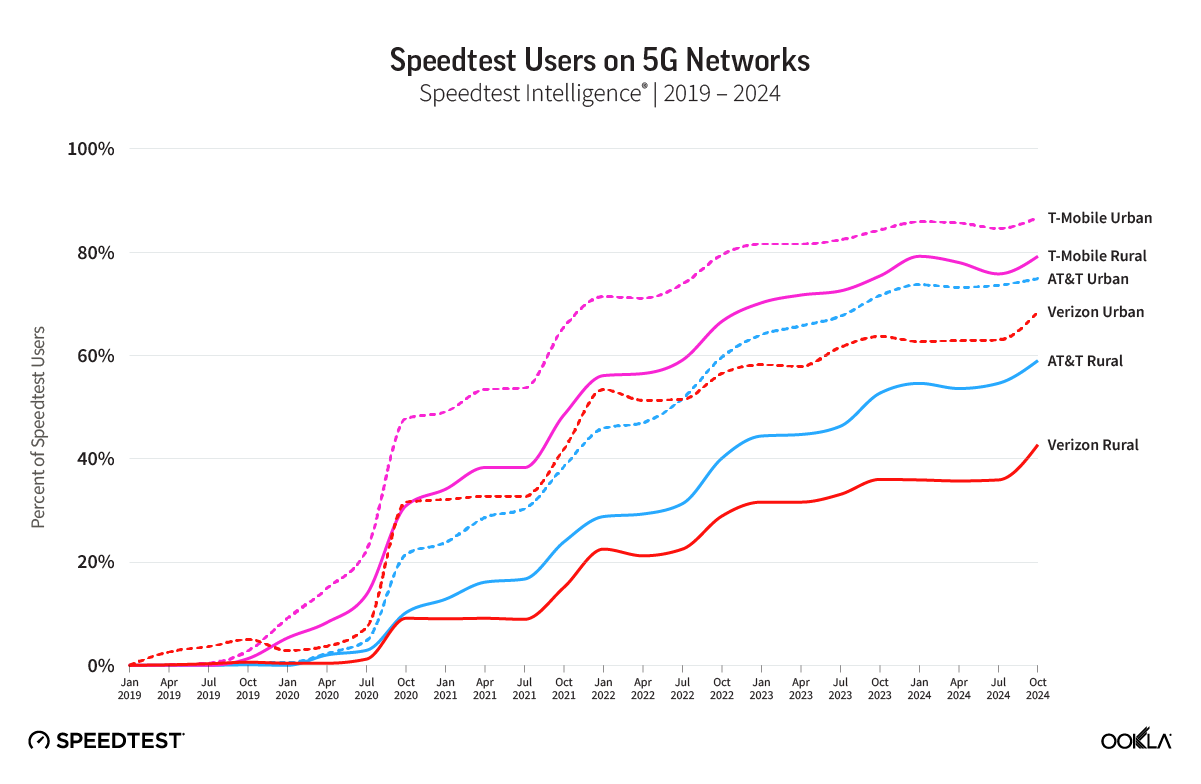
| November 18, 2025

Public Safety Connectivity: How Agencies Can Strengthen Critical Communications

Connectivity failures are inconvenient for most people, but for public safety agencies they can be catastrophic. Whether coordinating evacuations, dispatching first responders, or keeping hospitals online, resilient networks are essential to saving lives and protecting communities.

Real-world disasters highlight the stakes. From wildfires in Maui and California to hurricanes across the Southeast, connectivity has been disrupted when agencies needed it most. In those moments, responders face delays, residents lose access to critical information, and hospitals struggle to coordinate care. The risks are clear: without resilient communications, every aspect of emergency response becomes harder and more dangerous.

Agencies need visibility into how networks perform in the real world. Ookla’s ecosystem—Speedtest, Downdetector, and Ekahau—provides the tools to strengthen preparedness, improve response, and accelerate recovery. 

Read on to learn why resilient connectivity is so vital, the key challenges agencies face, and what recent disasters like the Lahaina wildfires reveal about the stakes. To dig deeper, download our full guide: Building Resilient Connectivity for Public Safety and Emergency Management.

When Communication Fails, Safety Fails

Disasters often strike in chaotic conditions where infrastructure is already damaged or failing. Responders may be rushing into wildfires, floods, or tornadoes with limited visibility and unreliable networks. Hospitals and shelters may suddenly find themselves overwhelmed, with communications buckling under the weight of demand. In these situations, reliable communication can often determine whether help arrives on time.

Communication breakdowns ripple outward. A single dead zone can cut a fire crew off from dispatch. If hospitals can’t access patient records or coordinate ambulance arrivals, patients may not get the care they need in time. When dispatchers can’t relay caller details in real time, teams enter dangerous situations without critical information—and communication breakdowns can affect every group involved in an emergency response:

  • First responders: Without reliable coverage, teams may lose contact with dispatch or lack access to real-time data
  • Dispatchers: Disrupted networks hinder the ability to gather details from callers, delaying information for crews in the field
  • Fire teams: Loss of radio or mobile service can force reliance on hand signals or runners, slowing response when every second matters
  • Healthcare and EMS: Connectivity failures prevent hospitals and ambulances from accessing patient records or coordinating care, directly affecting outcomes

Loss of service and communication blackouts are not hypothetical risks. From Chief Barry Hutchings of the Western Fire Chiefs Association describing a fire scene with no portable radio coverage, to hurricanes and wildfires cutting off entire regions, the consequences are well documented. Reliable communications across response routes, hospitals, and community centers can mean the difference between a timely response and catastrophic outcomes.

Key Connectivity Challenges for Agencies

Agencies are often asked to deliver flawless communication in the most challenging environments. Rural areas stretch networks thin, mountains block signals, and older government facilities can block wireless coverage. During a disaster, even modern infrastructure can be compromised by fire, flood, or wind damage.

The problem goes beyond poor coverage or inadequate capacity; agencies also often lack detailed insight into how networks perform in specific areas. An agency may know a dead zone exists, but they often lack the data needed to demonstrate the problem and secure funding for improvements. In other cases, they may be flying blind during an outage, without real-time visibility into what has failed or how widespread the issue is. Without the right tools, even well-prepared teams can struggle to manage the connectivity challenges emergencies present:

  • Coverage and reliability gaps: Rural areas, mountainous terrain, and dense building materials can create persistent dead zones
  • In-building connectivity gaps: Older or secure government facilities often block signals and limit network upgrades
  • Outdated infrastructure and regulatory hurdles: Aging infrastructure and regulatory hurdles slow tower deployments and upgrades
  • Situational blind spots: Without real-time network data, agencies can often lack the visibility needed to pinpoint outages, understand their scope, and coordinate an effective response
  • Infrastructure vulnerabilities: Natural disasters can often damage physical infrastructure, creating extended blackouts
  • Funding constraints: Without concrete evidence of where and how networks are falling short, agencies can struggle to secure federal or state support for upgrades

These challenges leave agencies vulnerable. Without reliable coverage and visibility, response times slow, public trust erodes, and communities face greater risk during emergencies.

A Framework for Preparedness, Response, and Recovery

Public safety cannot be purely reactive. Agencies must plan in advance, monitor conditions as crises unfold, and evaluate how well systems recover once the danger passes. The emergency management lifecycle—preparedness, response, recovery—ensures that agencies are not just reacting, but instead building long-term resilience.

In practice, responsibilities for each stage of that lifecycle are typically split across different teams. One group may focus on planning coverage improvements, another may monitor outages as they occur, and another might validate in-building Wi-Fi performance. Without a unified view, important gaps can go unnoticed. 

To close those gaps, agencies need integrated solutions that connect every stage, from pre-disaster planning through post-disaster recovery. A complementary mix of network performance data from Speedtest Intelligence®, website and service outage insights from Downdetector®, and wireless survey capabilities from Ekahau help ensure that each phase of the emergency management lifecycle is supported with the right visibility and intelligence:

  • Preparedness: Agencies use Speedtest Intelligence® data to identify coverage gaps, assess high-risk zones, and validate network upgrades. Public safety IT teams also use Ekahau tools to conduct wireless surveys and verify network performance in critical locations such as hospitals, command centers, and shelters
  • Response: Downdetector® detects website and service outages in real time, giving agencies early awareness of issues. Meanwhile, Speedtest provides immediate visibility into performance changes, while Ekahau validates temporary networks in shelters or mobile command posts.
  • Recovery: Agencies measure restoration speed, validate coverage improvements, and document outcomes to inform future investments. Downdetector and Speedtest data help secure funding by showing where networks fail during emergencies and measuring how quickly they recover.

The emergency management lifecycle—preparedness, response, recovery—ensures agencies are not only reacting in the moment but building more resilient systems for the future.

Lessons from Lahaina

When wildfires tore through Lahaina, Hawaii in August 2023, connectivity collapsed when residents and emergency managers needed it most. Evacuees had little information about safe routes, and responders struggled to understand whether networks were down locally or across entire islands. Without visibility into network conditions, emergency responders could not determine where they could reach people and where communications had already failed.

Tools like Downdetector and Speedtest provided critical real-time visibility into network conditions. By combining outage reports with performance data, agencies gained the situational awareness they needed to prioritize limited resources and focus on areas most in need.

The insights revealed a clear picture of how the crisis was unfolding and how that visibility informed response decisions. Downdetector tracked sudden spikes in outage reports, while Speedtest Intelligence revealed steep declines in network performance. Together, those insights allowed responders to distinguish between isolated disruptions and broader failures, helping prioritize key resources. The Lahaina fires show how connectivity insights can be as essential as water or fuel when disaster strikes.

The lesson from Lahaina is clear: visibility into connectivity provides essential intelligence during disasters. Identifying where networks fail and how they recover enables agencies to coordinate more effectively with providers, support first responders, and keep communities informed as conditions evolve.

Conclusion

Public safety and emergency management agencies cannot afford uncertainty in communication. Reliable networks are the foundation of preparedness, response, and recovery—and the consequences of failure are too great to ignore.

Ookla’s ecosystem of Speedtest, Downdetector, and Ekahau gives agencies the visibility, reliability, and security they need to protect communities. With better data, decision-makers can plan smarter, respond faster, and restore service more effectively when disaster strikes.

To learn how your agency can strengthen its response capabilities and ensure networks are resilient when it matters, check out our full guide, Building Resilient Connectivity for Public Safety and Emergency Management.

Ookla retains ownership of this article including all of the intellectual property rights, data, content graphs and analysis. This article may not be quoted, reproduced, distributed or published for any commercial purpose without prior consent. Members of the press and others using the findings in this article for non-commercial purposes are welcome to publicly share and link to report information with attribution to Ookla.

| April 16, 2025

Mind the Gap: London's 5G Performance Lags Behind Other UK Cities

Londoners spend more time in mobile signal not-spots, or coverage gaps, and experience slower 5G speeds than residents of other UK cities—resulting in poorer performance in everyday tasks such as web browsing.

London is the sprawling metropolis at the heart of the UK economy, home to one of the world’s largest and most lucrative service hubs, supporting a vast network of finance and technology firms. Beyond its strategic time zone and English-language advantage for accessing both American and Asian markets, London’s prosperity has been founded on the availability of world-class infrastructure that facilitates doing business.

The city’s reputation for international competitiveness has not, however, been matched by the quality of its telecommunications infrastructure. In recent years, a flurry of media reports has highlighted the frustrations of Londoners—and visitors alike—that experience frequent issues using mobile devices indoors, underground, and in busy areas. These problems, reported as being more pronounced than in other UK and European cities, typically manifest as poor quality of experience in everyday tasks such as web browsing, video streaming, and gaming.

This article is the first and a high-level prelude to a series exploring the competitiveness of mobile networks in European towns and cities—starting in the UK with city-level comparisons to London, and followed by a deeper, more comprehensive analysis among international peers coming in research later this year. 

Key Takeaways:

  • London lags behind the UK’s largest cities across key 5G performance indicators, and the gap to top-performing Glasgow is widening. In Q1 2025, London trailed other UK cities in 5G network consistency—a key indicator of performance at the lower end of the user experience—as well as in median download and upload speeds. Mobile users in London and Belfast experienced the weakest outcomes among UK cities, with median 5G download speeds of approximately 115 Mbps in both cities, significantly behind Glasgow’s 185 Mbps. London’s marked underperformance makes the UK unique in Western European terms—not only are the disparities between its major cities wider, but it is also unusual for the capital to be the primary laggard.
  • Mobile users in London spend more time in signal not-spots with no service than residents of other UK cities, reflecting lingering coverage gaps indoors and across key transport routes. The proportion of Londoners spending the majority of their time in locations with no service (0.7%) remained higher than in other UK cities in Q1 2025, but has improved significantly from 3.7% in Q1 2023. This progress reflects operator investments in network densification through small cells and the ongoing rollout of mobile coverage across the London Underground—historically one of the city’s largest mobile not-spots—which have together enhanced overall network availability in the capital. Time spent on 2G networks increased, however, across several UK cities over the last year, including Birmingham and Manchester, as the advancement of the 3G sunset in the UK contributed to greater propensity for 2G fallback.
  • The gap in 5G availability between the UK’s major cities and the national average has significantly narrowed over the past year. In Q1 2024, Leeds led UK cities in 5G availability, with a 21 percentage point gap above the national average. By Q1 2025, London had taken the lead in 5G availability among major UK cities, and that gap above the national average had narrowed to 13 percentage points. This trend reflects progress in 5G network expansion in smaller UK towns and rural areas in recent months, which has moved at a faster pace than coverage improvements in larger cities. Overall, median 5G download speeds fell by more than 7% on average across major UK cities between Q1 2024 and Q1 2025, likely reflecting the impact of shifting network load from older technologies onto 5G, which contributed to broader improvements in overall mobile network performance in most UK cities in the same period.

A confluence of factors has created unique headwinds for mobile network deployments in UK cities in recent years, particularly in dense urban settings like London

The deployment of 5G networks in higher-frequency spectrum—most commonly the 3.5 GHz band—continues to present significant challenges for operators globally. Like their counterparts across Europe, UK mobile operators have had to invest heavily in network densification during the 5G cycle. The widespread deployment of small cells at street level across UK cities illustrates the scale of effort required to increase network capacity and overcome the more limited propagation attributes of mid-band spectrum.

Over time, the city environment itself has become increasingly hostile to the operation of high-performing mobile networks. Across developed markets, advancements in building design and stricter regulations have led to a proliferation of highly insulated, airtight structures. These developments often incorporate low-E glass, metal cladding, and reinforced concrete—materials that, collectively, turn new and retrofitted buildings into de facto Faraday cages. London, in particular, presents unique challenges among UK cities, with a high concentration of high-rise buildings featuring deep floorplates. 

Indoor Mobile Not-Spots Have Proliferated Across Central London, Particularly in Dense Settings with New and Retrofitted Builds (Image: Ookla Cell Analytics)

While the UK’s Part L Building Regulations are not unique or unusually stringent by European standards, they have evolved alongside a set of factors particular to the UK context that have significantly hindered mobile operators’ ability to deliver high-performing 5G networks in dense urban environments. The roots of these factors stem as far back as 2017, well before the commercialization of the country’s first 5G networks, when the UK government introduced changes to the Electronics Communications Code (ECC) in an effort to accelerate mobile network rollouts and reduce costs by streamlining access to land for telecommunications deployments. 

The Digital Economy Act, which reformed the ECC, granted mobile operators and tower companies greater rights to access land on more favorable financial terms in the UK. The intention was to curb inflated lease costs, particularly in cases where landowners appeared to demand “ransom rents.” However, rather than accelerating network rollouts, the reforms triggered widespread legal disputes, uncertainty in lease negotiations, and delays in site access and upgrades. 

The impact of these land access reforms has been especially acute in dense urban settings such as London, where rooftop deployments play a disproportionate role due to limited ground-level space for mobile equipment. In London, the sheer number of individual property owners—including private landlords, commercial building managers, and housing associations—results in highly fragmented land ownership, making rooftop sites significantly more complex to manage, both legally and logistically, than rural ground leases.

The Combination of Increasing Building Density, Use of New Insulation Materials, and Decline in Rooftop Site Availability Has Resulted in More Frequent Fallback to Less Capable Low-Band Spectrum in UK Cities like London (Image: Ookla Cell Analytics)

The EEC further compounded this complexity by disrupting long-standing rooftop leasing arrangements in cities like London, leading to thousands of disputes since 2017 over issues such as ransom rents, blocked site upgrades, and non-renewals. The regulation reduced potential rental income by as much as 80% to 90% for some landlords, significantly discouraging the availability of rooftop space for mobile network deployments. This effect was particularly pronounced in London, where building owners have seen greater commercial value in alternative uses for scarce rooftop space, such as bars, gardens, or solar panel installations, hindering the ability of operators to densify their networks. 

The UK is the only European country to have adopted such a unilateral price-cutting approach to site access during the 5G cycle. To ease tensions between operators and land owners, the UK government introduced further changes in the “2022 Product Security and Telecommunications Infrastructure Act.” These updates aimed to encourage alternative dispute resolution, simplify lease renewals, and extend the provisions from the EEC to agreements signed before 2017. However, the reforms retained the reduced rental model, meaning while procedural barriers were reduced, incentives for property owners to host rooftop sites remained weak, failing to stem the decline in rooftop site availability in cities like London in recent years.

Combined with the UK’s decision to impose stricter controls on the use of telecom equipment from non-European vendors than those seen elsewhere in Europe, which diverted time and resources toward network rebuilds rather than expansion and upgrades, UK operators have faced significant headwinds in deploying mobile network infrastructure during the 5G cycle.

Progress in the 5G rollout belies lingering performance disparities among the UK’s major cities

Despite significant progress countrywide in improving 5G networks with additional sites, more spectrum availability (some of it from the refarming of 3G), and an expanded 5G standalone (SA) footprint, disparities continue to exist among the UK’s cities. The gap between the best- and worst-performing major cities in median 5G download and upload speeds, for example, widened between Q1 2024 and Q1 2025, based on analysis of Speedtest Intelligence® data.

The Gap in 5G Download Speeds Between Glasgow and Other UK Cities Has Widened
Speedtest Intelligence® | Q1 2024 – Q1 2025


In Q1 2025, Glasgow led the UK with median 5G download speeds reaching 185 Mbps, which was as much as 47% higher than in London, the slowest major city, and 24% higher than in Birmingham, the next best performer. This ranking profile extended to 5G network consistency, which measures the proportion of Speedtest samples that meet a minimum download and upload speed threshold of 25 Mbps and 3 Mbps. While more than 85% of Speedtest samples met this threshold in Glasgow, fewer than 75% did in London, which exhibited the lowest consistency rate among major UK cities and was the only one aligned with the national average that includes both rural and urban areas.

London’s underperformance at the lower percentiles of measures like download speeds is particularly notable, as it strongly reflects the experience of mobile users in more challenging conditions—such as at the network edge, during peak hours, or in congested areas. The city’s lower consistency score and weaker 10th percentile download and upload speeds suggest that Londoners are more likely to encounter poor mobile performance compared to residents of other major UK cities.

Londoners Experience Less Consistent 5G Performance Than Residents of Other UK Cities
Speedtest Intelligence® | Q1 2025

The UK stands out in Western Europe for both the scale of the performance gap between its major cities and the unusual fact that its capital is the lagging city. Most regional peers more closely resemble the profile of neighboring France, where Paris ranks among the top three cities nationally for 5G network consistency, as well as median download and upload speeds. In France, the gap in 5G network consistency between the best- and worst-performing cities was as narrow as 5 percentage points in Q1 2025—a disparity that is half that of the UK.

The UK's Cities Exhibit a Greater Range in 5G Consistency Than Other Western European Countries
Speedtest Intelligence® | Q1 2025

In practical terms, London’s underperformance in metrics like 5G download speed and consistency translates into poorer QoE outcomes in everyday tasks like web browsing. In Q1 2025, for example, median web page load times to popular global websites were higher in London than in nine out of ten other major UK cities.

Londoners Spend More Time Waiting on Popular Websites to Load
Speedtest Intelligence® | Q1 2025

Mobile not-spots continue to be a fixture of everyday life in UK cities, particularly in London

The combination of factors outlined earlier, including the shift toward insulation materials that inhibit signal propagation, the collapse in rooftop rental fees reducing access to mobile sites, and the use of higher-frequency spectrum for 5G, has posed challenges for mobile operators across all UK cities seeking to reduce the prevalence of mobile not-spots. These challenges have been particularly pronounced in the cities with the highest levels of density, most notably London.

Deep indoor and underground spaces (e.g., transport systems like the London Underground network) remain the primary contributors to time spent with no mobile signal or fallback to 2G networks. These cell edge scenarios are highly disruptive for the end-user, resulting in limited access to basic telephony features like texting and calling and a substantial increase in device-side power consumption. 

Londoners Spend More Time in Mobile Not-Spots Than the UK Average
Speedtest Intelligence® | Q1 2024 – Q1 2025

The proportion of mobile users in London spending the majority of their time in locations with no network access at all (0.7%) was higher than in other major UK cities in Q1 2025 (an observation related to the capital city that again defies Western European norms). By contrast, less than 0.3% of mobile users in Belfast, Bristol and Sheffield spent the majority of their time in not-spots in the same period. Overall, time spent with no service accounted for as much as 2.6% of quarterly network usage in Q1 2025 in London, significantly higher than the national average.

Despite the disproportionate scale of mobile not-spots lingering in London, recent operator investments in network densification and progress in the ongoing rollout of 4G and 5G coverage throughout the London Underground network are driving dramatic improvements in outcomes. The proportion of Londoners spending the majority of their time in locations with no service has more than halved over the last two years, reflecting a much more pronounced pace of improvement than other UK cities and putting the capital on course to fall into line with other large cities like Birmingham and Manchester.

The Proportion of Mobile Users Spending the Majority of Their Time on 2G Has Increased in Several UK Cities
Speedtest Intelligence® | Q1 2024 – Q1 2025 (Including Roaming Samples)

The advancement of the UK’s 3G sunset, which is set to be substantially complete by the end of this year, is reflected in a sharp reduction in the proportion of mobile users spending the majority of their time on 3G networks. In London, for example, this proportion fell from over 4.5% in Q1 2023 to less than 0.7% in Q1 2025.

The 3G sunset has, however, contributed to an increase in 2G fallback in UK cities at the cell edge where 4G and 5G networks are unavailable. Time spent on 2G increased across several UK cities over the last year, including Liverpool, where this trend has resulted in a larger share of users spending the majority of their time on 2G than in areas with no service at all (a rarity among UK cities). 

The Decline in 3G Usage Has Been Similarly Rapid Across UK Cities
Speedtest Intelligence® | Q1 2023 – Q1 2025

Cities that take a proactive approach to telecoms feature the best 5G outcomes

Glasgow’s position as the leading UK city in key 5G performance indicators is unlikely to be an outcome achieved by mere chance. Beyond the contribution of inherent structural factors related to building composition, such as a lower prevalence of high-rise developments relative to other major UK cities, Glasgow’s 5G leadership is also likely rooted in its early and proactive approach to supporting telecoms infrastructure.

The city was among the first in Europe to establish a dedicated “Telecoms Unit”, which streamlined access to city-owned assets for telecom deployments, provided standardized agreements for rental fees, and consolidated telecoms functions within the local authority to reduce departmental siloes. This proactive approach facilitates inward investment in network infrastructure and better 5G outcomes. 

Ookla retains ownership of this article including all of the intellectual property rights, data, content graphs and analysis. This article may not be quoted, reproduced, distributed or published for any commercial purpose without prior consent. Members of the press and others using the findings in this article for non-commercial purposes are welcome to publicly share and link to report information with attribution to Ookla.

| June 30, 2025

Poland Races to Regain 5G Competitiveness in Europe with Mid-Band Rollout | Polska galopuje do odzyskania konkurencyjności 5G w Europie dzięki wdrożeniu średniego pasma częstotliwości

Polish/Polski

Poland’s operators are rapidly deploying mid-band 5G in an attempt to capture the growing premium market segment

Late to the game in staging a mid-band auction, Poland has lagged behind its European peers in 5G deployment in recent years. This delay has weighed on the country’s global competitiveness in mobile network performance and slowed its progress toward meeting the European Commission’s flagship 5G deployment targets, which require universal 5G coverage across every EU member state by the end of the decade.

This article examines the state of Poland’s mobile market and its broader regional 5G competitiveness in the context of ongoing mid-band deployments. A follow-up report will assess the longer-term impact of the commercialization of the recently awarded low-band spectrum and ongoing network sunsets on network coverage and availability.

Key Takeaways:

  • Intensive capital spending on mid-band deployment drives substantial uplift in 5G performance across Polish operators from Q1 2024, pushing the country ahead of regional peers over the last year. Median 5G download speeds in Poland jumped by over 50% to 160.30 Mbps between Q1 2024 and Q1 2025, based on Speedtest Intelligence® data, propelling the country ahead of Czechia, Romania, and Slovakia for the first time in 5G performance. Despite this progress, Poland continues to trail its regional peers in 5G network Consistency, a measure of how reliably a mobile connection remains “fast enough” for normal use.
  • T-Mobile and Orange surpass Play and Plus in speed and select Quality of Experience (QoE) measures. Differences in how quickly and extensively Polish operators have deployed their mid-band spectrum assets have led to a diverging market profile since Q1 2024, with T-Mobile and Orange significantly extending their speed lead over their rivals. Between Q1 2024 and Q1 2025, median 5G download speeds rose by as much as 72% on Play (to 122.64 Mbps), 86% on T-Mobile (to 201.76 Mbps), and 90% on Orange (to 222.10 Mbps)—while declining by over 10% on Plus (to 116.76 Mbps). 
  • Network investments have broadened 5G coverage in Poland, but significant regional disparities remain. Nationally, 5G availability rose from 28.5% in Q1 2024 to 43.1% in Q1 2025, driven by continued Dynamic Spectrum Sharing (DSS) rollouts and the activation of mid-band spectrum—placing the country ahead of regional peers Bulgaria, Romania, and Hungary in 5G availability. Nonetheless, by Q4 2024, a pronounced coverage gap persisted between the country’s best- and worst-served provinces, with 5G availability in the populous Masovian Voivodeship (47.2%) double that of the Lubusz Voivodeship (23.6%).

Over the last year, Polish operators have been locked in an intense four-way race to catch up with their regional peers in 5G deployment, driven by stringent coverage obligations imposed by the Polish telecoms regulator (UKE), a wave of funding support from Brussels, and a growing push to compete for a larger share of the country’s widening premium market segment, where network performance has emerged as a key competitive differentiator.

Poland’s mobile market is today awash with deployment activity, as operators ramp up capital spending to the highest levels in years to equip thousands of mobile sites with mid-band spectrum, accelerate the sunset of 3G networks, and lay the groundwork for launching 5G standalone (SA) in the coming years. This flurry of activity follows the completion of the 700/800 MHz auction at the end of March this year, where all Polish operators secured low-band 5G spectrum for the first time—paving the way for improved rural and deep in-building 5G coverage and rounding out the country’s 5G spectrum release plans.

While 5G capital spending has slowed across much of Europe, Poland sees different dynamics due to late spectrum auctions

Poland was notably late in releasing dedicated 5G spectrum in the ‘pioneer bands’ identified by the European Commission as critical to the timely commercialization and rollout of 5G across EU member states. The country’s mid-band (3.6 GHz) auction, initially planned for mid-2020, was repeatedly delayed—by more than three years—due to the pandemic and a protracted security legislation process. 

These delays in spectrum availability have contributed to Poland’s divergence from much of the rest of Europe in both the economic and technical dimensions of the 5G rollout. Until recently, Polish mobile operators exhibited lower capital intensity (they invested less of their revenue) compared to peers in other European countries. Most of their spending went into upgrading 4G sites and preparing for the 3G shutdown, instead of building a new 5G mid-band capacity layer or expanding 5G coverage using low-band (700 MHz) spectrum.

Orange's Rising Mobile Capex Reflects 5G Network Expansion
Analysis of Orange Poland accounts | 2020 – 2024

Analysis of financial data published by Orange, Poland’s largest mobile operator by subscriber count, confirms that the era of lower capital intensity (relative to elsewhere in Europe) is over. The recent spectrum auctions have triggered a new cycle of investment, with Orange doubling its mobile network spending in the past three years. Play has also rapidly increased its investment, as its French parent Iliad reported injecting record amounts into Play’s mobile infrastructure last year.

Play's Contribution to Capex in the Iliad Group Surges as 5G Buildout Ramps Up
Analysis of Iliad Group accounts | 2020 – 2024

On the technical side, meanwhile, Poland’s spectrum delay meant that three of the country’s four operators were forced to rely heavily on Dynamic Spectrum Sharing (DSS)—a technology that allows 4G and 5G to operate on the same band and adjust ‘dynamically’ to demand—in an effort to deliver early 5G coverage in the 2100 MHz band while awaiting spectrum auctions. This strategy resulted in Poland’s initial 5G performance more closely resembling those typical of 4G networks, as DSS deployments are typically based on a 10 MHz carrier where part of the capacity is still reserved for 4G signals, making 5G speeds with DSS around 15–25 % lower than if the band were dedicated solely to 5G.

The limitations of using DSS to deliver a “5G experience” were exemplified by the speed advantage maintained by Plus earlier in the 5G rollout. Importantly, Plus was the only Polish operator that did not rely on DSS and instead dedicated a full 40 MHz carrier in the 2600 MHz (TDD) band to 5G before mid-band spectrum became available at the start of last year. Prior to the 3.5 GHz band coming online, when the other operators were still wholly dependent on DSS for 5G coverage, Plus’s median 5G download speed of 133.34 Mbps was as much as 77 % higher than T-Mobile’s, 81 % higher than Orange’s, and 92 % higher than Play’s. 

Intense Mid-Band Deployment lifts Poland’s Regional 5G Competitiveness and Reshapes Operator Dynamics

Polish operators move from mid-band spectrum acquisition to mass commercial deployment in record time

The pent-up demand for mid-band spectrum in Poland was evident when mobile operators like Orange, T-Mobile, and Play launched commercial services just three months after acquiring mid-band spectrum, moving quickly from the auction in October 2023 to commercial launches by January 2024. T-Mobile reported that its mid-band 5G network already covered more than 25% of the Polish population by April 2024, with more than 2,100 sites active, while Orange announced it had reached 40% coverage by mid-June.

This rollout pace is exceptional by European standards and indicative of the increased pace of deployment possible later in the 5G technology cycle. It took Spain’s Telefónica (Movistar) about six months to reach its first 1,000 mid-band sites by comparison, and Germany’s operators needed around nine months to achieve the same milestone.

Plus's Spectrum Holdings in the 2600 MHz TDD Band Lend it a Decisive Capacity Lead

Each operator secured a contiguous 100 MHz block of spectrum in the 3.5 GHz band, which is widely regarded as optimal due to the large channel bandwidth this configuration affords. However, Plus has been notably slower to commercialise this allocation at scale. Plus’s earlier strategy of deploying 5G in the dedicated 2600 MHz band (rather than relying on DSS), alongside later using the 2100 MHz band as well, gave it more flexibility to delay a broad mid-band rollout as it previously enjoyed a significant 5G speed advantage over competitors while they were still heavily dependent on DSS deployments. 

Mid-band deployment shifts 5G performance rankings among Polish operators

Mass deployment of a new capacity layer by the other three operators has since decisively altered performance dynamics in the Polish market and eroded Plus’s lead. In the space of one year between Q1 2024 and Q1 2025, Plus has moved from market leader in median 5G download speed to laggard, becoming the only Polish operator to see a year-on-year decline in 5G speed, down 10%, indicating the increasing limitations of its 2600 MHz strategy. 

Orange and T-Mobile Pull Ahead in 5G Performance with Mid-Band Deployment
Speedtest Intelligence® | Q1 2023 – Q1 2025

By contrast, mid-band deployment has boosted performance across the rest of the market, with median 5G speeds rising by as much as 72% on Play, 86% on T-Mobile, and 90% on Orange between Q1 2024 and Q1 2025. While Orange led the Polish market in Q1 with a median 5G download speed of 222.11 Mbps, the operator’s lead has narrowed significantly as T-Mobile’s mid-band buildout has progressed, with T-Mobile now recording median 5G download speeds of 201.76 Mbps, well ahead of third- and fourth-placed Play (122.64 Mbps) and Plus (116.76 Mbps), respectively.

Plus's Lead in 5G Consistency Narrows as 2600 MHz Advantage Recedes with Mid-Band Deployment
Speedtest Intelligence® | Q1 2023 – Q1 2025

Despite losing its lead in median 5G download speed, Plus continues to lead at the 10th percentile (29.44 Mbps in Q1 2025), meaning subscribers in its lowest-performing areas still enjoy comparatively better speeds than those on rival networks. This advantage is likely linked to Plus’s lower dependence on DSS. However, T-Mobile (24.48 Mbps) and Orange (21.88 Mbps) are quickly closing the gap, with their 10th percentile 5G speeds now converging toward Plus. Plus’s 5G network consistency, measured as the proportion of Speedtest samples meeting a minimum download and upload threshold of 25/3 Mbps, has also declined over the past year, although it remains the market leader.

On upload performance, meanwhile, Play’s 5G network led the market in Q1 2025, recording median speeds of 19.33 Mbps, followed by Orange (18.99 Mbps), T-Mobile (17.32 Mbps), and Plus (14.96 Mbps). Unlike the substantial gains seen in download speeds, there is limited evidence so far that the mid-band rollout has materially improved upload performance, with median upload speeds about 6% lower in Q1 2025 compared to the same quarter last year. This discrepancy arises primarily because all four operators continue to deploy 5G in non-standalone (NSA) mode, requiring devices to transmit uplink traffic via existing 4G anchor bands. Consequently, the newly available 3.5 GHz spectrum enhances downlink capacity but leaves the congested 4G uplink path unchanged.

Play Develops Lead in 5G Upload Performance
Speedtest Intelligence® | Q1 2023 – Q1 2025

The operators’ investments in deploying a new 5G capacity layer have coincided with a broader RAN refresh effort, translating into improved quality of experience for users in key use cases such as video streaming and web browsing. Median web page load times on T-Mobile’s network, for instance, improved by around 4% between Q3 2024 and Q1 2025. Orange led in video metrics such as start time, resolution, and uninterrupted playback in the last quarter.

5G Drives QoE Improvements in Use Cases like Web Browsing
Speedtest Intelligence® | Q1 2025

Capital investment expands 5G coverage, but Poland’s rural-urban digital divide persists

While investments in DSS and the mid-band rollout have enabled Polish operators to make significant strides in 5G availability, which increased nationally from 28.5% in Q1 2024 to 43.1% in Q1 2025, regional coverage disparities continue to be a feature of the mobile network experience in Poland. Operators have prioritized 5G deployments in the richest and densest parts of Poland where fiber is heavily deployed, including the Masovian (Warsaw) and Pomeranian (Tri-City) provinces. In these provinces, 5G availability reached more than 40% by the end of last year and contributed to driving materially higher median download speeds than the national average. 

5G Availability Remains Highly Varied Across Poland Outside of Urbanized Areas
Speedtest Intelligence® | 5G Availability (%) in Q4 2024

By contrast, border provinces along the south and west of the country continue to experience much lower levels of 5G availability. Lubusz had the lowest availability (23.6% at the end of last year), where there is lower population density and lower subscriber spending, which reduces operators’ commercial incentives for widespread 5G investment. This trend has driven the development of a notable speed gap between provinces, with mobile subscribers in Lubusz also experiencing the lowest median download speeds (59.97 Mbps) in Poland, almost 33% below the leading Masovian province.

Mobile Download Speeds Are Lower in Less Urbanized Areas of Poland
Speedtest Intelligence® | Median Download Speed (Mbps) in Q4 2024

Mid-band deployment improves Poland’s mobile competitiveness, but 5G consistency continues to trail regional peers

From a regional competitiveness lens, intensive mid-band deployments have been successful in breaking Poland’s cycle of mobile network underperformance, with median 5G download speeds rising by over 50% on average to 160.30 Mbps between Q1 2024 and Q1 2025. This has propelled the country ahead of Czechia, Romania, and Slovakia for the first time in terms of 5G download speed performance.

Mid-Band Deployments Propel Poland's Regional Competitiveness
Speedtest Intelligence® | 2020 – 2025

Despite Poland’s  progress on its mid-band 5G rollout, the lingering effects of reliance on DSS and limited 5G spectrum diversity—up until the recent 700/800 MHz auction—mean that Poland continues to trail its regional peers in terms of 5G network consistency. In Q1 2025, 82% of Speedtest samples in Poland met the minimum 5G performance threshold for a consistent mobile experience, compared to 86% in Hungary, 89% in Romania, and 93% in Bulgaria.

Newfound spectrum diversity lends Polish operators potent tool to stimulate ARPU growth

Poland’s previous reliance on DSS, driven by limited 5G spectrum diversity, likely contributed to its slower average revenue per user (ARPU) growth compared to neighboring countries in recent years. Polish operators initially introduced tariffs with “5G at no extra cost” bolted onto existing 4G bundles, keeping prices flat to defend market share (and thereby maintaining depressed ARPU levels relative to regional peers). Combined with the external shock induced by markedly higher energy prices, stagnant ARPU levels created challenging operating conditions in the Polish market and weighed on operator profitability. 

Intense Priced-Based Competition Precipitated Revenue Erosion in Poland During the First Half of the 5G Cycle
Analysis of GSMA Intelligence Data | % Change in Mobile ARPU (Q1 2020 vs Q1 2023)

In neighboring markets, by contrast, operators were able to leverage mid-band spectrum deployments as both technical and marketing levers, shifting their strategies from price competition toward service-based differentiation. This enabled them to more effectively upsell premium speed tiers or monetize specific use cases, such as fixed wireless access (FWA), which dedicated mid-band 5G deployments uniquely support.

T-Mobile and Play Outpaced Rivals in Subscription Share Growth in Recent Years
Analysis of UKE Market Data | 2019 – 2023

Similarly, the delayed timing of Poland’s mid-band 5G auction likely dampened supply-side factors key for driving growth in mobile data traffic. Between Q1 2020 and Q4 2024, traffic volumes in neighboring Bulgaria converged with that in Poland for the first time, increasing by 4.8x vs. Poland’s 2.6x. Meanwhile, Bulgarian operators capitalized early on mid-band spectrum availability to aggressively promote competitive FWA solutions (a major driver of mobile traffic in developed markets) and to introduce cheap unlimited data tariffs with fewer usage restrictions.

Poland Maintains Regional Lead in Mobile Data Volumes, but Bulgaria is Catching Up
Analysis of GSMA Intelligence data | 2020 – 2024

Polish operators have since sought to replicate Bulgaria’s success by debuting distinct marketing for their mid-band 5G deployments to differentiate the newer mid-band 5G rollouts from earlier DSS-based 5G networks in terms of performance and user experience. T-Mobile has leaned on ‘5G More’ branding, while Plus has used ‘5G Ultra’ to indicate the additional performance gains unlocked by their new 5G networks in locations where dedicated mid-band spectrum is deployed. This strategy has formed part of a broader shift in the market, with all operators moving away from a hyper-focus on price competition and toward ‘more for more’ pricing strategies, supporting improved profitability and renewed ARPU growth in the market with inflation-linked tariffs.

Poland Has Led Regional ARPU Growth Since Mid-Band 5G Deployments Started
Analysis of GSMA Intelligence Data | % Change in Mobile ARPU (Q1 2023 vs Q1 2025)

Low-band activation and network sunset progress set to reinforce mid-band 5G gains

With Poland’s telecom regulator, UKE, having set among Europe’s most ambitious coverage obligations for recent mid- and low-band spectrum auctions, operators are unlikely to delay commercial deployments in the newly acquired 700 and 800 MHz bands. These deployments are expected to start next month and will be crucial for establishing a national 5G coverage layer that, for the first time, extends deep indoors and into rural areas. This expanded coverage will also support wider rollout of voice over LTE (VoLTE) services, accelerating the 3G sunset and freeing up additional spectrum in the 900 MHz band.

We will revisit shortly to assess how Polish operators are progressing with deploying their new low-band spectrum and how effectively it is complementing the ongoing 3G sunset.


Polska galopuje do odzyskania konkurencyjności 5G w Europie dzięki wdrożeniu średniego pasma częstotliwości

Polscy operatorzy przyśpieszyli z wdrażaniem 5G w średnim paśmie, próbując przejąć rosnący segment rynku premium.

Polska, która spóźniła się z przeprowadzeniem aukcji na średnie pasmo, w ostatnich latach pozostawała w tyle za swoimi europejskimi rówieśnikami w zakresie wdrażania 5G. Opóźnienie to odbiło się na globalnej konkurencyjności kraju pod względem wydajności sieci mobilnych i spowolniło postępy w realizacji sztandarowych celów Komisji Europejskiej w zakresie wdrażania 5G, które wymagają powszechnego zasięgu 5G w każdym państwie członkowskim UE do końca dekady.

Niniejszy artykuł analizuje stan polskiego rynku telefonii komórkowej i jego szerszą regionalną konkurencyjność 5G w kontekście trwających wdrożeń średniego pasma. Kolejny raport oceni długoterminowy wpływ komercjalizacji niedawno przyznanego niskiego pasma na potrzeby pokryciowe 5G.

Kluczowe wnioski:

  • Intensywne wydatki kapitałowe na wdrożenie średniego pasma napędzają znaczny wzrost wydajności 5G u polskich operatorów od pierwszego kwartału 2024 r., pozycjonując kraj przed regionalnych konkurentów w ciągu ostatniego roku. Mediana prędkości pobierania 5G w Polsce wzrosła o ponad 50% do 160,30 Mb/s w okresie od I kwartału 2024 r. do I kwartału 2025 r., w oparciu o dane Speedtest Intelligence®, dzięki czemu Polska po raz pierwszy wyprzedziła Czechy, Rumunię i Słowację pod względem wydajności 5G. Pomimo tego postępu, Polska nadal pozostaje w tyle za swoimi regionalnymi rówieśnikami pod względem spójności sieci 5G, która jest miarą tego, jak niezawodnie zestawione połączenie mobilne pozostaje “wystarczająco szybkie” do normalnego użytkowania.
  • T-Mobile i Orange przewyższają Play i Plus pod względem prędkości i wybranych wskaźników jakości doświadczenia usług (QoE). Różnice w strategiach, jak szybko i szeroko polscy operatorzy wdrożyli swoje aktywa widma w średnim paśmie, doprowadziły do rozbieżnego profilu rynku od pierwszego kwartału 2024 r., przy czym T-Mobile i Orange znacznie zwiększyły swoją przewagę w zakresie prędkości nad rywalami. Pomiędzy I kwartałem 2024 r. a I kwartałem 2025 r. mediana prędkości pobierania 5G wzrosła aż o 72% w Play (do 122,64 Mb/s), 86% w T-Mobile (do 201,76 Mb/s) i 90% w Orange (do 222,10 Mb/s) – przy jednoczesnym spadku o ponad 10% w Plusie (do 116,76 Mb/s).
  • Inwestycje sieciowe zwiększyły zasięg 5G w Polsce, ale nadal utrzymują się znaczne różnice regionalne. W ujęciu krajowym dostępność sieci 5G wzrosła z 28,5% w I kwartale 2024 r. do 43,1% w I kwartale 2025 r., co wynikało z dalszego wdrażania dynamicznego współdzielenia widma (DSS) i aktywacji widma w średnim paśmie, dzięki czemu Polska wyprzedziła pod względem dostępności sieci 5G regionalne kraje takie jak Bułgaria, Rumunia i Węgry. Niemniej jednak do IV kwartału 2024 r. utrzymywała się wyraźna luka w zasięgu między najlepiej i najgorzej obsługiwanymi województwami w kraju, przy czym dostępność 5G w zaludnionym województwie mazowieckim (47,2%) była dwukrotnie wyższa niż w województwie lubuskim (23,6%).
  • Wyłączenia sieci 3G (ang. “3G sunset”) powodują gwałtowny spadek czasu spędzonego na 3G w 2024 r., ponieważ polscy operatorzy reorganizują widmo dla 4G (ang. “refarming”), ale ma to ogromny wpływ na dostępność usług w miejscach mniej zurbanizowanych. Podczas gdy T-Mobile pozostał jedynym polskim operatorem, który w pełni zakończył proces wygaszania sieci 3G do pierwszego kwartału 2025 r., zarówno Orange, jak i Play czynią obecnie znaczne postępy w zakresie refarmingu widma 3G 900 MHz i 2100 MHz na potrzeby 4G. Czas spędzony na 3G spadł poniżej 3% dla obu operatorów do końca 2024 roku. Natomiast abonenci Plusa nadal spędzali znacznie więcej czasu w sieci 3G – 13,41% na koniec 2024 roku.

W ciągu ostatniego roku polscy operatorzy byli jednak zamknięci w intensywnym wyścigu, aby dogonić swoich regionalnych kolegów we wdrażaniu 5G, napędzanym przez rygorystyczne obowiązki w zakresie zasięgu nałożone przez polskiego regulatora telekomunikacyjnego (UKE), falę wsparcia finansowego z Brukseli i rosnące dążenie do konkurowania o większy udział w poszerzającym się segmencie rynku premium w kraju, w którym wydajność sieci stała się kluczowym wyróżnikiem konkurencyjnym.

Polski rynek telefonii komórkowej jest dziś zdominowany aktywnością wdrożeniową, stąd operatorzy zwiększają wydatki kapitałowe do najwyższych poziomów od lat, aby wyposażyć tysiące stacji bazowych w widmo średniego pasma, przyspieszyć wyłączanie sieci 3G i położyć podwaliny pod uruchomienie samodzielnej sieci 5G (SA) w nadchodzących latach. Taką falę aktywności można zwłaszcza zauważyć po zakończeniu aukcji 700/800 MHz pod koniec marca tego roku, w której wszyscy polscy operatorzy po raz pierwszy zabezpieczyli widmo 5G w niskim paśmie – torując sobie drogę do poprawy zasięgu 5G na obszarach wiejskich i głęboko wewnątrz budynków (ang. “deep in-building”) w miastach oraz uzupełniając krajowe plany udostępniania widma 5G.

Podczas gdy wydatki kapitałowe na 5G spowolniły w dużej części Europy, Polska doświadcza inną dynamikę ze względu na późne aukcje na częstotliwości

Polska znacznie spóźniła się z udostępnieniem dedykowanych częstotliwości 5G w “pionierskich” pasmach zidentyfikowanych przez Komisję Europejską jako krytyczne dla terminowej komercjalizacji i wdrożenia 5G w państwach członkowskich UE. Krajowa aukcja częstotliwości pasma środkowego (3,6 GHz), początkowo planowana na połowę 2020 r., była wielokrotnie opóźniona – o ponad trzy lata – z powodu pandemii i przedłużającego się procesu legislacyjnego w zakresie bezpieczeństwa.

Te opóźnienia w dostępności częstotliwości przyczyniły się do tego, że Polska odbiega od reszty Europy zarówno w wymiarze ekonomicznym, jak i technicznym wdrażania 5G. Do niedawna polscy operatorzy komórkowi wykazywali niższą kapitałochłonność (inwestowali mniejszą część swoich przychodów) w porównaniu do innych europejskich operatorów. Większość ich wydatków przeznaczono na modernizację 4G i przygotowanie do wyłączenia 3G, zamiast budować nową warstwę pojemności 5G w średnim paśmie lub rozszerzać zasięg 5G przy użyciu niskich częstotliwości (700 MHz).

Rosnące nakłady Orange na sieć mobilną odzwierciedlają rozwój sieci 5G
Analiza rachunków Orange Polska | 2020–2024

Analiza danych finansowych opublikowanych przez Orange, największego operatora komórkowego w Polsce pod względem liczby abonentów, potwierdza, że era niższej kapitałochłonności (w porównaniu z innymi krajami w Europie) dobiegła końca. Niedawne aukcje częstotliwości wywołały nowy cykl inwestycyjny, a Orange podwoił wydatki na sieć mobilną w ciągu ostatnich trzech lat. Play również gwałtownie zwiększył swoje inwestycje, jego francuska spółka dominująca Iliad poinformowała w zeszłym roku o zainwestowaniu rekordowych kwot w infrastrukturę mobilną Play.

Udział Play w nakładach inwestycyjnych Grupy Iliad gwałtownie rośnie wraz z przyspieszeniem rozbudowy sieci 5G
Analiza rachunków Grupy Iliad | 2020–2024

Tymczasem od strony technicznej opóźnienie aukcji częstotliwości 5G w Polsce oznaczało, że trzech z czterech operatorów w kraju było zmuszonych w dużym stopniu polegać na dynamicznym współdzieleniu widma (ang. “Dynamic Spectrum Sharing” – DSS) – technologii, która pozwala 4G i 5G działać w tym samym paśmie i “dynamicznie” dostosowywać się do zapotrzebowania na pojemność danej technologii – w celu zapewnienia wczesnego zasięgu 5G w paśmie 2100 MHz w oczekiwaniu na aukcje częstotliwości. Strategia ta spowodowała, że początkowa wydajność 5G w Polsce bardziej przypominała typową dla sieci 4G, ponieważ wdrożenia DSS są zwykle oparte na nośnej 10 MHz, w której część pojemności jest nadal zarezerwowana dla sygnałów 4G, co powoduje, że prędkości 5G z DSS są o około 15-25% niższe niż gdyby pasmo było przeznaczone wyłącznie dla 5G.

Ograniczenia wykorzystania DSS do zapewnienia “doświadczenia 5G” zostały zilustrowane przewagą prędkości utrzymywaną przez Plusa na wcześniejszym etapie wdrażania 5G. Co ważne, Plus był jedynym polskim operatorem, który nie polegał na DSS i zamiast tego przeznaczył pełną nośną 40 MHz w paśmie 2600 MHz (TDD) na 5G, zanim na początku ubiegłego roku częstotliwości średniego pasma stały się dostępne. Przed uruchomieniem pasma 3,5 GHz, gdy pozostali operatorzy byli nadal w pełni zależni od DSS w zakresie zasięgu 5G, średnia prędkość pobierania 5G Plusa wynosząca 133,34 Mb/s była aż o 77% wyższa niż w T-Mobile, 81% wyższa niż w Orange i 92% wyższa niż w Play.

Intensywne wdrażanie średniego pasma podnosi regionalną konkurencyjność Polski w zakresie 5G i zmienia dynamikę operatorów

Polscy operatorzy w rekordowym czasie przechodzą od zakupu częstotliwości w średnim paśmie do masowego wdrożenia komercyjnego

Stłumiony popyt na częstotliwości średniego pasma w Polsce był widoczny, gdy operatorzy komórkowi, tacy jak Orange, T-Mobile i Play, uruchomili usługi komercyjne zaledwie trzy miesiące po nabyciu częstotliwości średniego pasma, szybko przechodząc od aukcji w październiku 2023 r. do komercyjnego uruchomienia do stycznia 2024 roku. T-Mobile poinformował, że jego średniopasmowa sieć 5G obejmowała już ponad 25% populacji Polski do kwietnia 2024 r., z ponad 2100 aktywnymi stacjami bazowymi, podczas gdy Orange ogłosił, że osiągnął 40% zasięgu do połowy czerwca.

To tempo wdrażania jest wyjątkowe jak na standardy europejskie i wskazuje na zwiększone tempo wdrażania możliwe w późniejszym okresie cyklu technologicznego 5G. Dla porównania, hiszpańska Telefónica (Movistar) potrzebowała około sześciu miesięcy, aby osiągnąć pierwsze 1000 stacji bazowych w średnim paśmie, a niemieccy operatorzy potrzebowali około dziewięciu miesięcy, aby osiągnąć ten sam kamień milowy.

Zasoby częstotliwości Plus w paśmie 2600 MHz TDD zapewniają mu zdecydowaną przewagę przepustowości

Każdy z operatorów zabezpieczył ciągły blok częstotliwości o szerokości 100 MHz w paśmie 3,5 GHz, który jest powszechnie wykorzystywany. Jednak Plus był znacznie wolniejszy w komercjalizacji tej alokacji na dużą skalę. Wcześniejsza strategia Plusa polegająca na wdrażaniu 5G w dedykowanym paśmie 2600 MHz (zamiast polegać na DSS), a później także na wykorzystaniu pasma 2100 MHz, dała mu większą elastyczność w opóźnianiu szerokiego wdrożenia średniego pasma, ponieważ wcześniej cieszył się znaczną przewagą prędkości 5G nad konkurentami, podczas gdy byli oni nadal silnie uzależnieni od wdrożeń DSS.

Wdrożenie średniego pasma zmienia rankingi wydajności 5G wśród polskich operatorów

Masowe wdrożenie nowej warstwy pojemności przez pozostałych trzech operatorów zdecydowanie zmieniło dynamikę wydajności 5G na polskim rynku i zmniejszyło przewagę Plusa. W ciągu jednego roku, między pierwszym kwartałem 2024 r. a pierwszym kwartałem 2025 r., Plus przesunął się z lidera rynku pod względem mediany prędkości pobierania 5G do jednego z wolniejszych, stając się jedynym polskim operatorem, który odnotował spadek prędkości 5G rok do roku, o 10%, co wskazuje na rosnące ograniczenia jego strategii 2600 MHz.

Orange i T-Mobile zyskują przewagę w wydajności 5G dzięki wdrożeniu pasma średniego
Speedtest Intelligence® | I kwartał 2023 – I kwartał 2025

Z kolei wdrożenie średniego pasma zwiększyło wydajność na pozostałej części rynku, a mediana prędkości 5G wzrosła aż o 72% w Play, 86% w T-Mobile i 90% w Orange między 1. kwartałem 2024 r. a 1. kwartałem 2025 r. Podczas gdy Orange był liderem polskiego rynku w pierwszym kwartale ze średnią prędkością pobierania 5G wynoszącą 222,11 Mb/s, przewaga operatora znacznie się zmniejszyła wraz z postępem budowy średniego pasma T-Mobile, przy czym T-Mobile odnotowuje obecnie medianę prędkości pobierania 5G na poziomie 201,76 Mb/s, znacznie wyprzedzając odpowiednio trzeciego i czwartego Play (122,64 Mb/s) i Plusa (116,76 Mb/s).

Przewaga Plusa w spójności 5G maleje, gdy przewaga pasma 2600 MHz ustępuje wraz z wdrożeniem pasma średniego
Speedtest Intelligence® | I kwartał 2023 – I kwartał 2025

Pomimo utraty pozycji lidera pod względem mediany prędkości pobierania 5G, Plus nadal prowadzi w 10. percentylu (29,44 Mb/s w 1. kwartale 2025 r.), co oznacza, że abonenci w obszarach o najniższych wynikach nadal cieszą się stosunkowo lepszymi prędkościami niż abonenci konkurencyjnych sieci. Przewaga ta jest prawdopodobnie związana z mniejszą zależnością Plusa od DSS. Jednak T-Mobile (24,48 Mb/s) i Orange (21,88 Mb/s) szybko zmniejszają lukę, a ich 10-procentowe prędkości 5G zbliżają się teraz do Plusa. Spójność sieci 5G Plusa, mierzona jako odsetek próbek Speedtest spełniających minimalny próg pobierania i wysyłania 25/3 Mbps, również spadła w ciągu ostatniego roku, chociaż pozostaje liderem rynku.

Tymczasem pod względem wydajności wysyłania, sieć 5G Play była liderem na rynku w pierwszym kwartale 2025 r., odnotowując medianę prędkości 19,33 Mb/s, a następnie Orange (18,99 Mb/s), T-Mobile (17,32 Mb/s) i Plus (14,96 Mb/s).

W przeciwieństwie do znacznych wzrostów prędkości pobierania, jak dotąd istnieją ograniczone dowody na to, że wdrożenie średniego pasma znacznie poprawiło wydajność wysyłania, przy czym mediana prędkości wysyłania była o około 6% niższa w pierwszym kwartale 2025 r. w porównaniu z tym samym kwartałem ubiegłego roku. Rozbieżność ta wynika przede wszystkim z faktu, że wszyscy czterej operatorzy nadal wdrażają 5G w trybie non-standalone (NSA), nadal wymagają od urządzeń technologii 4G do obsługi ruchu wysyłania i warstwy sygnałowej. W związku z tym nowo dostępne widmo 3,5 GHz zwiększa przepustowość łącza w dół, ale pozostawia zatłoczoną ścieżkę łącza 4G w górę bez zmian.

Play zyskuje przewagę w wydajności wysyłania danych w sieci 5G
Speedtest Intelligence® | I kwartał 2023 – I kwartał 2025

Inwestycje operatorów we wdrażanie nowej warstwy przepustowości 5G zbiegły się w czasie z szerszymi działaniami w zakresie modernizacji sieci RAN, przekładając się na lepszą jakość usług doświadczanych przez użytkowników w kluczowych zastosowaniach, takich jak wideo streaming i przeglądanie stron internetowych. Na przykład mediana czasu ładowania strony internetowej w sieci T-Mobile poprawiła się o około 4% między 3. kwartałem 2024 r. a 1. kwartałem 2025 r., co stawia ją w czołówce pod tym względem. Tymczasem Orange był liderem pod względem wskaźników wideo, takich jak czas rozpoczęcia, rozdzielczość i nieprzerwane odtwarzanie w ostatnim kwartale.

5G napędza poprawę jakości doświadczeń (QoE) w zastosowaniach takich jak przeglądanie stron internetowych
Speedtest Intelligence® | I kwartał 2025

Inwestycje kapitałowe zwiększają zasięg 5G, ale przepaść cyfrowa między wsią a miastem w Polsce utrzymuje się

Podczas gdy inwestycje w DSS i wdrożenie średniego pasma umożliwiły polskim operatorom poczynienie znaczących postępów w zakresie dostępności 5G, która wzrosła w skali kraju z 28,5% w I kwartale 2024 r. do 43,1% w I kwartale 2025 r., regionalne różnice w zasięgu nadal są cechą charakterystyczną sieci mobilnej w Polsce.

Operatorzy nadali priorytet wdrożeniom 5G w najbogatszych i najbardziej zaludnionych częściach Polski, gdzie światłowody są mocno rozwinięte, w tym w województwach mazowieckim (Warszawa) i pomorskim (Trójmiasto). W tych województwach dostępność 5G osiągnęła ponad 40% pod koniec ubiegłego roku i przyczyniła się do osiągnięcia znacznie wyższych średnich prędkości pobierania niż średnia krajowa.

Dostępność 5G pozostaje wysoce zróżnicowana w Polsce poza obszarami zurbanizowanymi
Speedtest Intelligence® | Dostępność 5G (%) w IV kw. 2024

Natomiast województwa przygraniczne na południu i zachodzie kraju nadal doświadczają znacznie niższych poziomów dostępności 5G. Województwo lubuskie miało najniższą dostępność (23,6% na koniec ubiegłego roku), gdzie występuje mniejsza gęstość zaludnienia i niższe wydatki abonentów, co zmniejsza zachęty komercyjne operatorów do powszechnych inwestycji w 5G. Tendencja ta doprowadziła do powstania znacznej luki prędkości między województwami, a abonenci mobilni w Lubuskiem również doświadczają najniższej mediany prędkości pobierania (59,97 Mb/s) w Polsce, prawie 33% poniżej wiodącego województwa mazowieckiego.

Prędkości pobierania w sieciach mobilnych są niższe na mniej zurbanizowanych obszarach Polski
Speedtest Intelligence® | Mediana prędkości pobierania (Mbps) w IV kw. 2024

Wdrożenie średniego pasma poprawia konkurencyjność mobilną Polski, ale spójność 5G nadal ustępuje regionalnym konkurentom

Z punktu widzenia konkurencyjności regionalnej, intensywne wdrożenia średniego pasma skutecznie przełamały cykl słabej wydajności sieci mobilnej w Polsce, a mediana prędkości pobierania 5G wzrosła średnio o ponad 50% do 160,30 Mb/s między 1. kwartałem 2024 r. a 1. kwartałem 2025 r. Dzięki temu Polska po raz pierwszy wyprzedziła Czechy, Rumunię i Słowację pod względem prędkości pobierania 5G.

Wdrożenia pasma średniego napędzają regionalną konkurencyjność Polski
Speedtest Intelligence® | 2020–2025

Pomimo postępów Polski we wdrażaniu 5G w średnim paśmie, utrzymujące się skutki polegania na DSS i ograniczonej różnorodności widma 5G aż do niedawnej aukcji 700/800 MHz oznaczają, że Polska nadal pozostaje w tyle za swoimi regionalnymi rówieśnikami pod względem spójności sieci 5G. W pierwszym kwartale 2025 r. 82% próbek Speedtest w Polsce spełniło minimalny próg wydajności 5G dla spójnego doświadczenia mobilnego, w porównaniu do 86% na Węgrzech, 89% w Rumunii i 93% w Bułgarii.

Nowo pozyskana różnorodność częstotliwości 5G daje polskim operatorom potężne narzędzie do stymulowania wzrostu ARPU

Wcześniejsza zależność Polski od DSS, wynikająca z ograniczonej różnorodności widma 5G, prawdopodobnie przyczyniła się do wolniejszego wzrostu średniego przychodu na użytkownika (ARPU) w porównaniu z sąsiednimi krajami na przestrzeni ostatnich lat. Polscy operatorzy początkowo wprowadzili taryfy z “5G bez dodatkowych kosztów” dodane do istniejących pakietów 4G, utrzymując ceny na stałym poziomie w celu obrony udziału w rynku (a tym samym utrzymując obniżone poziomy ARPU w porównaniu do regionalnych konkurentów). W połączeniu z zewnętrznym szokiem makroekonomicznym wywołanym znacznie wyższymi cenami energii, stagnacja poziomów ARPU stworzyła trudne warunki operacyjne na polskim rynku i wpłynęła na rentowność operatorów.

Intensywna konkurencja cenowa spowodowała erozję przychodów w Polsce w pierwszej połowie cyklu 5G
Analiza danych GSMA Intelligence | Zmiana procentowa ARPU w usługach mobilnych (I kw. 2020 vs I kw. 2023)

Z kolei na sąsiednich rynkach operatorzy byli w stanie wykorzystać wdrożenie częstotliwości w średnim paśmie zarówno jako korzyści techniczne, jak i marketingowe, przenosząc swoje strategie z konkurencji cenowej na zróżnicowanie oparte na usługach. Pozwoliło im to skuteczniej sprzedawać wyższe poziomy prędkości lub zarabiać na konkretnych rozwiązaniach, takich jak stały dostęp bezprzewodowy (FWA), dla którego działania wdrożone 5G w średnim paśmie nadaje się idealnie.

T-Mobile i Play wyprzedziły konkurentów w tempie wzrostu udziału subskrypcji w ostatnich latach
Analiza danych rynkowych UKE | 2019–2023

Podobnie, opóźniony termin polskiej aukcji 5G dla średniego pasma prawdopodobnie osłabił czynniki po stronie podaży, będące kluczowymi dla napędzania wzrostu konsumpcji danych z sieci mobilnych. W okresie od I kwartału 2020 r. do IV kwartału 2024 r. wolumen ruchu w sąsiedniej Bułgarii po raz pierwszy zrównał się z wolumenem w Polsce, wzrastając 4,8-krotnie w porównaniu do 2,6-krotnego wzrostu w Polsce.

W międzyczasie bułgarscy operatorzy wcześnie wykorzystali dostępność widma w średnim paśmie, aby agresywnie promować konkurencyjne rozwiązania FWA (główny czynnik napędzający ruch mobilny na rynkach rozwiniętych) i wprowadzić tanie taryfy nieograniczonej transmisji danych z mniejszymi ograniczeniami użytkowania.

Polska utrzymuje regionalne prowadzenie w wolumenach danych mobilnych, ale Bułgaria szybko nadrabia
Analiza danych GSMA Intelligence | 2020–2024

Od tego czasu polscy operatorzy starali się powtórzyć sukces Bułgarii, wprowadzając odrębny marketing dla swoich wdrożeń 5G w średnim paśmie, aby odróżnić nowsze wdrożenia 5G w średnim paśmie od wcześniejszych. T-Mobile oparł się na marce “5G Bardziej”, podczas gdy Plus użył sloganu marketingowego “5G Ultra”, aby wskazać dodatkowy wzrost wydajności odblokowany przez ich nowe sieci 5G w lokalizacjach, w których wdrożono dedykowane częstotliwości średniego pasma. Strategia ta stała się częścią szerszej zmiany na rynku, w której wszyscy operatorzy odchodzą od hiper-koncentracji opierającej się na konkurencji cenowej w kierunku strategii cenowych “więcej za więcej”, wspierając poprawę rentowności i ponowny wzrost ARPU.

Polska przoduje w regionalnym wzroście ARPU od momentu rozpoczęcia wdrożeń średniego pasma 5G
Analiza danych GSMA Intelligence | Zmiana procentowa ARPU w usługach mobilnych (I kw. 2023 vs I kw. 2025)

Aktywacja niskiego pasma i postępy w budowie sieci mają na celu wzmocnienie zysków 5G w średnim paśmie

W związku z tym, że polski regulator telekomunikacyjny, UKE, ustanowił jeden z najbardziej ambitnych zobowiązań dotyczących zasięgu w Europie dla ostatnich aukcji częstotliwości średniego i niskiego pasma, operatorzy raczej nie opóźnią komercyjnych wdrożeń w nowo nabytych pasmach 700 i 800 MHz. Oczekuje się, że wdrożenia te rozpoczną się w przyszłym miesiącu i będą miały kluczowe znaczenie dla ustanowienia krajowej warstwy zasięgu 5G, która znacznie poprawi pokrycie ciężko dostępnych miejsc wewnątrz budynków w miastach i zdalnych obszarów wiejskich. Rozszerzony zasięg będzie również wspierał szersze wdrażanie usług głosowych przez LTE (VoLTE), przyspieszając schyłek 3G i uwalniając dodatkowe widmo w paśmie 900 MHz.

Wkrótce powrócimy do tego tematu, aby ocenić, jak polscy operatorzy radzą sobie z wdrażaniem nowych częstotliwości niskopasmowych i jak skutecznie uzupełniają trwający proces wygaszania 3G.

Ookla retains ownership of this article including all of the intellectual property rights, data, content graphs and analysis. This article may not be quoted, reproduced, distributed or published for any commercial purpose without prior consent. Members of the press and others using the findings in this article for non-commercial purposes are welcome to publicly share and link to report information with attribution to Ookla.

| November 17, 2025

WISP Report Card: Data Shows Most Fail FCC’s 100/20 Mbps Benchmark

Wireless ISPs face a growing threat from LEO satellite providers like Starlink that can reach rural users with faster download speeds.

There are around 2,000 U.S. wireless internet service providers (WISPs) and about nine million Americans get their internet service from these companies, according to the Wireless ISP Association (WISPA).  Many of these WISPs are very small and provide service to just a few hundred customers. 

WISPs have become more prevalent over the past few years largely due to the introduction of vendor equipment that makes it possible to more cost-effectively deliver better coverage using unlicensed spectrum and commercial off-the-shelf hardware.

WISPs deliver their services using fixed wireless access (FWA) but they tend to be smaller and focused on certain markets such as rural areas or apartment complexes than the large telcos like Verizon, T-Mobile or AT&T, which also use FWA technology to deliver broadband services across the country. However, unlike the WISPs, these operators don’t consider broadband to be their primary business. 

Using Ookla’s Speedtest Intelligence® data, we examined the performance of eight of the larger U.S. WISPs—Etheric Networks, GeoLinks, NextLink Internet, Resound Networks, Rise Broadband, Starry, Unwired Broadband, and Wisper Internet — from Q1 2021 through Q2 2025. For those providers that offer both FWA and fiber, we categorized users with upload speeds under 100 Mbps as FWA customers to distinguish them from fiber users. While all eight of the WISPs that we monitored improved their median download speeds during that time period, their performance varies greatly. 

Key Takeaways

  • Starry, which is being acquired by Verizon, delivered the highest median download speeds (202.25 Mbps in Q2 2025) of all eight U.S. WISPs that we studied. 
  • GeoLinks delivered the slowest median download speeds (22.74 Mbps in Q2 2025) of the WISPs we reviewed. Its users in the 75th percentile (those in the upper end of the typical speed range) experienced download speeds of 56.58 Mbps in Q2 2025.  We measured GeoLinks customers in its California markets where the company currently uses an older platform on 5 GHz spectrum.
  • Because of Starry’s faster speeds, the WISP was able to deliver the FCC’s minimum requirement for broadband speeds of 100/20 Mbps to 66.88% of Speedtest users in Q2 2025. 
  • WISPs face a growing threat from low-Earth orbit (LEO) satellite providers like Starlink, which can reach rural users with download speeds that are often faster than WISPs. 
  • To continue to compete  in the broadband space, WISPs need to find ways to secure more spectrum to avoid network congestion and interference.

The Many Flavors of WISPs

The performance of WISPs in the U.S. is under scrutiny right now because of recent changes that the National Telecommunications and Information Administration (NTIA) made to the Broadband Equity and Deployment (BEAD)  program. In June 2025 the NTIA revamped BEAD to provide a technology-neutral approach and prioritize cost-per-location.This means that instead of favoring fiber, other technologies such as low-Earth orbit (LEO) satellite and FWA can compete with fiber for BEAD funding. The revisions also include a rule to ensure that bids go to the lowest-cost bidders.

States revised their BEAD applications and re-submitted them using the new guidance. Early indications are that many states plan to use FWA for at least a portion of their BEAD eligible locations. Connected Nation, a non-profit that monitors the digital divide, found that states have awarded 11.7% of eligible locations to FWA providers, and many of those FWA providers are categorized as wireless ISPs (WISPs). 

We analyzed the performance of eight of the largest U.S. WISPs over several quarters from Q1 2021 until Q2 2025. However, it’s important to note that all of these companies vary greatly in terms of their spectrum holdings, their business models, their coverage areas, and their vendor equipment, which drives a large variance in performance outcomes. 

Nevertheless, it’s notable that all eight of the WISPs we monitored improved their median download speeds during that time period. They also improved their median upload speeds, but to a much lesser extent. 

Starry outpaced all the others and recorded the highest median download speeds. In Q2 2025 Starry’s median download speed was 202.25 Mbps, which is more than double that of the Resound Networks with a median download speed of 99.41 Mbps in Q2 2025. Starry also was nearly nine times higher in median download speeds than the slowest of the eight WISPs, GeoLinks, which had a median download speed of just 22.74 Mbps in Q2 2025. 

A Comparison of WISPs Median Download and Upload Speeds
Q1 2021 through Q2 2025
A comparison of WISPs median download and upload speed over time.

The eight WISPs and their coverage areas

NameStates where WISP operatesSpectrum used
Etheric NetworksCalifornia2.4 MHz, 5.8 GHz unlicensed and 28 GHz licensed
GeoLinksCalifornia, Arizona, and Nevadaunlicensed 5 GHz, LMDS 29-31 GHz spectrum, unlicensed 59-71 GHz spectrum
NextLinkTexas, Oklahoma, Illinois, Iowa, Kansas, and Nebraska2.4 MHz, 5 GHz, and 6 GHz
Resound Networks

Texas, New Mexico, Arizona, Colorado, Oklahoma, Arkansas, Kansas6 GHz unlicensed, 5 GHz unlicensed, and 3.65 GHz licensed
Rise Broadband16 states including Colorado, Nebraska, Illinois, Iowa, Texas and Southern Wisconsin unlicensed 5 GHz, unlicensed 3.65 GHz, licensed 2.5 GHz, and some TV white space spectrum at 470-698 MHz
Starry BroadbandMajor cities such as Boston, Denver, Los Angeles, New York City and Washington, DC37 GHz licensed, 24 GHz licensed, some 5 GHz unlicensed
Unwired BroadbandCalifornia unlicensed 6 GHz
Wisper WirelessOklahoma, Kansas, Indiana, and Illinois 3.5 GHz (CBRS), 5.1 GHz, and maybe 6 GHz

Most WISPs struggle to deliver the FCC’s minimum broadband speeds to their customers 

All of the eight WISPs use a different configuration of spectrum licenses. Most are reliant upon some combination of low-, mid-, or high-band licensed and unlicensed spectrum. In addition, many have deployed fiber either as an alternative to their FWA service or to use to carry backhaul or middle-mile traffic. 

While using unlicensed spectrum means that a WISP can launch services quickly without having to purchase costly spectrum licenses, it also means that congestion and interference can result in the WISP having to carefully manage demand for their services. 

Using Speedtest data collected in Q2 2025 we compared the median download and upload speeds of the eight WISPs to determine what percentage of their Speedtest users were receiving the FCC’s minimum standard for fixed broadband speeds (100 Mbps downstream/20 Mbps upstream).   

Starry, which has mmWave spectrum licenses and uses proprietary equipment, is able to provide the FCC’s minimum standard for broadband to the highest percentage of users at 66.9%.  In contrast Rise Broadband, which primarily operates with unlicensed spectrum in the 5 GHz band and in the 3.55 GHz to 3.7 GHz bands (CBRS), but also uses some licensed spectrum in the 2.5 GHz band, is able to provide the FCC’s minimum requirement for broadband to just 6.7% of its users. 

WISPs% of Speedtest users achieving wireless broadband speeds of 100/20 Mbps
Starry66.9%
Resound Networks41.5%
Wisper Internet 26.0%
NextLink 24.4%
Unwired 21.8%
GeoLinks8.7%
Etheric 8.4%
Rise Broadband 6.7%

mmWave’s bigger pipe doesn’t always equal faster speeds

Starry, GeoLinks and Etheric all use some combination of high-band spectrum to deliver their FWA services. The benefits of this spectrum is it can deliver faster speeds and carry bandwidth-intensive applications. But it also requires line-of-sight or near-line-of-sight to work because of potential interference from buildings, trees, and even rain. 

Among the three providers that use mmWave spectrum we saw dramatic differences with Starry significantly outperforming GeoLinks and Etheric, which suggest that Starry has a greater penetration of mmWave spectrum among its customer base that is benefitting the WISP. 

Starry

Starry uses a proprietary technology with base stations that cover a radius of about one mile and its system operates on shared spectrum licenses in the 37.1, 37.3 and 37.5 GHz mmWave bands. It also acquired 104 licenses in the 24 GHz band that cover 51 partial economic areas. 

The company targets large apartment buildings with its service. Its setup consists of a rooftop base station that broadcasts a signal to multiple building-mounted receivers, allowing a single base station to serve dozens of buildings. Although it uses proprietary equipment it’s based upon modified 802.11ac/ax standards that takes advantage of the Wi-Fi chipset ecosystem.

The company, which is currently being acquired by Verizon, offers service to about 100,000 subscribers in apartment buildings in five markets; Boston, Denver, Los Angeles, New York/New Jersey, and Washington, D.C./Virginia.

Starry offers a variety of rate plans: $30 per month for up to 200 Mbps; $55 per month for up to 500 Mbps; and $75 per month for up to 1 Gbps. 

Ookla’s Speedtest® data shows that Starry has nearly doubled its median download speeds in its markets from 102.74 Mbps in Q1 2022 to 202.25 Mbps in Q2 2025. The company’s upload speed also increased, but not as dramatically from 52.29 Mbps in Q1 2022 to 54.34 Mbps in Q2 2025.  The company saw the biggest increase in speeds from Q1 2024 to Q2 2025, which is likely due to some network upgrades, including the deployment of the 2.0 version of its Comet receiver.  Starry said the upgrades would expand its coverage range as well as provide better spectral efficiency.  

Starry's Median Download, 75th Percentile Download, and Median Upload Speeds
Q1 2021 through Q2 2025
Starry's median download, median upload and 75th percentile speeds over time.

GeoLinks uses local multipoint distribution services (LMDS) spectrum that it acquired from Verizon in 2021 as well as some unlicensed 5 GHz and unlicensed 59-61 GHz spectrum. Those 208 LMDS licenses are in the 29/31 GHz bands and cover several markets. However, GeoLinks currently offers service primarily in California and has a few deployments in Arizona and Nevada, but our Speedtest data samples were all collected from the company’s California deployment where it is currently using the unlicensed 5 GHz spectrum and an older platform.. 

The company recently tested Intracom Telecom’s point-to-multipoint equipment to demonstrate multi-gigabit FWA using its 29/31GHz mmWave spectrum. In addition, it has indicated that it is interested in leasing its spectrum to other enterprises and operators that can then use its spectrum holdings to develop their own FWA services. 

GeoLinks offers a variety of price plans: $25.99 per month for speeds of 10/10 Mbps; $38.99 per month for 25/10 Mbps; $45.99 per month for 30/30 Mbps; and $69.99 per month for speeds of 100/25 Mbps. The company’s web site indicates that the $45.99 per month plan that delivers 30/30 Mbps is the most popular plan with its customers. 

Speedtest data shows Geolinks delivering median download speeds of just 22.74 Mbps in Q2 2025 with 75th percentile download speeds of 56.58 Mbps. Its users experience median upload speeds of 19.82 Mbps in Q2 2025.  

GeoLink's Median Download, 75th Percentile Download, and Median Upload Speeds
Q1 2021 through Q2 2025
GeoLink's median download, median upload and 75th percentile speeds over time.

Etheric Networks

Etheric Networks provides FWA service to the California Bay Area. The company has a fiber ring stretching from San Francisco to Monterey, California that connects its FWA towers and eight data centers. Etheric uses a mix of spectrum including unlicensed 2.4 GHz and 5.8 GHz spectrum. However, in 2024 Etheric partnered with BroadbandOne to leverage BroadbandOne’s 28 GHz mmWave spectrum. The company said this partnership will allow it to enhance its connectivity and serve more rural and agricultural areas. 

The company offers three residential price plans: $79 per month for speeds up to 100 Mbps; $99 per month for speeds up to 250 Mbps and $169 per month for 1 Gbps speeds. 

Speedtest data shows Etheric has nearly doubled its median download speeds from 21.34 Mbps in Q1 2021 to 41.09 Mbps in Q2 2025. Its users in the 75th percentile (those in the upper end of the typical speed range) saw speeds of 65.45 Mbps in Q2 2025.The company’s median upload speeds also increased over time from 13.6 Mbps in Q1 2021 to 29.5 Mbps in Q2 2025. 

Etheric Networks' Median Download, 75th Percentile Download, and Median Upload Speeds
Q1 2021 through Q2 2025
Etheric Networks' median download, median upload and 75th percentile speeds over time.

WISPs make the most of mid-band with CBRS licenses

Many WISPs take advantage of the mid-band CBRS spectrum, which is a 150 MHz shared spectrum in the 3.5 GHz to 3.7 GHz band that allows for flexible use by three different groups that are managed by a Spectrum Access System (SAS). The SAS can dynamically grant access to different users. The band is shared by these three parties: incumbent users such as the U.S. Navy that have priority access to the band; licensed users with Priority Access Licenses (PAL) that have exclusive use of a portion of the band in a specific geographic location; and the General Authorized Access (GAA) group who can access the spectrum but have no protection from interference from the other two groups.  

Several of the WISPs we analyzed deploy their services in the CBRS spectrum and primarily use the GAA portion of the band. Others have acquired CBRS PAL and some use a combination of both. Some WISPS also use unlicensed bands such as 5 GHz. 

Nextlink spent $28.4 million in FCC’s Auction 105 to purchase over 1,100 CBRS PAL licenses covering 491 counties in eleven states including Texas, Oklahoma, Kansas, Nebraska, Iowa, Minnesota, Wisconsin, Indiana, Wyoming, and Missouri. The company uses that spectrum to deliver its FWA service to its more than 100,000 subscribers (as of August 2025).  NextLink also has deployed fiber to more than 100,000 locations and has 20,000 fiber customers. 

Nextlink secured Connect America Fund II funding and participated in the FCC’s Rural Digital Opportunity Fund so much of its FWA expansion has been driven by those commitments. In August Nextlink said it has completed five of the six states as part of its CAF II funding and is halfway through its RDOF buildout. 

The company offers a variety of FWA plans: The Next50, which offers up to 50 Mbps speeds for $30 per month; the Next100 that offers speeds up to 100 Mbps for $40 per month; The Next300 that offers speeds up to 300 Mbps for $60 per month; and the Next500 that offers speeds up to 500 Mbps for $75 per month. 

Speedtest data shows NextLink has more than tripled its median download speeds from 19.45 Mbps in Q1 2021 to 68.47 Mbps in Q2 2025.  The WISP also increased its median upload speeds significantly from 4.72 Mbps in Q1 2021 to 18.26 Mbps in Q2 2025. NextLink users in the 75th percentile (those in the upper end of the typical speed range) get much higher speeds of 122.88 Mbps in Q2 2025. 

NextLink's Median Download, 75th Percentile Download, and Median Upload Speeds
Q1 2021 through Q2 2025
NextLink's median download, median upload and 75th percentile speeds over time.

Resound Networks

Resound Networks provides FWA service in Texas, New Mexico, Arkansas, Arizona and Oklahoma and uses Tarana Wireless gear in the unlicensed 5 GHz and 6 GHz spectrum bands. It also offers fiber service in some locations and is planning to expand its fiber footprint. Like many WISPs, Resound is focused specifically on rural communities that have historically been overlooked by larger ISPs. In 2022 the company was awarded $303 million through the FCC’s RDOF program to deliver FWA and fiber to 214,000 rural locations. 

Resound offers both residential and enterprise rate plans. Its residential plans start at 75 Mbps for $55 per month and go up to 1 Gbps for $130 per month. 

The company’s customers experienced a steady increase in their download and upload speeds from mid-2023 until Q2 2025 from a median download speed of 38.94 Mbps in Q3 2023 to 99.41 Mbps in Q2 2025.  Its users in the 75th percentile (those in the upper end of the typical speed range) experienced an even greater climb in download speeds from 62.99 Mbps in Q3 2023 to 190.76 Mbps in Q2 2025.  During this time period Resound was expanding its network. 

Resound Network's Median Download, 75th Percentile Download, and Median Upload Speeds
Q1 2021 through Q2 2025
Resound's median download, median upload and 75th percentile speeds over time.

Rise Broadband

Rise Broadband claims to be the country’s largest WISP with around 200,000 customers. It may also be one of the longest living WISPs because it dates back to 2006 when it started as JAB Broadband and its goal was to consolidate many of the country’s smaller WISPs to create one big WISP with a large footprint. 

Today Rise offers FWA service in16 states, mostly in the Midwest. Rise offers service primarily in rural areas and it uses a mix of unlicensed spectrum in the 5 GHz band and in the 3.55 GHz to 3.7 GHz bands (CBRS), but also uses some licensed spectrum in the 2.5 GHz band, to deliver its service. 

Like NextLink, the company is actively deploying fiber in addition to FWA. The company’s strategy is to deploy FWA initially to capture market share and then roll out fiber to the densest FWA coverage areas. 

Rise’s price plans start as low as $30 per month for 50 Mbps and reach up to 400 Mbps for $55 per month. 

Rise users logged median download speeds of 42.58 Mbps in Q2 2025, which is a significant jump from Q1 2021 when users experienced median download speeds of just 16.01 Mbps. Rise’s users  in the 75th percentile (those in the upper end of the typical speed range) were able to achieve download speeds of 65.97 Mbps in Q2 2025.  The company’s median upload speeds also increased from 4.05 Mbps in Q1 2021 to 18.38 Mbps Q2 2025. Rise saw a big jump in median upload speeds between Q2 2022 when users logged median upload speeds of 5.86 Mbps and Q3 2022 when users experienced median upload speeds of 13.68 Mbps. 

Rise Broadband's Median Download, 75th Percentile Download, and Median Upload Speeds
Q1 2021 through Q2 2025
Rise Broadband's median download, median upload and 75th percentile speeds over time.

Wisper Internet

Wisper Internet offers FWA in six midwestern states including Illinois, Missouri, Kansas, Oklahoma, Arkansas and Indiana. The company uses unlicensed spectrum in the 5 GHz, and a mix of unlicensed and licensed spectrum in the 2.5 GHz and 3.65 GHz bands.  Like NextLink and Rise, the company also has deployed fiber in a few select areas. 

Wisper offers a variety of rate plans including 25 Mbps for $70 per month; 50 Mbps for $75 per month; 100 Mbps for $80 per month; 200 Mbps for $110 per month and 400 Mbps for $140 per month. 

Similar to the other WISPs, Wisper’s median download speeds increased over time but it increased dramatically from Q3 2023 to Q2 2025 when its median download speeds increased from 33.74 Mbps to 52.90 Mbps. Likewise, the download speeds for users in the 75th percentile also increased, climbing from 55.12 Mbps in Q3 2023 to 107.90 Mbps in Q2 2025. This jump in speeds was likely due to  Wisper’s deployment of additional FWA gear from Tarana Wireless on 180 more towers in its footprint. 

Wisper Internet's Median Download, 75th Percentile Download, and Median Upload Speeds
Q1 2021 through Q2 2025
Wisper Internet's median download, median upload and 75th percentile speeds over time.

Unwired

Unwired Broadband provides FWA coverage in rural and underserved areas in central and northern California. The company said it has a network of more than 200 towers and a coverage area of about 17,000 square miles. Besides FWA, Unwired also provides some fiber service but It’s early in its deployment process. 

Unwired uses a combination of licensed and unlicensed spectrum to deliver its FWA service, including the licensed 2.5 GHz band and the unlicensed 6 GHz band. 

The company offers both business and residential FWA service and its pricing starts at $59.99 per month for 100 Mbps. 

Unwired users experienced increases in download and upload speeds over time but between Q3 2024 and Q4 2024 the jump was more dramatic. Median download speeds jumped from 27.22 Mbps in Q3 to 44.25 Mbps in Q4. Similarly median upload speeds increased from 9.7 Mbps in Q3 2024 to 15.9 Mbps in Q4. 

Unwired's Median Download, 75th Percentile Download, and Median Upload Speeds
Q1 2021 through Q2 2025
Unwired's median download, median upload and 75th percentile speeds over time.

WISPs’ performance is improving but competitive threats lurk 

Although the WISPs we studied are improving their networks and delivering better performance for their customers, the broadband market is rapidly changing. In the past many WISPs, particularly those in rural areas, faced little or no competition. But that’s no longer the case. 

As LEO satellite constellations such as Starlink become more powerful and more prevalent (Amazon’s Kuiper now has 153 satellites in orbit and is expected to launch late this year), WISPs will face growing competition from these companies. 

A recent Ookla report on Starlink found that Starlink’s network saw its median download speeds nearly double from 53.95 Mbps in Q3 2022 to 104.71 Mbps in Q1 2025, making its median download speeds on par or better than seven of the eight WISPs we reviewed (Starry was the only exception). With Starlink residential price plans starting around $80 per month, the company’s introductory price plan is a bit more expensive than some introductory price plans from WISPs but Starlink is aggressively promoting its services and offering large discounts on its equipment to entice new customers. 

To continue to play in the broadband space, WISPs need to try to secure more spectrum–licensed or unlicensed— to avoid network congestion and interference and also  invest in network upgrades so their services remain competitive. 

 To find out more about Speedtest Intelligence® data and insights, visit our website.  

Ookla retains ownership of this article including all of the intellectual property rights, data, content graphs and analysis. This article may not be quoted, reproduced, distributed or published for any commercial purpose without prior consent. Members of the press and others using the findings in this article for non-commercial purposes are welcome to publicly share and link to report information with attribution to Ookla.