
| March 30, 2020

Inside Japan’s Unique Approach to 5G

日本語で読む

Japan has been a leader in mobile technology since its inception, and Japanese companies continue to occupy the cutting edge of mobile telephony. LTE networks in Japan have been able to deliver very competitive speeds in the densest urban areas, which speaks volumes about the cell density of the country’s networks. This article explores how Japanese mobile operators are applying this leading mindset to 5G.

How Japan utilizes spectrum

Japanese operators utilize a “layer cake” spectrum approach, which aggregates multiple frequency bands into data lanes that provide faster speeds. This approach utilizes low 700, 800 and 900 MHz bands, coupled with mid-band 1500 and 2100 MHz and topped off with the high-band 2500 MHz band. With this approach, users with modern devices are able to simultaneously access disparate spectrum bands, which enables better speeds and thus an improved user experience. Combined with Japan’s dense grid of existing cell sites, the spectrum layer cake should provide a good base for the overlay of sub-6 GHz spectrum that Japan has allocated for 5G services.

Timelines for launching 5G in Japan

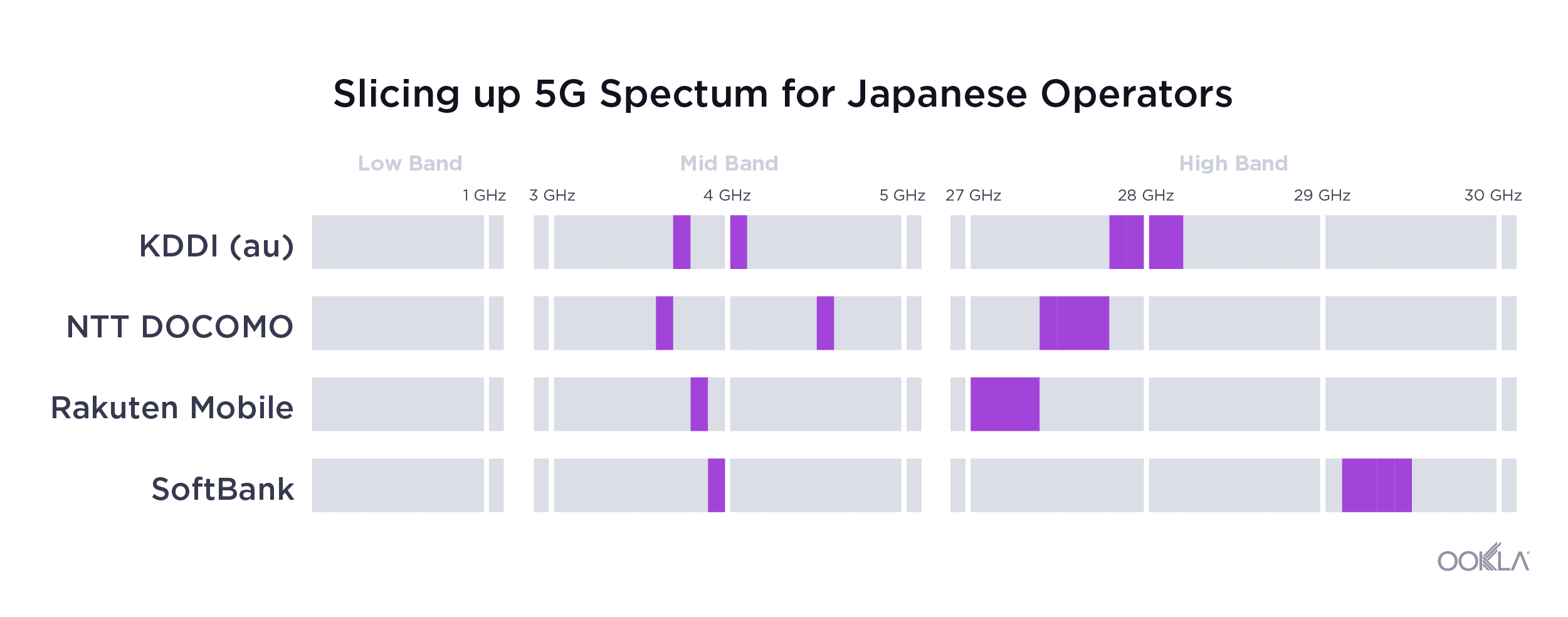
For the past few years, Japan has been building toward the 2020 Summer Olympic Games in Tokyo as an opportunity to showcase their next-generation wireless technology. Japan began conducting 5G trials as early as 2017. In 2018, Japan’s Ministry of Internal Affairs (MIC) revised the spectrum allocation process to encourage new operators to enter the 5G market. Then in April 2019 the MIC approved 5G spectrum allocations to four applicants: KDDI (au), NTT DOCOMO, Rakuten Mobile and SoftBank.

KDDI, NTT DOCOMO and SoftBank launched 5G this month, with NTT DOCOMO and KDDI first to market on March 25. NTT DOCOMO’s initial 5G launch will leverage sub-6GHz spectrum assets, offering peak download speeds of up to 3.4 Gbps, and peak upload speeds of up to 182 Mbps. Later in June, the operator will start selling 5G devices capable of operating on the mmWave band and accessing 400 MHz of high-band spectrum. This will allow for peak download speeds of 4.1 Gbps and upload speeds of 480 Mbps. SoftBank will launch second on March 27. Rakuten plans to launch 5G by June 2020.

How Japanese operators will use spectrum for 5G

Japanese operators are deploying 5G networks in both FR1 (sub-6GHz) and FR2 (millimeter-wave) frequency bands. Each licensee has been awarded 400 MHz of FR2 spectrum and KDDI, NTT DOCOMO and SoftBank have been awarded 200 MHz of FR1 spectrum. The exception is Rakuten, which requested 100 MHz of FR1 spectrum.
Ookla_5G-Spectrum-Chart_Japan_0320_en

Early trials and infrastructure

KDDI (au) 5G trials started in 2017 with Ericsson, Nokia and Samsung. KDDI awarded all three vendors with 5G contracts. KDDI also inked a seven-year roaming deal with Rakuten, the newest entrant in the wireless space, to provide LTE coverage to Rakuten’s subscribers when they roam outside of their coverage area.

NTT DOCOMO started early 5G trials using several infrastructure partners, including: Nokia and NEC Corp on 4.5 GHz spectrum band, Ericsson and Qualcomm on 4.5 GHz and the mmWave wave, and Huawei for mmWave. Fujitsu has proposed a software upgrade for existing LTE base stations which will enable 5G radio access. NEC Corp offered a small cells product supporting all three frequency bands (3.7 GHz, 4.5 GHz, 28 GHz) leveraging O-RAN (Open Radio Access Network Alliance), which aims to break the single-vendor-per-market lock and paves the way for a smooth transition to 5G software-defined networking and cloud services. NTT DOCOMO awarded NEC Corp, Fujitsu and Nokia with contracts, claiming the world’s first 4G/5G multi-vendor RAN (radio access network) interoperability.

SoftBank initially partnered with Chinese vendors Huawei and ZTE in 2017 to conduct mmWave trials in the 28 GHz frequency band. SoftBank awarded the contracts to Nokia and Ericsson.

A completely new approach from Rakuten, the “optimistic” entrant

Rakuten is a premier Japanese ecommerce company founded in 1997. Rakuten means “optimism” in Japanese, and now the company offers products and services across a multitude of industries, including: banking, mobile payment, mobile messaging (via the Viber app), travel and their own MVNO, to name a few. The company understands the importance of controlling the entire user experience for their customers — and the value of running their own facilities-based mobile network in addition to OTT (over-the-top) services.

Since Rakuten is deploying a mobile network from the ground up using greenfield licensed spectrum assets, the company has decided to do something that nobody has ever done before: disaggregating the hardware from the software and running a fully virtualized, cloud-native network. This LTE network has been fully operational with over 3,000 cell sites in three markets (Tokyo, Nagoya and Osaka) running limited trials since last year — and is expected to launch commercially on April 8. Because of its software-defined nature, the network can be upgraded to 5G, and the operator expects to have the upgrade pushed later this year.

Rakuten’s network architecture is unique, leveraging only antenna-integrated radios from traditional telecom vendors. Radios are fiber-fed via the fronthaul, and instead of processing at cell site cabinets, all the processing is happening remotely at centralized locations using off-the-shelf computer hardware running virtualized network functions. According to Rakuten CTO Tareq Amin, the process of activating a new cell site takes only eight and a half minutes instead of days. After Rakuten’s April launch, years worth of Rakuten’s research and development will be available to other operators globally via the Rakuten Mobile Platform (RMP), which could be very attractive to new entrants in the wireless space, such as DISH in the United States.

We will continue to monitor how these different 5G setups perform as 5G is rolled out in Japan and we look forward to providing future analysis on this topic.


日本国内における5Gへのユニークなアプローチ

日本は当初からモバイルテクノロジーのリーダーであり、日本企業は最先端のモバイルテレフォニーを占有し続けています。日本のLTEネットワークは、最も人口密度の高い都市地域でも非常に競争力のある速度を継続的に提供しています。これは、この国のネットワークの基地局密度の高さを物語っています。この記事では、日本の携帯電話事業者がこのような先進の考え方を5Gにどのように適用しているかを探ります。

日本のスペクトル活用法

日本の事業者は、複数の周波数帯域をデータレーンに集約して速度を高める「レイヤーケーキ」スペクトルアプローチを活用しています。このアプローチでは、700 MHz、800 MHz、900 MHzの低帯域と1500 MHz、2100 MHzの中帯域を組み合わせて、その上に2500 MHzの高帯域を乗せますこのアプローチにより、最新の電話機を所有するユーザーはさまざまなスペクトル帯域に同時にアクセスできます。これにより、高速化とそれに伴うユーザーエクスペリエンスの向上が実現します。このスペクトルレイヤーケーキと日本の既存の高密度基地局網との組み合わせは、日本が5Gサービスに割り当てた6 GHz以下のスペクトルのオーバーレイの良い基盤となります。

日本における5Gのローンチのタイムライン

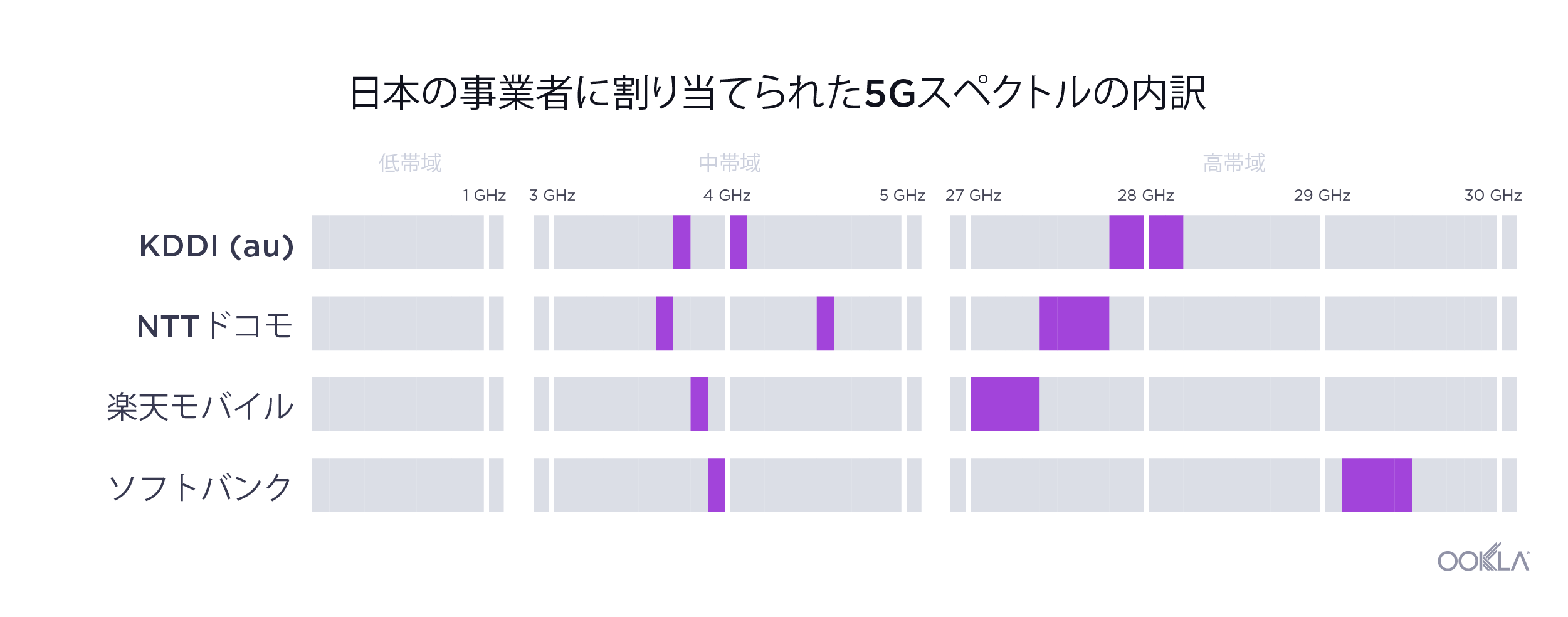
日本は、2020年に東京で開催される夏季五輪を、次世代ワイヤレステクノロジーをアピールする機会ととらえ、ここ数年それに向けて準備を進めてきました。日本は、早くも2017年に5G実証実験を開始しました。2018年、日本の総務省は、新規事業者の5G市場への参入を促すため、スペクトル割り当て手続きを改訂しました。その後、2019年4月、MICは4つの申請企業への5Gスペクトル割り当てを承認しました。承認を受けたのは、KDDI(au)、NTTドコモ、楽天モバイル、ソフトバンクです。

KDDI、NTTドコモ、ソフトバンクは今月、5Gをローンチする予定です NTTドコモKDDIが最初で、3月25日に発売された。NTTドコモの最初の5Gローンチでは、6GHz以下のスペクトルアセットを活用し、最大3.4 Gbpsのピークダウンロード速度と最大182 Mbpsのピークアップロード速度を提供します。7月後半、NTTドコモは、mmWave帯域で動作し、400 MHzの高帯域スペクトルにアクセスすることができる5Gデバイスの販売を開始する予定です。これにより、4.1 Gbpsのピークダウンロード速度と480 Mbpsのピークアップロード速度が可能になります。 ソフトバンクが2番目で、3月27日にローンチする予定です。楽天は2020年6月までに5Gを発売する予定です。

日本の事業者による5G用スペクトラムの使用方法

日本の事業者は、FR1(6GHz以下)とFR2(ミリメートル波)の両方の周波数帯域で5Gネットワークを展開しています。各ライセンシーは400 MHzのFR2スペクトルを割り当てられ、KDDI、NTTドコモ、ソフトバンクは200 MHzのFR1スペクトルを割り当てられました。例外は楽天です。楽天は100 MHzのFR1スペクトルを申請しました。
Ookla_5G-Spectrum-Chart_Japan_0320_jp

早期実証実験とインフラストラクチャ

KDDI(au)は、2017年にEricsson、Nokia、Samsungと共同で5G実証実験を開始しました。KDDIは、3つのベンダーすべてと5G契約を結びました。KDDIはまた、ワイヤレス市場の最も新しい参入企業である楽天と7年間のローミング契約を結び、楽天の加入者が楽天のサービス区域外でKDDIのLTEサービスを利用できるようにしました。

NTTドコモは、複数のインフラストラクチャパートナーと共同で早期5G実証実験を開始しました(4.5 GHzスペクトル帯域でNokiaとNEC、4.5 GHzとmmWave波でEricssonとQualcomm、mmWaveでHuawei)。富士通は、既存のLTE基地局を対象に、5G無線アクセスを可能にするソフトウェアアップグレードを実施することを提案しました。NECは、O-RAN(Open Radio Access Network Alliance)を活用して3つの周波数帯域(3.7 GHz、4.5 GHz、28 GHz)をすべてサポートする小型基地局製品を提案しました。このソリューションは、「市場ごとに1つのベンダー」体制を打破することを目的とし、5Gソフトウェアデファインドネットワーキングおよびクラウドサービスに円滑に移行するための道筋をつけるものです。NTTドコモは、NEC、富士通、Nokiaと契約を結び、世界初の4G/5GマルチベンダーRAN(無線アクセスネットワーク)相互運用をアピールしています。

ソフトバンクは当初、2017年に中国のベンダーであるHuaweiおよびZTEと提携し、28 GHz周波数帯域でmmWaveの実証実験を実施しました。ソフトバンクは、NokiaおよびEricssonと契約を結びました。

「楽観的」な新規参入企業である楽天のまったく新しいアプローチ

楽天は1997年に設立された日本の最大手eコマース企業です。楽天は日本語で「楽観主義」を意味しており、同社は現在、銀行、モバイル決済、モバイルメッセージング(Viberを使用)、旅行、楽天独自のMVNOなど、多数の業界に製品とサービスを提供しています。同社は、顧客のユーザーエクスペリエンス全体をコントロールすることの重要性と、OTT(オーバーザトップ)サービスに加えて独自の設備ベースのモバイルネットワークを稼働させることの価値を理解しています。

楽天は、認可を受けた未開発のスペクトルアセットを活用してモバイルネットワークをゼロから展開しているため、これまで誰もやったことがないことに取り組むことを決めました。それはハードウェアをソフトウェアから切り離し、完全に仮想化されたクラウドネイティブのネットワークを稼働させるというものです。このLTEネットワークは、3つの市場(東京、名古屋、大阪)で3,000以上の基地局によって完全に機能しており、昨年以降、限定的な実証実験が実施されています。商業ローンチは4月8日の予定です。このネットワークは、ソフトウェアデファインドの特性を持っているため、5Gにアップグレード可能で、楽天は今年の後半にアップグレードを行う予定です。

楽天のネットワークアーキテクチャは独特で、従来の電気通信ベンダーのアンテナ統合型無線のみを使用しています。無線は、フロントホールからファイバで送信され、基地局のキャビネットで処理される代わりに、リモートの集中拠点で仮想ネットワーク機能を実行する市販コンピューターハードウェアによってまとめて処理されます。楽天のCTOであるTareq Amin氏によると、新しい基地局は数日ではなくわずか8分半で稼働させることができます。楽天の4月のローンチ後、他の事業者は楽天モバイルプラットフォーム(RMP)を介して楽天の3年分の研究開発の成果を利用できるようになります。これはワイヤレス市場への新規参入を目指す企業(米国のDISHなど)にとって非常に魅力的でしょう。

私たちは、今後日本で5Gが展開されるにつれてこれらの異なる5Gセットアップがどのように機能するかを引き続きモニタリングしていきます。このトピックについての将来の分析を皆様にご提供できる機会を楽しみにしています。

Ookla retains ownership of this article including all of the intellectual property rights, data, content graphs and analysis. This article may not be quoted, reproduced, distributed or published for any commercial purpose without prior consent. Members of the press and others using the findings in this article for non-commercial purposes are welcome to publicly share and link to report information with attribution to Ookla.


| December 5, 2022

The United States — Ripe for Converged Networks

Key messages

  • Moves by mobile operators in the U.S. to offer fixed-wireless home broadband services are further blurring the lines between fixed and mobile networks. Cable operators in the U.S. are responding to this competitive challenge by driving the U.S. market further towards convergence, in the form of fixed-mobile bundling. This trend is driving greater competition in the market, lower prices, and more choice for consumers.
  • Speedtest Intelligence® data shows opportunities for cable companies and the big-three national operators to leverage positions of strength in one access technology to cross-sell to consumers and drive adoption of bundled services.
  • U.S. operators should look to European operators’ experiences with service bundling, where they have been shown to reduce churn and offer ARPU uplift opportunities, but require operators shift from a focus purely on price, to driving improvements in the consumer experience.
  • Fixed and mobile networks are already being used in tandem. For example in the U.K. BT includes a SIM within its Halo routers to offer redundancy to its fixed broadband customers. And already in the U.S. Comcast utilizes its XFINITY Wi-Fi hotspot network to provide high capacity coverage for its customers, allowing it to improve network performance in areas where 5G signal typically struggles to penetrate, while also offloading mobile traffic to its fixed network.
  • Looking to the future, we anticipate more strategic moves to drive improved consumer experiences as the convergence of fixed and mobile networks continues. The emerging set of Wireless Wireline Convergence (WWC) standards being developed by 3GPP and the BBF offer up some unique capabilities, but as ever, vendor and operator support will be key.

Blurring the lines between fixed and mobile networks

Fixed and mobile networks are becoming increasingly complementary, extending the reach of internet connectivity, performance, and reliability. Fixed networks support wireless devices through Wi-Fi offload in the home and via public and operator Wi-Fi access points, often in locations where cellular signals face propagation challenges. Additionally, wireless networks can provide cellular redundancy to fixed broadband services, often via a SIM added to the router.

Cable companies have offered mobile services for some time now via MVNO agreements, (Cox is set to be the latest example), and are able to utilize their Wi-Fi hotspot networks to offer greater coverage and capacity to subscribers. Ookla® data indicates that for markets such as the U.S. that have widespread fixed broadband penetration, mobile users spend approximately 75% of time on average connected to Wi-Fi networks, as opposed to wireless networks. This number ranged from a low of 67.5% for T-Mobile, to a high of 80.0% for cable operator Comcast’s XFINITY. This helped XFINITY and Spectrum rank as fastest overall mobile service across their respective service areas when considering 5G and Wi-Fi access combined.

On the flip side of the coin, the growth in fixed-wireless access (FWA), particularly via higher-speed 5G spectrum, offers an alternative to existing fixed networks. In the U.S., fixed wireless is already being used to cover locations that would  be too costly to lay fiber to reach, and is also being offered as a competitive alternative to existing fixed networks. Both Verizon and T-Mobile have championed this approach, and are seeing strong growth in their respective fixed-wireless customer bases, although fixed wireless still represents a small proportion of overall fixed broadband subscribers.

Fixed and wireless technologies also play an important role in today’s backhaul networks, with fiber instrumental in extending the reach and capacity of mobile networks, and microwave point-to-point wireless connections still common in many parts of the world for backhaul. Throw satellite connectivity into the mix via the growth of LEO constellations, and it’s clear that there’s no one-size-fits-all solution for providing universal connectivity — a blend of technologies is required.

Fixed-mobile bundling — initially focused on cost savings for consumers

The growth of fixed-mobile (convergent) bundles in the U.S. is occurring amidst a slowing of the global economy, with inflation running into double digits in many markets, pushing them towards a possible recession. This could well spur the adoption of fixed-mobile bundles in the U.S., paralleling the experience of many European markets during the last prolonged economic downturn which began in 2008. In this economic environment, a number of European operators introduced convergent bundles, offering them at an overall discount to the discrete underlying services. 

While not prevalent in all European markets, fixed-mobile bundles have taken hold in many key markets, championed by regional powerhouses including Telefonica and Orange. Orange even goes so far as to highlight convergence as the “bedrock of our strategy,” and has pursued M&A across Europe in order to combine fixed and mobile assets in order to pursue a convergent strategy. 

Initially, European operators pursuing convergent bundles saw a reduction in churn, as including more services within a bundle for multiple people in a household made these customers stickier. Over time, operators looked to drive increased ARPU by including additional services, particularly broadcast television and video streaming. For consumers, fixed-mobile bundles also offer managerial benefits, adding the convenience of a single bill for all telecoms services in a household and gives the account holder more control over telecoms expenditure as a result.

More recently, in European markets where fixed and mobile bundles have become commonplace, we’re seeing moves to expand the value offered to customers, to avoid ARPU erosion. For Movistar, this included a recent rebrand of its Fusion offering to MiMovistar, and a move to include services such as health, gaming, and security. The key lesson for U.S. telcos is to avoid a race to the bottom that will harm margins and ultimately investment. Instead, telcos should focus on extending the value delivered from fixed-mobile bundles. For cable companies with MVNO agreements driving Wi-Fi offload for their mobile customers can help improve performance. It also keeps wholesale costs down, allowing them to be more aggressive with their mobile pricing.

U.S. fixed-mobile service overlap — battle lines drawn

To estimate the current overlap in fixed and mobile subscriptions by provider and look at bundling opportunities within the U.S.,  we used Speedtest Intelligence data to show the share of Speedtest® samples for mobile devices conducted via wireless networks versus Wi-Fi. Cable operators Spectrum (Charter) and XFINITY (Comcast) show very high degrees of overlap, as explained by their sales model where mobile is not offered as a standalone service, but only as an add-on to their fixed broadband subscriptions services.

Overlap in fixed and wireless subscriptions (Q3 2022 | Speedtest® Data)
WIRELESS WIRELINE
AT&T
T-Mobile Verizon Spectrum XFINITY Other
AT&T Wireless 20.5% 0.1% 4.9% 21.7% 21.2% 31.6%
T-Mobile 11.2% 0.2% 7.8% 24.9% 26.1% 29.9%
Verizon Wireless 9.2% 0.1% 10.9% 23.1% 21.3% 35.3%
Spectrum 2.2% 0.1% 1.0% 85.7% 2.0% 9.1%
XFINITY 2.4% 0.1% 1.3% 2.1% 87.5% 6.7%

Three main takeaways emerge from the data:

  1. AT&T has a larger wireline footprint than Verizon, and this shows over 20% of its wireless customers also access AT&T’s fixed broadband service according to Ookla Speedtest data versus Verizon’s 10.9%. Both companies have opportunities to drive further mobile uptake among their fixed user bases.
  2. T-Mobile has a greenfield opportunity for fixed wireless, where strong 5G network performance should help it capitalize on both mobile and fixed net additions.
  3. Sizeable proportions of the big three’s mobile user base (in excess of 40%) accessing fixed Wi-Fi via either Charter or Comcast, represent a significant opportunity for the cable companies to expand their mobile user bases.

Beyond fixed-mobile bundling — driving experiential improvements to network service

The advent of 5G, alongside the COVID-19 pandemic, has helped drive growth in the use of data intensive services including video calling, video streaming, and mobile gaming. As these services continue to grow in popularity, and as consumers begin to demand more immersive extended reality (XR) experiences that push the boundaries of today’s networks, so operators will need to improve the performance of both fixed and mobile networks, while also looking to opportunities for network convergence to support enhanced service experiences and reduced operational costs.

High-throughput 5G service utilizes higher frequency spectrum bands than has been used for previous generations of mobile technology. These spectrum bands have lower propagation properties, particularly in-building, mandating that operators further densify their networks to offer consistent performance. Operator Wi-Fi hotspot networks can offer an alternative to this, providing a secure fixed network connection in locations where 5G signals can often degrade. In the U.S., cable companies have also begun to offer differentiated network speeds to their mobile subscribers when connected to their Wi-Fi networks, provisioning faster network speeds to capable smartphones.

Standards bodies have also identified a need to help drive fixed-mobile convergence. The development of Wireless Wireline Convergence (WWC) standards by 3GPP and the Broadband Forum (BBF) seeks to allow operators to converge existing fixed and mobile technology stacks using a common 5G core network. In doing so, operators will move to a single control plane for fixed and mobile sessions, enabling them to offer customers seamless connectivity via fixed and mobile access while also allowing them to aggregate the performance of both access networks to help drive enhanced performance and reliability. In doing so, this will allow operators to streamline the set of network functions and processes required to operate their networks, while also allowing them to simplify their Operational and Business Support Systems (OSS and BSS).

Leading operators such as Deutsche Telekom and BT are actively moving in this direction, with Deutsche Telekom in September conducting a proof of concept lab trial of WWC standards to steer traffic from a 5G residential gateway and route traffic along the entire wireline access chain to the core network. According to Ahmed Hafez, VP of network convergence at Deutsche Telekom, “convergence will allow us to optimize our network assets and deliver new, differentiated service experiences to our customers regardless of the access used.” BT has also signaled its intent to move to a single transport and core network serving both fixed and mobile services as it looks to accelerate the convergence of its mobile and fixed services in the U.K. under a single brand, EE.

While it’s clear that pioneers in the industry are looking to push the envelope on fixed-mobile convergence, there’s still a long way to go. We look forward to more operator trials of WWC standards, but ultimately it will also require the vendor ecosystem to integrate these standards in their product roadmaps to help spur adoption. If you’re interested to find out more about Ookla Speedtest Intelligence, and its wealth of fixed and mobile consumer initiated data and insights, please get in touch.

Ookla retains ownership of this article including all of the intellectual property rights, data, content graphs and analysis. This article may not be quoted, reproduced, distributed or published for any commercial purpose without prior consent. Members of the press and others using the findings in this article for non-commercial purposes are welcome to publicly share and link to report information with attribution to Ookla.