| November 18, 2025

Public Safety Connectivity: How Agencies Can Strengthen Critical Communications

Connectivity failures are inconvenient for most people, but for public safety agencies they can be catastrophic. Whether coordinating evacuations, dispatching first responders, or keeping hospitals online, resilient networks are essential to saving lives and protecting communities.

Real-world disasters highlight the stakes. From wildfires in Maui and California to hurricanes across the Southeast, connectivity has been disrupted when agencies needed it most. In those moments, responders face delays, residents lose access to critical information, and hospitals struggle to coordinate care. The risks are clear: without resilient communications, every aspect of emergency response becomes harder and more dangerous.

Agencies need visibility into how networks perform in the real world. Ookla’s ecosystem—Speedtest, Downdetector, and Ekahau—provides the tools to strengthen preparedness, improve response, and accelerate recovery. 

Read on to learn why resilient connectivity is so vital, the key challenges agencies face, and what recent disasters like the Lahaina wildfires reveal about the stakes. To dig deeper, download our full guide: Building Resilient Connectivity for Public Safety and Emergency Management.

When Communication Fails, Safety Fails

Disasters often strike in chaotic conditions where infrastructure is already damaged or failing. Responders may be rushing into wildfires, floods, or tornadoes with limited visibility and unreliable networks. Hospitals and shelters may suddenly find themselves overwhelmed, with communications buckling under the weight of demand. In these situations, reliable communication can often determine whether help arrives on time.

Communication breakdowns ripple outward. A single dead zone can cut a fire crew off from dispatch. If hospitals can’t access patient records or coordinate ambulance arrivals, patients may not get the care they need in time. When dispatchers can’t relay caller details in real time, teams enter dangerous situations without critical information—and communication breakdowns can affect every group involved in an emergency response:

  • First responders: Without reliable coverage, teams may lose contact with dispatch or lack access to real-time data
  • Dispatchers: Disrupted networks hinder the ability to gather details from callers, delaying information for crews in the field
  • Fire teams: Loss of radio or mobile service can force reliance on hand signals or runners, slowing response when every second matters
  • Healthcare and EMS: Connectivity failures prevent hospitals and ambulances from accessing patient records or coordinating care, directly affecting outcomes

Loss of service and communication blackouts are not hypothetical risks. From Chief Barry Hutchings of the Western Fire Chiefs Association describing a fire scene with no portable radio coverage, to hurricanes and wildfires cutting off entire regions, the consequences are well documented. Reliable communications across response routes, hospitals, and community centers can mean the difference between a timely response and catastrophic outcomes.

Key Connectivity Challenges for Agencies

Agencies are often asked to deliver flawless communication in the most challenging environments. Rural areas stretch networks thin, mountains block signals, and older government facilities can block wireless coverage. During a disaster, even modern infrastructure can be compromised by fire, flood, or wind damage.

The problem goes beyond poor coverage or inadequate capacity; agencies also often lack detailed insight into how networks perform in specific areas. An agency may know a dead zone exists, but they often lack the data needed to demonstrate the problem and secure funding for improvements. In other cases, they may be flying blind during an outage, without real-time visibility into what has failed or how widespread the issue is. Without the right tools, even well-prepared teams can struggle to manage the connectivity challenges emergencies present:

  • Coverage and reliability gaps: Rural areas, mountainous terrain, and dense building materials can create persistent dead zones
  • In-building connectivity gaps: Older or secure government facilities often block signals and limit network upgrades
  • Outdated infrastructure and regulatory hurdles: Aging infrastructure and regulatory hurdles slow tower deployments and upgrades
  • Situational blind spots: Without real-time network data, agencies can often lack the visibility needed to pinpoint outages, understand their scope, and coordinate an effective response
  • Infrastructure vulnerabilities: Natural disasters can often damage physical infrastructure, creating extended blackouts
  • Funding constraints: Without concrete evidence of where and how networks are falling short, agencies can struggle to secure federal or state support for upgrades

These challenges leave agencies vulnerable. Without reliable coverage and visibility, response times slow, public trust erodes, and communities face greater risk during emergencies.

A Framework for Preparedness, Response, and Recovery

Public safety cannot be purely reactive. Agencies must plan in advance, monitor conditions as crises unfold, and evaluate how well systems recover once the danger passes. The emergency management lifecycle—preparedness, response, recovery—ensures that agencies are not just reacting, but instead building long-term resilience.

In practice, responsibilities for each stage of that lifecycle are typically split across different teams. One group may focus on planning coverage improvements, another may monitor outages as they occur, and another might validate in-building Wi-Fi performance. Without a unified view, important gaps can go unnoticed. 

To close those gaps, agencies need integrated solutions that connect every stage, from pre-disaster planning through post-disaster recovery. A complementary mix of network performance data from Speedtest Intelligence®, website and service outage insights from Downdetector®, and wireless survey capabilities from Ekahau help ensure that each phase of the emergency management lifecycle is supported with the right visibility and intelligence:

  • Preparedness: Agencies use Speedtest Intelligence® data to identify coverage gaps, assess high-risk zones, and validate network upgrades. Public safety IT teams also use Ekahau tools to conduct wireless surveys and verify network performance in critical locations such as hospitals, command centers, and shelters
  • Response: Downdetector® detects website and service outages in real time, giving agencies early awareness of issues. Meanwhile, Speedtest provides immediate visibility into performance changes, while Ekahau validates temporary networks in shelters or mobile command posts.
  • Recovery: Agencies measure restoration speed, validate coverage improvements, and document outcomes to inform future investments. Downdetector and Speedtest data help secure funding by showing where networks fail during emergencies and measuring how quickly they recover.

The emergency management lifecycle—preparedness, response, recovery—ensures agencies are not only reacting in the moment but building more resilient systems for the future.

Lessons from Lahaina

When wildfires tore through Lahaina, Hawaii in August 2023, connectivity collapsed when residents and emergency managers needed it most. Evacuees had little information about safe routes, and responders struggled to understand whether networks were down locally or across entire islands. Without visibility into network conditions, emergency responders could not determine where they could reach people and where communications had already failed.

Tools like Downdetector and Speedtest provided critical real-time visibility into network conditions. By combining outage reports with performance data, agencies gained the situational awareness they needed to prioritize limited resources and focus on areas most in need.

The insights revealed a clear picture of how the crisis was unfolding and how that visibility informed response decisions. Downdetector tracked sudden spikes in outage reports, while Speedtest Intelligence revealed steep declines in network performance. Together, those insights allowed responders to distinguish between isolated disruptions and broader failures, helping prioritize key resources. The Lahaina fires show how connectivity insights can be as essential as water or fuel when disaster strikes.

The lesson from Lahaina is clear: visibility into connectivity provides essential intelligence during disasters. Identifying where networks fail and how they recover enables agencies to coordinate more effectively with providers, support first responders, and keep communities informed as conditions evolve.

Conclusion

Public safety and emergency management agencies cannot afford uncertainty in communication. Reliable networks are the foundation of preparedness, response, and recovery—and the consequences of failure are too great to ignore.

Ookla’s ecosystem of Speedtest, Downdetector, and Ekahau gives agencies the visibility, reliability, and security they need to protect communities. With better data, decision-makers can plan smarter, respond faster, and restore service more effectively when disaster strikes.

To learn how your agency can strengthen its response capabilities and ensure networks are resilient when it matters, check out our full guide, Building Resilient Connectivity for Public Safety and Emergency Management.

Ookla retains ownership of this article including all of the intellectual property rights, data, content graphs and analysis. This article may not be quoted, reproduced, distributed or published for any commercial purpose without prior consent. Members of the press and others using the findings in this article for non-commercial purposes are welcome to publicly share and link to report information with attribution to Ookla.

| December 3, 2025

The Need for Ongoing Network Performance Monitoring by U.S. States

Establishing Best Practices for U.S. State Broadband Program Accountability

Billions of dollars have already been deployed in the last several years to close the digital divide through state-directed projects with funding from the American Rescue Plan Act (ARPA) and the Capital Projects Fund (CPF). In 2026, we will finally start to see deployments begin with funding from the Broadband Equity, Access, and Deployment (BEAD) Program. State broadband offices are managing this unprecedented influx of federal funding, overseeing projects that are reshaping local economies, and transforming how communities access education, healthcare, and jobs.

The challenge now isn’t just about building networks; it’s also about monitoring the progress of delivering broadband to underserved communities. While the National Telecommunications and Information Administration (NTIA) sets broad guardrails for BEAD, most accountability for these expenditures ultimately falls on the states. Governors, legislatures, and local communities will all want proof that taxpayer-funded projects are delivering real, measurable improvements in connectivity and adoption.

In this article, we’ll explore why traditional oversight and one-time site inspection isn’t enough, how regular monitoring can strengthen state broadband programs, and how Ookla’s data and mapping tools help agencies maintain transparency for monitoring performance over time.

The Accountability Challenge Beyond Federal Mandates

State broadband offices aren’t just following federal guidance—they’re responsible for demonstrating that public investments are delivering measurable improvements in connectivity. Governors, legislators, and community officials expect clear evidence that awarded projects are expanding coverage and improving network performance. ARPA and CPF projects have already been funding large-scale broadband expansion, but those programs do not include any significant federal requirements for long-term performance monitoring. As BEAD-funded buildouts begin, NTIA is expected to require limited ongoing verification similar to what has been implemented for the Connect America Fund (CAF).

Without broad, consistent network performance testing, states risk losing visibility into how billions in public funds are being used, undermining their ability to demonstrate results or enforce accountability. Legislators and local officials will increasingly demand that broadband offices demonstrate outcomes, not just project completion, and pressure for transparent, data-backed reporting is only growing stronger.

Key considerations for state broadband offices include:

  • ARPA and CPF oversight gaps: Many of these earlier programs lack ongoing testing requirements, leaving states to fill the void with their own network performance monitoring standards.
  • BEAD expectations: Preliminary NTIA guidance, released September 19, 2025, suggests that testing requirements will likely follow those already outlined for CAF. That equates to a minimum of 5 and no more than 50 testing locations being required per award area, depending on the number of locations served. Testing requirements do not extend beyond the award areas in an ISP’s footprint unless necessitated by other support programs. 
  • Public accountability: State agencies must be ready to justify funding decisions and results to policymakers and the public alike. Search engines, and now AI, have given all of us an expectation of immediate answers. While annual reports serve as important milestones, most stakeholders will have no more patience than the general public. There is a high value in having more current statistics and updated maps readily available.

As states shift from deployment to documentation, accountability becomes not just a compliance measure but a foundation of trust with ISP partners and a direct responsibility to the communities involved.

The Limitations of One-Time Physical Inspection

Regularly monitoring performance is the only way to know whether broadband networks are actually delivering on their promises over time. Inspecting a project once—checking that equipment is installed and operating—might confirm that a build is complete, but it doesn’t reveal how that network performs for real users after the ribbon-cutting. Physical inspections can serve an important purpose at an early phase, but the expectation is that these new deployments will continue to meet the performance metrics promised in their award applications, at a minimum, over the next decade and beyond.

Broadband networks evolve with population shifts, infrastructure upgrades, and increasing user demand. What performs well during an initial inspection may degrade over time due to usage congestion, higher than expected adoption, aging equipment, or inadequate maintenance. One-time field checks simply cannot capture:

  • Actual user experience: A one-time test doesn’t reflect what residents see day to day.
  • Performance trends: Ongoing data collection via crowdsourced testing reveals where service quality improves, plateaus, or declines.
  • Adoption patterns: Geolocated test data helps identify whether networks are gaining traction across different communities.

NTIA uses Ookla data in its mapping tools to understand how connectivity looks at the community level—offering proof that consistent, crowdsourced insights add value far beyond one-time field inspections. Continuous visibility ensures states aren’t just checking boxes but improving outcomes for the people these programs were designed to help.

Speedtest Data Paints a Picture of Success

In the example below, we see the best 10% of Download Speeds for all fixed operators aggregated to Hex Resolution 7 in and around the Buena Vista, Georgia, community. The left image represents six months of Speedtest results ending on December 31, 2024. The right image represents six months of tests ending July 31, 2025 after new network equipment has been deployed.

Areas on the left map shown in yellow saw the best 10% of Speedtest results below 100 Mbps. Those in red saw the best 10% of Speedtest results at less than 10 Mbps. These same areas, six months later, broadly show best speeds over 500 Mbps. In fact, many areas shown in dark green have best speeds results above 900 Mbps (see chart below). This constitutes broad evidence that residents in proximity of Buena Vista, Georgia, have seen an astonishing improvement in their access to high quality broadband. 

The “Best 10%” metric is used to better represent what the ISPs are capable of delivering to their subscribers as opposed to the variety of experiences users have beyond the gateway. In contrast, median speeds are often used to competitively benchmark ISP performance. In Q3 2024, the median download speed on the Download chart below was 87.37 Mbps. By Q2 2025, the median speed had jumped to 211.73 Mbps for an increase of 142%. These examples demonstrate how real-world, continuously updated Speedtest results can be used to monitor improvements over time within a community.

Upload speeds have also increased with the best 10% of tests improving by 151% and median speeds improving by over 708%. These boosts in upload speeds are a strong indicator of significant deployment of synchronous fiber within the study area. Multisever latencies are also moving in the right direction, with the best tests improving (or falling) by almost 34% and median results by 42%. Also noteworthy, as households gained access to new services, the number of Speedtest results jumped from 1,008 in the earlier six month period to 2,352 in the latter six month period. This represents a 133% increase in testing activity as both service technicians and subscribers validated the improved broadband access.

While all of these metrics and more can be broken out by individual ISPs, the purpose of these generic “All Providers” illustrations is to show how overall connectivity in an area can dramatically improve, whether from a single provider or from incumbents finding themselves pressured to improve and retain market share. 

How States Can Implement Ongoing Monitoring

For most state broadband offices, accountability will not end when a project is marked complete. Leaders need to prove that networks are performing as promised, closing coverage gaps, and improving user experience long after construction wraps up. That level of visibility requires tools that turn speed and latency data into something decision-makers can easily interpret and act upon. State broadband offices can take accountability further by adopting platforms that transform large tables of testing data into actionable intelligence. 

Ookla’s datasets and visualizations allow agencies to move beyond compliance toward ongoing transparency and smarter, data-driven decision-making:

  • ArcGIS Layers: As an Esri™ partner, Ookla provides pre-aggregated data in formats that integrate directly with ArcGIS platforms. States can visualize broadband performance by census boundaries or hexagon grids, making it easier to track buildouts and evaluate service quality across geographies.
  • Dashboards and Reports: State broadband offices require data that is ready-to-use and actionable. New pre-built dashboards display both current and historical trends in metrics such as speed, latency, and consistency. These views can be shown by state, county, or census block group, supporting quarterly and annual reporting, as well as benchmarking against all other U.S. states and territories. Custom reports are also available for deeper performance insights.
  • Speedtest Insights: Ookla’s Speedtest Insights data helps states identify mobile coverage gaps and highlight disparities in both urban and rural connectivity. Some states have their own initiatives to improve wireless coverage and also use Ookla data to inform funding strategies for unserved and underserved areas. Should non-deployment funds be approved for wireless infrastructure investment, it could prove to be another game-changer for solving the digital divide and it is anticipated that the FCC will be sharing guidance in 2026 on the $9 billion Rural 5G Fund. 

Using these tools together gives broadband offices a current view of network health, helps track awardee performance, and ensures that investments translate into measurable improvements for residents and businesses.

Data-Backed Accountability: Best Practices for State Broadband Offices

State broadband programs have entered a new phase—one where oversight, transparency, and public accountability will be in demand as connectivity is already expanding using taxpayer subsidies. Physical inspection and limited performance checks will not meet the demands of governors, legislators, or the public. Ongoing monitoring, backed by trusted third-party data, is emerging as the new standard best practice.

Ookla’s datasets and visual tools give state broadband offices the means to see how well networks are performing in the real world, identify where support is still needed, and hold awardees accountable for promised outcomes. With ongoing visibility into performance, states can ensure their broadband dollars deliver long-term impact, genuine connectivity, and real accountability for every community they serve.

Reach out if you’d like to explore how Ookla data can support your efforts to expand quality broadband access to everyone.

Ookla retains ownership of this article including all of the intellectual property rights, data, content graphs and analysis. This article may not be quoted, reproduced, distributed or published for any commercial purpose without prior consent. Members of the press and others using the findings in this article for non-commercial purposes are welcome to publicly share and link to report information with attribution to Ookla.

| April 23, 2025

U.S. Broadband Speeds Are Improving but the Digital Divide Is Growing

A new report from Ookla found that the digital divide increased for 32 states between 1H 2024 and 2H 2024, indicating that much of the broadband expansion is occurring in urban areas instead of rural areas.

Key Takeaways

  • The number of states with 60% or more of users experiencing the FCC’s minimum standard for fixed broadband speeds of 100 Mbps downstream and 20 Mbps upstream increased from 10 states in the 1H of 2024 to 22 states (and the District of Columbia) in the 2H of 2024. 
  • New Jersey, Connecticut, Delaware, North Dakota, and Maryland are the top five states with the highest percentage of Speedtest users with 100/20 Mbps. 
  • 32 states saw their digital divide increase between the 1H of 2024 and the 2H of 2024 and 17 states saw their digital divide decrease. 

Many U.S. states made sizable gains in their broadband infrastructure during 2024 and much of that growth was fueled by private equity financing, mergers and acquisitions, capex investments, and government funding. 

According to Ookla Speedtest Intelligence® data, the number of states in the U.S. delivering the minimum standard for fixed broadband speeds as designated by the Federal Communications Commissions (FCC) of 100 Mbps downstream and 20 Mbps upstream is growing. In fact, in our latest U.S. State Broadband Report, we found that states with 60% or more of Speedtest users receiving 100/20 Mbps dramatically increased between the first half and the second half of 2024. 

However, that increase didn’t result in sweeping improvements to the digital divide. Instead, 32 states saw their gap between the percentage of urban users and rural users that receive the minimum required broadband speeds grow during this time period. Ookla uses the Census Bureau’s urban-rural classification to determine which users are urban vs. rural. 

New Jersey is No. 1

Seven states now have 65% or more of Speedtest users experiencing the FCC’s minimum standard for broadband of 100/20 Mbps. New Jersey is No. 1 with 68.97% of Speedtest users experiencing the FCC’s minimum requirement followed closely by Connecticut with 68.35%. Delaware moved up from the No. 5 slot in the first half of the year to the No. 3 ranking in the second half of 2024. 

On the opposite end of the spectrum, Montana and Alaska have fewer than 40% of Speedtest users that receive the minimum broadband speeds of 100/20 Mbps so it’s no surprise that Montana and Alaska are also two of the least densely populated states in the country. 

Digital Divide Grows

While the number of states with 60% or more of users experiencing 100/20 Mbps more than doubled from the first half of 2024 to the second half of 2024, it appears that much of that progress occurred in urban areas because the digital divide, which is the gap between urban and rural users in a state, became much more prominent in 32 states during that time period. 

Washington state leads the nation with the biggest digital divide in the second half of 2024 and it was also at the top of the list in the first half of the year. Oregon and Illinois are also top states with the biggest digital divide in the second half of the year. 

The lack of affordable broadband is known to exacerbate the digital divide and some of this increase in the digital divide is likely due to the demise of the Affordable Connectivity Plan (ACP), which provided discounted broadband services to more than 23 million low-income U.S. households. The FCC ended the ACP program on June 1, 2024, because of a lack of Congressional funding. 

Download the Full Report 

To find your state’s standing and how it compares to the other 49 states in broadband connectivity, download this free report here.

Ookla retains ownership of this article including all of the intellectual property rights, data, content graphs and analysis. This article may not be quoted, reproduced, distributed or published for any commercial purpose without prior consent. Members of the press and others using the findings in this article for non-commercial purposes are welcome to publicly share and link to report information with attribution to Ookla.

| October 1, 2024

How the 50 U.S. States Stack up in Broadband Speed Performance: 1H 2024

Check out the full report available now with the complete results for all 50 states.

Affordable, reliable, high-speed broadband is considered a necessity in the U.S. because it enables people to access online classes, secure health care assistance, register for basic government services, handle their banking needs and participate in many other essential services.  

It’s also critical to the economic viability of every state because it supports remote workers, enables businesses to operate more efficiently and attracts new enterprises to an area. 

But many states have struggled to make broadband service available to 100% of their residents primarily because service providers are focused on providing it to areas where it’s most profitable. Using Ookla’s Speedtest Intelligence® data, this report identifies the states that are currently delivering the minimum standard for fixed broadband speeds as established by the Federal Communications Commission (FCC) to the highest percentage of Speedtest users. It also singles out the states that need the most improvement when it comes to delivering the minimum standard for broadband to their residents. 

Key takeaways 

  • Connecticut, North Dakota, Delaware and six other states are the top performing states because they have the highest percentage of Speedtest users that meet the FCC’s minimum standard for fixed broadband speeds of 100 Mbps downstream and 20 Mbps upstream. While comparing small, densely populated states with larger, sparsely populated states may seem unfair, we thought it was important to note the current performance of each state so we can track their progress in future reports.  
  • New Mexico, Arizona and Minnesota saw the biggest improvement in the percentage of Speedtest users getting the FCC’s minimum standard for fixed broadband speeds (100 Mbps down/20 Mbps up) between the first half of 2023 and the first half of 2024.  
  • Washington, Alaska, Illinois and Oregon have the most prominent digital divide of all the 50 states. These four states have the biggest gap between the percentage of rural Speedtest users vs. the percentage of urban Speedtest users that get FCC’s minimum standard of broadband speeds of 100 Mbps downstream/20 Mbps upstream. 
  • Not surprisingly, less than 40% of the Speedtest users of Alaska, Montana and Wyoming (which are three of the least densely populated states in the U.S.), are receiving the minimum broadband speeds of 100 Mbps downstream/20 Mbps upstream.

Broadband in the spotlight

The COVID-19 pandemic put a spotlight on the importance of having broadband access and the role it played in allowing people to continue working and receiving access to healthcare as well as keeping students in school.  The American Rescue Plan Act of 2021 provided $3.2 billion to help low-income households in the U.S. pay for broadband access during the COVID-19 pandemic. 

This sudden focus on broadband accessibility, also prompted Congress to pass the Infrastructure Investment and Jobs Act of 2021 which set aside $42.5 billion for the Broadband, Equity, Access and Deployment (BEAD) program and provided funding for every state to expand its broadband services. The National Telecommunications and Information Administration (NTIA) runs the BEAD program and the funding is being used for planning, infrastructure, and adoption programs in all 50 states, Washington, DC and several U.S. territories. 

BEAD initially provided $100 million to every state with the remainder of the funding to be divided among the 50 states based upon their unserved and underserved populations. As of September 18, 2024, 44 eligible entities have been approved for both the Volume 1 and Volume 2 phases of BEAD. Volume 1 of the state’s proposal details the list of locations that are eligible for BEAD funding as well as a description of how certain entities can dispute the eligibility status of the various locations. Volume 2 includes each state’s description of how it plans to select ISPs and its overall broadband objectives. Once approved for both phases, states can then get access to the money that has been allocated for them.  

To help manage these federal funds every state and territory established a broadband office that is tasked with determining the extent of their broadband coverage problems and draft broadband strategies that will resolve the problem. 

The FCC in March 2024 decided to revise its current definition of broadband as 100 Mbps downstream and 20 Mbps upstream, which is a substantial upgrade from its previous benchmark of 25 Mbps download and 3 Mbps upload speed that was first established in 2015.

This is the first time in nearly a decade that the FCC raised the speed requirement. Although this new benchmark is being used throughout the U.S., many households still lack basic broadband services. 

Top performing states

Using Ookla’s Speedtest Intelligence® data collected in the first half of 2024 we were able to compare the median download and upload speeds in all 50 states and identify the states that currently doing the best job of delivering the FCC’s minimum standard for fixed broadband speeds (100 Mbps downstream/20 Mbps upstream) to the highest percentage of Speedtest users.  

At least 60% or more of the Speedtest users in Connecticut, North Dakota, Delaware, Maryland, New Hampshire, North Dakota, Rhode Island, Tennessee, Utah and Virginia are getting the FCC’s minimum standard for fixed broadband speeds of 100 Mbps downstream and 20 Mbps upstream.  In Connecticut, which is the top state, 65.8% of Speedtest users are receiving the minimum broadband standard. But at just 65.8% that indicates that there is much more work ahead for states. 

Interestingly, all nine of the states in this list have received final approval for both phases of BEAD funding. However, it’s unlikely that BEAD funding approval played any role in these nine states leading the rest of the country in delivering the minimum standard for broadband because BEAD funding isn’t expected to start impacting broadband deployment projects until 2025 at the earliest, with some states having to wait longer depending on their proposal status with NTIA.

Top performing U.S. states with over 60% of Speedtest users achieving broadband speeds

RankStatePercentage of Speedtest users achieving broadband speedsBEAD funding approval
1Connecticut65.8Yes
2North Dakota65.5Yes
3Maryland63.7Yes
4Delaware63.3Yes
5Rhode Island62.7Yes
6Tennessee62.2Yes
7Utah61.8Yes
8New Hampshire60.5Yes
9Virginia60.1Yes
Source: Ookla Speedtest data.
*Note NTIA approval of BEAD funding is changing rapidly. While BEAD funds haven’t likely played a role in broadband deployments yet, they will in the future.

Southwestern US sees big improvements in broadband 

New Mexico, Arizona and Minnesota saw the biggest improvement in the percentage of their residents getting the FCC’s minimum standard for fixed broadband speeds (100 Mbps down/20 Mbps up) between the first half of 2023 and the first half of 2024.  

New Mexico leads the rest of the states with its gains in broadband in the past year. Ookla data indicates that New Mexico saw a 50% increase in the percentage of its population with access to the FCC’s minimum broadband speeds of 100 Mbps/20 Mbps. Arizona also saw a 45% jump in the percent of  its population with access to the FCC’s minimum broadband speeds of 100 Mbps/20 Mbps. 

Arizona, and specifically, the city of Mesa, AZ, has been a hotbed of activity for fiber deployments. In 2022 Google Fiber decided to deploy fiber to Mesa, AZ after the city council approved plans to bring a data center to the area. In addition, AT&T also announced plans to bring its fiber service to Mesa in 2023. These new fiber entrants are competing with existing broadband providers Cox Communications and Lumen. 

U.S. states with largest year-on-year increase in Speedtest users achieving broadband speeds

RankStateIncrease in Speedtest users obtaining broadband speeds (1H 2023 vs 1H 2024)BEAD funding approval
1New Mexico50%Yes
2Arizona45%Yes
3Nevada37%Yes
4Minnesota38%No
5Colorado35%Yes
6Washington35%Yes
7Oregon32%Yes
8Wyoming32%Yes
9Maine30%Yes
10Utah29%Yes
Source: Ookla Speedtest data.
*Note NTIA approval of BEAD funding is changing rapidly. While BEAD funds haven’t likely played a role in broadband deployments yet, they will in the future.

Sparse population equals inferior broadband

Not surprisingly, the most sparsely populated states in the U.S. tend to also have the smallest percentage of their population receiving the FCC’s minimum broadband speeds. Building broadband networks in rural states is incredibly expensive, and in some areas the terrain can make it nearly impossible. For example, in Alaska, where the ground may be frozen for many months out of the year, it’s difficult to dig trenches to install fiber. 

Ookla’s Speedtest data collected in the first half of 2024 found that less than 40% of the residents of Alaska, Montana and Wyoming (which are three of the most sparsely populated states in the U.S.), receive the minimum broadband speeds of 100 Mbps downstream/20 Mbps upstream.

The digital divide is still evident in many states

A big part of the impetus behind the federal government’s BEAD program is to finally close the gap between those with and without access to broadband, or what is commonly referred to as the digital divide.

But there are still many states that have a prominent gap between the number of rural and urban residents that have access to the FCC’s minimum standard of broadband speeds of 100 Mbps downstream/20 Mbps upstream.

Using the Census Bureau’s urban-rural classification and Ookla data compiled in the 1H of 2024, Washington, Alaska, Illinois and Oregon have the biggest digital divide compared to the other 50 states. For example, while 61.1% of urban Speedtest users in Washington state receive broadband speeds of 100 Mbps/20 Mbps, only 28.7% of its rural Speedtest users receive those same speeds.  

Breaking Down the Digital Divide
Percentage of urban and rural Speedtest users in each state with access to broadband speeds of 100/20 Mbps.

Broadband speeds are improving but more work is needed

U.S. broadband networks offer faster and more reliable connectivity to more people today than they did just a few years ago, however there’s still a large percentage of the U.S. population without adequate access to broadband connectivity.  

Thanks to new funding such as the BEAD program, there are many efforts underway to improve modern broadband networks. We expect to see these advancements in 2025 as more states start to put their BEAD funding into action. 

We will provide semi-annual updates on the broadband speed performance of providers in the 50 states and also to track the improvements that states are making to bridge the digital divide. For more information about Speedtest Intelligence data and insights, please get in touch.

Ookla retains ownership of this article including all of the intellectual property rights, data, content graphs and analysis. This article may not be quoted, reproduced, distributed or published for any commercial purpose without prior consent. Members of the press and others using the findings in this article for non-commercial purposes are welcome to publicly share and link to report information with attribution to Ookla.

| June 25, 2025

The BEAD Proposal Deadline Looms: U.S. States Need Better Data Now

States across the U.S. are in a race against the clock. Following new guidance from the National Telecommunications and Information Administration (NTIA), states have until September 3, 2025 to revise and resubmit their proposals for the $42.5 billion Broadband Equity, Access, and Deployment (BEAD) program, which is designed to fund high-speed internet buildouts in unserved and underserved areas across the country. It’s a tight timeline, especially given the difficult task ahead: evaluating which internet service providers (ISPs) can truly deliver reliable broadband, and which ones may be overpromising.

While the latest guidance for BEAD is new, the challenge of verifying provider claims isn’t. Federal programs have long struggled with network performance data that looks solid on paper but falls short in practice. Now that states are making the calls, broadband offices need dependable ways to tell which networks can truly deliver. 

To qualify for BEAD funding, providers must demonstrate the ability to deliver speeds of at least 100 Mbps download and 20 Mbps upload and latencies below 100 ms. A wave of new ISPs is eager to meet that mark and be included in state proposals. But some rely on technologies that have sometimes struggled to meet speed requirements with current network and infrastructure deployments. 

Whether new applicants can meet the required performance metrics consistently when real users are online, particularly during peak hours, is a question many officials will be asking as they are weighing the options before them. For broadband offices already juggling community needs, infrastructure gaps, and political pressure, validating these claims isn’t just a technical challenge — it’s a logistical one.

The Challenge: Sorting Real-World Performance From Wishful Claims

One of the most urgent tasks states now face is verifying whether ISPs can truly meet the FCC’s broadband speed standard of 100 Mbps download and 20 Mbps upload. On paper, many providers may qualify — but real-world performance often tells a different story.

That’s where Ookla can help. Our data offers a real-world view into actual user experiences — not marketing promises or theoretical models. By mapping where service consistently meets the FCC’s broadband benchmark, states can make faster, more informed decisions about which providers and which technologies are ready to meet BEAD’s requirements. Whether evaluating rural deployments or contested service areas, objective performance data helps broadband offices focus their proposals on providers that can truly deliver.

New guidance from the NTIA now requires states to treat all broadband technologies equally — including fixed wireless and LEO satellite — and prioritize the lowest-cost proposals. That shift opens the door to more providers and deployment types, but also makes it harder to assess which ones can actually meet BEAD requirements. Ookla’s data gives states the ability to evaluate these newer technologies with the same level of rigor as traditional fiber and cable options.

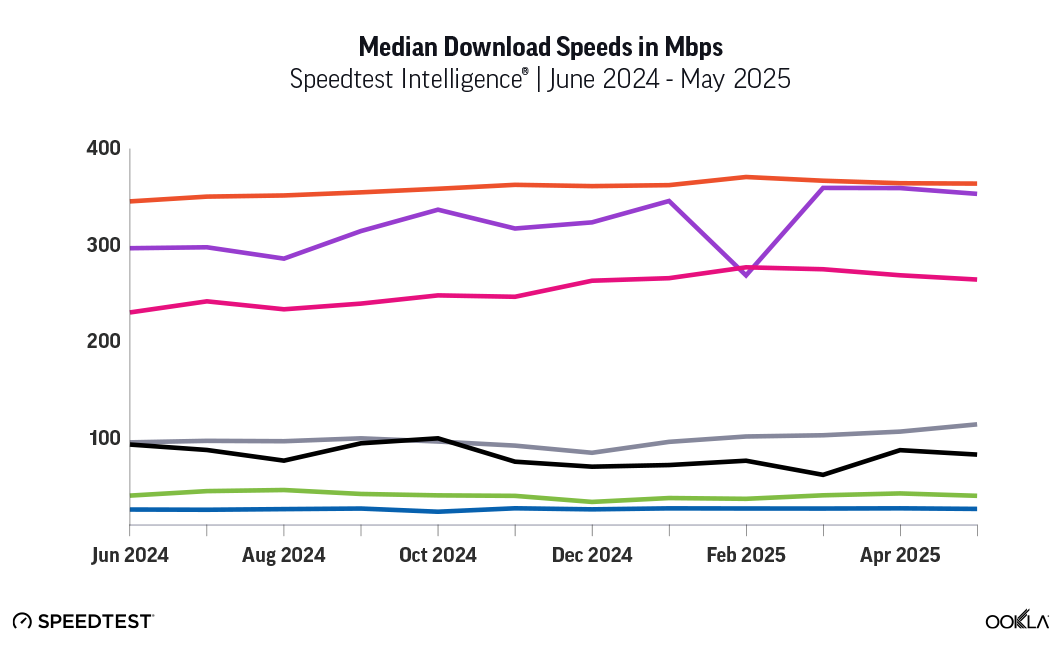
Anonymized chart above of sample operators from a single state shows median download speeds in Mbps from companies using virtually all widely used internet technologies including Cable, DSL, Fiber, FWA, Satellite, and WISP.

Conclusion

Better data supports better decisions — and helps ensure that BEAD funding goes to networks that can support the communities they’re meant to serve, not just on paper but in the real world. With proposals due by September 3, states need every advantage they can get. 

The funding choices broadband offices make in the coming weeks will shape internet access for years to come, especially in areas that have historically been overlooked or underserved.

Discover how Ookla’s broadband data can enhance your BEAD program proposals. For inquiries, please reach out to us at us-government@ookla.com.


Ookla retains ownership of this article including all of the intellectual property rights, data, content graphs and analysis. This article may not be quoted, reproduced, distributed or published for any commercial purpose without prior consent. Members of the press and others using the findings in this article for non-commercial purposes are welcome to publicly share and link to report information with attribution to Ookla.
| August 5, 2025

How States and Local Governments Track Broadband Progress with Ookla’s ArcGIS Online Dashboards

Internet service has joined the ranks of essential utilities; it’s foundational to economic development, public services, and everyday life. But when it comes to understanding which areas have fast, reliable internet—and which don’t—many public sector teams are still relying on outdated information, especially federal coverage maps. Accurate, location-based performance data has been hard to come by, and even harder to put to use.

That’s where Ookla’s new ArcGIS-based dashboards come in. Built for use at every level of government—from state agencies to local broadband offices—these tools combine Ookla’s rolling 12-month Speedtest Intelligence data with powerful visualization capabilities inside Esri’s ArcGIS environment. Because they’re built on hosted layers that integrate directly with ArcGIS Online, agencies can access up-to-date connectivity data without manual uploads or custom integrations—saving time and fitting into workflows many teams already use. 

From there, users can explore broadband performance by state, county, or block group (a U.S. Census-defined area used for broadband funding decisions), track monthly and year-over-year changes, and compare progress across regions—all without needing deep GIS expertise.

In this article, we’ll explore what the dashboards offer, how they’re helping public-sector teams move beyond static maps, and what early adopters like Hawaii and West Virginia are already doing with them. We’ll also look at how the dashboards are evolving to support mobile data and more flexible reporting options.

Why Better Data Visualization Matters for Broadband Planning

Public sector broadband teams—whether overseeing a small town or an entire state—face growing pressure to show where funding is needed and where progress is happening. Speedtest Intelligence provides rich, real-world performance data, and the ArcGIS dashboards help teams tap into that depth more efficiently. By simplifying access and visualization, the dashboards make it easier to explore trends, spot gaps, and communicate insights across geographies and time periods. 

Here’s a closer look at how the dashboards are structured and what they include:

  • Hosted in ArcGIS Online: Dashboards are delivered through ArcGIS Online and built on Ookla’s rolling 12-month median Speedtest data
  • Core metrics included: Download and upload speeds, latency, jitter, test counts, and device counts
  • Flexible geographic views: Users can explore data across state, county, and block group geographies, depending on their needs
  • Updated monthly: Dashboards provide near-real-time insights into performance trends
  • Custom filtering and breakdowns: Visualizations support comparisons and speed breakouts by percentile (e.g., 90th, median, 10th percentile download and upload speeds)
  • FCC threshold analysis: Clients can easily identify which areas meet (or fall short of) the FCC’s 100/20 Mbps benchmark for download and upload speeds.

Together, these tools help government teams to monitor broadband conditions, identify gaps, and support data-driven decisions for stakeholders and legislators.

Drilling Into the Details: Four Dashboards That Work Together

Broadband offices and policy makers need more than just numbers—they need clarity around where things are working, where they’re not, and how performance aligns with goals that matter for their communities. Understanding broadband performance means more than looking at speed metrics alone—it requires a holistic view of how connectivity performance varies across regions, how it changes over time, and whether it meets the goals tied to funding and planning. 

That’s why the ArcGIS dashboards include four focused views that help teams across all levels of government track progress, compare regions, and evaluate service against meaningful benchmarks.

  • Monthly Trends Dashboard: View median speeds, latency, jitter, test counts, and device counts across a rolling 12-month window. Users can filter by state, county, or block group.
  • Year-over-Year Change Dashboard: Compare current performance to previous years to see where speeds, latency, or jitter have improved—or declined. Data is broken out by geography and metric.
  • State Comparison Dashboard: Benchmark one state’s connectivity against others in the same region, division, or across the U.S. This view is especially useful for supporting economic development and funding decisions.
  • FCC Comparison Dashboard: Overlay Ookla Speedtest data with FCC broadband coverage data to flag areas where federal maps may overstate service availability.

Each view is designed to answer specific questions quickly: How are we trending? How do we compare to other states? And where do we see discrepancies that might affect funding or reporting? These supporting dashboards turn complex performance data into actionable insights for states, cities, and counties alike.

Spotting the Gaps: Where FCC Maps and Real-World Performance Don’t Align

Accurate broadband coverage data is critical when millions in funding are on the line. For broadband offices tasked with allocating those dollars, having trusted information is essential, but government maps don’t always reflect what people are actually experiencing. One of the most powerful features of Ookla’s ArcGIS dashboards is their ability to highlight the gaps between reported coverage and real-world performance in a clear, actionable way.

The dashboards make it easy to spot those discrepancies and dig into the details at a granular level:

  • Hexagon-based overlays: Dashboards use hex-shaped grids to show which areas meet or fall below the FCC’s 100/20 Mbps threshold
  • Drill-down insights: Users can click into individual hexes to view Speedtest performance and test counts
  • Custom filters: Teams can isolate areas by number of tests, performance thresholds, or number of Broadband Serviceable Locations (BSLs)
  • Flagging discrepancies: Differences between reported coverage and actual Speedtest results can help identify areas for ISP follow-up or further investigation
  • Exportable data: Insights can be shared in reports or integrated into state systems for further analysis

FCC broadband data still plays a central role in determining where federal funds are allocated—but it’s not always accurate. By layering Speedtest Intelligence data on top of government coverage maps, the dashboards give broadband teams a clearer way to validate service claims and advocate for resources where they’re truly needed.

Early Adoption in the Real-World 

Hawaii and West Virginia are already testing these dashboards, marking the start of broader adoption. For states working to identify coverage gaps, benchmark performance, and clearly communicate broadband progress, these tools make it easier to explore the data, surface key insights, and share results with the people who need to see them.

Feedback from Hawaii and West Virginia is already shaping product development, with updates underway to support mobile datasets and more flexible, exportable reporting options:

  • Fixed data available now: Fixed broadband data dashboards are already in use; mobile versions are in development
  • Geography-based filtering: Dashboards are delivered pre-filtered to each state’s geography
  • No advanced GIS skills needed: Designed for ease of use by teams without dedicated GIS staff
  • Public-facing options: Results can be embedded into websites or shared with lawmakers and stakeholders
  • Exportable reports coming soon: PDF and Word formats can help teams share insights without needing a full ArcGIS license

The dashboards are powered by Speedtest’s hosted layers—monthly-updated datasets that plug directly into ArcGIS Online. These hosted layers make it easier for agencies to access and visualize Speedtest data without dealing with manual uploads or complex integrations. For teams already using ArcGIS to track broadband or demographic data, it’s a faster path to meaningful insight.

Looking ahead

Access to accurate, actionable broadband data has always been a challenge. With these ArcGIS dashboards, states and local governments finally have a clear view of connectivity across their communities, grounded in real-world performance data they can explore and use.

Whether the goal is identifying underserved areas, tracking progress over time, or communicating results to legislators and stakeholders, Ookla’s ArcGIS dashboards give teams the tools to act with confidence.

As more states adopt the platform and new capabilities roll out, these dashboards are quickly becoming a go-to resource for building broadband strategies that reflect what’s really happening on the ground. The dashboards were also recently featured during the 2025 Esri UC Plenary Session, underscoring their growing role in public-sector broadband planning (Esri account required to view).

To learn how our ArcGIS dashboards can support your broadband planning efforts—whether you’re running a statewide program or managing broadband efforts in a single community—reach out to our team.

Ookla retains ownership of this article including all of the intellectual property rights, data, content graphs and analysis. This article may not be quoted, reproduced, distributed or published for any commercial purpose without prior consent. Members of the press and others using the findings in this article for non-commercial purposes are welcome to publicly share and link to report information with attribution to Ookla.