| October 3, 2022

Fibre AltNets Have an Important Role to Play in the U.K.'s Gigabit Future

Fixed broadband internet reached 86% of households at the end of 2021 in the U.K., and most customers have access to speeds of at least 30 Mbps. While seven large internet service providers (ISPs) dominate the United Kingdom fixed broadband market, the competitive landscape is vibrant, hosting dozens of alternative providers (AltNets). The U.K. fibre market also attracts new funding, which allows alternative providers to expand their fibre footprint. In fact, Ookla Speedtest Intelligence® data reveals smaller providers are sometimes the fastest across a few cities and counties.

Key Takeaways:

  • Speedtest Intelligence® data shows that across the United Kingdom in the first half of 2022, the median broadband download speed was 61.69 Mbps, with a median upload speed of 17.63 Mbps. Northern Ireland ranked first for median download speed at 65.21 Mbps, followed by England (62.40 Mbps), Scotland (57.13 Mbps), and Wales (49.71 Mbps). 
  • Virgin Media O2 was the U.K.’s fastest fixed broadband provider, achieving a median download speed of 116.44 Mbps and an upload speed of 20.86 Mbps during Q1-Q2 2022. Across the 146 British counties we looked at, Speedtest Intelligence data showed that in Q1-Q2 2022 Virgin Media O2 was the clear speed leader, clocking the top download speeds in a whopping 71% of those counties. Virgin Media O2, having already upgraded its network to DOCSIS 3.1 plans to migrate to fibre to the premises (FTTP) over the next few years. The company is also planning to challenge Openreach in the wholesale market thanks to a new joint venture. 
  • AltNets had the top speeds in London, Glasgow, Liverpool, and Manchester, as well as across a number of counties. Public funding has helped facilitate the emergence of fibre ISPs in rural areas where fibre deployment is not commercially viable. Other AltNets like Hyperoptic are already well established, deploying and operating an FTTP network in areas with high density, which connects existing and new multi-dwelling buildings.

On the road to Gigabit connectivity

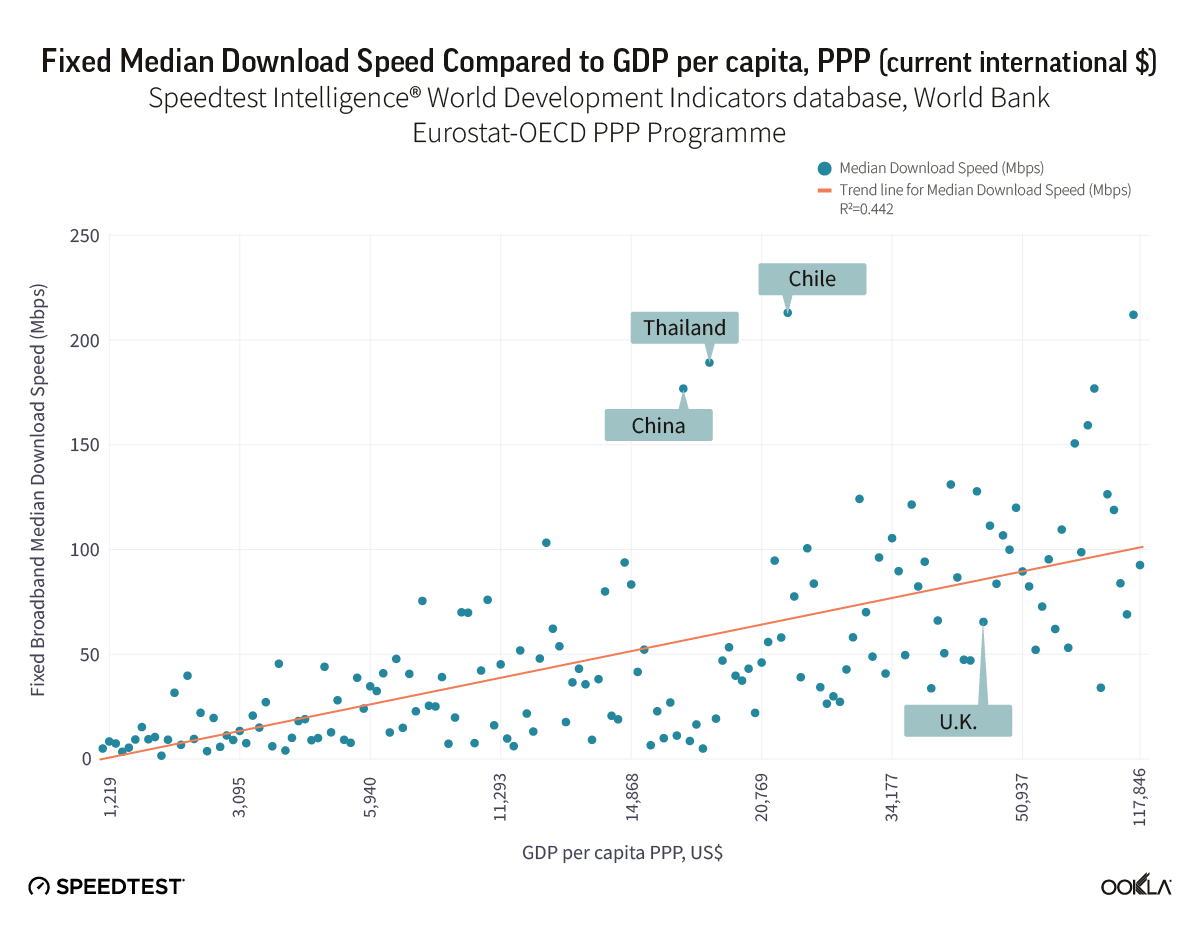
We looked at GDP and PPP in 2021 across 160 markets to see if there’s a correlation between wealth and internet speeds. While the correlation between fixed broadband speed and wealth was weak, many factors can determine a country’s internet performance like consumer demand, market competition, and regulatory stimulus. There are, however, some market exceptions like Chile, China, and Thailand, which outperform their economic peers. We discussed how Thailand’s supportive regulatory environment resulted in an increased fibre adoption in this article from 2021

On the other hand, we would have expected some markets to transition to fibre more swiftly and provide users with faster median download speeds — but haven’t yet done so. The U.K. is one of those markets; according to Speedtest Global Index™ in August 2022, it ranked 55th, with a median fixed broadband download speed of 66.22 Mbps and 18.25 Mbps upload. 
Northern Ireland was the speediest across the U.K.

Speedtest Intelligence® data shows the median fixed broadband download speed across the U.K. was 61.69 Mbps and the median upload speed was 17.63 Mbps in the first half of 2022. Looking at fixed speeds across the four British nations, Northern Ireland ranked first for fastest median download speed at 65.21 Mbps, followed by England (62.40 Mbps), Scotland (57.13 Mbps), and Wales (49.71 Mbps). 
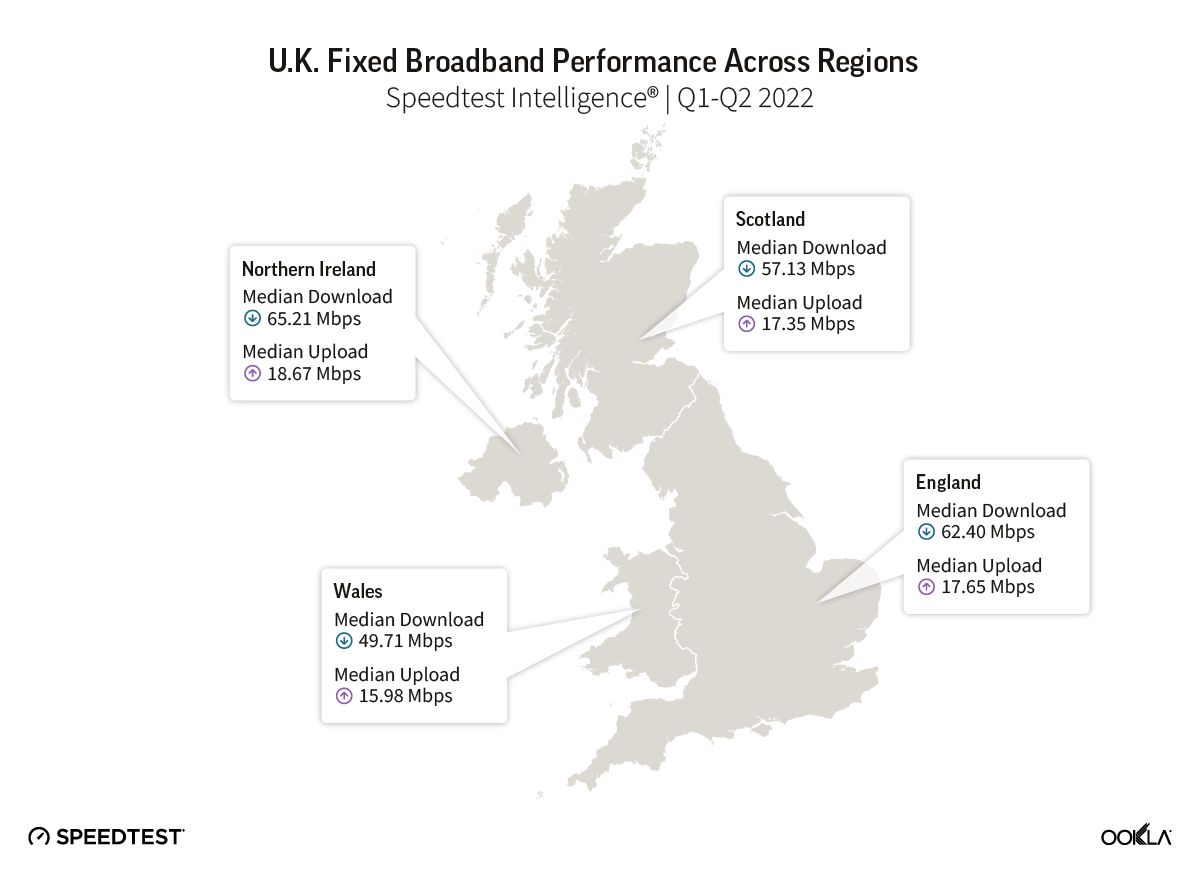
Map of U.K. fixed broadband performance across regions

The number of homes that are gigabit-capable fixed broadband reached 19.3 million (66% of all U.K. homes) in January 2022, up from 13.7 million (47%) in September 2021. Most homes in the U.K. (97%) have access to “superfast broadband connection,” defined as download speeds of at least 30 Mbps. Yet, only a third can order a fibre-to-the-premise (FTTP) service. However, much faster speeds are on the horizon with the government targeting 85% gigabit-capable coverage by 2025, and nationwide fixed broadband speeds of 1 Gbps or better by 2030. 

To help realise this, the British government created the U.K. Gigabit Programme, investing a total of £5 billion, of which at least £1.2 billion will be available by 2025 to provide connectivity for areas currently difficult to reach. This in turn has made the fibre market attractive for investors to provide funding for smaller network providers that want to take advantage of this market opportunity. There are about 100 smaller, alternative providers (AltNets) offer FTTP broadband across the U.K. These AltNets come in various sizes, stages of maturity, and have different business models. With the upcoming changes to regulation, which will allow pension funds to invest into venture capital to back high-growth tech startups, even more funding could be poured into the sector. 

Virgin Media O2 leads for fastest download speed at 116.44 Mbps
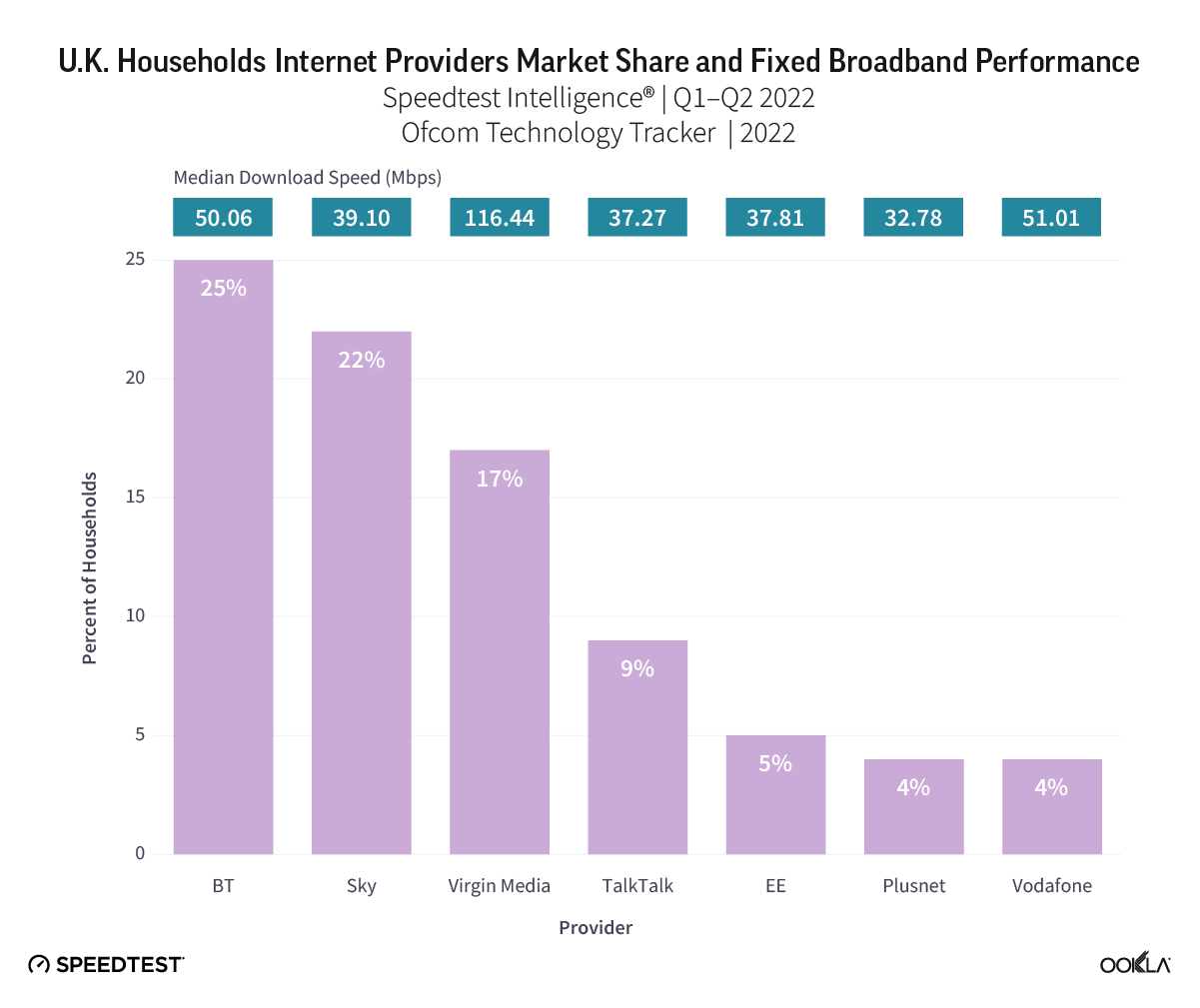
Chart of U.K. household internet providers market share and fixed broadband performance

The U.K. market landscape is dynamic, with around 300 ISPs serving the market, but only a few offering nationwide coverage. The median fixed broadband speed in the U.K. is heavily influenced by the network technology provided by leading providers, which predominantly rely on copper-based network infrastructure supplied by Openreach. BT, Sky, Talk Talk, EE, Plusnet, and Vodafone all use Openreach, which itself is a wholly owned subsidiary of the BT Group but legally separated. Openreach has allocated £12 billion to upgrade its copper network to fibre. In August 2022, Openreach reported that its FTTP network passed over 8 million premises and is on target to provide fibre service to 25 million premises by the end of 2026. 

The U.K.’s fastest broadband provider, Virgin Media O2, announced in December 2021 that it had completed its upgrade of its Hybrid Fibre Coax (HFC) network to a gigabit-capable DOCSIS 3.1 technology. Not to be outdone in the fibre race, the operator is upgrading that network to XGS-PON technology, which it aims to complete by 2028. In its Q2 2022 earning release, Virgin Media O2 stated that Project Lightning, a £3 billion network expansion programme, has been accelerating and “the cumulative Lightning footprint is now 2.9 million, [and] the company is on-track to add over 500,000 Lightning premises in 2022.”

Virgin Media O2’s shareholders, Liberty Global and Telefónica, alongside investment firm, InfraVia Capital Partners, announced a new fibre joint venture with a war chest of £4.5 billion. The initial goal is to roll out fibre to new greenfield areas, expanding to 5 million homes outside of Virgin Media O2’s network by 2026, with the opportunity to expand to an additional 2 million homes by 2027. Virgin Media O2 will be the anchor tenant of the network, but the network will be available to other ISPs on a wholesale basis. 

Alternative players making headway in the wholesale market

Although Openreach and Virgin Media O2 dominate the fibre landscape in terms of homes passed, roll-out plans, and scale of investment, CityFibre has emerged as the largest alternative wholesale fibre network provider. CityFiber recently secured a £4.9 billion debt package that will fund a network covering a third of the U.K. market (8 million homes) by 2025. CityFibre is backed by Goldman Sachs, Antin Infrastructure Partners, Mubadala Investment Company, and Interogo Holding. 

The reason the provider attracts such large-scale capital investment is because its fibre expansion plans are based on a long-term purchasing commitment from multiple wholesale customers, including TalkTalk, Vodafone, Zen, and 30 other ISPs. Thanks to this business model, CityFibre, established in 2011, scaled from a small start up aimed at rescuing failed fibre projects in small U.K. cities, to becoming a network that has just passed 2 million premises

Another wholesale fibre provider, Netomnia, was founded in 2019 by the former CEO of Community Fibre and has ambitious plans to reach 1 million premises by 2023. To date, Netomnia has already passed 210,000 premises and it expects to extend across 48 towns and cities by the end of this year. Along with ISP YouFibre, Netomnia has secured £418 million in funding since 2020: £123 million in funding in November 2021, followed by £295 new funding led by DigitalBridge Investment Management in April 2022. The provider is a registered supplier in the Scottish Broadband Voucher Scheme (SBVS), which subsidises the cost of connecting a rural premise to a fibre network up to £1,500 per household and up to £3,500 for businesses. 

AltNets had the top speeds in London, Glasgow, Liverpool, and Manchester
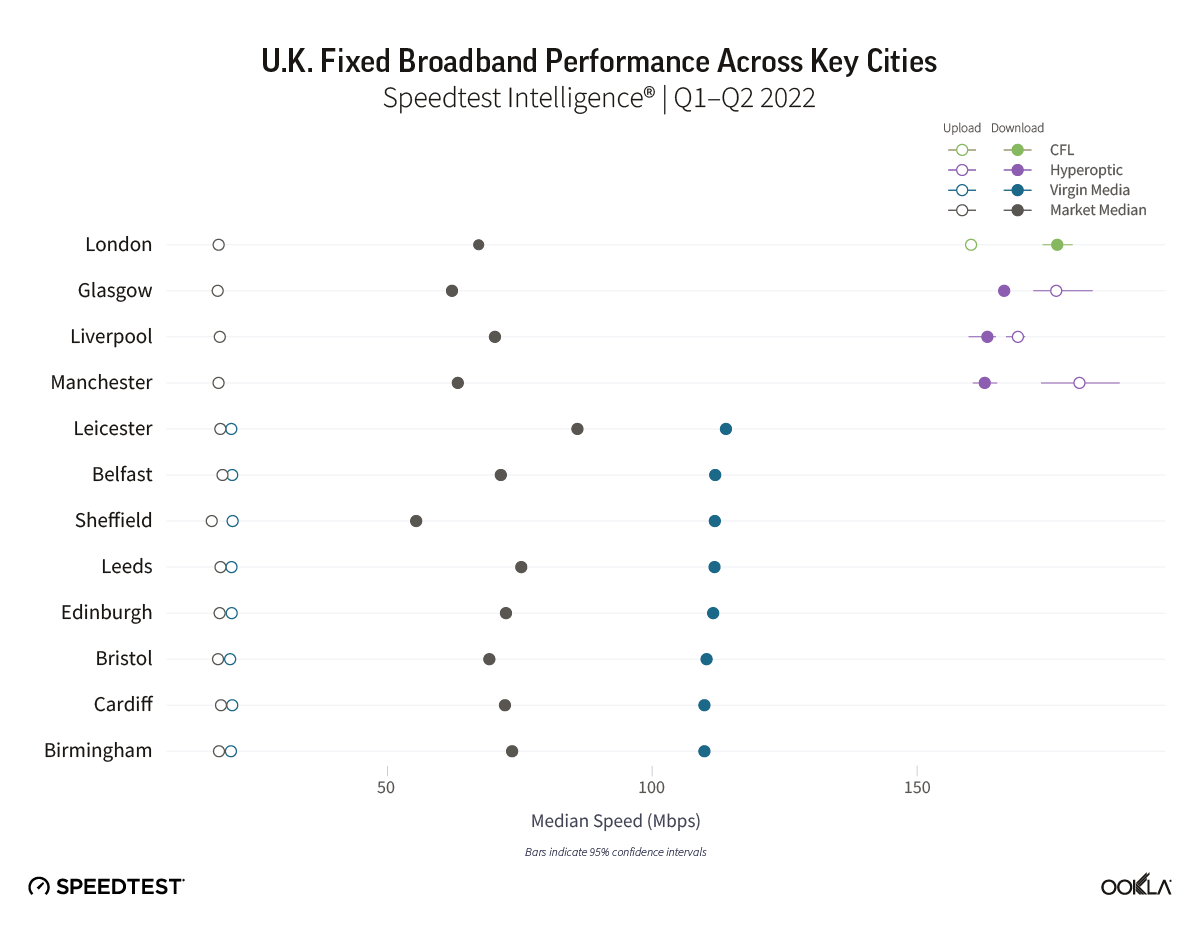
Using Speedtest Intelligence data, we looked at the median fixed broadband speeds across key British cities during Q1-Q2 2022. Virgin Media O2 led for speed in eight of the 12 cities we looked at. 

However, in three cities – Glasgow, Liverpool, and Manchester – Hyperoptic had the fastest fixed broadband speeds, achieving download and upload speeds in excess of 150 Mbps during Q1-Q2 2022. 

Hyperoptic, which is backed by private equity house KKR, currently reaches 1 million homes and is planning to exceed 2 million by the end of the year. The ISP committed to invest £200 million in 2022 to expand its network by laying more than 1,500 kilometres of fibre to connect an additional 400,000 homes and businesses. Hyperopitc’s strategy is to deploy and operate an FTTP network in buildings and areas with high customer acquisition potential, targeting areas with high density and connecting existing homes and new multi-dwelling buildings. Hyperoptic has a particularly strong position in social housing and works with social housing providers and councils to provide some residents with free or reduced priced fibre broadband. Hyperoptic also targets new building developments as these properties will soon have to be connected per proposed changes in the Building Regulation 2010. Hyperoptic also has partnerships with over 250 developers across the country, providing them an opportunity to deliver service to new homes as they’re built. The provider also has working relationships with 16 of the 20 largest building development companies, including Barratt Developments. 

AltNets and their various business models
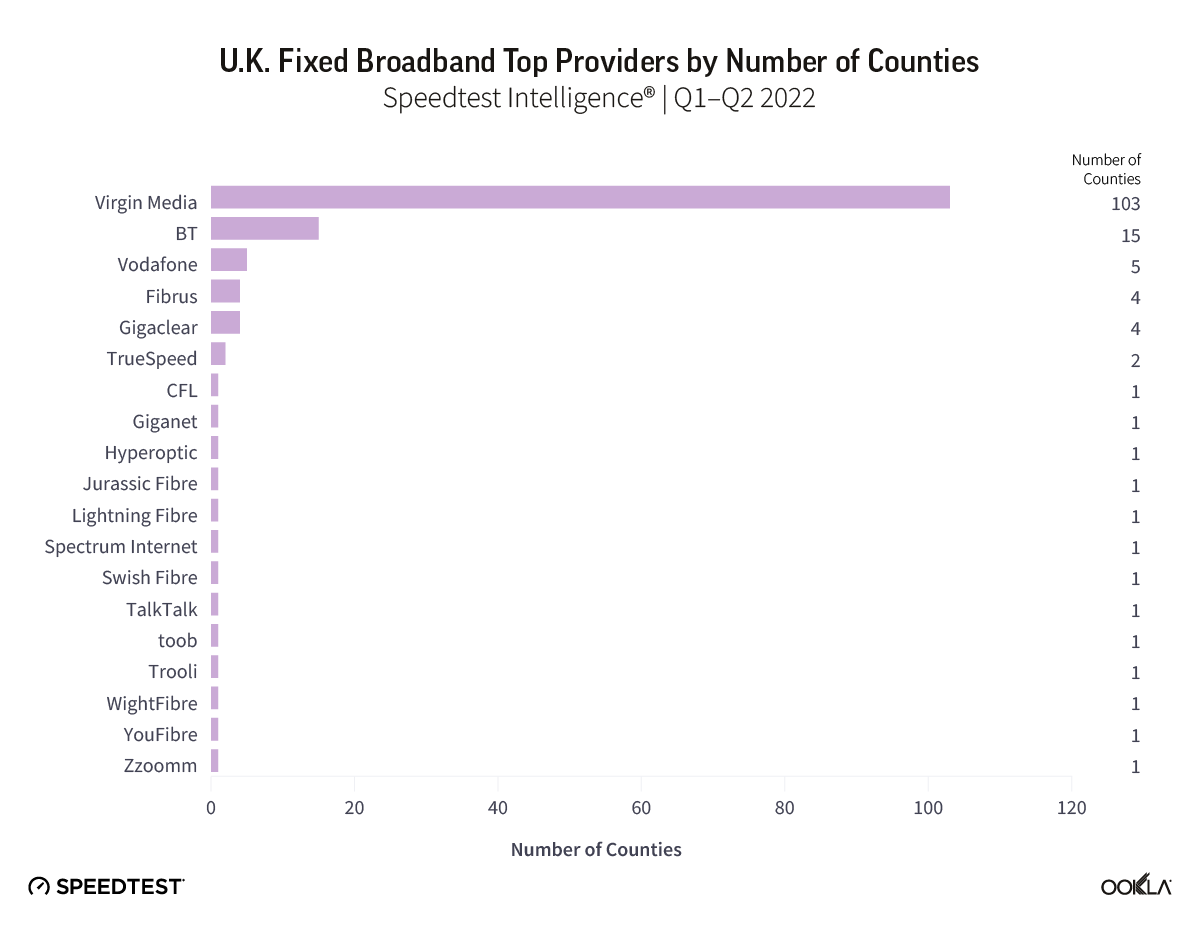
Chart of U.K. fixed broadband top providers by number of counties

Across the 146 British counties we looked at, Speedtest Intelligence data shows that Virgin Media O2 had the fastest median download speeds in a whopping 71% of those counties. BT ranked a distant second, posting the top speeds in about 10% of counties, while Vodafone led in five counties. Fibrus and Gigaclear registered the top speeds in four counties each, with TrueSpeed leading in two counties. Various other providers led in one county. 

Vodafone is CityFibre’s anchor customer nationwide, and the two providers have a strategic partnership. In November 2021, Vodafone expanded on the partnership, increasing its long-term volume commitment from 12 to 285 cities, towns, and villages across 8 million homes CityFibre is targeting. Vodafone initially signed a partnership with CityFibre in November 2017, which allowed it to offer fibre to Vodafone’s customers starting in Milton Keynes. In fact, Vodafone was the fastest provider in Milton Keynes, offering a median download speed of 159.64 Mbps, along with a median upload speed of 125.24 Mbps. 

Fibrus had the fastest median download speed in four counties in Northern Ireland. Fibrus was selected to deliver Project Stratum, under which Fibrus will receive £165 million to bring full fibre connectivity to 76,000 premises across Northern Ireland. An additional £32 million was awarded to bring another 8,500 harder to reach premises into the project’s scope. By the end of 2021, Fibrus passed over 100,000 premises with Project Stratum accounting for 20% of these connections. The rapid growth, network expansion, and customer acquisition resulted in an operating loss of £15.5 million for Fibrus, and £92 million invested into network build. Fibrus secured £220 million from a consortium of banks consisting of NatWest, ABN Amro, ING, Sabadell, LBBW, and the U.K. Infrastructure Bank to fund its roll out.

The vast amount of public funding facilitated the emergence of fibre ISPs focusing on rural areas where fibre deployment is not commercially viable. For instance, Fibrus was chosen to deliver fibre in Northern Ireland, where Project Stratum funds fibre broadband deployments in rural communities. 

Gigaclear had the fastest download speed in four counties: Buckinghamshire, Northamptonshire, Oxfordshire, and Rutland. Gigaclear passed 300,000 premises across 22 English counties in May, 60% of its target of 500,000 premises by the end of 2023. The provider secured £525 million worth of debt financing in 2020 with Lloyds, NatWest, Santander, and ABN AMRO, and in 2021, received a £190 million investment boost partially co-financed by the new U.K. Infrastructure bank. It has been reported that Gigaclear is working with Rothschild bankers to raise £200-300 million of additional capital to fund its network deployment. In some communities, the provider holds contracts with local authorities to build fibre networks through the Building Digital U.K. (BDUK) programme. In these communities, Gigaclear invested £9 of its capital for every £1 of subsidy it received.

Giganet, which was the fastest in Portsmouth, was the single-fastest provider at the county-level at 305 Mbps, about three times faster than England’s national average. The provider focuses on underserved rural areas, including some connected premises that are part of the BDUK programme.

WightFibre operates only in the Isle of Wight, and it aims to create the U.K.’s first “Gigabit Island.” The company has completed the migration of legacy cable network customers to a new full fibre network in 2021, and it switched off its copper network in August 2022. WightFibre’s fibre network is available to over 40,000 premises, with a target of 60,000 premises by end of 2022; 75,000 by 2024; and ultimately covering 96% of the island’s premises (80,000). 

Broadband for the Rural North (B4RN) is a registered Community Benefits society. It is building a fibre network in isolated or socially deprived rural communities and also helping similar community-driven network deployments in other areas. The community is directly involved in bringing the network to residents and those in surrounding premises, installing it and passing on the skills to the next community. The fibre network was initially deployed in the rural northwest of England and has gradually expanded from there. Any profits were reinvested, with 5% of profits being paid to members. BR4N was the fastest provider in Cumbria with a median download speed of 113.74 Mbps and 127.98 Mbps upload. 

Although Voneus does not have the fastest download speed in any county, its business model is worth noting. Voneus begins by rolling out its Fixed Wireless Access (FWA) solution, which has relatively low Capex and Opex, bringing communities quickly online, and then deploys FTTP. This allows the company to mitigate the risk associated with higher costs of fibre delivery in three ways:

  1. Thanks to FWA Voneus already has an established base of customers that recognise the benefits of faster broadband.
  2. Voneus takes advantage of the rural gigabit voucher scheme, securing a cost contribution toward every home connected.
  3. This reduces cost and build time. Voneus has code power and PIA accreditation that allows it to utilise existing pole and duct infrastructure.

Over £30 billion investment into fibre 

According to the Independent Networks Cooperative Association (INCA) report, alternative providers connected over 1 million FTTP premises, having passed 5.5 million premises with fibre at the end of 2021. Virgin Media O2 passed 16.8 million households with its gigabit-capable (but not yet FTTP) network, while Openreach reported 8 million premises within reach of its fibre network. Looking ahead, the report predicts that alternative providers will pass 30 million premises by 2025. It also notes that Virgin Media O2 plans to extend its network to 22 million premises, and Openreach has a target of 26 million by 2026. All of these ambitious plans exceed 31 million premises in the U.K. This means there will be some level of overbuild, especially in more densely populated areas. To deploy fibre networks, AltNets will spend £12 billion on fibre networks, in addition to £12 billion announced by BT Group, £2 billion planned by Virgin Media O2, and £5 billion coming from the government. 

Challenges are few, labour force shortage is the most pressing 

Translating the fibre investment into ROI will remain a challenge, particularly for some smaller, regional players, while increasing interest rates will put pressure on others. Industry consolidation is already in place with CityFiber buying Fiber Nation, Swish Fiber acquiring People’s Fiber, and Community Fiber buying Box Broadband. There is even more on the horizon, as fibre roll out requires significant capital investment and most players, apart from Hyperoptic, aren’t turning a profit. 

Another challenge is the consumer take-up, meaning the proportion of subscriptions and homes passed. This is most efficiently done in areas that are greenfield, but where customer acquisition can be tricky. Hyperoptic recently introduced its Switch Now campaign, offering free broadband for up to nine months if a customer switches providers to Hyperoptic. 

BT reported it has 26% take-up equivalent to 1.3 million FTTP customers, while CityFibre reported that in Milton Keynes, fibre take-up of 25% with other locations growing on a similar trajectory. 

Access to sufficient physical and human resources to upgrade to full fibre is another challenge. To alleviate these hurdles, the U.K. government proposed that it could fast-track entry for thousands of foreign workers to help with the roll-out of gigabit broadband. We will continue to follow the fibre race in the U.K. and we will monitor what impact it will have on fixed broadband speeds. If you’d like to learn more about internet speeds and performance in other markets around the world, visit the Speedtest Global Index.

Ookla retains ownership of this article including all of the intellectual property rights, data, content graphs and analysis. This article may not be quoted, reproduced, distributed or published for any commercial purpose without prior consent. Members of the press and others using the findings in this article for non-commercial purposes are welcome to publicly share and link to report information with attribution to Ookla.


| September 19, 2022

MTN Performed Best Among Operator Groups in Sub-Saharan Africa

This article explores mobile performance in select countries across Sub-Saharan Africa (SSA). We examine how four operator groups – Airtel, Orange, MTN, and Vodacom – mobile performance compared against each other during Q2 2022 across ten countries. In our previous analysis of the state of the 5G networks South Africa Spearheads 5G in Africa, but the Road is Long and Windy for Others we analyzed mobile performance on modern chipsets during 2021 (full year) across the African continent. We concluded that these are still early days for 5G across the region as challenges remain around affordability and infrastructure. In this article we focus our analysis on these four operator groups which command the majority (62%) of the SSA subscriptions. We also compare mobile performance on modern chipsets across ten countries. Those ten countries account for 59% of the region’s connections, including:

  • East Africa: Kenya, Rwanda, Tanzania, and Uganda; 
  • Southern Africa: Democratic Republic of Congo, South Africa, and Botswana; 
  • West Africa: Côte d’Ivoire, Guinea, and Nigeria.

Key messages:

  • Speedtest Intelligence® data shows that MTN South Africa delivered the fastest median download speeds across analyzed operators, at 65.95 Mbps in Q2 2022. However, Vodacom in Johannesburg was the fastest operator considering speeds across top cities, reaching 81.36 Mbps median download speed in Q2 2022. In South Africa, MTN outperformed Vodacom in terms of median mobile speeds during Q2 2022. 
  • Comparing Airtel and MTN performance across the three countries they operate in, Airtel took the top spot in Nigeria, both in terms of median download and upload speed in Q2 2022, while in Uganda and Rwanda there were no winners. Such was the case in Botswana too, where there was no winner between Mascom and Orange.
  • In Côte d’Ivoire, MTN took the market lead versus Orange in Q2 2022, whereas in Guinea, the situation was reversed and Orange took the top spot. 
  • Vodacom subsidiary Safaricom won the accolade in Kenya vis a vis Airtel, in Tanzania there was no clear winner as Vodacom won the download speed and Airtel the upload. 
  • In the DRC, which is host to three of the operator groups, there was no winner overall, although Orange was the top player in terms of download speeds.
  • During Q2 2022, South African network performance has been affected by load shedding, which resulted in consumer reporting not having signal and access to mobile internet according to Downdetector®

MTN South Africa delivered the fastest median download speed in Q2 2022

Chart of mobile performance among operators across African markets

Using Speedtest Intelligence® data we compared mobile performance in Q2 2022 on modern chipsets across 21 operators. Our results show that median download speeds ranged between 2.89 Mbps (MTN Guinea) and 65.95 Mbps (MTN South Africa). Median upload speeds varied between 1.55 Mbps (MTN Guinea) and 14.84 Mbps (Airtel Uganda).

We can clearly see the impact that 5G has on overall performance as South African operators came first thanks to having 5G networks in place. MTN South Africa was well ahead of the rest of operators, despite facing challenges with load shedding, with median download speed of 65.95 Mbps, followed by Vodacom South Africa with a median download speed of 48.70 Mbps. If we take 5G out of the equation, Safaricom Kenya was the fastest operator among the analyzed operators. 

Vodafone in Johannesburg stole the show

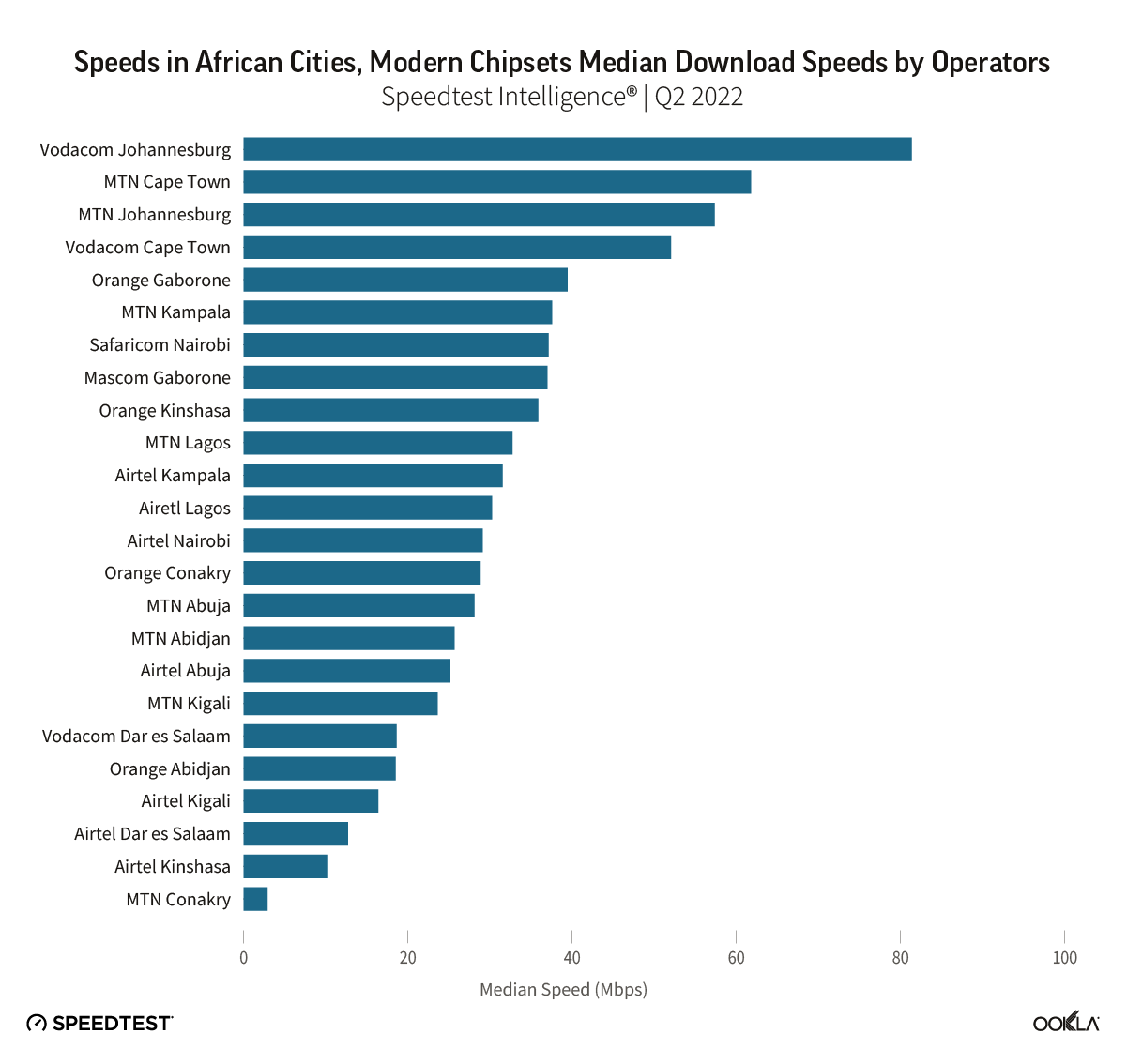
When it comes to mobile speeds in capital cities, it is not surprising that cities that have 5G networks came top of the list. As such, Johannesburg led the pack, with a median download speed of 66.54 Mbps, ahead of Cape Town at 49.22 Mbps. Vodacom got ahead of MTN in Johannesburg and was the fastest operator across 12 cities we analyzed, with a median download speed of 81.36 Mbps in Q2 2022 compared to 73.83 Mbps in Q1 2022. MTN was faster in Cape Town. Taking 5G out of the equation, Orange in Gaborone, the capital city of Botswana, achieved median download speeds of 39.46 Mbps.

Chart of median download speeds of African cities by operator

MTN got ahead of Orange, Airtel, and Vodacom 

Using Speedtest Intelligence data for Q2 2022, we compared mobile performance on modern chipsets and 4G Availability in the countries where Airtel, Orange, Vodacom, and MTN operate.

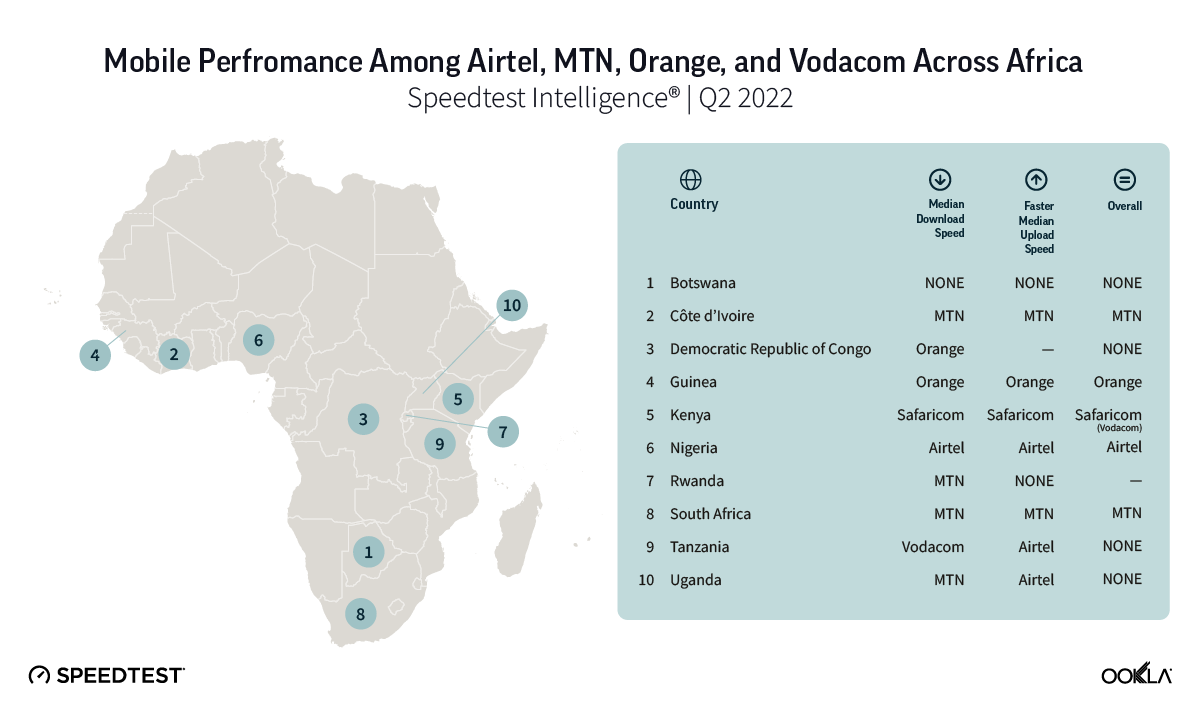
MTN outperformed Orange in Côte d’Ivoire and Vodacom in South Africa, both in terms of median download and upload speeds. While MTN had better download speed in the Democratic Republic of Congo, in Rwanda MTN performed better than Airtel with regards to median download speed. Orange took the top spot in Guinea, Airtel in Nigeria, and Safaricom in Kenya. In the rest of the countries, the difference in mobile performance was either not statistically significant or there was not a single operator that delivered better performance across both upstream and downstream.

Map of mobile performance among Airtel, MTN, Orange, and Vodacom across Africa

We have included a more detailed analysis below.

Airtel versus MTN

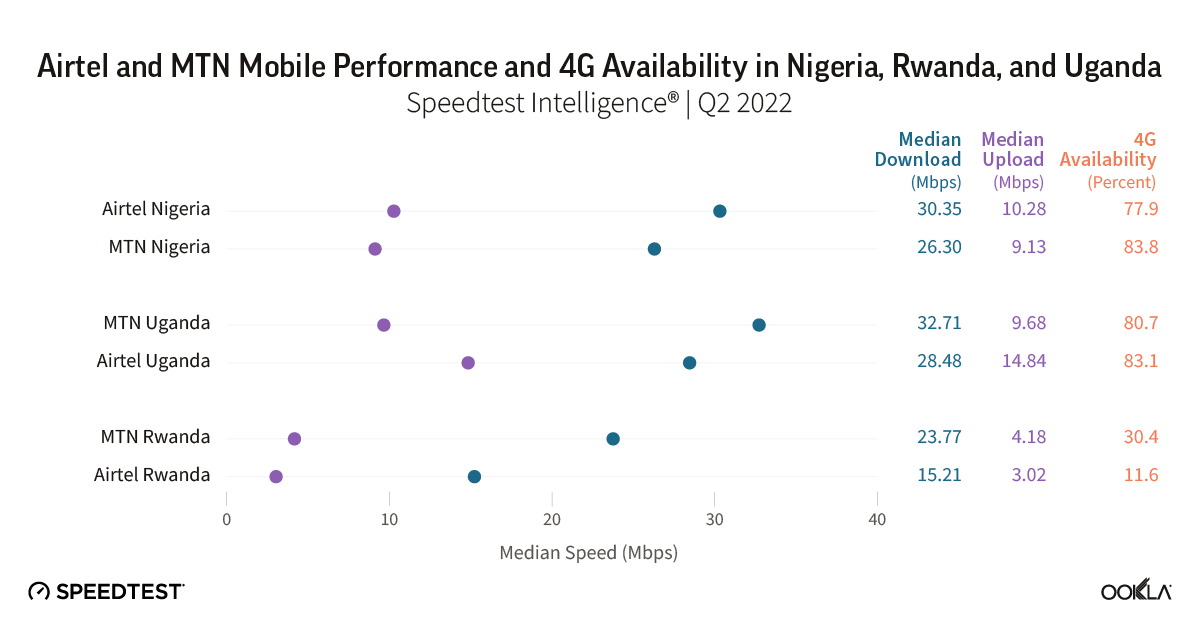
Chart of Airtel and MTN mobile performance and 4G availability in Nigeria, Rwanda, and Uganda

Nigeria: Airtel took the top spot in terms of speed, MTN had better 4G Availability.

  • As of Q2 2022, MTN Nigeria commanded 38.9% of Nigeria’s mobile users, with its 74.1 million subscribers almost double that of Airtel’s 46.0 million. 
  • Yet when it comes to mobile performance, Airtel Nigeria was ahead of MTN; in Q2 2022, Airtel Nigeria recorded a median download speed of 30.35 Mbps and a median upload speed of 10.28 Mbps, both of which topped those of MTN (26.30 Mbps download and 9.13 Mbps upload). 
  • Those speeds are set to increase as both companies have invested heavily into network infrastructure, with a combined investment of N208.5 billion ($502 million). The investment translates into an increase in 4G Availability as well. In Q2 2022, MTN had 83.8% 4G Availability compared to Airtel’s 77.9%. 

Uganda: MTN ahead in download speed, Airtel had better upload.

  • MTN’s 53.9% market share in Uganda translates to 16.3 million subscribers as of Q2 2022. Meanwhile, Airtel Uganda had a 45.1% market share (13.6 million). 
  • In Q2 2022, MTN Uganda was ahead of Airtel in terms of median download speeds, while Airtel had at least a 33% better median upload speed. 
  • In its recent annual report, Airtel announced that its 4G network was available to 90% of the population of Uganda, effectively providing coverage to the entire country. To aid its capacity, Airtel Uganda is also rolling out fiber, which helps to boost data throughput. For example, in the capital – Kampala – 79% of sites are connected through fiber. In terms of 4G Availability, MTN and Airtel came closely together at  83.1% and 80.7%, respectively.

Rwanda: MTN took the top spot for median download and 4G Availability 

  • MTN Rwanda increased its customer base by 1.7% year-on-year (YoY) to 6.6 million as of Q2 2022, expanding its lead in customer market share by 2.7 pp to 65.6%, Airtel controlled the remainder of the market. 
  • MTN Rwanda performed better than Airtel when it comes to median download speed: MTN had a 33% better median download speed.
  • MTN Rwanda also had the best 4G Availability order to further increase smartphone penetration in the market and stimulate demand for data services, in June 2022, MTN Rwanda and Bank of Kigali (BK Group) signed an agreement to introduce device financing. This program will enable customers to spread over the cost of smartphones over an extended period of time.

MTN versus Orange

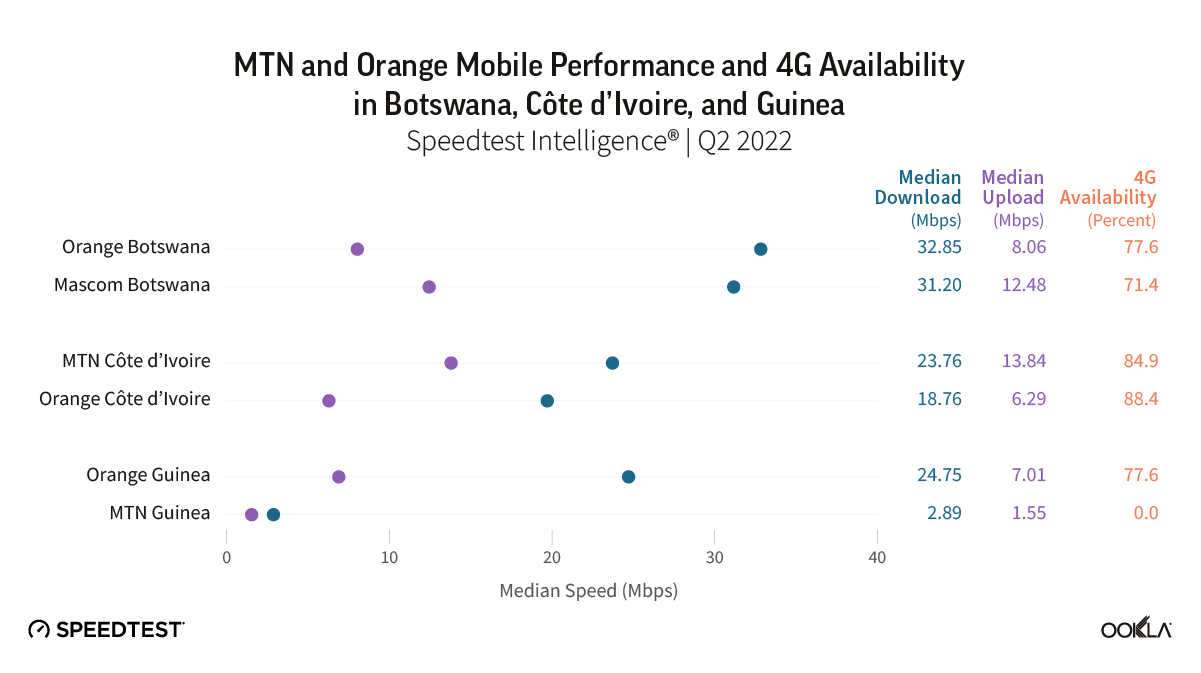
Chart comparing 4G availability in Botswana, Cote d'Ivoire, and Guinea

Botswana: Mascom and Orange performed similarly. 

  • Mascom (MTN) is the largest operator in Botswana, with 1.8 million subscribers in Q2 2022 and a 42.2% market share. Orange is the second largest operator, ending Q2 2022 with 1.7 million subscribers and 41.2% market share.
  • Comparing the operators’ performance, the difference in terms of both median download and upload speeds as well as 4G Availability was not statistically significant and there is no winner.  

Côte d’Ivoire: MTN stole the show in terms of performance. 

  • MTN had 38.9% subscriber market share in Côte d’Ivoire as of Q2 2022, which equates to 15.8 million subscribers, Orange ended Q2 2022 with 14.6 million subscribers (36.0% market share). 
  • MTN had faster median download and upload speeds compared to that of Orange, and the gap might widen even more going forward. In December 2021, MTN Côte d’Ivoire started 5G trials at nine locations in Abidjan. This was followed by the Ivoirian government adopting a roadmap for the launch of 5G technology in February this year, with 5G networks expected to go live by 2023. 

Guinea: Orange commands the Guinean market. 

  • Market leader, Orange, which switched on its 4G network in 2019, accounted for 60% of mobile connections in Q2 2022 in Guinea, ahead of MTN (30.8%). According to telecom regulator ARPT, in Q4 2021, Orange held a 69.9% market share of mobile Internet traffic, while MTN held 26.9%. 
  • Orange was far ahead in terms of performance during Q2 2022. Part of the reason being that Orange is currently the sole provider of 4G services in the country, with MTN awarded a 4G operating license in February 2022 but it has not launched the services yet.

Vodacom versus Airtel

Chart of Vodacom and Airtel mobile performance and 4G availability in Kenya and Tanzania

Kenya: Safaricom won across all metrics. 

  • Safaricom is the largest operator in Kenya by a mile, with 67.1% market share (equivalent to 42.7 million connections) ahead of Airtel 25.9% (16.4 million).
  • Safaricom also exhibited better network performance during Q2 2022, with a median download speed of 36.25 Mbps and upload of 13.83 Mbps, compared to Airtel (28.58 Mbps download speed and 8.44 Mbps upload). 
  • Safaricom has signed a multi-year contract with satellite provider Intelsat to modernize its network and expand LTE coverage. Safricom is focusing more on 4G rather than pursuing 5G as the cost of 5G handsets is prohibitive and slowing down its 5G expansion. In a bid to increase smartphone usage on its network, Safaricom partnered with Google to allow its customers to pay for 4G-enabled phones in installments. Customers pay as little as KES 20 ($0.34) per day over a nine-month period. The operator’s ultimate target is to upgrade about four million 2G and 3G phones to 4G. Safaricom had also partnered with Vivo to sell 4G phones. 
  • Meanwhile, Safaricom’s top competitor in Kenya, Airtel Kenya, paid $5 million as part of an agreement with the regulator to acquire and operate spectrum from 2015 through 2025. The operator has a remaining balance of $10 million to settle over the next three years, with a cumulative payout of $20 million. 

Tanzania: Vodacom did better on download speeds. 

  • Tanzania’s mobile market is served by seven mobile operators, making it one of the most competitive markets in Sub-Saharan Africa. Vodacom ended June 2022 with 15.6 million subscribers, which translated into a 28.8% market share, GSMA Intelligence estimates that Airtel held a 27.4% market share in Q2 2022, equivalent to 14.8 million subscriptions.  
  • Vodacom’s median download speeds were ahead of Airtel’s  – 17.08 Mbps versus 12.89 Mbps. Vodacom’s 4G Availability also topped Airtel’s at 87.1%, compared to 77.7%. To further increase its network reach, in May 2022, Vodacom Tanzania signed a deal with the National ICT Broadband Backbone (NICTBB), a national fiber optic cable network. This will allow Vodacom to increase rural connectivity after an initial investment of €5.82 million ($6.22 million) in October 2021. Furthermore, in September 2022, Vodacom launched 5G mobile service in Dar es Salaam with a target to expand to approximately 230 locations in other cities. In time, as more users migrate to 5G smartphones and tariffs this will lead to Vodacom improving its speeds further. 

Orange versus Vodacom versus Airtel

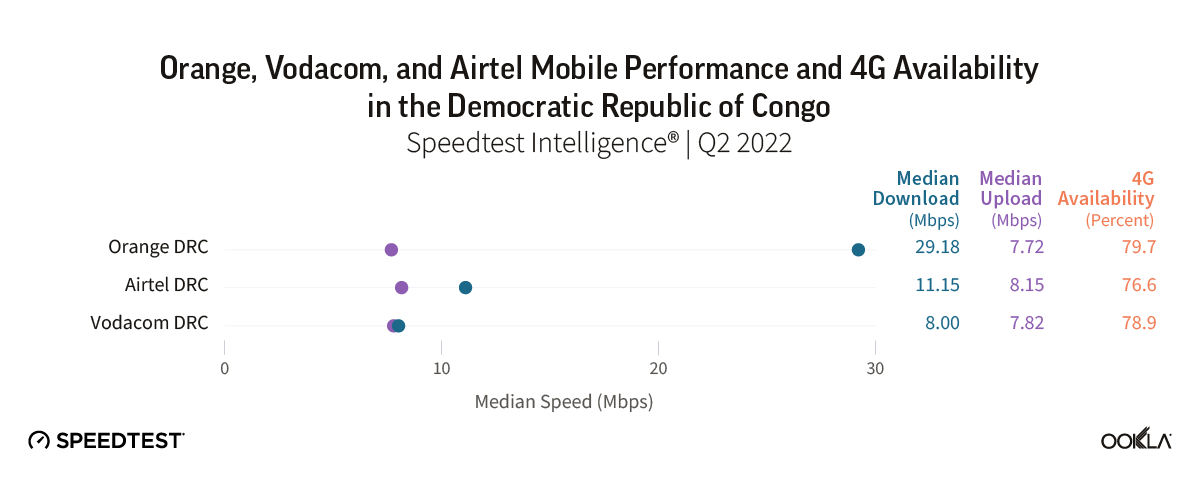
Chart of Vodacom, Orange, and Airtel mobile performance and 4G availability in Democratic Republic of Congo

Democratic Republic of Congo: Orange was the top player in terms of download speeds

  • The Democratic Republic of Congo is the third largest country by population across the SSA and largest by area. It hosts seven mobile operators, including three of the four groups we analyze — Vodacom, MTN, Orange, and Airtel. 
  • In Q2 2022, Vodacom was the largest operator by number of connections with market share of 35.3% and 16.0 million connections, followed by Airtel (12.8 million) and Orange (12.2 million). 
  • Comparing operators’ mobile performance, Orange led in terms of median download speed (29.18  Mbps), ahead of Airtel (11.15 Mbps) and Vodacom (8.00 Mbps). Operators came head to head with regards to 4G Availability. 

MTN versus Vodacom

Chart of MTN and Vodacom performance and 4G availability in South Africa

South Africa: MTN outperformed Vodacom in terms of mobile speeds. 

  • Vodacom ended June 2022 with 45.1 million subscriptions equivalent to a 41% market share. MTN is the second largest player with 35.3 million connections, and had a net addition of almost 837,000 in the quarter. MTN noted in their results that: “The overall growth in the base was particularly encouraging given the significant ramp-up in load shedding, which impacts systems and typically constrains new customer acquisitions.” 
  • The South African market might see a consolidation if the proposed acquisition of Telkom by MTN gets the green light. This will change the market dynamics as MTN will become the number one player by number of connections.
  • In terms of mobile performance, MTN had better median download and upload speeds, while Vodacom led on 4G Availability. We have commented on the state of the 5G market in South Africa in our recent article

Mobile networks don’t exist in a vacuum 

It is important to note that mobile performance is impacted by a number of factors, including underlying infrastructure such as access to fiber backhaul and reliable power supply, spectrum availability as well as end-user devices to name a few. Case in point is the fact that, despite being the regional leaders when it comes to mobile performance, South African operators faced issues related to infrastructure reliability and availability over the past three months. Operating conditions in South Africa were affected by increased incidents of rolling power outages (load shedding) and there are no signs of respite. 

We have seen these outages reflected in Downdetector® data, which is the world’s most popular platform for user-reported service status information. During Q2 2022 users reported 46,810 incidents for Vodacom and 34,882 problems for MTN. There were two top issues reported: no signal and no mobile internet: lack of signal accounted for the majority (46%) of Vodacom’s reported outages, followed by inability to access mobile internet (36%). This has been reversed for MTN — majority of issues were related to mobile internet (43%), followed by no signal (40%). Noteworthy is the fact that there were reports of total blackouts: 7% for Vodacom and 5% for MTN.  

Chart of top indicators percent distribution for Vodacom and MTN in South Africa

Vodacom commented in its results call for the quarter ended on June 30, 2022 that they already spent ZAR 1.7 billion ($99.9 million) on batteries and generators to offset the impact of load shedding with further ZAR 500 million ($29.4 million) allocated to battery purchases. Vodacom also continues to optimize site utilization by using IoT.nxt technology to reduce the amount of energy consumption per site but also piloting wind power and solar projects. While its competitor, MTN, stated in its interim results report that it “rolled out a  comprehensive network resilience plan including additional batteries, generators and enhanced security features.” 

We will continue to monitor mobile networks performance across Africa, looking at how various factors affect it. If you are interested in benchmarking your performance or if you’d like to learn more about internet speeds and performance in other markets around the world visit the Speedtest Global Index™.

Ookla retains ownership of this article including all of the intellectual property rights, data, content graphs and analysis. This article may not be quoted, reproduced, distributed or published for any commercial purpose without prior consent. Members of the press and others using the findings in this article for non-commercial purposes are welcome to publicly share and link to report information with attribution to Ookla.

| September 6, 2022

South Africa Fixed Broadband Speeds Up as Fiber Takes Off

We recently examined the state of the 5G performance in South Africa, and we now turn our attention to the fixed broadband side. In July 2022, our Speedtest Global Index® ranked South Africa in 95th place, with a median download speed of 35.90 Mbps and a median upload speed of 29.56 Mbps. South Africa has come a long way in the past four years in terms of fixed network performance. In July 2019, for instance, South Africa ranked 112th with fixed median download and upload speeds of 9.95 Mbps and 5.56 Mbps, respectively.

Key messages:

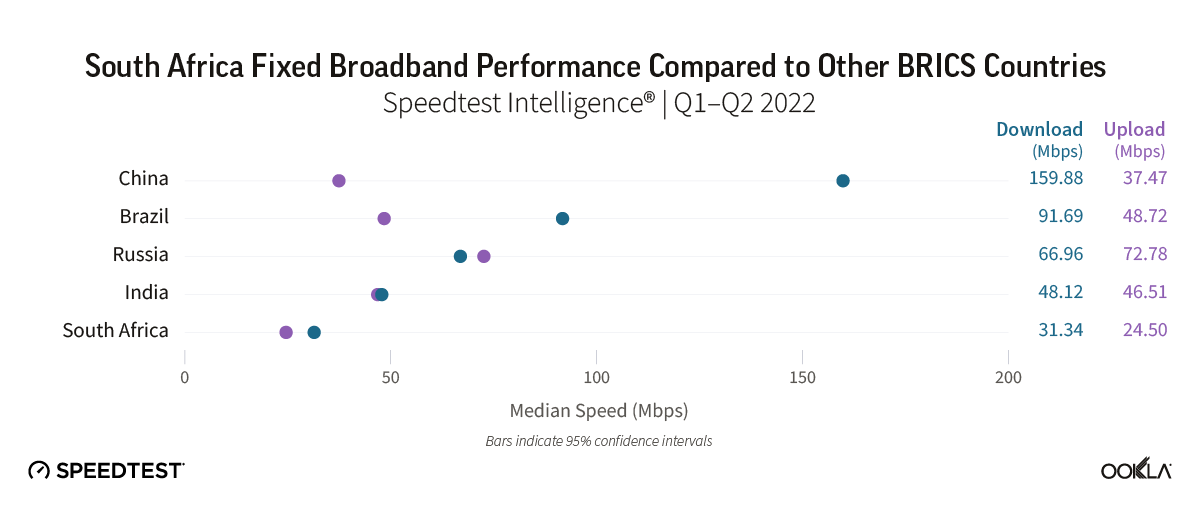
  • Speedtest Intelligence® data shows that fixed broadband speeds in South Africa have doubled over the past three years – from 15.11 Mbps median download speed in Q1-Q2 2020 to 31.34 Mbps in Q1-Q2 2022, benefiting from increased competition and growth in Fiber to the Home subscriptions. 
  • South Africa still has a long way to go to catch up with other BRICS countries, Brazil, Russia, India, and China. Telecom regulator, ICASA, could consider setting a minimum broadband speed to stimulate market adoption outside of urban areas, which are currently underserved. 
  • With only 10% of households connected to broadband, there is substantial room for growth, and operators are looking to extend fiber beyond affluent areas. Furthermore, there is a growing number of mergers and acquisitions in the market. South Africa is home to a complex fiber market with alternative ISPs competing for market share using open fiber networks deployed by Telkom’s wholesale division, Openserve, and alternative FNOs such as Vumatel. 
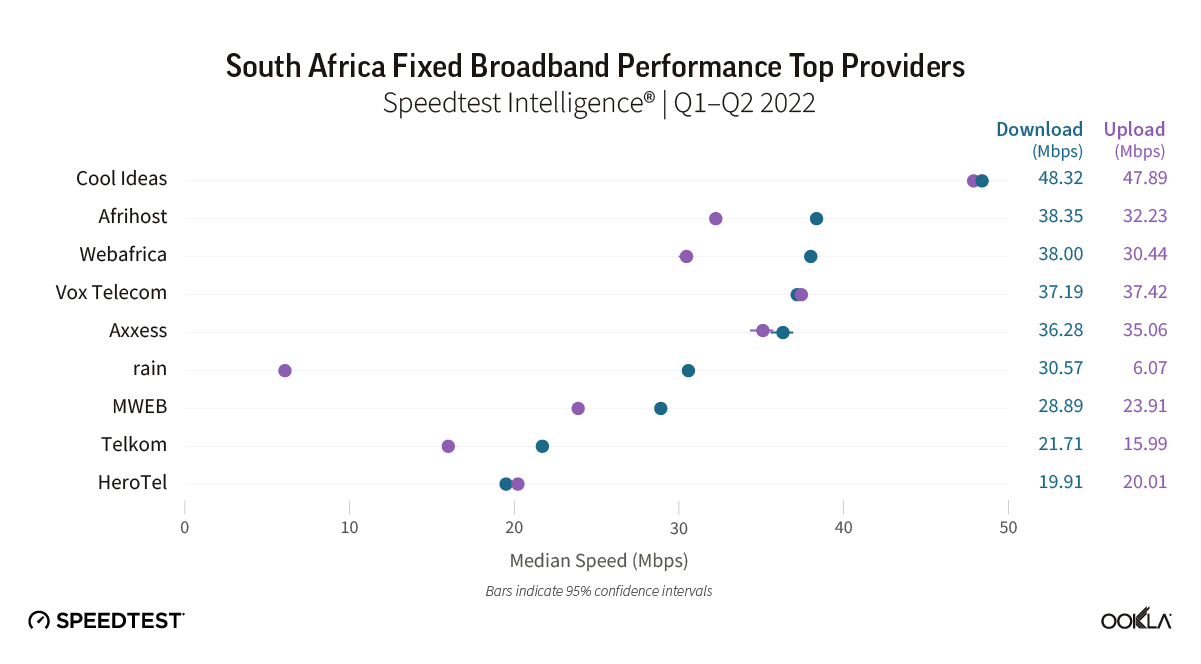
  • Cool Ideas took the lead in 1H 2022 with a 48.32 Mbps median upload speed and 47.89 Mbps download speed, but its market lead could be soon challenged as many operators are already offering speeds in excess of 30 Mbps.
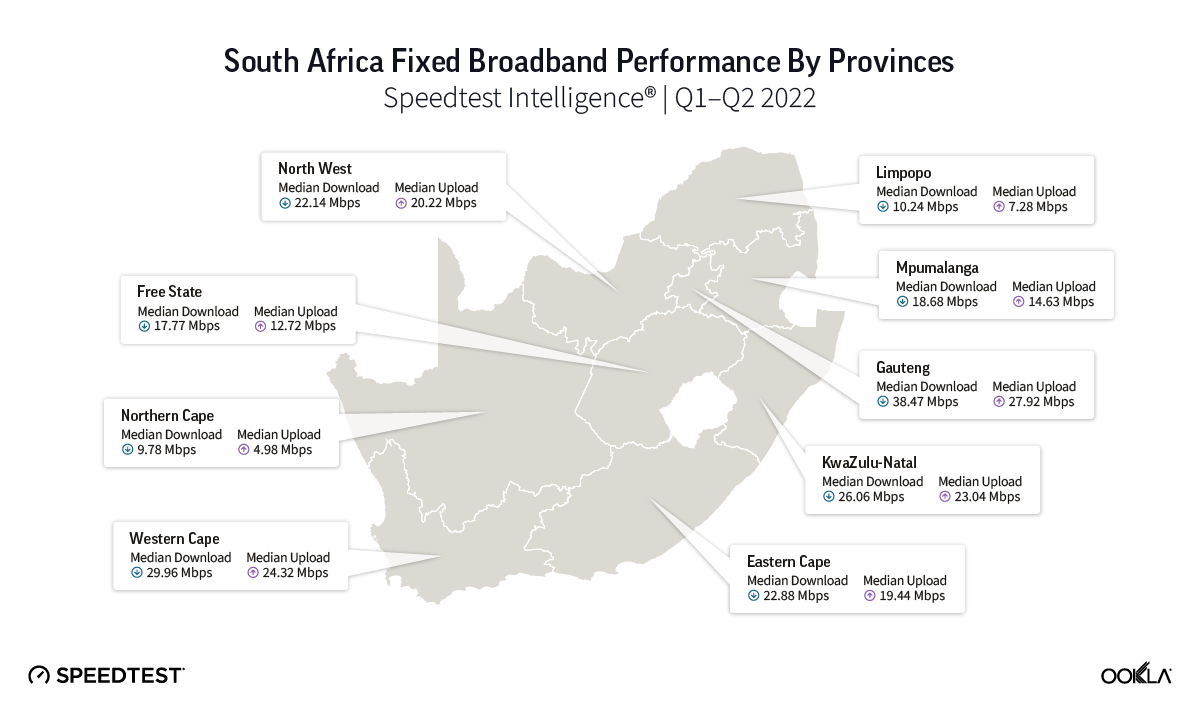
  • Gauteng, home to the country’s largest city, Johannesburg, had the best median fixed broadband download speeds of 38.47 Mbps and 27.92 Mbps upload speeds. South African capital city, Johannesburg, was the fastest of the five cities we analyzed.

South African median fixed speeds doubled in the past three years, thanks to fiber growth 

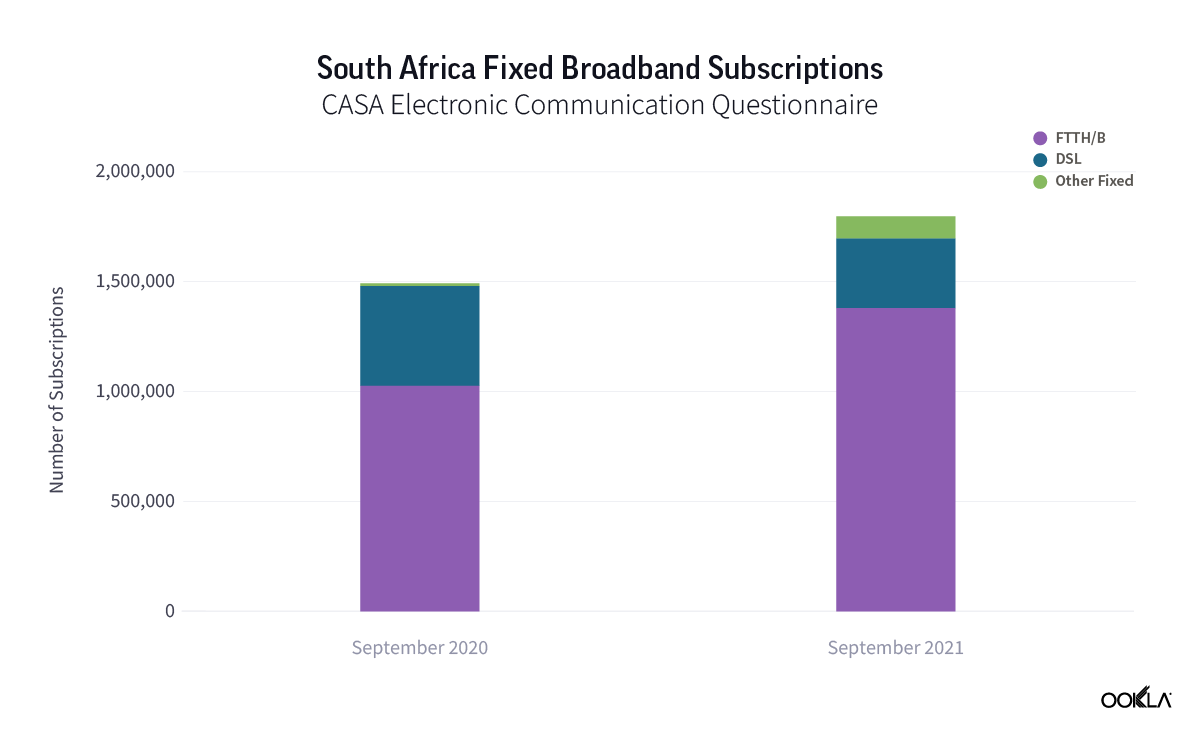
Speedtest Intelligence® data shows that fixed broadband speeds in South Africa have more than doubled over the past three years — moving from 15.11 Mbps median download speed in Q1-Q2 2020 to 31.34 Mbps in Q1-Q2 2022; for upload speed, the increase has been more pronounced, improving from a median upload speed of 8.85 Mbps in Q1-Q2 2020 to 24.50 Mbps in Q1-Q2 2022. These improvements are due to increased market competition and a growing number of fiber connections. According to South African regulator Independent Communications Authority of South Africa (ICASA), fixed line broadband subscriptions increased by 20.4% in 2021, while Fiber to the Home/Building (FTTH/B) subscriptions grew by 34.4%. In fact, FTTH/B subscriptions have increased 44 times over the past seven years: from 31,843 in September 2015 to 1.4 million in September 2021, steadily replacing DSL lines. 

Chart of number of fixed broadband subscriptions in South Africa

However, fixed broadband adoption is still relatively low. There are 17.4 million households in South Africa, and if we translate the overall number of broadband subscriptions into household adoption, this equates to just 10% of South African households having fixed broadband in September 2021. On one hand, this marks an improvement over 2020, when less than one-tenth (8.3%) of households had access to fixed internet at home, according to the General Household Survey. But on the other hand, there was — and is — a significant urban/rural divide. 14% of households in metropolitan areas had access to the Internet at home compared to only 0.8% of rural households according to the same survey.

To help narrow the digital divide, the South African government’s South Africa Connect (SA Connect) initiative was put in place in 2013. Phase One of Digital Development focused on prioritized provision of broadband connection services to government buildings, health facilities, schools, post offices, and police stations in eight districts, but its scope has been reduced due to Covid-19 pandemic. Now, SA Connect entered a second stage, which aims to cover 100% of the population with at least 10 Mbps and 80% of the population with 100 Mbps broadband access by 2030, which forms part of government’s commitment to bridge the digital divide, especially in rural communities, while also advancing the digital economy.

There is still room to grow for South Africa to catch up with other BRICS markets 

Using Speedtest Intelligence data, we compared fixed download speeds across the BRICS countries, which include five major emerging economies: Brazil, Russia, India, China, and South Africa during Q1-Q2 2022. China topped the rankings across the BRICS countries, posting a median download speed of nearly 160 Mbps. South Africa, meanwhile, finished last, indicating that South Africa still has room to grow in terms of fixed broadband performance and adoption. 

India has already taken steps to improve fixed broadband performance by setting minimum broadband speeds. We have commented how TRAI, the Telecom Regulatory Authority of India, published several recommendations designed to increase fixed broadband network rollouts and adoption. The recommendations also aim to help achieve India’s targets of universal broadband provision of 50 Mbps, as well as breaking into the top-50 of the ITU’s ICT Development Index by 2022. 

Chart comparing fixed broadband performance of South Africa to other BRICS countries

South Africa could also look to Chile for inspiration on how to improve its fixed broadband performance. Currently, Chile tops the ranking in terms of global fixed broadband performance, with a fixed median download speed of 213.73 Mbps. While it took time, Chile’s healthy fixed broadband performance is due to a mix of a supportive regulatory environment and robust market competition. According to Chilean regulator Subtel, 83% of fixed broadband connections comprise speeds of 100 Mbps thanks to a growing penetration of fiber to the home (FFTH). 

The rise of fiber network operators 

There are multiple drivers behind the growth of fiber in South Africa, ranging from Telkom retiring its legacy infrastructure, consumer demand for faster speeds, and the growing consumption of bandwidth-hungry content, from video streaming services to cloud-based enterprise applications. As such, the fixed incumbent, Telkom, is no longer the default wholesale infrastructure provider, which was the case with DSL. The increasing competition in South Africa gave birth to a very competitive and vibrant fiber wholesale market. In fact, South Africa is experiencing a fiber network operators (FNOs) boom, with over 30 FNOs deploying their own infrastructure and sharing it with other operators on an open-access basis. 

It’s important to note the difference between FNOs and ISPs: an FNO manages and owns fiber optic connectivity infrastructure; an ISP handles everything customer related, such as getting customers online, support, billing, and more. ISPs often have relationships with multiple FNOs and negotiate deals with them. FNOs like Vumatel, Fibrehoods, Link Africa, Dark Fiber Africa, Openserve, Frogfoot, and Metro Fiber continue to increase their footprint. The competition between FNOs is heating up, both in terms of geographical footprint and on pricing. For instance, MetroFibre recently introduced pay-as-you-go internet options to target underserved areas, while others are doubling speeds offered at the same price. 

Vumatel is the market leader in terms of homes passed — the number of premises to which an operator has the capability to connect — and active subscribers, with a self-reported 39% market share across both measures. Vumatel’s fiber network passes 1.5 million homes and has over 450,000 customers connected to its fiber network, with over 30,000 kilometers of fiber network. Vumatel acquired companies such as SADV and Fibrehoods to expand its reach. Vumatel, so far, has mostly focused on big metropolitan areas, but it is now expanding to high-density lower-income areas by offering prepaid packages. In 2017, Vumatel announced a pilot project where residents of Alexandria township could get access to 100 Mbps speeds for less than ZAR 100 (USD 5.88) per month, but the project hasn’t yet come to fruition.

With fiber leveling the competitive field, Telkom created a wholesale fixed-line division, Openserve, in 2015. Openserve’s legal separation will be completed on September 1, 2022 when it will become a wholly owned subsidiary of Telkom Group. There are over 200 ISPs (Internet Service Providers) using its open access network. Openserve reported that by June 30, 2022, its fiber network passed over 890,000 homes — a 45.3% increase from 612,451 a year earlier. At the same time, the number of households connected to its fiber network increased by 35.2% to 414,847, representing an FTTH connectivity rate of 46.6%. Openserve fiber network has the largest reach, with more than 170,000 kilometers of fiber deployed. The operator invested capex to the tune of R 3,472 million (USD 204 million) to modernize and expand the network in 2021 to replace legacy copper networks with fiber. To monetize its investment, Openserve informed ISPs that it plans to stop offering ADSL services from October 2021 in areas within its fiber footprint, with the ultimate goal of shutting down copper based services by 2024.

Frogfoot acquired LinkAfrica’s Western Cape FTTH assets in September 2021 to help its presence in the Western Cape, where Frogfoot increased the number of homes passed to 312,000. Currently, the FNO’s fiber network has passed 336,000 homes, connecting 128,600 homes and 12,500 businesses. In June 2022, Frogfoot announced its Century Promotion, which enables participating ISPs to offer discounted rates on four different line speeds. As a result, end-users can obtain top-tier 1 Gbps connections for less than ZAR 1,000 (USD 58.76). Frogfoot’s ultimate goal is for consumers to subscribe to a 50 Mbps package at well below ZAR 500 (ZAR 29.38) per month.

Vodacom is also looking to increase its market presence in the fixed broadband space. In November 2021, it acquired a 30% stake in a newly combined InfaCo, which combines assets of Community Investment Ventures Holdings (CIVH) and Vodacom’s fiber assets with an option to increase the stake to 40%. The deal, which is currently undergoing regulatory approval processes, gives Vodacom access to the fiber networks of Vumatel and Dark Fiber Africa (DFA), which are both owned by CIVH. Vumatel’s fiber network will be merged with Vodacom’s FTTH and fiber-to-the-business assets. 

Cool Ideas took the lead as fiber land grab heats up

Using Speedtest Intelligence®, we compared fixed broadband performance in South Africa during Q1-Q2 2022 across the country’s top providers, those that account for 3% or more of total test samples, which leaves smaller ISPs off our rankings. Our data shows that Cool Ideas led the South African fixed broadband market in the first half of 2022. Cool Ideas reached almost 50 Mbps symmetrical speeds, with 48.32 Mbps median upload speed and 47.89 Mbps download speed. Afrihost, Webafrica, Vox Telecom, Axxess, and rain achieved median download speeds in excess of 30 Mbps. Operator performance in the region can be heavily impacted by the technology offered, with pure FTTH provider Cool Ideas topping our rankings. Fixed download speeds, however, are just one part of the story. Another is coverage. Operators such as Afrihost, MWEB, Vox Telecom, and Axxess use MTN and Vodacom’s mobile networks to offer Fixed Wireless Access (FWA) to expand their coverage in areas where there is no fiber or ADSL coverage.

Chart comparing fixed broadband performance of top providers in South Africa

Cool Ideas, which only offers fiber to homes and businesses, was acquired by Afrihost, but it continues to operate as a standalone brand. The ISP is using Vumatel’s network, which has announced that it will increase speeds for its customers. Cool Ideas customers have recently been notified that their 20/10 Mbps package will be upgraded to 50/50 Mbps for free, while the 100/100 Mbps package will double to 200/200 Mbps. 

Afrihost, which finished second in our rankings, offers a range of technologies including FTTH, fixed wireless, ADSL, VDSL, and mobile data. Afrihost and Cool Ideas merged in August 2021 after South Africa’s Competition Commission approved Afrihost buying a majority stake in Cool Ideas. Cool Ideas continues to operate its brand and business separately from Afrihost, with the same employees and management team it had before the merger. Afrihost also owns a majority stake in another South African ISP, Axxess. 

Rain, formerly known as iBurst and Wireless Business Solutions (WBS), offers 4G and 5G mobile data to its customers. In November 2019, it became the first company in Africa to launch a 5G Standalone network. Its 5G network currently covers 6 million households in South Africa, including those in Johannesburg, Tshwane, Cape Town, and Potchefstroom in the North West province. Rain plans to expand to new areas and towns along the Garden Route and in Gauteng and Mpumalanga. 

MWEB’s technology mix includes DSL, fiber, and LTE. It is a consumer arm of Dimension Data. 

HeroTel operates in more than 400 towns and 107 municipalities, with over 150,000 homes passed. It has almost 130,000 broadband subscriptions, 45% of which use fiber, with the remainder using FWA services. CIVH, owner of Vumatel, acquired a 45% stake in Herotel in February 2022, and the company wants to increase its stake in Herotel to 100%. The goal is to expand the footprint of fiber to lower income communities in smaller towns and cities, where Herotel already has a network.

Vox Telecom offers DSL using Telkom’s network and provides fiber using open access fiber networks. Vox Telecom acquired Frogfoot, an FNO, in July 2015. 

Gauteng province speeds ahead the country’s average

Map of fixed broadband performance by province in South Africa

Across the nine South African provinces, Gauteng is the smallest by land mass, but it’s also the most populous and wealthiest province, home to the country’s largest city, Johannesburg. Given the population and economics of the province, It’s perhaps no surprise that Gauteng had the best median fixed broadband download and upload speeds at 38.47 Mbps and 27.92 Mbps, respectively. Gauteng’s leading speeds are due to several operators posting median download speeds faster than 40 Mbps, such as Afrihost, Axxess, Cool Ideas, Vox Telecom, and Webafrica.

Northern Cape, on the other hand, the largest but most sparsely populated province in South Africa, was home to a median download speed three times lower than the country’s average of 31.34 Mbps. 

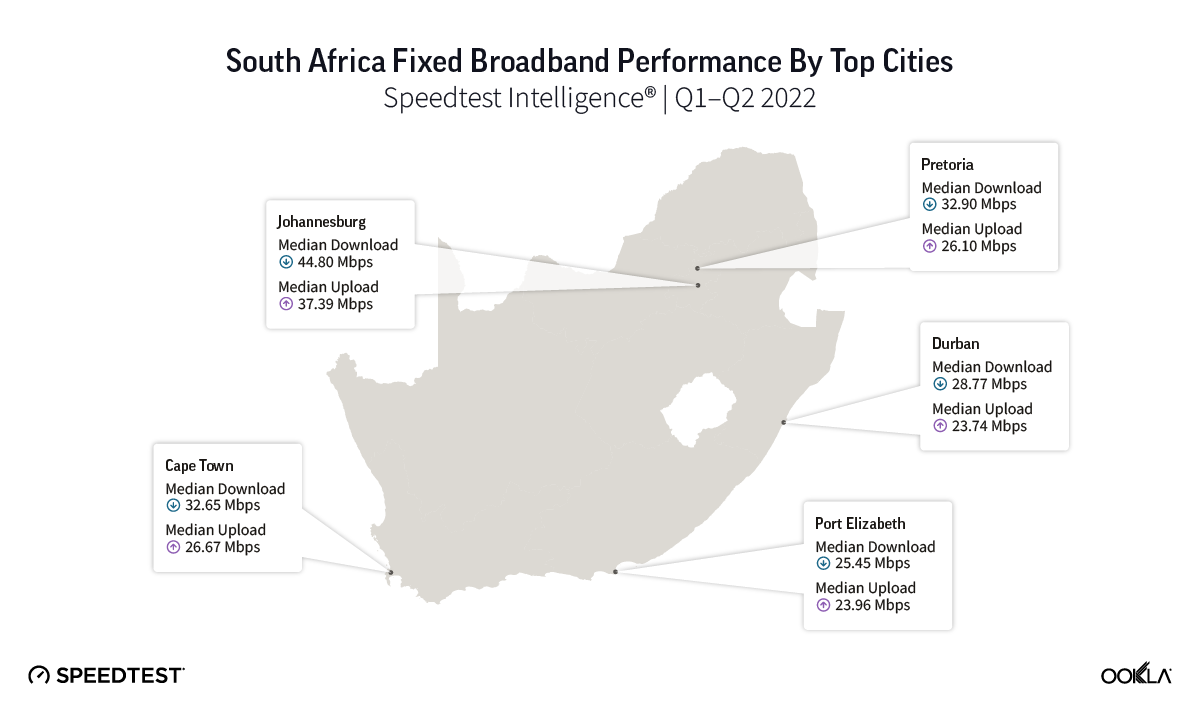
Residents of Johannesburg had the fastest broadband

Map of fixed broadband performance in top cities of South Africa

Johannesburg performed well across the five cities we looked at in terms of median download and upload speeds. Download speeds in Johannesburg ranged from 25.53 Mbps to 51.49 Mbps, while in Port Elizabeth, speeds were much lower, ranging from 6.36 Mbps to 30.11 Mbps. Typically fiber networks first reach rich and affluent communities that present a fertile ground for their services. For example, a northern suburb of Johannesburg–Parkhurst–was Vumatel’s first suburb. 

More is needed to improve fixed networks performance and adoption

Increasing download speeds require more investment in broadband infrastructure from ISPs and FNOs, but most importantly there is a need for reliable underlying infrastructure. Several undersea cables landed in South Africa, including WACS, EASSy, Seacom, SAT3/SAFE, and SACS, with the Equanio and 2Africa cables coming online soon, which helps increase network capacity. However, operators are also facing issues related to infrastructure reliability and availability such as loadshedding (rolling power outages). Affordability is another matter that needs to be addressed. 

We will continue to monitor network performance in South Africa to see what effect the fiber race will have on fixed broadband speeds. If you’d like to learn more about internet speeds and performance in other markets around the world, visit the Speedtest Global Index™.

Ookla retains ownership of this article including all of the intellectual property rights, data, content graphs and analysis. This article may not be quoted, reproduced, distributed or published for any commercial purpose without prior consent. Members of the press and others using the findings in this article for non-commercial purposes are welcome to publicly share and link to report information with attribution to Ookla.
| August 21, 2022

Qatar – Stronger Competition Driving 5G Performance Gains Ahead of World Cup

Key messages

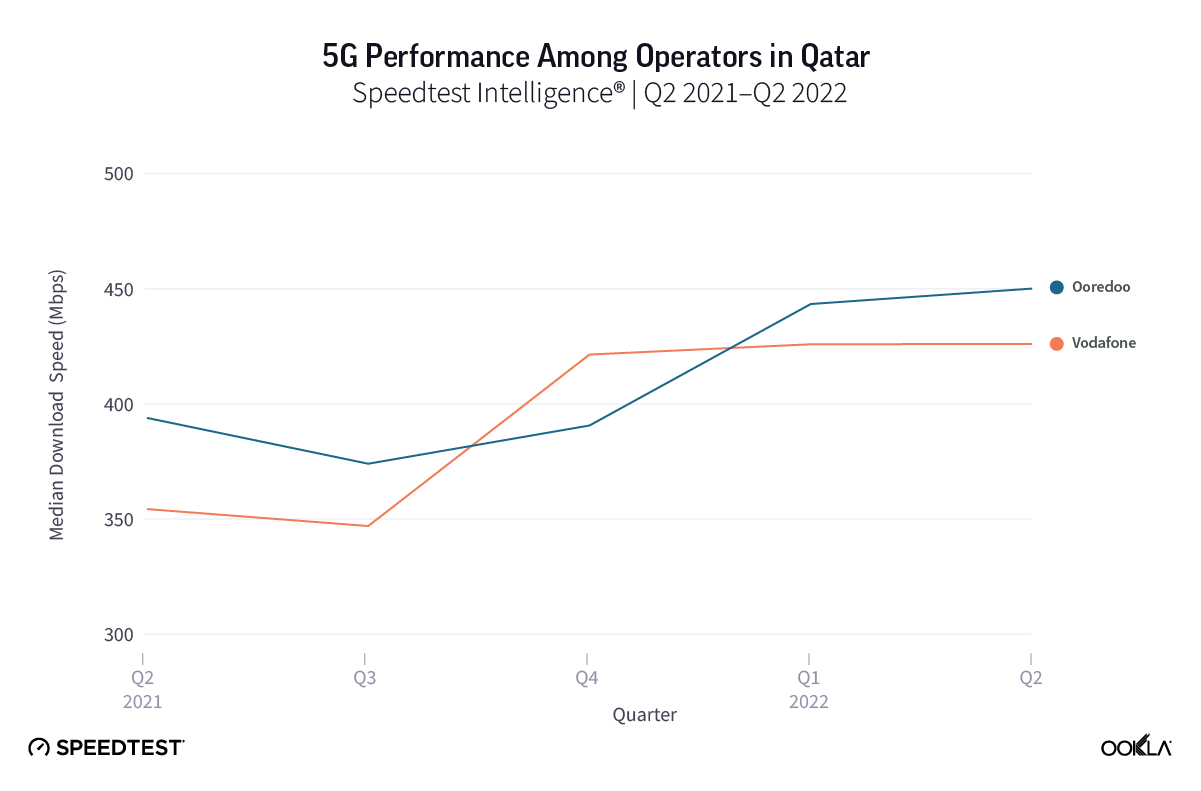
  • Vodafone’s resurgence is putting pressure on market leader Ooredoo to maintain its performance lead. Vodafone’s Turnaround Strategy has created a more level competitive playing field in Qatar, helping it increase its market share and drive strong growth in top-line revenues and net profit so far this year. Vodafone’s improving performance in median 5G network speeds is driving Ooredoo to react in order to maintain its lead.
  • Strong 5G network investment in Qatar, as both operators seek to gain the upper hand, with all eyes on the up-coming FIFA World Cup. This major event gives both operators a chance to demonstrate the capabilities and resilience of their 5G networks to a global audience. They have already driven median 5G download speeds in the market to over 400 Mbps so far in 2022, and with mmWave spectrum due to be allocated in 2023, consumers should expect faster performance to come.
  • Perfect storm has helped propel Qatar to second place globally in mobile download speeds. A desire to rapidly transition their customer bases to 5G has boosted 5G Availability in the market, and has helped Qatar climb to second place in Ookla’s Speedtest Global Index as of July 2022.
  • Beyond faster speeds, consumers are paying less and have access to unlimited 5G tariffs. While headline median 5G speeds impress, strong competition is also driving improved outcomes for consumers, as ARPU falls quarter-on-quarter. Both operators have also introduced unlimited 5G tariffs, including voice, SMS and data, albeit with fair usage caps.

Vodafone’s resurgence has forced Ooredoo to respond and helped drive network speeds to new highs 

Vodafone Qatar’s resurgence as a stronger competitor to market leader Ooredoo Qatar has taken place at a key juncture for the Qatari market — the arrival of 5G. Qatar’s Communications Regulatory Authority (CRA) amended the mobile licenses held by Vodafone Qatar and Ooredoo Qatar in early 2019. The new licenses included harmonized terms and conditions for both companies, authorizing each to utilize 100 MHz of C-band spectrum and committed them to roll out commercial 5G networks before the end of 2020 in all densely populated areas. It also required they provide coverage of all primary roads and highways as well as all venues associated with the up-coming FIFA World Cup. This was updated in May 2022 to plan the allocation to both operators of additional spectrum in the C-band as well as high frequency (26 GHz) spectrum by 2023, while their license obligations require their 5G networks to cover 99% of Qatar with minimum download speeds of 100 Mbps by 2024.

Both network operators have invested heavily in their 5G networks, with Ooredoo attaining 99.5% population coverage in Q1 2022, and Vodafone committed to near universal coverage by the end of 2022. This drive to increase coverage and rapidly migrate users to 5G means that Qatar is among the top markets globally in terms of 5G Availability, (the percentage of users with 5G-capable devices who spend a majority of their time connected to 5G networks), which stood at 46.8% as of Q2 2022 according to Speedtest Intelligence®. Ooredoo maintained an advantage over Vodafone in median 5G download speeds in Q2 2022, recording 450.08 Mbps compared to Vodafone’s 426.04 Mbps, while Vodafone maintains an advantage in upload speeds of 28.61 Mbps to Ooredoo’s 26.76 Mbps.

Ookla® Speedtest Intelligence data shows that Vodafone’s renewed position within the market is helping spur network investment from both operators. In early 2021, Ooredoo had the upper hand in terms of 5G download performance, while in Q4 2021 Vodafone’s performance jumped considerably, prompting Ooredoo to strengthen its position in  Q1 2022. Monthly Speedtest® data shows that the performance gap between the two operators is beginning to narrow once more. At a national level, this has helped Qatar maintain a top-five position in Ookla’s Speedtest Global Index (a global ranking of median download speeds based on all mobile technologies), and as of July 2022 it ranked second globally.

Vodafone targeting market share gains, helping drive ARPU in the market lower

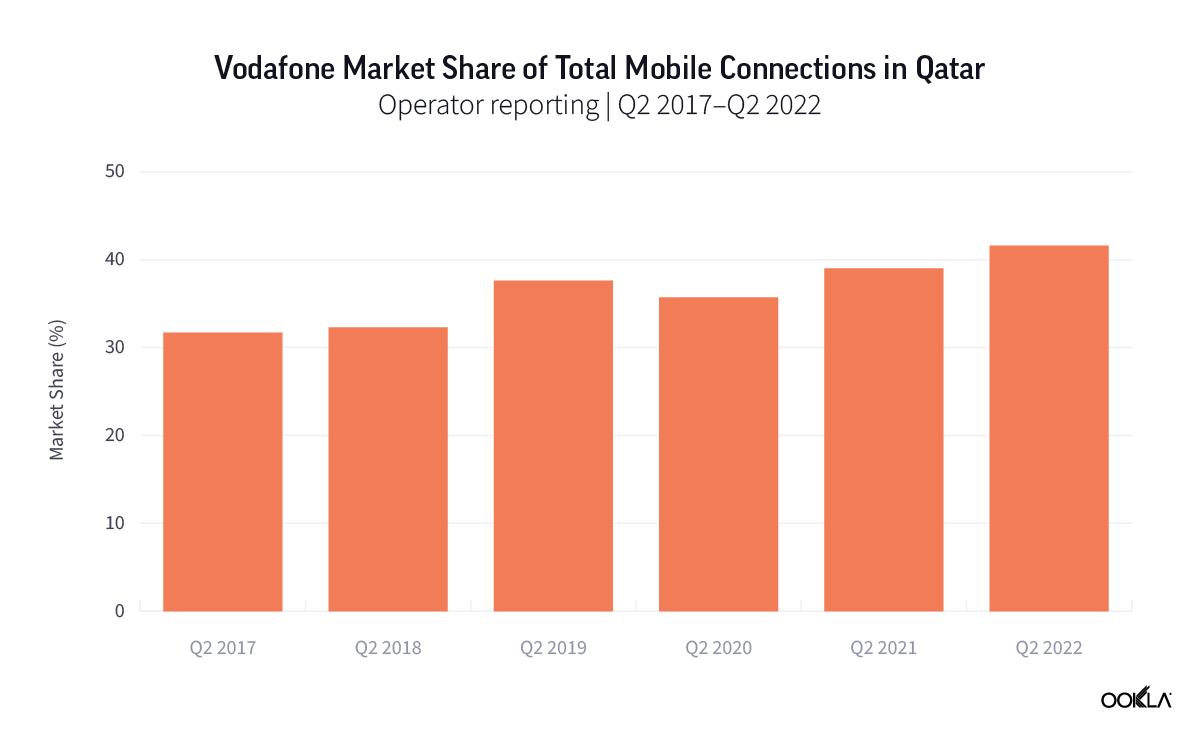
Qatar has been a challenging market for Vodafone Group. Vodafone Qatar launched in 2009 as the second mobile network operator in the country. While it was able to grow market share, it consistently made losses — in the nine months to December 2017, the company made a loss of QAR 182.16 million (~$50 million), which led to Vodafone Group selling its share in the operator in 2018. The Qatar Foundation took control of the company, having increased its shareholding to 50%, maintaining the Vodafone brand but also implementing a Turnaround Strategy, designed to reverse the company’s fortunes, with a focus on cost containment and revenue growth. 

Vodafone Qatar’s operational and financial performance has gone from strength to strength over the five years since then. Costs have fallen from close to 75% of revenues in 2017, to under 60% during 1H 2022, spurred by a rigid focus on cost containment. During the first half of 2022, Vodafone Qatar grew top line revenues by 23.5% (year-on-year, with service revenues increasing by 14%), while net profit rose by 61.3%.

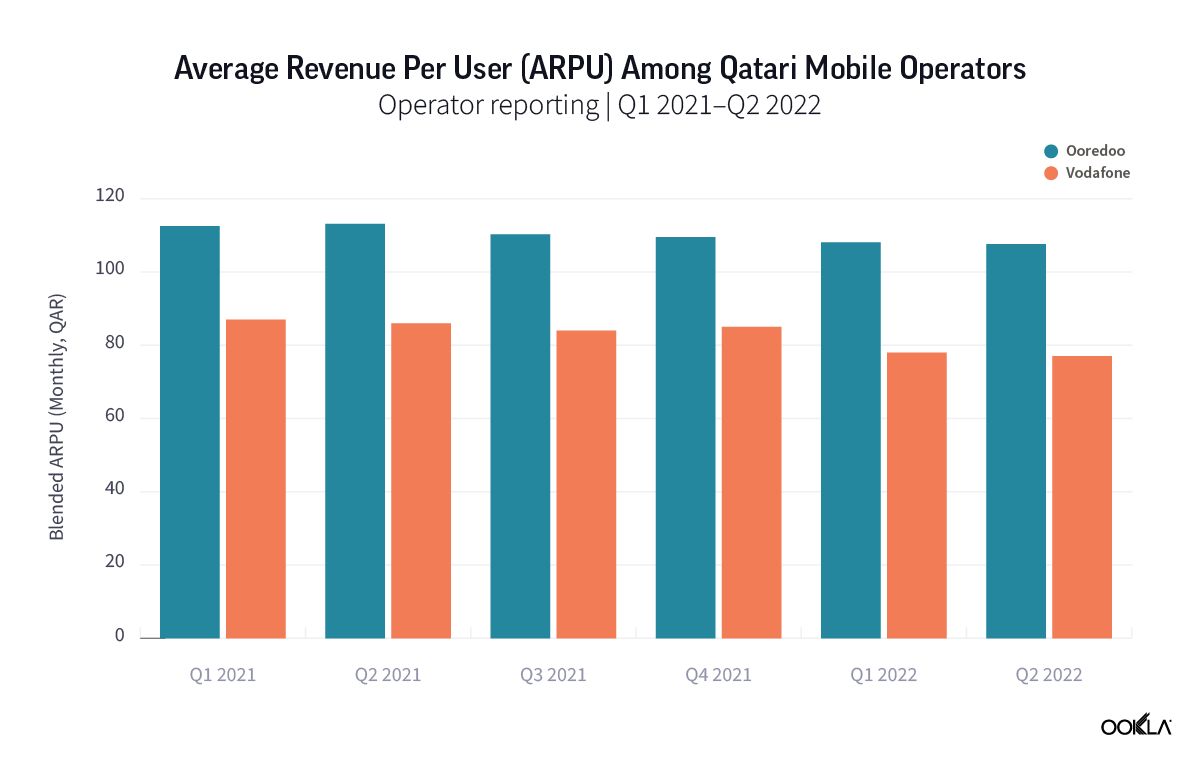
The company is reaping the benefits of an aggressive move to capture new customers — in Q1 2022 its mobile connections base topped 2 million for the first time, representing 18.6% growth year-on-year, well above Ooredoo’s 6.8% growth. Vodafone was the first to introduce “unlimited” tariffs to the market in 2019 across voice, SMS, and data (subject to a fair usage policy), while it has also allowed users across all its tariffs to access 5G. Vodafone’s 5G Availability, the proportion of its users with 5G capable devices which spend a majority of time connected to 5G networks, hit 53.0% during Q2 2022, ahead of Ooredoo’s 42.0%. Vodafone’s drive to acquire new customers has come at the expense of average revenue per user (ARPU), as it is clear it is undercutting Ooredoo in the market. Vodafone’s ARPU fell by 10.3% in the year to Q1 2022, while Ooredoo’s only declined by 3.9%, despite being almost 40% higher. 

Focus currently on FIFA World Cup Qatar 2022, but more to come

A large part of 5G network investment in the country is targeted at the upcoming FIFA World Cup, scheduled to take place in November and December 2022. The award of the world’s premier global football tournament was a significant coup for Qatar, and is predicted to attract around 1.5 million visitors, a significant increase on the local population of 2.93 million. In addition to covering all fan zones related to the event, both operators have been investing heavily in increasing the capacity of their networks and in building enhanced network assurance capabilities, to make sure their networks can cope with the strain of the additional connections and traffic from the event. 

Ooredoo announced in March that it had been selected by the FIFA World Cup organizers as the Official Global Connectivity Services Provider. This will involve providing connectivity services to all media rights licensees in Qatar, and it is building a dedicated network to support broadcast video production and distribution. In order to further boost its network capacity for users at the event, Ooredoo signed a partnership agreement with Ericsson in November 2021, where the vendor will provide network optimization and event management services, covering 5G services in fan zones, stadiums, airports, and major tourist attractions. While not an official partner, Vodafone Qatar’s role in delivering a successful event should not be overlooked. It has tapped the experience of the wider Vodafone Group in delivering connectivity at major events, has been aggressively densifying its 5G network (with over 50% more radio access network sites deployed since 2017), and has also been expanding the reach of its GigaNet fiber network. 

The failure to allocate mmWave spectrum in time for the World Cup has disappointed, however this will now take place in 2023, and consumers should expect further 5G performance gains once both operators begin deployment. We will continue to look at performance on both operator’s networks as we draw closer to the World Cup, and at how they handle the deluge of visitors and traffic that it will bring. To stay abreast of Ookla’s latest content, you can subscribe to our updates here.

Ookla retains ownership of this article including all of the intellectual property rights, data, content graphs and analysis. This article may not be quoted, reproduced, distributed or published for any commercial purpose without prior consent. Members of the press and others using the findings in this article for non-commercial purposes are welcome to publicly share and link to report information with attribution to Ookla.
| July 12, 2022

Caribbean Advances Toward Digital Future but Some Are Left Behind

Mobile connectivity in the Caribbean is a growth industry with 28 million unique mobile subscribers as of Q2 2022, a market penetration of 63.7%, according to the GSMA, short of the global market penetration of 67.1%. Additionally, few Caribbean markets have 5G. In advance of the CANTO conference on July 17, we examined Q2 2022 data from the five most populous Caribbean countries as well as Puerto Rico to see how initiatives to enable digital evolution and transformation are progressing. We looked at country-level performance data as well as mobile availability statistics in each country.

Mobile performance varies widely across the Caribbean

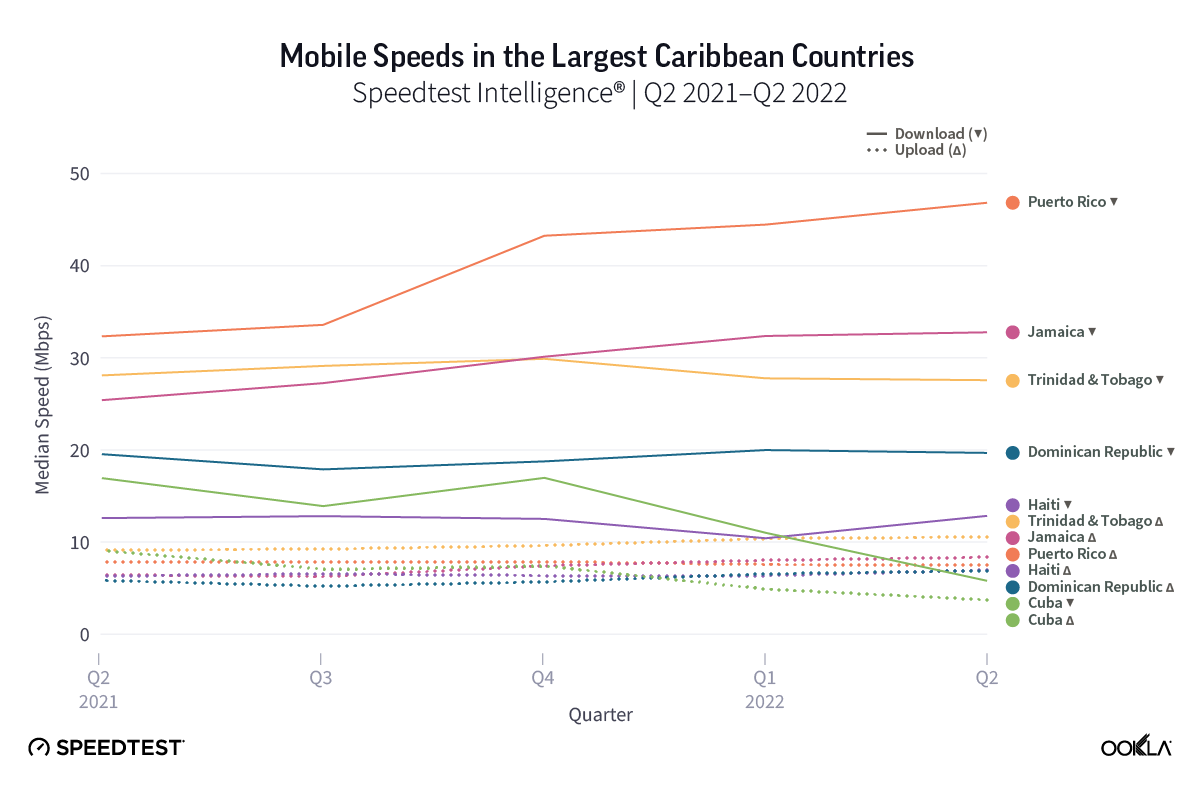
At 46.84 Mbps, Puerto Rico had the fastest median mobile download speed by far when comparing the most populous Caribbean countries during Q2 2022 using Speedtest Intelligence®. This was at least a 43% improvement over Q2 2021. 5G is a big differentiator with only Puerto Rico and the Dominican Republic having commercial availability for 5G according to the Ookla® 5G Map and Trinidad and Tobago showing only limited 5G Availability. Puerto Rico was 35% faster for download speed than Jamaica, which fared well for median download speed, coming in second on this list at 32.77 Mbps, at least 20% faster than in Q2 2021. Trinidad and Tobago (27.57 Mbps), the Dominican Republic (19.67 Mbps), and Haiti (12.83 Mbps) followed. Cuba was far behind the other countries on this list with a mobile download speed of 5.78 Mbps, at least a 162% drop from Q2 2021.

Chart of mobile speeds in Caribbean countries

Trinidad and Tobago had the fastest median mobile upload speed among the most populous Caribbean countries during Q2 2022. At 10.54 Mbps, Trinidad and Tobago’s mobile upload speed was 24% faster than that in Jamaica (8.34 Mbps) and up at least 6% over Q2 2021. Puerto Rico (7.48 Mbps) followed, then Haiti (6.94 Mbps), the Dominican Republic (6.87 Mbps), and Cuba (3.71 Mbps). Cuba’s median upload speed was down at least 117% when comparing Q2 2021 to Q2 2022.

Chart of latency in Caribbean Countries

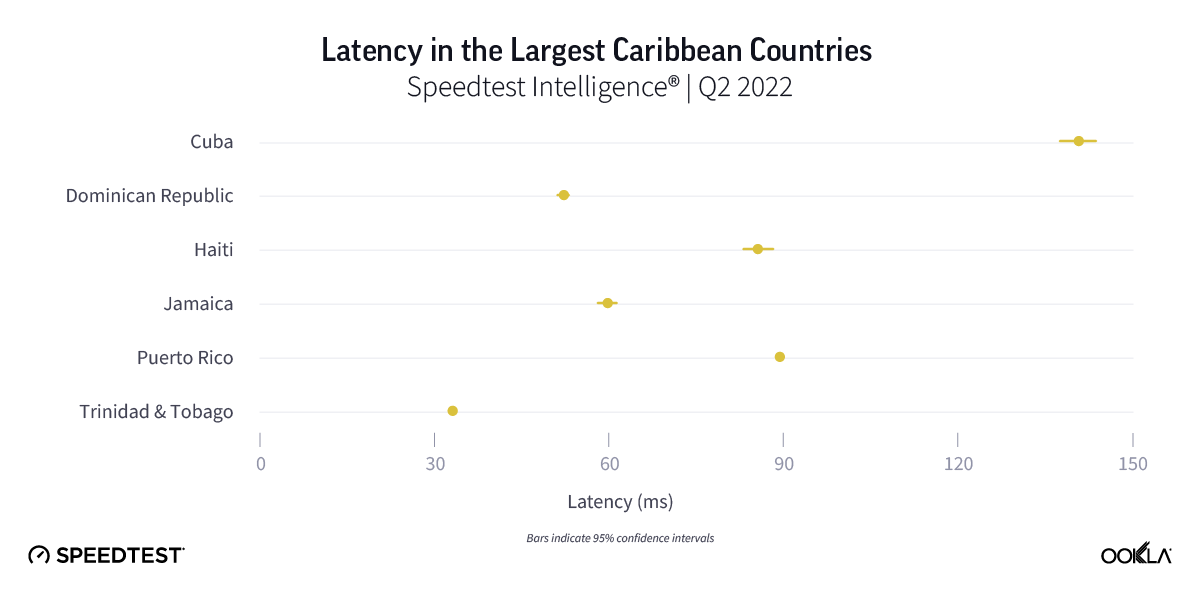
Trinidad and Tobago had the lowest median multi-server latency on our list during Q2 2022 at 33 ms followed by the Dominican Republic (52 ms), Jamaica (60 ms), Haiti (86 ms), Puerto Rico (89 ms). At 141 ms, Cuba’s latency was the highest.

Availability shows some populations are stuck with decades-old technologies

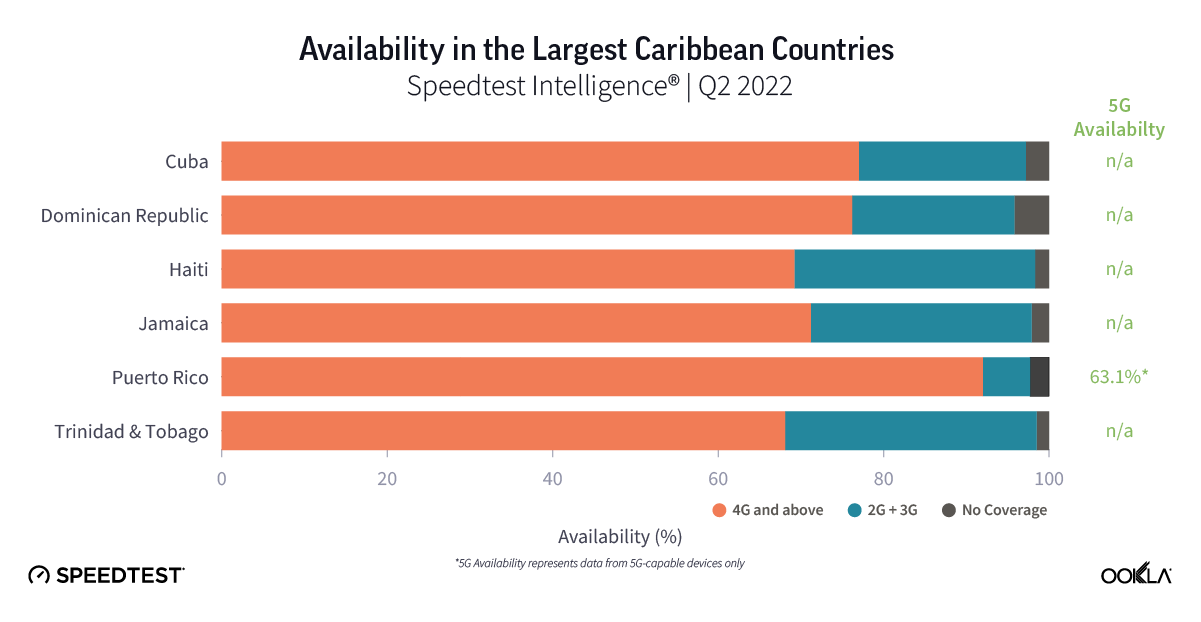
Data from Speedtest Intelligence in Q2 2022 shows that Puerto Rico had a 5G Availability, the proportion of users with 5G-capable devices who spend the majority of their time on 5G, of 63.1%. While we also saw 5G results in the Dominican Republic, there were insufficient 5G samples in the Dominican Republic to reliably analyze.

Chart of availability in Caribbean countries

Puerto Rico had the highest 4G Availability, the proportion of users who spend the majority of their time on 4G and above, among the most populous Caribbean countries at 92.0%. Cuba followed at 77.0%, then the Dominican Republic (76.2%), Jamaica (71.2%), Haiti (69.2%), and Trinidad and Tobago (68.1%).

Unfortunately, the other countries show a large number of users who are still relying on legacy mobile technologies. 3G and 2G are only sufficient for basic uses including: voice and texting, social media, and navigation apps. Users who want rich media experiences or video calling need access to 4G or higher.

2G and 3G Availability, the proportion of users who spend the majority of their time on 2G and 3G, was higher in Haiti (29.1%) and Trinidad and Tobago (30.4%) during Q2 2022 with no statistical difference between the two. Jamaica closely followed at 26.7%, then Cuba (20.2%), the Dominican Republic (19.6%), and Puerto Rico (5.7%) where both Liberty Mobile and T-Mobile have both recently sunsetted their 3G networks. Affordability of new handsets and more expensive subscription tiers could play a role in slow upgrades.

The Caribbean is certainly an exciting and growing telecom market. We’ll be interested to see what new initiatives come out of CANTO and how they help consumers in the region get closer to a digital future. Please stop by Booth 22 at CANTO to visit with us and discuss local provider performance and more.

Ookla retains ownership of this article including all of the intellectual property rights, data, content graphs and analysis. This article may not be quoted, reproduced, distributed or published for any commercial purpose without prior consent. Members of the press and others using the findings in this article for non-commercial purposes are welcome to publicly share and link to report information with attribution to Ookla.
| May 12, 2022

How EXPO 2020 Dubai Became the Fastest Show on Earth

A project 8 years in the making

The UAE was awarded the right to host the World EXPO 2020 in November 2013 following its successful bid. EXPO 2020 Dubai, the first in the MEASA (Middle East, Africa and South Asia) region was originally scheduled for 2020, but was delayed due to the COVID-19 pandemic, opening to visitors for 6 months between October 2021 and March 2022. 

While international travel had resumed from many markets when the EXPO opened its doors in October 2021, the event had to contend with a subsequent wave of COVID-19 restrictions around the world. Despite this, and the resultant impact on international travel and the maintenance of social distancing and other COVID-19 safety measures, EXPO 2020 operated without interruption during the six months it was open. It was a huge event, welcoming in excess of 24 million visitors to a greenfield build consisting of pavilions from 191 countries, across a site covering 4.38 square kilometers.

Showcasing 5G’s potential

The Telecommunications and Digital Government Regulatory Authority (TDRA) of the UAE has been very proactive in creating an enabling telecoms regulatory environment. In November 2018 it allocated 100 MHz of spectrum in the C-band, to both Etisalat and du, to enable them to roll out 5G networks. In addition, it has been proactive in enabling the operators to begin the sunsetting of their legacy 2G networks, to be able to refarm spectrum for use for newer mobile technologies. Thanks in part to this early allocation of 5G spectrum, and a favorable investment climate, as of March 2022 the UAE ranked 1st in Ookla’s Speedtest Global Index, based on median mobile network download speeds.

EXPO 2020 represented an opportunity for both Etisalat and du to showcase the performance of their 5G networks on a global stage. As a greenfield build, EXPO 2020 represented a unique opportunity, but also a significant challenge, given its sprawling layout across 4.38 square kilometers, and the coverage challenges posed by 191 pavilions which varied significantly in terms of size and construction material, as well as the main dome at the center of the EXPO. Both network operators had to be able to deliver a consistent 5G experience, supporting up to 25 million visitors across the six month period, with an anticipated peak of up to 300,000 visitors at a time.

Fastest global event

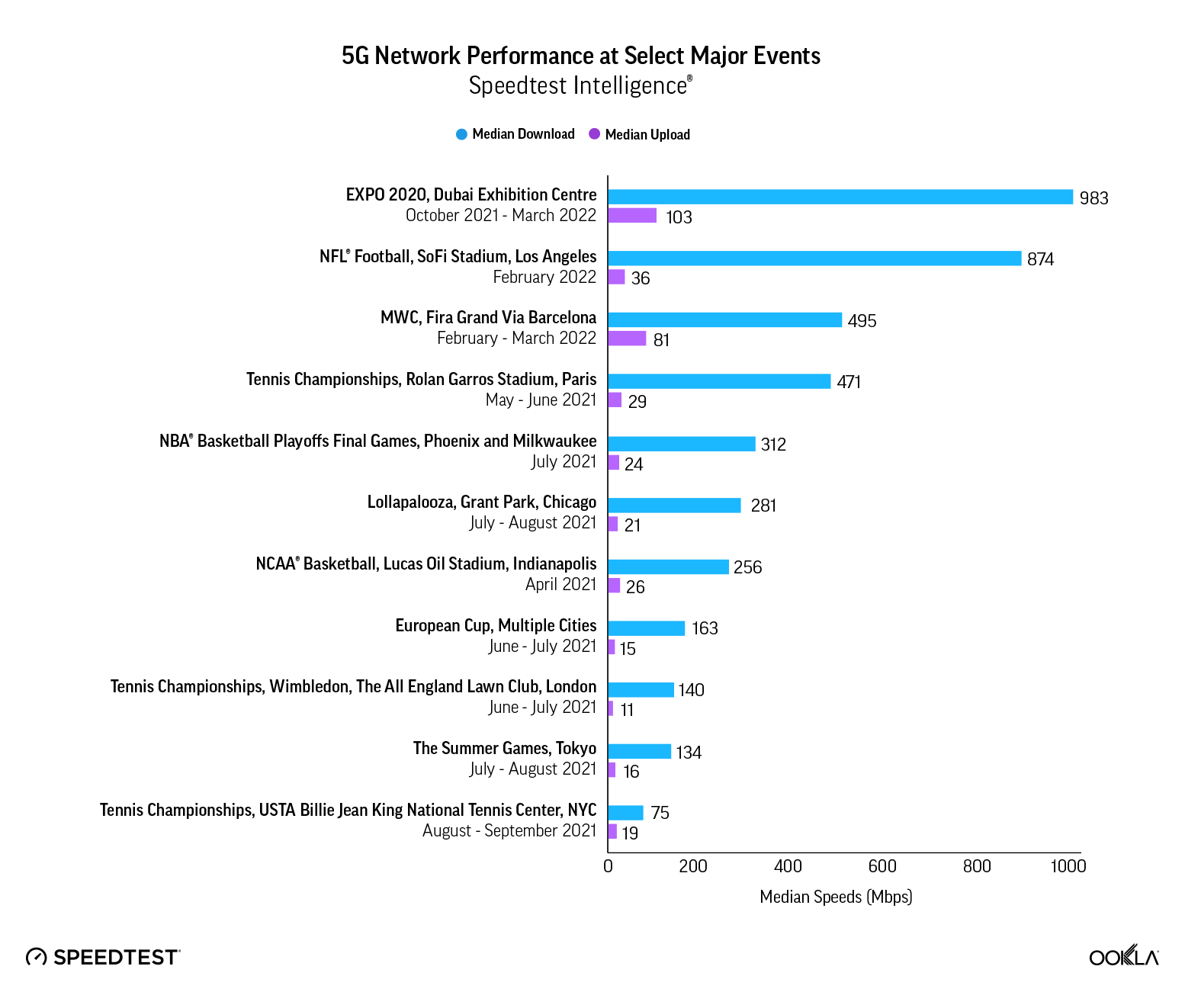
We compared the network performance at EXPO 2020 against other select major events worldwide, to understand how operators are building improved consumer experiences using 5G, and pushing the boundaries for performance at large scale events. The macro sites of EXPO 2020’s 5G network utilized 200 MHz of spectrum in total, using dual carrier aggregation to link high-capacity C-band spectrum with 90 MHz of spectrum in the 2.6 GHz band.

The 5G speeds recorded at the event by Ookla Speedtest Intelligence, confirm that EXPO 2020’s 5G network is the fastest event on record, with peak 5G download speeds in excess of 2 Gbps on Etisalat’s network. According to Doug Suttles, CEO and Founder of Ookla, “the speeds delivered on the Expo 2020 network are truly impressive – the fastest we’ve seen on 5G using mid-band spectrum, and testament to the work of Etisalat’s network build and the vision of the Expo 2020 team.”

5G Network Performance at Major Events

Across the duration of the event, the EXPO 2020 network achieved a median 5G download speed of 983.19 Mbps, putting it ahead of the next fastest event surveyed, the 2022 Super Bowl, which recorded a median 5G speed of 874.48 Mbps. It also outstripped its closest competitor on median 5G upload speed, recording 103.06 Mbps to the 81.32 Mbps recorded at MWC Barcelona 2022. For users without a 5G capable device or tariff, 4G/LTE performance at EXPO 2020 was also the fastest event we measured, with a 4G/LTE median download speed of 122.65 Mbps, putting it ahead of MWC Barcelona 2022, which recorded a speed of 90.41 Mbps.

Etisalat’s median 5G network speed clocked at over 1 Gbps

EXPO 2020 signed a premium partnership agreement with Etisalat in June 2016 to be its telecommunications and digital services provider. As part of this, Etisalat was responsible for developing the EXPO site’s telecoms infrastructure, which aimed to provide visitors and participants a cutting-edge, immersive digital experience to bring EXPO 2020’s themes of Opportunity, Mobility, and Sustainability to life.

Etisalat was tasked with deploying a greenfield dedicated network for EXPO 2020, capable of supporting up to 25 million visitors in total, and up to 300,000 per day, across an area of 4.38 square kilometers. As part of the 5-year network build project, the first commercial 5G network in the MEASA region, Etisalat clearly wanted to showcase the capabilities of a next-generation 5G network. However, with 191 pavilions, as well as the main dome in the center of the EXPO, to ensure the best blend of coverage and performance, it deployed:

  • Over 8,500 mobile access points, including 20 macro cell sites, 91 small cells, and 40 in-building sites, to provide full coverage
  • 700km of fiber optic cable, including 10 Gbps connections to all sites
  • 800km of cabling to support indoor mobile and Wi-Fi network requirements
  • 2 data centers within the EXPO itself
  • Redundancy in the form of a dedicated fallback Wi-Fi network, as well as the option to rapidly deploy cells on wheels (COW)

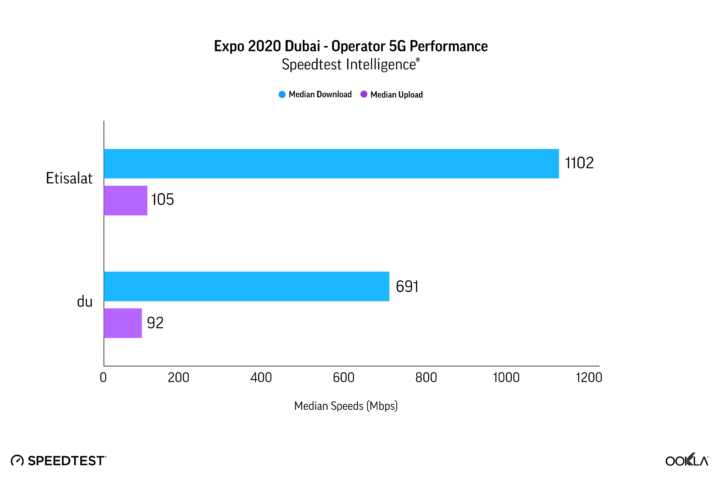
Across the six months that EXPO 2020 Dubai was open, and despite the much larger and more complex coverage requirement compared to other events (given the multitude of exhibitions pavilions), both Etisalat and du recorded impressive median 5G network speeds. Etisalat’s median speed of 1.10 Gbps, ahead of du’s 691 Mbps, helped drive Expo 2020 to first place as the fastest event on record. Median upload performance between the two operators was a closer affair, with Etisalat recording 105.09 Mbps, ahead of du’s 91.79 Mbps.

EXPO 2020’s economic impact and legacy 

EXPO 2020 provided a significant contribution to the UAE economy. In a February update, the IMF claimed that the UAE’s economic recovery was gaining momentum, estimating that it grew 2.2% in 2021, and forecasting that growth will accelerate to 3.5% in 2022. The IMF noted that this momentum was due to the country’s swift response to the COVID-19 pandemic alongside macroeconomic policies that have helped key sectors rebound, and economic activity related to EXPO 2020. With EXPO 2020 now complete, as part of its legacy, it will transition into District 2020 – a smart city deployment. District 2020 will re-use at least 80% of the EXPO-built infrastructure, including key components of the 5G network build, for both residential and business use.

Please contact us to learn how Ookla® can help you determine if your network is prepared for the massive crowds that accompany a marquee event, and analyze how your network performs both indoors and out, down to the building level.

Ookla retains ownership of this article including all of the intellectual property rights, data, content graphs and analysis. This article may not be quoted, reproduced, distributed or published for any commercial purpose without prior consent. Members of the press and others using the findings in this article for non-commercial purposes are welcome to publicly share and link to report information with attribution to Ookla.
| June 21, 2022

South Africa Spearheads 5G in Africa, but the Road is Long and Windy for Others

Key Messages 

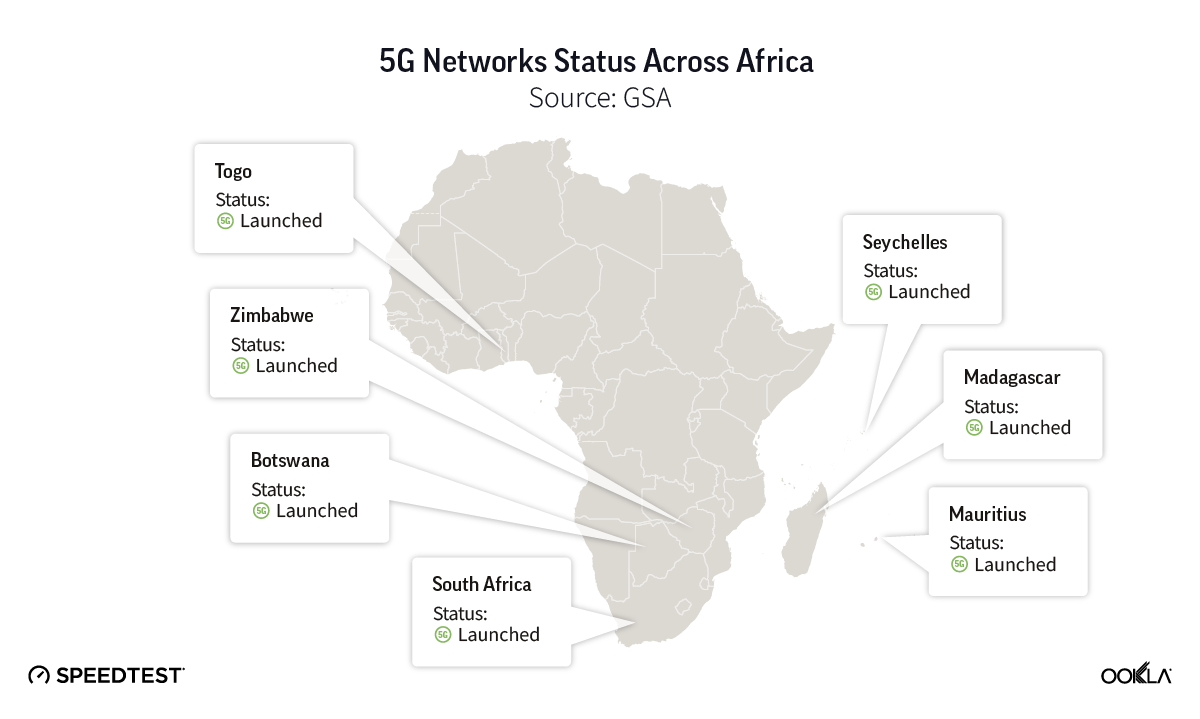
  • 4G continues to expand in Africa, and 5G is on the operators’ radar. South Africa was the first country in the region to launch 5G, and has since been joined by a handful of countries: Seychelles, Zimbabwe, Botswana, Mauritius, Madagascar, and Togo.
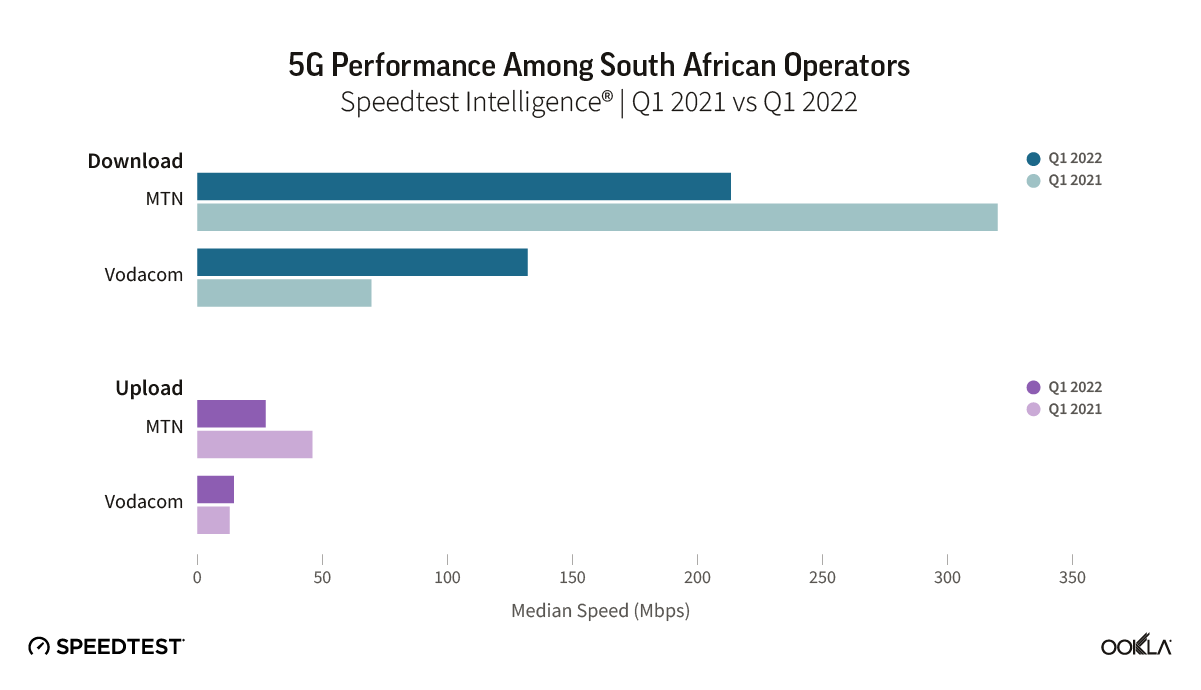
  • We examine 5G performance in South Africa in Q1 2022 vs. Q1 2021. In Q1 2022, MTN had the fastest median 5G download speed in South Africa at 213.37 Mbps, ahead of Vodacom (132.11 Mbps). MTN showed a strong improvement to its 5G Availability from Q1 2021 to Q1 2022, growing from 1.0% to 9.7%. 
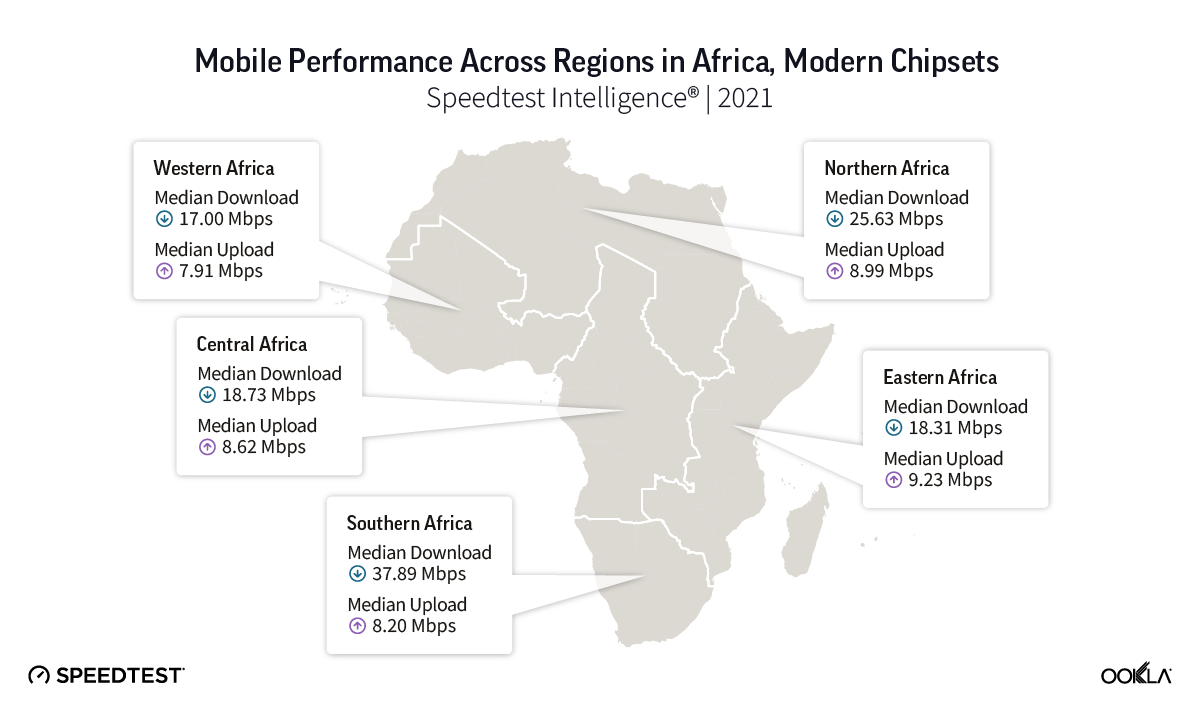
  • Using Speedtest Intelligence® data, we analyzed mobile performance on modern chipsets during 2021. Southern Africa is the fastest region in Africa in terms of median download speed of 37.89 Mbps, followed by Northern Africa at 25.63 Mbps, Central Africa at 18.73 Mbps, Eastern Africa at 18.31 Mbps, and Western Africa at 17.00 Mbps.
  • Johannesburg is the fastest city in sub-Saharan Africa.

Narrowing the digital divide for wider societal benefits 

According to GSMA Intelligence, there were almost one billion mobile connections across sub-Saharan Africa (SSA) in Q1 2022. Unfortunately for those users, it’s no secret that mobile performance and coverage in Africa have been subpar. We examined the state of the North African market in June of 2021, but the time is long overdue to examine the state of networks specific to SSA. 

Affordable 4G smartphones and targeted financing for under-served demographics are key for bridging the digital divide, but that’s not the only benefit: A World Bank study found that 4G coverage can help cut poverty by up to 4.3%. Additionally, the International Finance Corporation estimates a 10% boost to mobile broadband penetration in Africa could lift GDP per capita by 2.5%. 

Southern Africa had the fastest median download speed across African regions

Using Speedtest Intelligence® data, we analyzed mobile performance on modern chipsets during 2021 (full year) across the African continent. Modern chipsets include all mobile tests, regardless of connection technology used, as long as they are taken on devices that are identified as being capable of achieving the fastest speeds available in a market. Ookla closely monitors the launch and widespread release of new device models built on chipsets capable of utilizing the latest mobile network technologies. We aggregated speeds across countries that fall within the five African regions as defined by the United Nations. When looking at median download speeds in 2021, Southern Africa ranked first, with a median download speed of 37.89 Mbps, followed by Northern Africa at 25.63 Mbps, Central Africa at 18.73 Mbps, Eastern Africa at 18.31 Mbps, and Western Africa at 17.00 Mbps. 

Eastern Africa had the fastest median upload speed at 9.23 Mbps, followed by Northern Africa at 8.99 Mbps, Central Africa at 8.62 Mbps, Southern Africa (8.20 Mbps), and Western Africa (7.91 Mbps). 

To support the growing demand for faster speeds there is a growing investment in both surface and undersea cables. For example, Google’s new subsea cable, the Equiano, landed in Togo in March 2022 and Nigeria in April 2022. The cable is set to become operational by the end of the year and is also expected to bring connectivity to areas such as Namibia, South Africa, and neighboring regions.

We have chosen nine countries for our analysis as they were home to over half (56%) of the region’s connections, including:

  • Eastern Africa: Kenya, Tanzania, and Uganda; 
  • Southern Africa: Democratic Republic of Congo, South Africa, and Botswana; 
  • Western Africa: Côte d’Ivoire, Guinea, and Nigeria.

South Africa ahead of the pack for median download speed

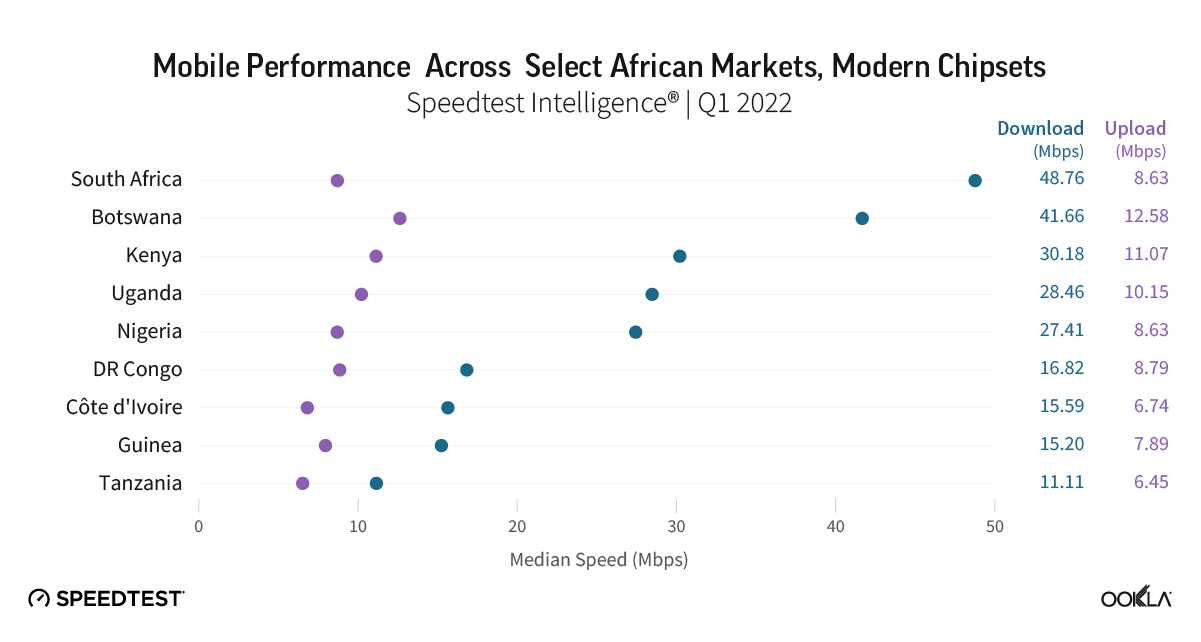
Analysis based on data from Speedtest Intelligence shows that mobile speeds varied widely across African countries during Q1 2022. When looking at mobile performance on modern chipsets across the nine countries of the SSA region, our results showed that median download speeds ranged between 11.11 Mbps (Tanzania) and 48.76 Mbps (South Africa). Median upload speeds were between 6.45 Mbps (Tanzania) and 12.58 Mbps (Botswana). 

4G Availability was in excess of 50%

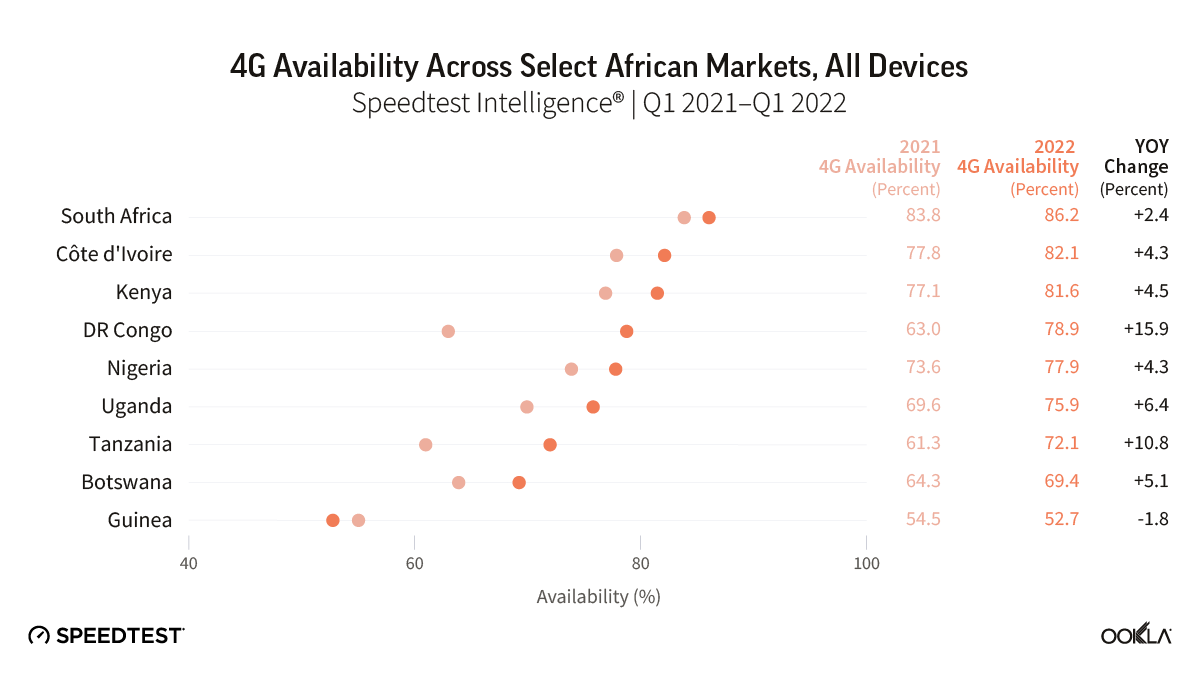
4G Availability describes the percentage of users on all devices who spend the majority of their time connected to 4G technology both roaming and on-network. Across the nine countries we looked at, 4G Availability exceeded 50% across the board. South Africa had the highest 4G Availability at 86.2%, followed by Côte d’Ivoire (82.1%), Kenya (81.5%), Democratic Republic of Congo (78.9%), Nigeria (77.9%), Uganda (75.9%), Tanzania (72.1%), and Botswana (69.4%). Guinea ranked last at 52.7%, largely because only Orange Guinea offers 4G services, utilizing 1800 MHz spectrum for which it was granted a license in March 2019. According to Ookla Map Elements®, Orange’s LTE network covers 14% of the Guinean population. However, that should change soon with MTN being awarded a 4G operating license in February 2022.

Johannesburg has the fastest median download speed among select African cities

Map showing Mobile Performance in Capital Cities in Africa

When it comes to speeds in select African capital cities, Johannesburg was fastest with a median download speed of 65.54 Mbps — nearly 35% faster than that of the next-fastest city, Cape Town at 48.27 Mbps.

Gaborone stood out for posting the third-fastest median download speed on the list at 42.29 Mbps. Meanwhile, Nairobi, Kampala, Lagos, and Abuja ranked closely together in terms of median download and upload speeds, with median download speeds ranging between 27.77 Mbps and 33.38 Mbps, with upload speeds ranging between 8.48 Mbps and 11.92 Mbps. 

The early days of 5G in Africa show green fields for operators

As 4G continues to expand in Africa, 5G is on operators’ radar. In sub-Saharan Africa, the 5G journey has already begun, but it is still early days for 5G deployment and commercialization. 

South Africa was the first country in the region to launch 5G, and has since been joined by a handful of countries: Seychelles, Zimbabwe, Botswana, Mauritius, Madagascar, and Togo. According to GSA, there were nine commercial 5G networks in seven markets across the region by the end of May 2022. In these markets, 5G coverage remains limited to major cities. Furthermore, just over two dozen operators are either planning, or testing 5G technology or are already in the deployment stage. Regulators across the regions have also started to make spectrum available for 5G. 

BOTSWANA: In February 2022, Botswana Communications Regulatory Authority (BOCRA) offered existing and new operators an opportunity to apply for spectrum in 5G frequency bands, covering low and mid band spectrum. This will allow operators to expand their existing 4G networks and roll out 5G. Operators are allowed to re-farm their existing spectrum to augment new spectrum to enable them to roll out 5G. Shortly after, during the same month, Mascom launched four 5G sites in the capital Gaborone as part of plans to roll out 111 sites across Botswana by the end of 2022.

KENYA: The Communications Authority of Kenya (CA) developed a roadmap to facilitate 5G deployment. CA is preparing to reallocate spectrum in the 3500 MHz band, which was previously assigned for FWA networks in Kenya but will be refarmed for 5G by June 30, 2022. In May 2022, Safaricom was allocated 60 MHz of spectrum in the 2600 MHz band, which was previously used by the security agencies but has been released following a change in the technology that they use.

NIGERIA: In December 2021, MTN and Mafab Communication won 100 MHz TDD each in the 3.5 GHz spectrum band. In line with the terms and conditions of the concessions, the telcos are expected to commence the rollout of their 5G networks from August 24, 2022. While Airtel Africa pulled out of Nigeria’s 5G auction, its CEO Segun Ogunsanya stated they have sufficient spectrum in other bands to launch 5G.

SOUTH AFRICA: In March 2022, the Independent Communications Authority of South Africa (ICASA) completed a delayed 5G auction, selling spectrum across 700 MHz, 800 MHz, 2.6 GHz, and 3.5 GHz bands. Rain and Vodacom got new low-band frequency assets in the 700 MHz band while Telkom and MTN gained spectrum in 800 MHz. All bidders received spectrum in mid-bands, which is considered the sweet spot for 5G in terms of speed and availability.

MTN leads on 5G in South Africa

Despite the fact that the 5G spectrum auction was completed in March 2022, Vodacom and MTN launched 5G services beforehand using emergency, temporary spectrum allocated during the COVID-19 pandemic. The regulator released spectrum in April 2020 to help operators alleviate some of the challenges they faced in responding to the high demand for data during COVID-19. 

In May 2020, Vodacom launched the first 5G network across Africa, in partnership with Nokia in the 3.5 GHz band. At the time of launch, the network was available in three cities — Johannesburg, Pretoria, and Cape Town — with a total of 190 5G sites. MTN followed in June 2020, using spectrum across 1800 MHz, 2100 MHz, and 3500 MHz bands. In its latest report, MTN reported that in 2021, it had over 1,000 5G sites across several spectrum bands with plans to significantly scale up with 3.5GHz spectrum. 

Using Speedtest intelligence data, we compared operators’ 5G performance in Q1 2022 against data from Q1 2021. In Q1 2022, MTN’s median 5G download speed reached 213.37 Mbps — decreasing by a third when compared to Q1 2021 (320.10 Mbps).  Median upload speed suffered a nearly 40% decrease, going from 46.05 Mbps to 27.32 Mbps. When we examined the State of 5G Worldwide in 2021, we concluded that it’s common to see new mobile access technologies slow down as adoption scales, particularly early on in the tech cycle and as more users are logging on to existing 5G networks. As such, the downward tendency in MTN’s performance is not surprising at all. Vodacom, on the contrary, almost doubled its median 5G download speed from 69.93 Mbps to 132.11Mbps.

5G Availability, which describes the percent of users on 5G-capable devices that spend the majority of their time on 5G, continues its upward trajectory across South Africa, from just 0.9% in Q1 2021 to 5.6% in Q1 2022. MTN had shown a stronger improvement to its 5G Availability in the Q1 2021 to Q1 2022 period than its rival, growing from 1.0% to 9.7%.

Since the award of temporary spectrum in 2020, MTN has intensified its investment to increase network coverage, improve speeds, and enhance the overall customer experience. The operator has also invested in an expansion drive into rural and peri-urban areas and a major 5G rollout, reaching 15% of South Africa’s population at the end of 2021. MTN is also planning to extend its 5G coverage to 25% of the population by the end of 2022, and 60% by 2025. As part of MTN’s “Modernization of Network South Africa” (MONZA) project, MTN has been allocating a budget to extend network reach into rural communities, support 5G expansion, and restore vandalized infrastructure: ZAR 624 million ($38.7m) for Eastern Cape, ZAR 749 million ($46.5m) for Western Cape, ZAR 820 million ($50.9m) in Limpopo and Mpumalanga.

Vodacom’s 5G Availability had grown from 1.4% in Q1 2021 to 6.4% in Q1 2022. Vodacom reported in its FY 2022 results (for year ended March 2022) that in South Africa, capital expenditure was directed at improving capacity and resilience of the network and increasing 5G roll-out. As of March 2022, the operator’s 4G network covered 97.9% of the population, and it had also extended 5G sites to 624.

This investment drive is paying off. According to ICASA’s report, 5G population coverage reached 7.5% in 2021, an increase from a mere 0.7% in 2020. However, there is a disparity between urban and rural population coverage. 5G was present across all of the urban provinces, with Kwazulu-Natal in the lead with 20% 5G population penetration, while only three regions (Free State, Gauteng, and Western Cape) reported 1-2% population coverage in rural areas.

Having invested into spectrum and network roll-out, the operators look for ways to monetize 5G. For example, MTN has partnered with Australia’s Emerge Gaming to allow people to play cloud games on their Huawei P40 Pro phone using MTN’s 5G network. This is all in order to attract more consumers, especially video games’ enthusiasts. MTN also partnered with Huawei South Africa, Miniandante Mining, and Minetec Smart Mining to transform old mining processes using 5G. 

African nations still face many hurdles to modernizing networks

It is still early days for 5G across most of Africa. South Africa is leading the region having launched commercial networks in 2020. One of the key challenges across Africa in terms of network rollouts regardless of technology relate to the cost of mobile base stations, the backhaul technology that connects mobile sites to the core network, and energy supply. 

Recent World Bank report points to the three main areas where infrastructure costs can be prohibitive in rural settings, such as the mobile base station, the backhaul technology that connects mobile sites to the core network, and energy supply. To alleviate the challenges operators are taking steps and looking to innovative approaches to improve the situation. For example, Orange DRC partnered with NuRAN to construct and operate 2,000 solar-powered mobile towers, with a particular focus on rural communities, which will cover at least 10 million people in rural areas. These lower-cost “light towers,” are better suited to covering remote locations with small populations and come with significant cost savings. One of the reasons for lower costs is being powered by renewable energy solutions, particularly solar, rather than more expensive diesel generators. 

Device affordability is another issue. There are currently a few initiatives across the continent aimed at expanding connectivity to areas where it’s lacking. For instance, Google partnered with Safaricom in Kenya for a program that allows customers to pay for 4G-enabled phones in installments, while MTN Uganda reinforced a partnership with M-Kopa in March 2022 to introduce 4G smartphones on installment payment terms. MTN also inked a partnership with M-Kopa in 2021 that facilitated the sale of more than 70,000 smartphones, financing over 2 million customers across Africa. Orange in Cote d’Ivoire launched a similar initiative in partnership with Yabx and Cofina. Yabx, a Dutch firm that offers credit across multiple countries in Africa, will provide the technology and manage the complete customer journey that will enable Cofina, an Ivorian financial institution that provides SME financing, to launch plans for Orange subscribers. Bringing 5G devices into the African markets will be even more challenging.

Operators continue to innovate and we are keeping a close eye on how the network deployments are progressing and the network performance end users experience. If you are interested in benchmarking your performance or if you’d like to learn more about internet speeds and performance in other markets around the world visit the Speedtest Global Index™.

Ookla retains ownership of this article including all of the intellectual property rights, data, content graphs and analysis. This article may not be quoted, reproduced, distributed or published for any commercial purpose without prior consent. Members of the press and others using the findings in this article for non-commercial purposes are welcome to publicly share and link to report information with attribution to Ookla.
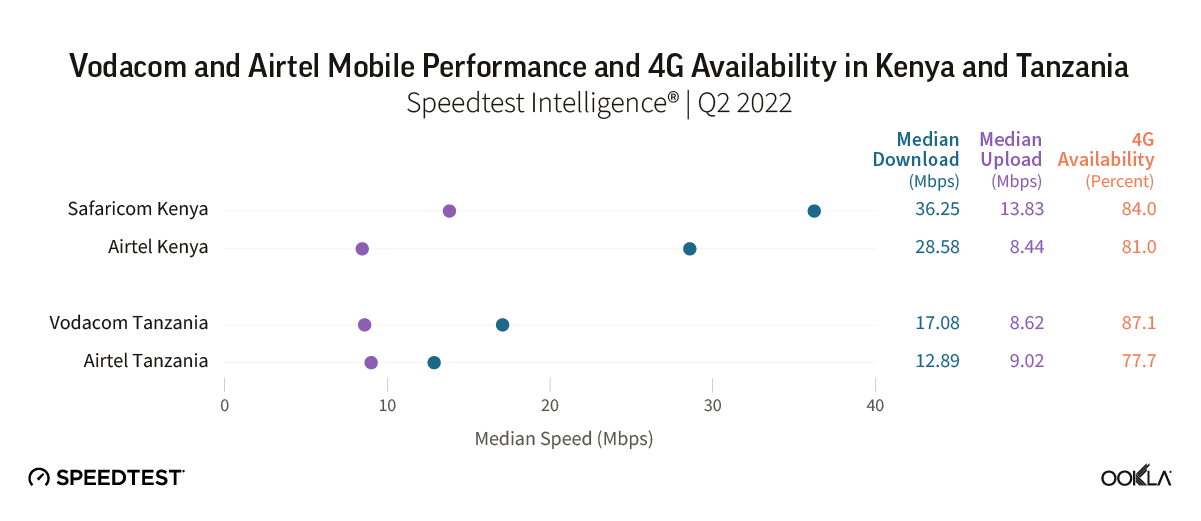
| June 30, 2022

The Philippines is a Duopoly No More: Assessing DITO’s Impact on 4G and 5G Performance

The Philippines is a country with the highest number of social media users globally. Filipinos also spend a lot of time online —according to the Digital 2022 report, internet users aged 16 to 64 spent an average of 10 hours and 27 minutes using the internet each day. Yet, the Philippines suffer in terms of having relatively low mobile internet speeds due to challenging geography and affordability. Recently, the Filipino mobile market witnessed the arrival of a third mobile player, DITO whose ambitions are to disrupt a duopoly of Globe and Smart, owned by PLDT (Philippine Long Distance Telephone Company). In this article we will review the current state of the Filipino mobile market, one year after it became a three-player market.

Key takeaways

  • The third operator, DITO, entered the market in March 2021 and is working to expand its market share. The operator has met all of its coverage and performance obligations, and it plans further investment and expansion of its 4G and 5G networks.
  • Overall 4G performance improved in the country thanks to a mix of more operator investments and regulatory reforms. Smart led on median 4G download speed in Q1 2022 at 18.57 Mbps. DITO, a 4G/5G player, had the best 4G Availability in Q1 2022 at 91.2%.
  • 5G Availability improved partially thanks to easing of the Right of Way (RoW) rules but also operators’ investment into 5G networks. Smart won both in terms of 5G speeds and 5G Availability in Q1 2022, it recorded 200.43 Mbps median download speed and 25.5% 5G Availability, ahead of Globe with 121.29 Mbps download speed and 15.3% 5G Availability. DITO has just started rolling out a 5G network.
  • Consumer attitudes shifted in a positive direction in the past year, both in terms of NPS score and rating of mobile operators.

Reintroducing a third player into the Filipino market

In 2011, PLDT acquired Digitel, which meant that the Philippines turned into a two-operator mobile market. This didn’t fare well for the Filipino consumers. A 2014 study by the think tank LIRNEasia found that internet users in the Philippines have paid more for worse connectivity compared to other Asian countries with investment into the telecom sector held back. A third player was introduced to the market to add competition, to improve network performance, and to reduce prices in the market. In November 2018, the Department of Information and Communications Technology (DICT) and the National Telecommunications Commission (NTC) declared Mislatel (now DITO Telecommunity Corporation), a new major telco player. DITO’s launched commercial operations in March 2021 in Visayas and Mindanao.

DITO market share after a year of commercial availability

Entering an already saturated telecom market wasn’t an easy task. According to GSMA Intelligence, Filipino market penetration stood at 137.5% with an average of 2.1 SIMs per user in Q1 2021. In addition, the new operator’s license came with coverage and performance obligations, which are tracked by technical audits performed on behalf of the NTC. Repetitive failure to deliver on its commitments would result in the loss of its franchise and the forfeiture of a multi-billion-Peso bond. DITO committed to a five-year network rollout plan as follows:

  • First Year: commitment to reach more than 37.01% country population with a minimum average broadband speed of 27 Mbps — DITO achieved 37.48% population coverage as per February 2021 Audit
  • Second Year: DITO exceeded its 51.01% population coverage target (achieved 52.57% population coverage) as per September 2021 Audit.
  • Third Year: 70% population coverage audited in July 2022, DITO’s current coverage is around 64%-65%.
  • Fifth Year: 84% population coverage obligation, which the operator itself has increased to over 90% by the end of its five-year network rollout program and average mobile internet speed of 55 Mbps speed.

As a result, the newcomer’s strategy wasn’t to start a price war with the incumbent operators. Rather, the goal is to win consumers’ mindshare by delivering faster speeds, differentiated customer experience and simpler products. The operator tapped into its parent company’s distribution network — retail stores of Udenna Group and gasoline stations of Phoenix Petroleum to distribute its services. It also leveraged China Telecom’s know-how and funding.

One year on, in Q1 2022, Globe was the market leader by subscriber numbers, with 87.4 million, Smart followed with 70.3 million. The newcomer, DITO, held a 1% market share — on March 15, 2022 it announced it had 7 million subscribers, which is lower than we would expect from a new market entrant. DITO targets 12 million subscribers by year end, which seems within its reach, as it has recently announced reaching 9 million customers as of June 2022. Its gains are aided by its promotional packages such as unlimited data for 30 days promotion with 25 GB of data, unlimited text and 300 minutes of calls. One of DITO’s challenges is that it doesn’t operate 2G and 3G networks so its customers have to have 4G-capable phones.

Chart of mobile operator market share in the Philippines

Furthermore, the introduction of Mobile Number Portability (MNP) in September 2021 could shift the landscape. MNP allows subscribers to keep their existing mobile number when changing mobile providers, helping to remove the hassle of losing an existing number when switching operators. This hasn’t been as successful as expected — with only 5,000 requests being made in a space of three months (September to December 2021). In time, and with more customer education, we foresee MNP to have more of an impact on the market.

Philippines catching up on 4G

Chart of 4G performance in Philippines in comparison to other south eastern Asian countries

Using Speedtest Intelligence® data, we compared 4G performance in the Philippines against that of its regional peers in Q1 2022. Singapore came first with a 44.11 Mbps median 4G download speed ahead of Vietnam (34.89 Mbps), followed by Thailand (24.86 Mbps) and Malaysia (22.41 Mbps). Across Indonesia, the Philippines, and Cambodia, the 4G median speeds were well under 20 Mbps, with the Philippines coming with a 15.53 Mbps median download speed and a 5.14 Mbps median upload speed.

Smart leads on median 4G download speed; DITO on 4G Availability

Chart of LTE performance comparison in Q1 2022 versus Q1 2021 among operators in the Philippines

Using Speedtest Intelligence® data, we analyzed LTE Performance in the Philippines comparing Q1 2021 (when DITO commercially launched), and Q1 2022 (almost one year of DITO being in operation). The overall LTE performance has improved — increasing from 11.15 Mbps in Q1 2021 to 15.53 Mbps in Q1 2022. Smart came first in terms of median LTE download speed in Q1 2022, at 18.51 Mbps followed by DITO (15.77 Mbps) and Globe (12.59 Mbps). However, Dito’s median 4G speeds have decreased over a space of a year, which is quite common as a network gets more congested. Latency, on the other hand, has improved across all operators, especially DITO which recorded latency of 26 ms in Q1 2022 versus 35 ms in Q1 2021.

Analysis based on data from Speedtest Intelligence shows that 4G Availability — the proportion of users on all devices who spend the majority of their time connected to 4G technology — has also improved to 84.8% in Q1 2022 from 80.6% in Q1 2021. One important distinction to bear in mind is that while 4G/5G Availability measures the time users spend on a 4G or 5G technology, coverage is a measurement of space and geo-spatial availability. Therefore, operator’s network coverage is just one part of the story. Compatible handsets, SIMs, and tariffs are important factors that influence it.

Since DITO is a 4G-only operator, it is not surprising that it also had the best 4G Availability in Q1 2022 (91.2%), ahead of Globe (84.9%) and Smart (83.8%) that provide access to all network technologies 2G, 3G, 4G, and 5G. Additionally, DITO, despite facing challenges raising funding, plans to invest PHP 50 billion ($915 million) during 2022 in the network roll out in order to adhere to its license obligations, which we outlined here, that specify its population coverage and network speeds.

Other operators also continue to commit capital expenditures for network investment. For instance, Globe Telecom earmarked PHP 89 billion ($1.6 billion) for CAPEX this year, and in Q1 2022 already spent PHP 21 billion ($384 million) — 10% higher than a year before, of which 82% was dedicated to data network builds “to help boost mobile and internet experiences for a greater number of Filipinos.” The operator has set a goal of building more than 1,700 new cell sites across the country in 2022 to extend its geographic reach and to expand beyond the 1,407 sites it deployed in FY21. In the first three months of this year it built out 234 cell sites nationwide, upgraded 2,344 mobile sites to 4G, and installed 380 5G sites.

Our analysis suggests that DITO’s entry combined with regulatory changes, resulted in more network investment and an overall improvement in 4G coverage and performance across all operators. As such, Smart reported that on December 31, 2021, Smart had a total of 38,600 4G/LTE base stations, which has further increased to 39,500 in Q1 2022. This corresponds to population coverage across Smart’s 3G, 4G and 5G networks of 97% in Q1 2022. The majority of devices (81%) are “latched” onto the operator’s 4G network.

Caloocan led on 4G speeds and 4G Availability

Map of LTE performance in Philippines cities

In the Philippines, up to one third of its population resides within Metro Manila, which comprises 16 cities, including the three most populous cities: Quezon (2.9 million), Manila (1.8 million), and Caloocan (1.6 million). Manila, the capital city, is one of the most densely populated cities in the world. Caloocan, Quezon, and Manila came closely together in terms of 4G performance. Smart came first in those three cities: Caloocan (28.66 Mbps), Quezon City (28.24 Mbps), and Manila (30.88 Mbps). DITO was fastest in Cebu, it recorded a 16.60 Mbps median download speed in Q1 2022 but its median upload speed was on par with Smart. While in Davao City, the biggest city outside of Metro Manila, DITO and Smart went head to head with 7.17 Mbps and 6.86 Mbps median download speed, respectively.

Based on Speedest Intelligence data, Caloocan performed best in terms of 4G Availability but 4G Availability improved across all five cities. Quezon and Manila showed the best year-on-year improvement, increasing its 4G Availability from 81.8% in Q1 2021 to 86.7% in Q1 2022 (Quezon) and 83.5% to 88.2% (Manila). Despite being a challenger, DITO managed to come first in terms of 4G Availability in a number of locations: Caloocan (98.3%), Cebu (80.0%), and Davao City (88.9%). Globe won 4G Availability in Quezon (88.3%) while there was not a sufficient statistically significant difference in Manila to declare a winner.

The Philippines fared well in 5G performance and 5G Availability

Chart of 5G performance in souther eastern Asian countries

According to Speedtest Intelligence data, Singapore led Southeast Asian on median 5G upload speeds in Q1 2022, Thailand and the Philippines followed with 207.27 Mbps and 163.51 Mbps median download speed, respectively. We commented on the Singaporean roll out strategy in our recent article.

In terms of 5G Availability, (the proportion of users on 5G-capable devices who spend a majority of their time on 5G networks), Thailand came first among its regional peers. Thailand was one of the first markets to launch 5G in the Asia Pacific region, with AIS and TrueMove H both launching commercial 5G services in Q1 2020, shortly after the conclusion of the country’s 5G auction. In the Philippines, 5G Availability was 18.1% in Q1 2022, ahead of Singapore (8.9%) and Indonesia, where operators launched 5G in select cities in June 2021, which explains the very low 5G Availability in Q1 2022 at 0.4%.

The Philippines looks to 5G to achieve imperative digital transformation

The importance of 5G technology and its role in enabling digital transformation is one of the pillars of the National Broadband Plan (NBP) approved in 2017. It outlines strategies and initiatives that should be taken to increase accessibility, affordability, and network quality. NBP also addresses policy and regulatory issues, such as spectrum, infrastructure policy, and modernizing regulations. Apart from the release of 5G spectrum in 3.3 GHz and 3.5 GHz bands, the Filipino government also supports 5G via a technology neutral policy, where all existing frequency bands can be used for 5G deployment.

Spectrum is one part of the puzzle

Various blocks of spectrum in and around 3.5 GHz have been awarded on a technology-neutral basis and are suitable for 5G usage. For instance, Smart, in its Q1 2022 results, reported that its 1800 MHz frequencies, previously used for 2G service, were being reallocated to provide 4G LTE service to handle the increased volume of data traffic. In addition, the newcomer, DITO, was awarded various blocks of frequencies, including spectrum at 700 MHz, 900 MHz, 2000 MHz, 2100 MHz, 2600 MHz, 3300 MHz, and 3500 MHz.

Sharing passive infrastructure

The terrain of the country poses substantial challenges related to network deployments — the Philippines comprises around 7,640 islands — about 2,000 of which are inhabited. To expedite the construction of telecom towers, especially in the unserved and underserved areas, the DICT issued guidelines on Shared Passive Telecommunications Tower Infrastructure (PTTI). The Philippines government has been pushing since September 2018 to attract investment from international tower companies by promising to streamline the cumbersome procedures required to build and connect towers. Operators are also looking to rationalize their tower portfolio: in April 2022, PLDT sold its towers for PHP 77 billion ($1.4 billion) to Axiata’s Edotco unit and EdgePoint Infrastructure. This is to support DICT’s goal of improving tower density via tower sharing. PLDT/Smart retained ownership of the active infrastructure such as antennas, radios and fiber backhaul, TowerCos own the passive infrastructure. Globe isn’t averse to selling its passive infrastructure either, as it works with various tower companies for its network rollout. The newcomer, DITO, had to catch up pretty fast in terms of network buildout — since 2019 it built close to 5,000 cellular towers, over 100 data centers, and laid out more than 30,000 kilometers of fiber cable.

Fortifying infrastructure to ensure network resiliency

Another challenge is the country’s propensity to natural disasters. Ookla’s data showed that the country’s internet speed saw a slight decline in January 2022, due to infrastructure damages brought in 22 provinces by Typhoon Odette. To future-proof the network for that, PLDT launched a project to deploy additional submarine fiber links to upgrade connectivity in Luzon. The project will replace old domestic fiber optic network (DFON) links and enhance the resiliency of PLDT’s network, and fortify existing aerial cables with underground inland cables to ensure network resiliency.

Furthermore in March 2022, DICT unveiled a plan to spend PHP 50 billion ($915 million) over the next three years, to improve the country’s digital infrastructure, as within two years only 2,000 towers out of 50,000 needed have been built.

Smart wins the 5G game in the Philippines

Chart of 5G performance among top providers in the Philippines

5G continues to advance in the Philippines. The operators have launched 5G mobile networks in 2020, not long after the Thai operators. Globe initially launched 5G technology for Fixed Wireless Access (FWA) in selected towns in June 2019, followed by 5G enhanced Mobile Broadband (eMBB) in February 2020 in Metro Manila, at the start available to premium “Globe Platinum” customers. Smart launched 5G network in July 2020, originally targeting postpaid subscribers in Metro Manila that had Smart-certified handsets — including devices from Huawei, Samsung, RealMe and Vivo — and 5G-activated SIM. Both operators utilized spectrum in the 3,500 MHz band, which is considered the sweet spot in terms of 5G network capacity and coverage. Our data shows that Smart recorded 200.43 Mbps median download/19.67 Mbps median upload speed in Q1 2022 ahead of Globe’s 121.29 Mbps download/ 9.93 Mbps upload.

Country-level 5G Availability almost doubled within a space of a year — from 9.4% in Q1 2021 to 18.1% in Q1 2022. Part of this is related to easing of the Right of Way (RoW) rules, which were adapted and rewritten in March 2021, when the Department of Public Works and Highways (DPWH) issued an order lifting the ban on the construction of critical infrastructure, particularly cell sites, along national roads. The Philippines are not the only country that benefits from RoW reform. In October 2021, India’s Department of Telecommunications (DoT) revised the Indian Telegraph Act Right of Way (RoW) rules which makes it easier to install aerial optical fiber cable in the country. To circumvent digging into the streets to lay fiber, the idea of deploying overhead fiber on street furniture such as light poles and traffic lights has been put forward.

Smart led in terms of 5G Availability, it reached 25.5% in Q1 2022, ahead of Globe (15.3%), due to different spectrum deployment strategies these operators take. Smart had 1.6 million connected 5G unique devices on its network in Q1 2022, more than triple the level than a year prior (376,000 in Q1 2021) while at end-March 2022, Globe logged over 2.0 million devices in its 5G network.

The operators plan further investment in 5G. In its Q1 2022 results, Smart’s parent company — PLDT — revised its 2022 CAPEX guidance to PHP 85 billion from PHP 76-80 ($1.39 – $1.46 billion) due to increased investment in the 5G rollout in different parts of the country. In December 2021, the US Trade and Development Agency (USTDA) awarded a grant to Smart to expand 5G to 96% of population and to support Smart’s investment in equipment and services from Cisco Systems. In Q1 2022, Smart reported its mobile data traffic grew 30% year-on-year to 1,010 petabytes. The number of its 5G base stations increased from 5,000 in 2020 to 7,300 in February 2022, corresponding to 66% 5G population coverage in Q1 2022. Aside from boosting its 5G network rollout, Smart introduced new 5G services to attract and migrate more data users to 5G, Signature Plans+, the first postpaid line-up in the country featuring Unlimited 5G, and also introduced the country’s first Unli 5G data offers for prepaid subscribers in April 2021.

Globe added 390 new sites in the first three months of 2022, extending its 5G network reach to 95% of NCR (National Capital Region) and 84% of key cities in Visayas and Mindanao. In 2021, Globe spent PHP 92.8 billion to achieve 2,000 5G outdoor sites and in-building solutions, build 1,407 new cell sites, and install 1.4 million fiber-to-the-home lines. Globe’s 5G services utilize a virtual 5G core network to deliver both FWA and mobile broadband service in areas where fiber deployment is challenged by various permit and RoW issues.

DITO selected Nokia to deploy 5G services in the island of Mindanao in May 2021 to augment an existing partnership on 4G roll out. In March 2022, Dito started the rollout of its 5G home Wi-Fi service pilot in 146 villages in the Metro Manila area. Villages in the City of Manila, Caloocan City, and Quezon City will be the first to access up to 500 Mbps of download speed through the Dito 5G Home WiFi Starter Kit. DITO 5G network isn’t available widely, we have however seen some 5G tests in Caloocan, where the operator reached a 5G median download speed of 512.66 Mbps in Q1 2022.
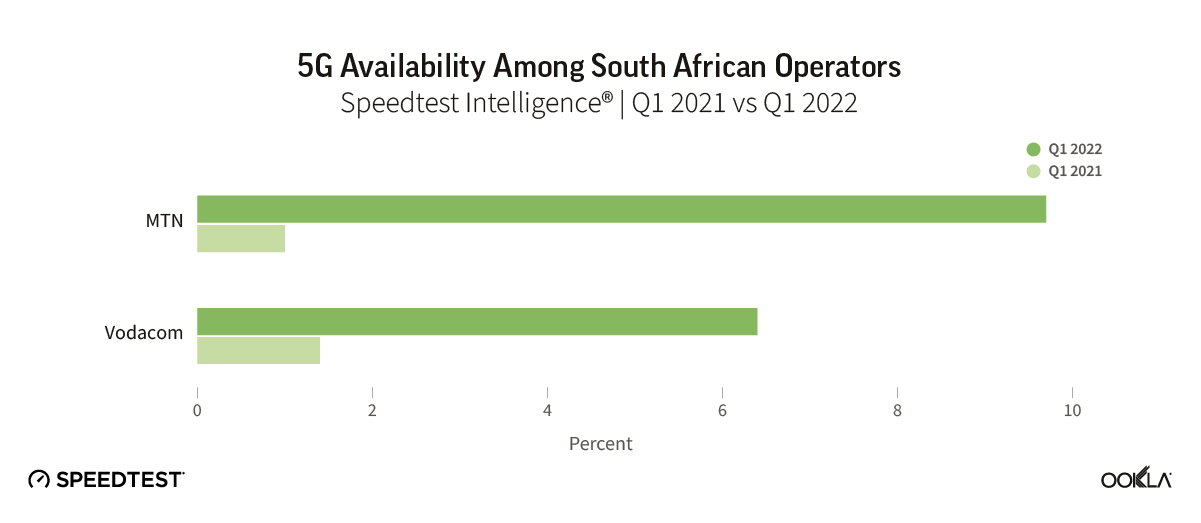

Consumer attitudes improve

To assess whether there has been a shift in the consumer’s attitude towards mobile operators over the past year, we utilized Speedtest® Consumer Sentiment data, which is gathered from single-question surveys presented to users at the end of a Speedtest. This dataset provides rich insights into customer satisfaction over time, as well as competitive benchmarking, by providing data on both Net Promoter Score (NPS) and customers’ rating of their providers. Upon its entry into the market, DITO was rated most highly, which reflected its approach to winning customers’ mindshare. This, however, has changed — as of Q1 2022, Smart came first in ratings. Noteworthy though, is the overall improvement across operators, which is also linked with the mobile speeds increase.

Chart of five-star ratings of top mobile providers in the Philippines

Comparing NPS score to providers’ performance it is clear that better speeds impacted customer perception of operators. In Q1 2021, NPS for all cellular technologies was -34.53 with an average download speed of 6.47 Mbps, which improved to -25.32 in Q1 2022 (8.75 median download speed).

We’ll continue using data from Speedtest Intelligence to see how 4G and 5G in the Philippines improves with additional operator investment and how consumers benefit.

Ookla retains ownership of this article including all of the intellectual property rights, data, content graphs and analysis. This article may not be quoted, reproduced, distributed or published for any commercial purpose without prior consent. Members of the press and others using the findings in this article for non-commercial purposes are welcome to publicly share and link to report information with attribution to Ookla.