| January 19, 2026

Oman’s Path Toward Faster, More Accessible, and Resilient 5G Services

Oman is one of the most dynamic mobile markets in the Gulf region, with three mobile operators, Omantel, Ooredoo, and Vodafone, and two MVNOs, Friendi and Renna. Increased competition and infrastructure investments, combined with the refarming of 3G spectrum, helped Oman lift its position in Ookla’s Speedtest Global Index™ in 2025. This article shares insights about the mobile performance evolution of the three operators, discusses the drivers for its improvement, and assesses the country’s network resilience during the Red Sea cable cut in September 2025.

Key Takeaways:

  • Oman’s regulatory strategies drove competition and 5G expansion. The infrastructure sharing policies of the Telecommunications Regulatory Authority (TRA) that supported the entry of a third mobile operator, Vodafone, in 2022, combined with mid- and low-band spectrum allocation and the mandated 3G network sunset roadmap, contributed to the rapid expansion of 5G population coverage (reaching 91% in 2024).
  • Increased investment and network improvements led to a rise in Oman’s ranking in Ookla’s Speedtest Global Index. Operator investments grew significantly between 2021 and 2025, expanding the 5G site count to 6,671 by mid-2025. These investments, alongside the competitive and regulatory environment, resulted in all-technologies’ median download speed more than doubling to 121.84 Mbps by the end of 2025, while 5G download speed reached 259.94 Mbps. Consequently, Oman climbed five positions to the 18th spot in the Index in 2025.
  • Omantel and Ooredoo maintain a significant performance lead over Vodafone in 5G download speeds. This advantage is attributed to the greater spectrum holdings of the two incumbent operators, particularly in the mid-band (3.3-4.2 GHz) for 5G, and ongoing substantial infrastructure investments. On the other hand, Vodafone’s limited spectrum assets appear to be constraining its download speeds, while its upload speeds are more competitive thanks to its use of 700 MHz FDD spectrum band.
  • Oman’s geo-redundant international connectivity strategy provided superior resilience during the September 2025 Red Sea cable cuts compared to neighboring Gulf countries like the UAE. Oman leverages over 20 subsea cables and terrestrial links, allowing operators to reroute traffic and mitigate against impacts to online service quality, evidenced by only a small increase in gaming latency and web loading time during the outage.

Competition has been driving network investment and has contributed to improving the network experience for users in Oman

Vodafone’s entry into a saturated mobile telecom market in Oman in March 2022 has significantly reshaped the competitive landscape, long dominated by Ooredoo and Omantel. It created an impetus for further growth, leading to a jump in the number of mobile subscribers to over 6.6 million in Q2 2025, up from 5.7 million in Q1 2022, corresponding to a mobile penetration of 125.5%. Note that the drop in population penetration at the end of 2024 is due to adjustments to the government’s population figure.

Mobile subscribers and population penetration, Oman
Source: TRA | Q1 2022 – Q2 2025

Vodafone’s competitive pricing and digital-first strategy helped it to rapidly expand its market share within 3 years to reach 16% by the end of June 2025. MVNOs, Renna and Friendi (piggybacking on the network of Omantel and Vodafone, respectively), also control a sizable share of the market at 19% by targeting the youth and expat segments, respectively. That said, Omantel and Ooredoo, which share a similar market share, continue to control the majority of the market in terms of subscribers.

Mobile Subscribers’ Market Shares, by Operator, Oman
Source: TRA | H2 2023 – H1 2025

5G was launched in late 2019, initially to provide fixed-wireless access (FWA) services, before enabling 5G mobile services in 2021. Market players have been increasing their mobile infrastructure capex since, growing from OMR 87.1 million ($226.1 million) in 2021 to OMR 124.3 million ($323.0 million) in 2024, according to the TRA. This helped to expand the 5G network from 1,587 sites with population coverage of 44.9% in 2021 to 5,893 sites with population coverage of 91% in 2024. By comparison, 5G population coverage reached 99% in Qatar and the UAE, according to regulatory and operators’ sources. This is quite an achievement considering that Oman has a larger land mass and more challenging terrain to deploy telecom infrastructure.

These investments enhanced broadband services for consumers and businesses, providing higher download and upload speeds. According to Speedtest Intelligence® data, the 5G median download speed experienced by end users in Oman rose from 191.03 Mbps in Q4 2022 to 259.94 Mbps in Q4 2025. During that period, the median speed for all technologies saw more impressive improvements, more than doubling and reaching 121.84 Mbps by the end of 2025. As a result, Oman moved up to the 18th position in the Speedtest Global Index by five places between January and December 2025.

All Technologies and 5G Median Download Speed, Oman
Source: Speedtest Intelligence® | Q2 2022 – Q4 2024

Regulatory decisions have played a role in boosting 5G coverage and enhancing network performance.

The TRA initiated a network sunset roadmap for 3G, freeing valuable spectrum for 4G and 5G, and encouraging infrastructure sharing, which was instrumental in lowering the barrier to entry for the third operator, Vodafone.

Omantel and Ooredoo were allocated a 100 MHz block each in the prime mid-band spectrum (3.4 – 3.7 GHz) in 2019 to launch 5G services. This band is critical because it offers an optimal balance between coverage and capacity (up to gigabit speeds), and benefits from wide smartphone support. Finally, TRA allocated 26 GHz spectrum (mmWave) in March 2024, to be used for 5G and future 6G trials, while exempting operators from spectrum fees during the experimentation period.

A cornerstone of the TRA’s strategy to improve network performance and spectral efficiency was the mandated retirement of legacy 3G infrastructure. By decommissioning 3G, the TRA allows operators to refarm valuable low-band spectrum (typically 900 MHz and 2100 MHz) for 4G and 5G use, which provides far greater data capacity per MHz of spectrum.

The TRA coordinated a phased regional shutdown of 3G, from low-density areas to the capital, to minimize consumer disruption. The process was largely completed by mid-2025. That said, the TRA maintained legacy service on a few stations near Muscat International Airport to comply with specific aviation or legacy system requirements.

As part of the 3G network sunset, more than 5,600 base stations were deactivated or upgraded nationwide. The TRA also halted the import of mobile devices that did not support at least 4G and VoLTE, ensuring that consumers maintain voice and data access once the 3G network is shut down.

The regulator also mandated the “sale and leaseback” and the sharing of passive infrastructure, such as towers, to reduce capex and encourage investment in active equipment. (e.g., radio network, core network). To this end, it established Oman Tower Company (OTC) in 2018 to acquire existing structures from operators, and build and operate new ones in order to lease them back to the operators. The primary beneficiary of this policy was the third mobile operator, Vodafone, which launched commercial operations rapidly in 2022 and focused its investment capital on active equipment and customer acquisition. In addition to the creation of OTC, the TRA mandates that dominant operators must share their passive infrastructure with other licensed players on reasonable and fair terms.

Omantel and Ooredoo lead in 5G network performance thanks to their spectrum assets and massive investments

Omantel was the first to launch 5G mobile services in February 2021. It deployed nearly 2,300 5G sites and 3,800 4G sites by the end of 2024, having trialed 5G Advanced (5.5G) and activated a second 5G carrier, 100 MHz on 2.5 GHz, in 2024. Omantel allocated OMR 80.9 million ($210.21 million) in 2024 to its network, primarily tied to 5G rollout and 4G network expansion, achieving 92% population coverage and 98% for 4G. 

Ooredoo introduced 5G mobile services in April 2021. The company focused its investments in 2024 and 2025 to close the 5G coverage gap, and dedicated 84% of its OMR 38 million ($98.75 million) CAPEX in the first nine months of 2025 to network expansion. As a result, 5G population coverage increased from 79% in 2024 to 97% in September 2025. In addition, it boosted capacity on existing sites with high demand, especially to support fixed wireless access services.

The entry of Vodafone forced the incumbents to accelerate their own investment plans to defend their market share. Vodafone adopted an asset-light business model, facilitating services’ rapid deployment and minimizing capital expenditures. For example, it initially leased tower capacity from Oman Tower Company (OTC) for its 5G network and roamed over Ooredoo’s network for 4G services while it was building its own coverage. By May 2025, it deployed a cloud-based 5G network powered by more than 2,572 5G sites, achieved over 98% population coverage, and reached one million users connected to its 5G network. Its cloud-native 5G core paves the way for a future commercial 5G standalone (SA) deployment. 

Strategic spectrum allocation, activation of new carriers, combined with infrastructure investments, helps Omantel and Ooredoo to defend their market position and outperform Vodafone in terms of network speeds. Both operators benefit from wider bandwidth allocations for 5G compared to Vodafone: the two incumbents had access to 100 MHz on 3.3-4.2 GHz carriers for 5G; Omantel has a further 100 MHz on a 2.5 GHz carrier (but less used than the C-band), while Vodafone opted to use only 40 MHz on the 2.5 GHz band and 10 MHz on the 700 MHz band, dynamically shared (with DSS) between LTE and 5G.

Spectrum dedicated to 4G services also impacts 5G performance since the latter is deployed in 5G non-Standalone (NSA) mode in Oman, meaning that the core network is still 4G and acts as the anchor carrier. Ookla Speedtest data, illustrated in the chart below, shows that Omantel and Ooredoo hold more diversified spectrum bands and wider bandwidth for each of them compared to Vodafone. Note that the data presented in this chart is based on samples from Android-based handsets and that “Max Bandwidth” refers to the maximum bandwidth reported by handsets, per carrier within the band

Ookla data also shows that Omantel’s 4G users are heavily concentrated in the 1800 MHz primary band, while 800 MHz is the second most frequently used primary carrier. Ooredoo’s 4G users are more well-distributed across different spectrum assets, spread mostly between 1800 MHz, 2100 MHz, and 800 MHz. Finally, Vodafone’s 4G user distribution is more concentrated in the 1800 MHz carrier, while fewer users camp on the 900 MHz and 700 MHz bands. Note that Omantel’s 35 MHz bandwidth in the 1800 MHz band is split between 2 carriers: 20 MHz and 15 MHz.

4G Bandwidth per Frequency Band Used, Per Operator, Oman
Source: Speedtest® Data

Ookla data also reveals operators are exploring the use of new spectrum bands for 5G. For example, Omantel is considering 900 MHz and 2100 MHz bands, while Ooredoo is testing 1800 MHz and 800 MHz bands. It has also activated 80 MHz in the 2300 MHz band in the summer of 2025 (see image below). Access to additional spectrum bands provides the operators with faster speeds, increased capacity, wider coverage, and lower latency. Specifically, access to low-band, sub-GHz spectrum improves session continuity and provides wider coverage, and when aggregated with mid-band spectrum, allows increased download capacity.

Maps of samples showing the activation of a new 5G carrier, Ooredoo, Oman

Ookla Speedtest Intelligence data show that 5G median download speeds for both Omantel and Ooredoo have been trending up since Q3 2023, to reach 323.41 Mbps and 321.67 Mbps, respectively, in Q4 2025. Ooredoo’s jump in performance in the last two quarters of 2025 is likely the result of the activation of 80 MHz in the second carrier of the 2300 MHz.

During that period, Vodafone’s median 5G download speed slightly declined to 87.9 Mbps, reflecting the more limited spectrum bandwidth forcing traffic to be equally split between 700 MHz (as the coverage layer) and 2.5 GHz (the capacity layer), in addition to growing demand on its network. The results for 5G upload speeds are more convergent with Vodafone, Ooredoo, and Omantel achieving 24.98 Mbps, 24.96 Mbps, and 20.84 Mbps, respectively, in Q4 2025, after leading the market in this area before.

5G Median Download and Upload Speeds, Per Operator, Oman
Source: Speedtest Intelligence® | Q2 2022 – Q4 2024

Oman’s network resilience: mitigating the Red Sea cable crisis

The Omani government is committed to expanding the digital infrastructure in the country as part of the country’s “Vision 2040” to drive innovation, economic diversification, and improve public services. As part of its strategy, Oman aims to consolidate its position as a regional hub for international connectivity.

Oman successfully leveraged its unique geographical location to offer unmatched route diversity and wholesale connectivity dominance in the region. By facing both the Arabian Sea and the Indian Ocean, Oman can establish different traffic routes between Asia in the East, and Africa and Europe in the West.

Zain Omantel International (ZOI), a joint venture that combines the international wholesale assets of Omantel and Zain, played an important role in ensuring that the outage had a limited impact on Omani internet users. ZOI operates more than 20 terrestrial and subsea cables that land in Oman. This multiplicity of traffic routes has resulted in better resilience for local operators compared to some of their peers in the Gulf region, particularly in the UAE. This was evidenced during the recent cuts in the subsea cables across the Red Sea on September 6th, 2025, which took offline two main cables, SMW4 and IMEWE, near Jeddah (Saudi Arabia), disrupting connectivity across the Middle East, South Asia, and Africa. 

Map of Subsea cables operated by Zain Omantel International (ZOI) and the approximate location of Red Sea cable cuts

Operators in the region, including ZOI, are considering deploying terrestrial and hybrid (subsea and terrestrial) cables. Although terrestrial routes are more expensive to deploy per kilometer compared to submarine cables, they are more resilient and could offer shorter routes. For example, ZOI announced a partnership with Telecom Egypt to establish a new route that combines terrestrial (via Saudi Arabia) and subsea segments. A terrestrial fiber optic project called SONIC (Saudi Omani Network Infrastructure Corridor) is being built by stc (Saudi) and Ooredoo (Oman), planned for completion in 2026. ZOI is also building an 8,000 km terrestrial fiber network connecting Saudi Arabia with all neighboring countries, including Oman.

Another integrated subsea and terrestrial network is planned across 8 MENA countries, including Jordan, Oman, and Saudi Arabia, TEAS (Trans Europe Asia System). Once operational, it will be available on an open access model with a choice of vendors and local operators at its landing stations. These projects will complement existing subsea cables by bypassing the Red Sea altogether and reinforce the country’s position as a digital hub. 

Consumer QoE data from Ookla shows the negative impact of this outage on the response time of web browsing and gaming services, particularly for UAE users, as traffic had to be rerouted via non-optimal and longer paths. In contrast, users in Oman saw only a small increase in latency during the same period. For example, web loading time jumped from 2.14 seconds on September 2nd to 3.51 seconds on September 7th, while in Oman, it jumped only from 1.89 seconds to 2.44 seconds over the same period. Game latency was also affected during the outage, peaking at 137 ms on September 6th in the UAE (up from a baseline of 91), while in Oman, it reached 97 ms (up from 83 ms).


Impact of Red Sea Cable Cuts on Mobile QoE
Source: Speedtest Intelligence® | Sep 2 – Sep 9, 2025

Oman’s mobile market has been fundamentally reshaped by regulatory mandates, such as the 3G network sunset, and aggressive investment, particularly since the entry of Vodafone. These factors have significantly elevated the country’s mobile performance and its standing in the Speedtest Global Index, and created a healthy competitive environment that benefits end users. Omani operators have not only built national networks that can deliver very fast download speeds over 5G, but the nation’s multi-route connectivity strategy, spearheaded by Omantel, has proven effective in establishing Oman as a case study for digital resilience in the face of international cable outages.

Please contact us for more details on how tools such as Speedtest Intelligence can help provide actionable insights into network performance and resilience.

Ookla retains ownership of this article including all of the intellectual property rights, data, content graphs and analysis. This article may not be quoted, reproduced, distributed or published for any commercial purpose without prior consent. Members of the press and others using the findings in this article for non-commercial purposes are welcome to publicly share and link to report information with attribution to Ookla.

| January 19, 2026

Analyzing the Uplink in the Age of AI

Emerging AI technologies could put an increased focus on mobile users’ upload connections and capabilities.

Most mobile users today are mostly concerned with surfing the web, watching videos and checking social media – all tasks that center on their phone’s ability to pull data down from the internet.

But this may change as AI sails into the mainstream. Already services like ChatGPT can analyze users’ uploaded pictures. And some smart glasses hint at a future where AI could provide real-time insights into an uninterrupted, uploaded live stream of users’ daily activities.

This kind of future could put new demands on mobile networks. Thus, it’s worth looking at how mobile network operators globally have managed their uplink connections to date, in the shadow of this possible AI future.

Key takeaways:

  • Of the 17 major operators analyzed in Ookla Speedtest Intelligence® data, U.S. providers allocated the smallest percentage of capacity to users’ uplink connections. Chinese operators allocated the largest percentage.
  • Mobile upload speeds have been rising globally from 2021 to 2025, thanks to the release of additional spectrum and a variety of technological advances. But operators have not been increasing the percent of network capacity allocated to uplink connections during this period. Some have been reducing that percentage.
  • According to Ookla RootMetrics® drive test data for the U.S. market, T-Mobile, AT&T, and Verizon all allocated 20% of their Time Division Duplex (TDD) midband network “slots” to uplink connections in the second half of 2025. TDD is widely used among 5G network operators to determine the ratio between uplink and downlink resources in midband spectrum.
  • Future AI technologies could create new networking demands. For example, widespread adoption of smart glasses – those that upload users’ live views for AI analysis – may create a multitude of lengthy, continuous video streams that could pose difficulties for bandwidth-constrained uplink connections. At the same time, however, there are plenty of unknowns in this emerging space. For example, will most future AI requests be answered by software running inside of users’ phones, thus eliminating the need for a network connection entirely?

Anticipating the effect of AI on the network

Meta’s newest smart glasses allow users to receive an AI analysis of what they see. Google’s Gemini Live provides a similar service. These types of offerings hint at a new paradigm of computing that could eventually stream users’ live video feeds directly to an AI analysis bot. This constant visual data stream could even allow AI to proactively understand a user’s context in real-time and offer immediate, situation-specific assistance, without being prompted.

Real-world scenarios using this type of technology abound. For example, as a user looks at a broken appliance, an AI bot could identify the specific model, access repair manuals, and highlight exactly which component needs attention via audio and visual cues. It could provide instant translation of foreign street signs as a user walks past them, or it could offer nutritional analysis of food via a glance at a menu.

If these kinds of services become popular, high levels of uplink traffic could put additional demand on mobile networks globally. Already 5G equipment vendor Ericsson has speculated on what this AI future might mean for mobile network operators. “The uplink traffic will increase significantly over the coming years and, indeed, is becoming telecom’s new ‘currency,’” the company wrote. “This potential growth of uplink traffic underlines the importance of network capacity planning, spectrum allocation, and RAN [radio access network] feature developments.”

Ericsson isn’t alone. “AI changes how traffic is generated, where it flows and when it peaks. It increases uplink use in the home, it injects automation and machine vision into industrial sites, and it multiplies east–west movement between data centers,” Nokia wrote in its own report on future mobile traffic, including from AI.

And in a new report, the GSMA trade association offered three different scenarios for future growth of traffic on mobile networks globally. “In the low-growth scenario, the downlink remains predominant at around 85% of total traffic, with uplink at 15%,” the firm wrote. “However, in the medium- and high-growth scenarios, the share of uplink increases to around 25% and 35%, respectively, by 2040.” The reason? AI.

But such predictions are just that: forecasts that may – or may not – come true. There is still much uncertainty regarding the parameters and the extent of AI traffic on a wireless network. For example, it’s not clear how much AI processing will ultimately be conducted on users’ devices and how much will need to be routed through a network connection to a cloud-based computing service. This question is central to forecasting AI’s eventual networking demands.

Another unknown involves the speed at which AI requests will need to be answered. This topic sits in the realm of latency – the time it takes for a cloud-based service to respond to a request from a user – and it too will have serious implications for eventual AI networking designs.

Yet another unknown involves the extent to which 5G will play a role in an AI future. How many AI requests will be routed through wired and Wi-Fi connections? Will those types of non-cellular networking connections be pervasive enough to reduce any possible AI strain on a 5G operator’s network?

Such questions go on and on: Will newer video compression technologies ease upload bandwidth demands? Will technological advancements – such as those from new 5G-Advanced standards – make wireless networks even more speedy and efficient?

With all that said, now is the time for 5G operators to begin considering how AI might affect the usage of their networks. For years now, mobile users globally have been sucking down movies and memes on the downlink. But AI may flip that: It will need eyes and ears to work, and that could translate into massive streams of data flowing up from users to the internet.

Operators gauge uplink capacity allocations

Frequency Division Duplexing (FDD) was used widely in previous generations of cellular technology, including 4G LTE, to determine the amount of capacity allocated to users’ uplink connections. FDD divides users’ uplink and downlink connections into two dedicated, separate channels. Think of FDD traffic as lanes on a highway separated by a concrete barrier: One lane is permanently dedicated to uplink traffic, and the other is permanently dedicated to downlink traffic. This setup worked well for initial networking priorities focused on voice and coverage in spectrum allocations between 5 MHz and 20 MHz.

But FDD doesn’t cut it in the age of 5G. Operators need speedy, efficient and flexible data connections, particularly when they’re dealing with chunks of midband spectrum that can range up to 100 MHz or higher.

“To increase flexibility as well as make spectrum usage more efficient, Time Division Duplex (TDD) is becoming increasingly common and important,” noted the GSMA global trade association.

As a result, many of today’s midband 5G networks use TDD. For example, according to Ookla’s RootMetrics drive testing data in the U.S., a large portion of T-Mobile’s 5G samples used TDD technology. Specifically, around 93% of T-Mobile’s downlink samples used standalone (SA) 5G in the second half of 2025. Of that 93%, 78.6% used TDD and the rest (14.4%) used FDD.

TDD essentially uses a single “lane” for data traffic in both directions, upstream and downstream, but it rapidly switches the direction of the flow of traffic thousands of times per second. By adjusting the timing of this “traffic light,” an operator can decide to keep the light green for downloads for 80% of the time and only switch to uploads for 20% of the time, for example.

While dynamic TDD allocations may be possible – where an operator adjusts its traffic light in real time to meet a sudden surge in users’ uplink demands – most operators stick to static, synchronized patterns to maintain network stability and prevent interference.

Upload capacity varies by operator and geography

Since operators have some control over the network resources they allocate to uplink connections versus downlink connections, it’s worth looking at how some of the biggest operators in the world handle this decision.

To do so, we used the relationship between upload and download speeds as a basic proxy for carriers’ allocation of networking resources toward uplink and downlink capacity. (This is separate from Ookla’s Speed Score® that incorporates download speeds, upload speeds, and latency).

To be clear, upload and download speeds are a product of operators’ network capacity decisions, but they can be affected by a wide variety of factors including operators’ spectrum holdings and the capabilities of users’ phones. Nonetheless, this study of operators’ upload and download speeds helps to shine a light into their capacity priorities within the parameters of what they can control.

The below findings are from Ookla Speedtest Intelligence data. They show the percent of networking capacity dedicated to operators’ uplink connections, which we calculated by dividing aggregated upload speeds by the sum of operators’ aggregated download and upload speeds. We only used the top 10% fastest 5G download samples (using both FDD and TDD) in order to obtain a clearer view into operators’ networking designs, one that’s unimpeded by connections potentially suffering from interference, network congestion, or other issues.

Network Resources Allocated to Uplink Connections
Speedtest Intelligence | 2025

Of the operators studied, it’s clear that Chinese wireless network operators like China Telecom and China Unicom likely allocate a larger portion of their network capacity to users’ uplink connections

On the other end of the chart, U.S. operators like Verizon, AT&T, and T-Mobile likely allocate a smaller portion of their network capacity to users’ uplink connections.

It’s also worth noting that overall spectrum ownership doesn’t appear to affect operators’ approaches to uplink capacity. For example, according to the GSMA’s Spectrum Navigator, Vodafone holds the most overall midband and lowband spectrum (526 MHz) of the 17 operators studied. China Telecom sits in the middle of the pack with 220 MHz of midband and lowband spectrum. And AT&T sits near the bottom with 172 MHz.

The ratio between uplinks and downlinks could reflect a wide range of factors such as differences in customers’ usage patterns, device capabilities, local competition among operators for the title of fastest provider, network vendor capabilities, and other parameters. Indeed, some Asian network operators have been highlighting service plans that focus on uplink performance as a way to entice livestreamers.

That focus on the uplink could expand to other markets. Uplink is “one of most under-talked topics of the industry,” T-Mobile Chief Network Officer Ankur Kapoor recently told Fierce Network.

As speeds rise, downlinks dominate

Most users around the world are enjoying faster uplink speeds than ever before. For example, overall mobile upload speeds in the U.K. increased by around 36% between 2021 and 2025, according to Ookla Speedtest Intelligence data for the market’s 10% fastest connections across all mobile technologies. In the U.S., that figure is around 40%. Other leading 5G markets have seen similar improvements.

This uplift can be traced to a wide variety of factors ranging from additional spectrum allocations (more spectrum typically results in faster speeds) to technological innovations like carrier aggregation (which can speed up connections by “glueing” together transmissions in different spectrum bands) and MIMO antennas (which can transmit and receive simultaneous data streams).

But there are also plenty of caveats. Yes, mobile upload speeds have been rising globally, but that’s mainly because 5G enables faster overall connections, both on the uplink and the downlink. In some countries, like Brazil, the percentage of network capacity allocated to upload speeds has been falling. In other countries, like China, the capacity allocated to the uplink has been holding relatively steady. In no country in this study is the percentage of capacity allocated to the uplink rising in a significant way.

Percent Capacity Allocated to Upload
Speedtest Intelligence | 2021 – 2025

The data reveals a clear trend: as mobile network technologies mature and meet baseline user needs for upload capacity, operator focus pivots toward driving ever-faster download speeds. Indeed, overall mobile download speeds in the U.K. increased by around 58% between 2021 and 2025, according to Ookla Speedtest Intelligence data for the market’s 10% fastest connections across all mobile technologies. In the U.S., that figure is around 251%.

Thus, while uplink performance is improving, the proportional importance of download capacity continues to dominate operator investment and network configuration choices.

Here too are caveats. Network operators can tweak their networks in different ways for different locations. For example, venues like sports stadiums or concert halls may feature network settings and equipment tuned in ways that aid fans’ uplink connections.

Another important caveat: Nationwide standards for TDD connections designed to prevent interference. As explained by the GSMA, all the operators in a given geographic area that use 5G TDD in spectrum bands like 3.5 GHz must synchronize their network “clock” and frame structure so that all their users transmit and receive data at the exact same times. This helps prevent interference and avoids large, inefficient physical separation zones between networks. This may explain the similarities in uplink percentages among operators in the same geographic markets in recent years.

RootMetrics highlights operators’ uplink settings

Aggregated Speedtest results are one way to gain a view into operators’ uplink calculations. Another, more exacting method is via RootMetrics drive test results. Such tests – using flagship, off-the-shelf Android smartphones – provide a deeper look into operators’ network settings via 11 million total tests conducted annually. RootMetrics administers controlled, nationwide testing in the U.S. and elsewhere.

A sampling of RootMetrics’ insights into uplink connections: Roughly 79% of T-Mobile’s uplink sample tests in the second half of 2025 traveled over the operator’s 2.5 GHz midband spectrum holdings. And just over one-third of those samples used two-carrier aggregation technology. By aggregating multiple carriers on the uplink and downlink, operators can increase users’ overall speeds.

More importantly, RootMetrics data can offer a closer look at the uplink settings deployed by U.S. wireless network operators. For example, it can show the number of network “slots” allocated to uplink connections. In TDD networks, “slots” are the specific time intervals – typically measured in milliseconds – within a transmission frame that are designated for either sending data (downlink) or receiving data (uplink).

According to RootMetrics U.S. data, T-Mobile, AT&T, and Verizon all allocated 20% of their TDD midband network “slots” to uplink connections in the second half of 2025. However, the operators’ median upload speeds during that period showed some variation:

U.S. Median Upload Speeds
RootMetrics | 2H 2025

There are a variety of reasons behind these results. For example, T-Mobile was an early mover to 5G standalone (SA) technology, which generally supports speedier connections than non-standalone (NSA) architecture. Furthermore, T-Mobile’s midband 5G network sits in 2.5 GHz spectrum, whereas Verizon’s uses C-band and AT&T uses both 3.45 GHz and C-band. And the operators also apply different levels of carrier aggregation to their uplink connections.

That last item – carrier aggregation – can have clear impacts on users’ uplink speeds. For example, the Samsung Galaxy S24 and S25 Ultra smartphones are endowed with carrier aggregation technology for uplink connections. Such technology binds two bands of spectrum together to improve network capacity and upload speed. T-Mobile in 2024 enabled two-carrier aggregation for uplink connections on its 5G SA network. The result of this deployment can be seen within Speedtest data:

Upload Speeds Among T-Mobile's Top 10% Fastest 5G Samples
Speedtest Intelligence | Q4 2025

In RootMetrics’ testing in the fourth quarter of 2025, roughly 37.8% of T-Mobile’s 5G SA samples in its 2.5 GHz spectrum used two-carrier aggregation technology.

Ookla analyst Kerry Baker contributed to this article.

Ookla retains ownership of this article including all of the intellectual property rights, data, content graphs and analysis. This article may not be quoted, reproduced, distributed or published for any commercial purpose without prior consent. Members of the press and others using the findings in this article for non-commercial purposes are welcome to publicly share and link to report information with attribution to Ookla.

| June 30, 2025

Starlink Elevates In-Flight Wi-Fi Performance

Airlines are using in-flight connectivity to differentiate their service and create brand value

Just as hotels have progressively integrated Wi-Fi connectivity as a standard amenity for their guests, in-flight Wi-Fi is transitioning from a novelty to a convenience to an expected service.

Reflecting this increasing expectation, the American Customer Satisfaction Index (ACSI) this year incorporated “Quality of in-flight Wi-Fi” into its benchmarks for the airline industry. In-flight Wi-Fi placed 21st out of the 21 benchmarks, ranking lower than baggage handling, seat comfort, and even airline food.

To assess this performance, we analyzed our Speedtest data collected during Q1 2025. We examined performance for individual airlines and for in-flight connectivity service providers.

KEY TAKEAWAYS:

  • In-flight Wi-Fi for the majority of users compares very poorly with their experience on terrestrial networks
  • Hawaiian Airlines and Qatar Airways stand out as the best performing airlines based on our data
  • Starlink’s low-earth orbit (LEO) satellite constellation drives performance for leading airline Wi-Fi
  • Expect airlines to ramp up their efforts — in-flight connectivity can be a key point of differentiation for travelers, helps support the premium brand value that many international airlines aspire to create, and is an opportunity to monetize a literally captive audience

Airline In-Flight Wi-Fi Performance – Download / Upload / Latency

In-flight Wi-Fi Speed and Latency Performance by Airline
Speedtest data, Q1 2025, airlines sorted by median

Hawaiian Airlines and Qatar Airways use Starlink’s low-Earth orbit (LEO) satellite constellation to deliver their inflight Wi-Fi, resulting in download speeds and upload speeds and latency that are better than the other airlines.

Many other airlines are also providing very usable speeds. Spirit Airlines, Air Canada, Delta Airlines, Breeze Airlines, American Airlines and Aeromexico all provide 10th percentile (where 90% of the results are faster) download speeds above 10 megabits per second (Mbps) and very respectable median download speeds. Furthermore, upload speeds on most of these airlines tend to support basic uplink connectivity needs like emailing. However, when the upload speed is observed alongside the many high-latency results, real-time uses like gaming or video calling are likely not possible (to the relief of all other passengers).

Lufthansa, at the other end of the download speed ranking, is limited by the Deutsche Telekom LTE ground-to-air network. While Lufthansa may offer other connectivity options, our data shows a significant number of its passengers are still connecting via this poorer-performing service.

Likewise, given the premium brand reputation of carriers like Japan Airlines, Turkish Airlines, and Cathay Pacific, they likely offer better-performing connectivity services on other aircraft. However, as with Lufthansa, our data reveals that a notable portion of their passengers are still encountering a substandard Wi-Fi experience.

Qatar Airways presents additional insight as, along with Starlink as one of its connectivity service providers, it also operates planes with geo-stationary orbit GEO connectivity. This is most evident in the multiserver latency results. While Qatar’s median latency is similar to Hawaiian Airlines, its 10th percentile (the laggiest experience) is much higher, keeping it in the company of other GEO-supported airlines.

Connectivity Service Providers

In our Speedtest samples of in-flight connectivity service providers we collect a mix of GEO, LEO, medium earth orbit (MEO), multi-orbit / hybrid network providers, and even ground-based LTE.  Furthermore, the category includes satellite service integrators. These integrators do not own or operate their own satellite constellations. Instead they partner with satellite operators for capacity while managing the business relationship with the airline, including installing and managing the in-flight connectivity system on the aircraft.

In-flight Connectivity Service Providers and Associated Airlines

Deutsche TelekomAir France, Cathay Pacific, Condor, Lufthansa
Hughes (SES)Spirit Airlines
Inmarsat (Viasat)Air New Zealand, Qatar Airways
IntelsatAir Canada, Alaska Airlines, American Airlines, United Airlines
MTN Satellite CommunicationsSouthwest Airlines
Nelco (PAC/Intelsat)Air India
Panasonic Avionics CorporationAer Lingus, Air France, American Airlines, ANA, Asiana Airlines, British Airways, Etihad Airways, EVA Air, Fiji Airways, Finnair, Iberia Airlines, ITA Airways, Japan Airlines, KLM, Korean Air, Malaysian Airlines, Scandinavian Airlines, Singapore Airlines, SWISS Airlines, TAP Air Portugal, Thai Airlines, United Airlines, Virgin Atlantic, VoeAzul, WestJet, Zipair Tokyo
SITA SwitzerlandQatar Airways
SpaceX StarlinkHawaiian Airlines, Qatar Airways
Türk TelekomTurkish Airlines
ViasatAeromexico, American Airlines, Breeze Airlines, Delta Airlines, EL AL Airlines, Icelandair, JetBlue, Southwest Airlines, United Airlines, Virgin Atlantic
* Based on Speedtest data samples, Q1 2025; not based on active or announced partnerships
  • Deutsche Telekom is in the European Aviation Network, a hybrid network that combines a GEO satellite from Viasat/Inmarsat with a ground-based LTE network across Europe. 
  • Hughes, an EchoStar company, provides GEO satellite internet for consumers and enterprises. In late 2022 it began offering “Hughes Fusion,” a multi-orbit in-flight connectivity solution that can simultaneously communicate with both GEO and LEO satellites. Hughes frequently collaborates with European satellite operator SES, a GEO and MEO provider.
  • Intelsat provides in-flight connectivity through its fleet of GEO satellites and offers a multi-orbit solution that combines its GEO network with access to a LEO constellation. Intelsat is in the process of being acquired by SES.
  • MTN Satellite Communications, primarily known for its services in the maritime and remote land-based sectors, also provides in-flight connectivity. The company leverages capacity from various satellite operators across different orbits, both GEO and LEO.
  • Nelco, a Tata Group enterprise, has partnered with Intelsat to offer its GEO-based connectivity services to airlines operating in Indian airspace. 
  • Panasonic Avionics Corporation (PAC) – a provider of in-flight entertainment and connectivity systems, does not operate its own satellite constellation. Instead, it partners with various satellite operators, including those with GEO and LEO networks (eg, Eutelsat OneWeb), to offer multi-orbit connectivity service to airline customers.
  • SITA Switzerland, a multinational information technology company, partners with satellite network operators, to deliver passenger broadband.
  • SpaceX Starlink is rapidly expanding its LEO satellite network, offering high-speed, low-latency internet service to airlines, and is being adopted by several carriers.
  • Türk Telekom has been providing in-flight connectivity through partnerships including Panasonic Avionics.
  • Viasat operates a constellation of high-capacity GEO satellites. Its services are used by numerous airlines globally. Viasat acquired Inmarsat, another GEO satellite network, in May 2023.

Connectivity Service Provider In-Flight Wi-Fi Performance – Download / Upload / Latency

In-flight Wi-Fi Speed and Latency Performance by Connectivity Service Provider
Speedtest data, Q1 2025, provider sorted by median

The advantages of its dense LEO constellation compared to the GEOs make SpaceX’s Starlink the clear standout in speeds and latency. Its medians are 152.37 Mbps download speed, 24.16 Mbps upload speed, and 44 milliseconds (ms) multi-server latency.

Hughes and Intelsat, with their multi-orbit offering, deliver solid median download speeds – 84.55 Mbps and 61.61 Mbps, respectively. Viasat performs well on download speed, too, at 50.38 Mbps, given it is a GEO provider. 

On the other end of the scale, the LTE ground network of Deutsche Telekom delivers a minimally usable median download speed of 4.14 Mbps. Passengers on these flights may have access to GEO services (which, for example, we see in our data with Air France, though not in sufficient sample size to include in this article), but, as stated above, given we record Speedtest samples on Deutsche Telekom means that passengers are connecting with very slow internet speeds.

Looking more closely at slower download speeds, the 10th percentile reveals a similar pattern to the median, with Starlink still performing well at 65.31 Mbps, and Hughes and Viasat still managing usable download speeds of 28.29 Mbps and 12.78 Mbps, respectively. The rest of the provider speeds tail off and down into the single-digit Mbps, and raises a question: is it the satellite constellation capacity or the onboard Wi-Fi technology (or both) that is the limiting factor? The question of onboard Wi-Fi technology is taken up in the conclusion to this research article.

Examining the uplink, besides Starlink at 24.16 Mbps, only Intelsat provides adequate median upload speeds at 9.96 Mbps. Next, Panasonic Avionics, Turk Telekom (also PAC) and Nelco (also PAC) neatly cluster – 3.65, 3.40 and 2.60 Mbps, respectively – followed by Deutsche Telekom at 2.53 Mbps.

Latency is the starkest separation between LEO and GEO, which is obvious given the orbital altitude differences in distance between them is roughly 60 times or more. Bearing this in mind, Starlink’s median multiserver latency of 44 ms would otherwise seem an outlier compared with all other providers, ranging from 667 ms to 839 ms.

Nowhere to go but up

In-flight connectivity isn’t seamless. Depending on airline routes or models of airplanes, different connectivity service providers may be used (or occasionally restricted by governments when crossing over certain territories). Moreover, old equipment on and in the airplanes takes time and expense to upgrade.

However, the upgrades are happening as many airlines see value and opportunity to provide extended services, along with better Wi-FI. For example, United Airlines is not just moving its entire fleet to Starlink for better performance, but also to deepen its customer loyalty relationships. “Access will be free for all MileagePlus customers and includes game-changing inflight entertainment experiences like streaming services, shopping, gaming and more.” SAS is also working with Starlink to enhance its “gate-to-gate” connectivity and offer free high-speed Wi-Fi by the end of this year.

Not all airlines are selecting Starlink. Also announced this year, American Airlines has aligned itself with Viasat and Intelsat, while Delta has gotten on board with Viasat and Hughes, deplaning Intelsat.

Another example of improvement, this time inside the airplane, is Panasonic Avionics offering Wi-Fi 6E. Wi-Fi 6E adds the 6 GHz frequency band to prior Wi-Fi generations (that offered 2.4 GHz and 5 GHz), which has more channels and less interference than older Wi-Fi devices. 

Finally, competition is heating up. The likes of Project Kuiper and, perhaps, AST SpaceMobile will add new LEO options, where we see the leading LEO Starlink performing very well in our Speedtest data. Intention to provide “direct-to-device” connectivity to wireless customers from the mobile network operators, helps support the scale of the capital-intensive business case for launching rockets and orbiting satellites.

Watch this space

We will be revisiting this topic soon with updated information and insights. If you are an airline or an in-flight connectivity service provider, we’d like to hear from you to ensure we’re capturing and reflecting your passengers’ Wi-Fi connection experience.

Ookla assists ISPs, venue owners, and companies in designing Wi-Fi networks, monitoring their performance, and optimizing them. Please contact us to learn more about Speedtest Intelligence and Ekahau.


Ookla retains ownership of this article including all of the intellectual property rights, data, content graphs and analysis. This article may not be quoted, reproduced, distributed or published for any commercial purpose without prior consent. Members of the press and others using the findings in this article for non-commercial purposes are welcome to publicly share and link to report information with attribution to Ookla.

| April 9, 2025

Speedtest Experience Ratings: A New Way to Understand Your Internet Performance

We are excited to introduce Speedtest Experience Ratings, a new beta feature in the Speedtest app and website designed to help you better understand how your Speedtest results translate into real-world performance. These ratings provide insights on four key online activities: Web Browsing, Online Gaming, Video Streaming, and Video Conferencing. Each metric is given a score on a 1 to 5 scale (1 = Poor, 5 = Excellent) to indicate expected performance.

Metrics Impacting Your Ratings

While Speedtest primarily displays download speed, upload speed, and ping, our Experience Ratings account for additional factors like jitter, loaded latency, and packet loss. All of these metrics can impact real-world performance, even if your speed results look strong.

  • Download Speed: How quickly you can pull data from a server on the internet to your device
  • Upload Speed: How quickly you can send data from your device to the internet
  • Latency (or Ping): The reaction time of your connection — how quickly your device gets a response after you’ve sent out a request
  • Jitter: Also called Packet Delay Variation (PDV), jitter is a measure of the variability in ping over time
  • Loaded Latency Increase: Calculates the excess latency by finding the higher value between download and upload latency and subtracting a baseline latency
  • Packet Loss: Packet loss occurs when a packet of data being sent over the internet is not received or is incomplete

Understanding Experience Ratings

Web Browsing

Web browsing includes activities like visiting websites, scrolling social media, and checking emails. This is one of the least demanding activities in terms of speed and latency, but stability is key.

  • Relevant Metrics: Download speed, Ping, Packet Loss, Jitter, and Loaded Latency Increase
  • Recommended Speeds:
    • Download: At least 1-5 Mbps
  • Latency Considerations: Latency is not typically an issue for basic browsing
  • Estimated Data Usage:
    • General browsing & social media: ~60 MB per hour
    • Email (without large attachments): ~1 MB per email
    • Email (with attachments): Varies based on file size

Online Gaming

A smooth gaming experience requires a combination of sufficient download and upload speeds as well as low latency. High latency can cause lag, delays in player actions, and an overall poor experience.

  • Relevant Metrics: Ping, Packet Loss, and Loaded Latency Increase
  • Recommended Speeds:
    • Download: 3-10 Mbps per player (higher for modern, high-resolution games)
    • Upload: 1-3 Mbps
  • Latency Considerations:
    • Ideal Ping: Below 50ms
    • Moderate Ping: 50-100ms (may experience minor lag)
    • High Ping: Over 100ms (noticeable lag and delay in gameplay)
  • Estimated Data Usage:
    • Casual gaming: ~40 MB per hour
    • Competitive online gaming: ~100 MB per hour
    • Game downloads/updates: Varies significantly (e.g., AAA games can be 50-150 GB)

Video Streaming

The quality of your video streaming experience depends primarily on high download speeds and low latency. If latency is too high or speeds fluctuate, you may experience buffering, interruptions, or a reduction in video resolution.

  • Relevant Metrics: Download, Ping, Packet Loss, and Loaded Latency Increase
  • Recommended Speed:
    • Standard Definition (SD, 480p): 3-4 Mbps
    • High Definition (HD, 720p-1080p): 5-10 Mbps
    • 4K Ultra HD: 25 Mbps or higher
  • Latency Considerations:
    • Low latency helps ensure smooth playback without buffering.
  • Estimated Data Usage:
    • SD (480p): ~700 MB per hour
    • HD (1080p): ~1.5-3 GB per hour
    • 4K UHD: ~7-10 GB per hour

Video Conferencing

For smooth video calls, both high download and upload speeds are important. Low latency is crucial for keeping video and audio in sync, whereas excessive latency can lead to delays, choppy video, and distorted or out-of-sync audio.

  • Relevant Metrics: Ping, Packet Loss, Jitter, and Loaded Latency Increase
  • Recommended Speeds:
    • Standard Definition (480p): 1 Mbps download / 1 Mbps upload
    • High Definition (720p-1080p): 3-6 Mbps download / 2-3 Mbps upload
    • 4K Video Conferencing: 10-15 Mbps download / 5-10 Mbps upload
  • Latency Considerations:
    • Low latency helps ensure smooth playback without buffering.
  • Estimated Data Usage:
    • SD (480p): ~700 MB per hour
    • HD (1080p): ~1.5-3 GB per hour
    • 4K UHD: ~7-10 GB per hour

Speedtest Experience Ratings in Action

Here’s a look at Experience Ratings during a Speedtest:

Want to know your Experience Ratings? Take a Speedtest!

Ookla retains ownership of this article including all of the intellectual property rights, data, content graphs and analysis. This article may not be quoted, reproduced, distributed or published for any commercial purpose without prior consent. Members of the press and others using the findings in this article for non-commercial purposes are welcome to publicly share and link to report information with attribution to Ookla.
| October 16, 2025

There's Growing Interest in T-Mobile's Starlink Satellite Service

Speedtest data highlights the early usage of T-Mobile’s T-Satellite service, which works on most new iOS and Android smartphones released in the past 2-4 years. The service is available to T-Mobile customers as well as customers of AT&T, Verizon and other providers.

Editor’s note: This article was updated on October 17 to include information about devices connecting to Starlink that also registered as having active service.

T-Mobile first announced its satellite plans with partner SpaceX in August 2022, just before Apple unveiled its own satellite partnership with Globalstar. Fast forward to 2025 and T-Mobile officially launched its satellite texting service with SpaceX on July 23.

Now, Ookla Speedtest® data provides a look at the early usage of T-Mobile’s T-Satellite service across T-Mobile, AT&T, Verizon and FirstNet users. (FirstNet is for public-safety customers and runs over AT&T’s network.) The below data is derived from Android smartphones that registered with SpaceX Starlink satellites at some point between December 2024 and September 2025.

Key Takeaways:

  • T-Mobile customers accounted for roughly 60% of all connections. When only counting devices that reported having active service at the time of their Starlink connection, that figure rose to 70.8%.
  • Los Angeles County, California, was the country’s most popular location for T-Satellite activity. This massive county contains both the city of Los Angeles and Angeles National Forest, an area known for its rugged mountains, steep canyons and extensive trail systems. It’s also where T-Mobile deployed free T-Satellite text messaging services in the early days of 2025, amid multiple wildfires.
  • The median download and upload speeds of Starlink’s fixed internet service showed no signs of degradation amid the testing and launch of T-Mobile’s T-Satellite service this year. That’s likely due to the fact that Starlink’s smartphone-capable satellites are different from those supporting its fixed internet service.

T-Satellite Rockets into the Commercial Marketplace

Direct to device (D2D) technology connects smartphones directly to satellites for text messaging and other services, primarily in outdoor, rural areas where no other connections exist. Those satellites are hundreds of miles above the Earth, traveling thousands of miles an hour. Thus, such phone-to-satellite connections represent an impressive technological feat considering standard, terrestrial cellular networks connect smartphones to stationary cell towers that are on the ground, usually just a few miles away.

Apple, via Globalstar’s satellites and spectrum holdings, pioneered the D2D market. Every iPhone since the iPhone 14, introduced in 2022, can send and receive text messages through these satellites. In September, Apple expanded D2D into its lineup of smartwatches.

But Apple isn’t the only D2D player to achieve liftoff.

T-Mobile first unveiled its satellite ambitions in 2022, via a public press conference featuring outgoing T-Mobile CEO Mike Sievert and SpaceX’s Elon Musk. The companies promised a service that could connect smartphones directly to SpaceX’s Starlink satellites via a sliver of T-Mobile’s licensed spectrum holdings. Unlike Apple and Globalstar’s offering, this setup doesn’t require users to purchase a new phone.

SpaceX began launching satellites in support of its D2D service starting in early 2024.

Then, in February of 2025, T-Mobile launched a beta test of its SpaceX-powered T-Satellite text messaging service, complete with a high-profile Super Bowl advertisement. Importantly, T-Mobile offered the beta service for free, for three months, to its own customers as well as customers of its rivals, AT&T and Verizon. T-Mobile said it gradually added users to the service as part of its testing efforts, eventually gaining 2 million signups for the beta and 30,000 daily users, including “hundreds of thousands” of customers from AT&T and Verizon.

Finally, T-Mobile commercially launched its T-Satellite messaging service in July 2025, with around 650 Starlink satellites. The offering is now available at no extra cost to T-Mobile customers on the operator’s Experience Beyond plan (which starts at $100 per month). For other customers – including T-Mobile customers on other plans, as well as those of AT&T and Verizon – it’s available for an extra $10 per month. Non-T-Mobile customers can access the service via an eSIM.

Ookla Speedtest data captured throughout 2025 shows growing interest in T-Satellite:

Weekly Count of Devices Connected to Starlink D2D
From Speedtest data, December 2024 – September 2025
This is a chart that shows the growth of T-Mobile's T-Satellite.

As of September 2025, T-Mobile customers remained the biggest group of users connecting to SpaceX’s D2D satellites. But AT&T customers also show links to those satellites:

Percent share of Starlink D2D Device Connections, Active and Non Active Devices
From Speedtest data, December 2024 – September 2025
This is a chart that shows Starlink D2D Device connections. AT&T: 34%. T-Mobile: 60.9%

However, when only counting the Android devices that reported having active service (rather than counting both devices with active service as well as devices without) the figures are a bit different:

Percent share of Starlink D2D Connections on Devices with Active Service
From Speedtest data, December 2024 – October 2025

This fluctuation may simply be due to the fact that D2D is a relatively new technology and therefore device settings may vary depending on the gadget’s make, model, and operator settings.

Also, it’s possible that Verizon customers aren’t showing as much interest in T-Satellite because of Verizon’s 2024 agreement with Skylo. Skylo doesn’t operate its own satellites, but it does purchase connectivity from those that do, including Viasat, Ligado Networks, TerreStar and EchoStar.

Verizon began offering Skylo-powered text messaging in emergency situations in January 2025 on Samsung Galaxy S25 series smartphones. Since then it has added support for newer Google Pixel phones, and it expanded the service into regular, nonemergency situations.

AT&T, meanwhile, has an agreement with satellite operator AST SpaceMobile. That company hopes to begin offering intermittent satellite connections to AT&T and Verizon customers starting later this year. AST SpaceMobile has promised more continuous service in 2026 as it adds more satellites to its planned constellation.

National Forests and National Parks are Top Locations for D2D Users

This interactive map displays the locations where Speedtest data showed a Starlink D2D connection over the course of 2025:

And here is a list of the top five U.S. counties by total D2D device connections over the course of 2025:

  1. Los Angeles County, California
  2. Larimer County, Colorado
  3. Teton County, Wyoming
  4. Mohave County, Arizona
  5. Mineral County, Montana

That Los Angeles County is the most popular location for T-Satellite D2D connections is interesting. Although the city of Los Angeles sits in the southern portion of Los Angeles County, California, the Angeles National Forest sits in the northern part. This remote area contains several wilderness zones, including the Cucamonga Wilderness, Magic Mountain Wilderness, and Pleasant View Ridge Wilderness, as well as a portion of the Pacific Crest Trail.

Cellular coverage throughout the northern portion of Los Angeles County is poor or nonexistant:

Los Angeles County has also been the scene of several major wildfires this year, including the Palisades and Eaton Fires in January 2025. In one of its first public D2D forays, T-Mobile delivered free Starlink D2D messaging to 198,000 users in areas affected by those January wildfires.

Other top D2D locations in the U.S. feature geographic characteristics similar to that of Los Angeles County. For example, Larimer County, Colorado, is located in the northern part of the state and contains parts of Rocky Mountain National Park and Roosevelt National Forest. Similarly, Teton County, Wyoming, is the home of Grand Teton National Park and a significant portion of Yellowstone National Park. And Mohave County, Arizona, includes parts of Grand Canyon National Park, Lake Mead National Recreation Area and the Mojave Desert. All of these areas sport at least some cellular dead zones.

D2D Connections are Relatively Rare

National forests and national parks are vacation destinations, visited occasionally. Based on Ookla Speedtest data, U.S. users are in reach of a cellular network the vast majority of the time.

Percent Time Spent Without Service
From Speedtest data, Full-Year 2024
This is a chart that shows percewnt time spent without service. AT&T T-Mobile and Verizon it's about 62% on Verizon for 4G, 27% for T-Mobile. For 5G it's 34% for Verizon and 69% for T-Mobile and 60% for AT&T. And it's like 2% for time spent with no service.

This data reflects the fact that homes, offices, coffee shops, schools and other familiar locations – in cities and towns with cellular coverage – are where most users spend the bulk of their time. It also highlights the impressive coverage provided by the 651,000 cell sites around the U.S. These sites – from massive cell towers to small cells atop light posts – cover most populated areas (while Wi-Fi covers most indoor locations).

The 2.79% of the time when the average U.S. user isn’t connected to a cellular network is where the D2D market can play. Clearly, 2.79% is a relatively small slice of time, but it may also represent the hours when an internet connection might be the most useful. Whether it’s a flat tire in the middle of nowhere or a broken ankle on a mountainside, users may place a value on a D2D satellite connection far in excess of the time they actually spend on it.

For example, in a recent survey of around 1,000 smartphone users, the financial analysts at TD Cowen found that more than 60% would pay at least $5 per month for some kind of satellite D2D service. That’s worth an additional $3 billion in additional annualized revenue for the U.S. wireless industry.

This is why so many companies are investing into the D2D industry. Lynk Global, AST SpaceMobile, Viasat and Iridium are among the companies planning or building satellite constellations for D2D services. Others, like Amazon’s Kuiper, may add D2D capabilities to their satellites at a later date.

That said, D2D market leaders aren’t standing still. SpaceX recently inked a $17 billion deal to acquire spectrum from EchoStar to help expand its D2D service beyond text messaging. And Apple is plowing $1.7 billion into its satellite partner Globalstar for the construction of a new satellite constellation with as-yet-unannounced capabilities.

SpaceX may have Big Plans for Starlink and D2D

SpaceX has been using its rocket-launching business to build out its Starlink satellite internet constellation, which now stretches across 8,000 satellites and roughly 7 million global fixed internet customers. SpaceX’s rockets add satellites to Starlink’s constellation on an almost daily basis.

However, Starlink’s D2D satellites are separate and apart from those dedicated to the company’s fixed internet business (although both types of satellites share the same backhaul links). This is why Starlink’s fixed internet speeds in the U.S. haven’t been affected by the testing and launch of T-Mobile’s T-Satellite service.

Starlink's U.S. Fixed Internet Monthly Performance
Speedtest Intelligence, January 2024 – August 2025
This is a chart that shows the growth in speeds of Starlink fixed internet. It was like 129 Mbps in August 2025.

This is important because SpaceX has so far received $478 million in grants from the U.S. government’s Broadband Equity, Access and Deployment (BEAD) program. That money is intended to bring fixed internet connections to almost 300,000 rural locations across the U.S.

Starlink’s D2D business currently runs over about 650 satellites. When those satellites orbit beyond the borders of the U.S., they’re used by other cellular operators in Starlink’s Direct to Cell program including Rogers (Canada), Optus (Australia), Telstra (Australia), KDDI (Japan), Entel (Chile & Peru) and Kyivstar (Ukraine). The service has proven so popular that New Zealand mobile operator One has reportedly expanded the amount of licensed spectrum it will run through Starlink’s satellites from 5 MHz to 15 MHz. And Starlink recently claimed 7 million D2D users globally.

But satellite-powered text messaging isn’t the end of Starlink’s D2D ambitions. Already T-Mobile and other Starlink partners are beginning to deploy some early data services. For T-Satellite users, those data services are restricted to select smartphone apps including AccuWeather, AllTrails, Google Maps, Google Messages, onX Backcountry, WhatsApp, X and Apple apps like Maps, Messages and Music. And T-Mobile is working to temper early users’ expectations.

“Satellite connections aren’t always instant – because satellites move overhead, your phone may need a moment to find one,” T-Mobile warns. “If you don’t see signal right away, just give it a little time and try again. This isn’t high speed data, but it’s built for what matters most off grid.”

SpaceX is working to speed things up. With the $17 billion in spectrum it purchased from EchoStar, SpaceX says it expects to ultimately provide D2D data speeds generally comparable to those on 4G LTE networks. According to Ookla Speedtest Intelligence, 4G operators in the U.S. provided 33 Mbps median download speeds and 4 Mbps median upload speeds in 2024.

SpaceX has already asked the FCC for permission to launch as many as 15,000 D2D satellites in pursuit of this objective. The company must also work with phone vendors to ensure its new spectrum licenses are supported in future phones.

Should existing cellular operators worry about all this? Maybe, according to SpaceX’s Elon Musk. When asked whether Starlink could become a global phone carrier in the future, “that would be one of the options,” Musk replied. But he added that “we’re not going to put the other carriers out of business. They’re still going to be around because they own a lot of spectrum. But yes, you should be able to have Starlink like you have an AT&T, or T-Mobile, or Verizon or whatever.”

When asked the same question in a different venue, SpaceX’s Gwynne Shotwell was a little more circumspect: “We will be initiating discussions with telcos in a different way now,” she said. “It’s our spectrum, but we want to work with them, almost providing wholesale capacity to their customers. We have to work with the device manufacturers, the chip companies, and working with telcos on the end game. It’s really exciting, but it’s a huge amount of work.”

Ookla retains ownership of this article including all of the intellectual property rights, data, content graphs and analysis. This article may not be quoted, reproduced, distributed or published for any commercial purpose without prior consent. Members of the press and others using the findings in this article for non-commercial purposes are welcome to publicly share and link to report information with attribution to Ookla.

| December 15, 2025

Largest Outages of 2025: A Downdetector Analysis

In 2025, digital services proved both indispensable and fragile. This year’s largest outages were defined by platform-level disruptions, particularly across video, gaming, and communication platforms, that impacted millions of users. However, given how many individual platforms rely on the same few cloud providers and core systems, the role of centralized infrastructure also played a key role, demonstrating how a single point of failure can still cause disruption to cascade across multiple services simultaneously.

We used Downdetector® data from 2025 to analyze millions of user reports and identify the largest website and service outages of the year.

The World’s Biggest Outages of 2025

2025 saw a combination of major outages across gaming, streaming, and social media services, but none were more impactful than the cloud services outages that affected companies across the globe. These large-scale incidents underscored how failures in core infrastructure can ripple outward to millions of users. Here is a look at the largest global outages of 2025, according to Downdetector data.

  • AWS (Oct 20, 2025): The largest global incident of 2025 was the result of an AWS outage that received over 17 million Downdetector reports across Amazon and all other impacted services. This outage lasted over 15 hours and was traced to an issue with the automated DNS management system for DynamoDB in the US-EAST-1 region. This single point of failure caused widespread disruption across dependent platforms like Snapchat, Netflix, and various e-commerce sites.
  • PlayStation Network (Feb 7, 2025): The second largest global outage stemmed from the gaming sector, with over 3.9 million reports to the PlayStation Network Downdetector page. This network-wide disruption affected users for over 24 hours, locking out players from major titles like Call of Duty and Fortnite. Downdetector’s Incident Attribution analysis concluded the cause was internal to PSN, with no major cloud or ISP involvement.
  • Cloudflare (Nov 18, 2025): The world’s third-largest outage, registering over 3.3 million reports across all impacted services, was due to a global disruption within the core cloud infrastructure that lasted for nearly five hours. This massive incident affected countless websites, applications, and APIs that rely on Cloudflare’s services. The sheer scale and duration of user-reported issues highlighted the global dependence on centralized cloud infrastructure.

Biggest Outages in Each Region

Note: Global outage data is based on total reports across all impacted services while regional outage data is based on data for individual services.

United States and Canada

United States and Canada experienced the highest concentration of high-impact outages, with the top three all surpassing over 1 million reports.

  • PlayStation Network (Feb 7, 2025): Topped the chart with 1.6 million reports.
  • YouTube (Oct 15, 2025): Recorded 1.5 million reports during its global streaming issue.
  • AWS (Oct 20, 2025): The cloud outage drove 1.2 million reports to the status page.
  • Snapchat (Oct 20, 2025): With 944,675 reports, the social media app was a major casualty of the AWS incident.
  • Starlink (Jul 24, 2025): The satellite internet service saw a significant spike with 583,989 reports.
  • Verizon (Aug 30, 2025): A major telecommunications disruption at Verizon registered 515,923 reports, highlighting the continued vulnerability of connectivity services.

Europe (EU)

Europe’s outages were a mix of gaming, social, and major telecommunications disruptions.

  • PlayStation Network (Feb 7, 2025): The gaming platform’s global issue topped the EU list with 1.7 million reports.
  • Snapchat (Oct 20, 2025): This social media service saw the second-highest outage activity in the region with 989,559 reports submitted by users.
  • Vodafone (Oct 13, 2025): A UK-wide internet outage for this major telecommunications company generated 833,211 reports. The problem, attributed to a non-malicious software issue with a vendor partner, affected broadband, 4G, and 5G services.
  • WhatsApp (Feb 28, 2025): The messaging platform caused significant disruption for its users with 621,763 reports.
  • Spotify (Apr 16, 2025): The music streaming service’s outage recorded 468,334 reports, making it a major non-video streaming event.
  • Odido (June 15 + June 25, 2025): Within 10 days, the Netherlands telecommunications provider experienced two separate outages that totaled 357,685 reports (June 15th) and 382,003 reports (June 25th).

Asia Pacific (APAC)

Social media and cloud services dominated the largest outages in the Asia Pacific region.

  • X (Twitter) (Mar 10, 2025): X topped the list with 645,395 reports, demonstrating the service’s critical role in the region.
  • Snapchat (Oct 20, 2025): The social media app had the second-largest outage, with 399,108 reports.
  • YouTube (Oct 15, 2025): The global streaming issue that hit YouTube was felt acutely in the APAC region, registering 245,087 reports.
  • AWS (Oct 20, 2025): The cloud service failure drove 175,380 reports, with another AWS-related incident on April 15 adding 106,667 reports.

Latin America (LATAM)

Latin America’s largest outages featured global streaming and cloud failures, alongside significant regional financial and telecom disruptions.

  • YouTube (Oct 15, 2025): The streaming platform’s outage in October led the region with 183,672 reports.
  • AWS (Oct 20, 2025): The cloud services outage was the second largest in the region, recording 164,011 reports.
  • WhatsApp (Feb 28, 2025): The messaging platform saw 87,265 reports during a disruption in late February and then just two months later it experienced another outage that generated 57,095 reports.
  • Banco Itaú (Oct 6, 2025): This major banking platform’s outage registered 73,745 reports, highlighting a serious disruption in the banking and finance vertical.

Middle East and Africa (MEA)

The largest outages in the Middle East and Africa featured significant disruptions from key regional telecommunications providers alongside major global cloud and social media services.

  • Du (Feb 8, 2025): This telecommunications provider experienced a major disruption in February, recording 28,444 reports.
  • Cloudflare (Nov 18, 2025): The cloud service provider saw 28,016 reports in MEA during the global outage.
  • Snapchat (Oct 20, 2025): The social media platform registered 26,392 reports during a service disruption in October.

Conclusion

Downdetector is your source for information about service disruptions, monitoring real-time performance for thousands of popular web services globally. Businesses looking for early alerting on service issues, deeper competitive intelligence, and the ability to correlate an issue to an upstream or downstream provider may find Downdetector Explorer™, the enterprise version of Downdetector, a key resource.

Ookla retains ownership of this article including all of the intellectual property rights, data, content graphs and analysis. This article may not be quoted, reproduced, distributed or published for any commercial purpose without prior consent. Members of the press and others using the findings in this article for non-commercial purposes are welcome to publicly share and link to report information with attribution to Ookla.

| November 26, 2025

Major Cloudflare Outage Sparks Global Service Disruptions

A major service disruption involving Cloudflare last week underscored the systemic concentration risk present in today’s internet ecosystem, where so much of the world’s internet traffic depends on a small number of core providers. With over 3.3 million Downdetector user reports across all impacted services globally, the event demonstrated the wide-ranging and cascading impact that foundational infrastructure failures have on countless dependent online services.

To see how the recent Cloudflare outage compares to other outages this year, register for our upcoming webinar: Lessons Learned from the Biggest Service Outages of 2025.

Downdetector Reports Highlight Global Impact of Cloudflare Outage

The Cloudflare disruption on November 18, 2025, was not a simple capacity overload, but a systemic failure of the global control plane. Preliminary analysis indicates that a configuration update intended to optimize routing across the Cloudflare backbone inadvertently triggered a “thundering herd” scenario, causing edge locations to reject valid traffic.

As shown in the timeline below, the issue began at 11:00 AM UTC when the erroneous config propagated to the Europe and North America regions simultaneously. Because Cloudflare acts as the “immune system” and content delivery layer for a significant portion of the modern web, this single point of failure instantly decoupled backend infrastructure (AWS/Google) from end-users, affecting services ranging from low-latency gaming (League of Legends) to real-time AI inference (OpenAI).

The significant blast radius meant that the incident triggered a massive surge in user-reported problems. Downdetector amassed over 3.3 million global user reports across impacted services over the course of the outage. The graphic below offers a timeline of how the reports started to appear on Downdetector:

Downstream Impact: Services Most Affected by Cloudflare Outage

The primary impact was felt by services that rely on Cloudflare’s infrastructure. Besides just Cloudflare, we saw a surge in reports for a number of impacted services. Here is a look at the services that received the most reports during this time:

The impact spanned multiple critical verticals, including Streaming, Gaming, and Cloud/SaaS providers.

Global Outage Volume by Region

In addition to impacting individual services, we were able to track the global footprint of the outage by monitoring reports by country. The United States received the most reports during this time with over 150K reports on Cloudflare alone. 

The ability to quickly see a geographic heatmap of problem reports is a key feature in the Downdetector Explorer dashboard, helping teams quickly see if an issue is regional or global.

A Succession of Major Outages is Stimulating Deeper Policymaker Oversight

This outage lands in the middle of a wider policy shift that treats large cloud and internet infrastructure providers as potential sources of systemic risk rather than ordinary vendors. In the EU, regulators have just published the first list of critical ICT third-party providers under the new Digital Operational Resilience Act (DORA), bringing hyperscale cloud, data centre and network providers into a dedicated oversight regime that explicitly targets concentration risk, while the UK is rolling out a parallel Critical Third Parties framework for services whose disruption could threaten financial stability.

Coming so soon after a major AWS outage and other large-scale incidents, the Cloudflare event is likely to be used as further evidence that dependence on a small number of core cloud and edge platforms is now a live concern for boards, regulators and policymakers, and that organizations need much better mapping, monitoring and stress-testing of their third-party digital dependencies. 

For companies operating in these complex environments, understanding the true scope and source of a disruption is vital. Downdetector Explorer allows companies to quickly monitor both their own services and the third-party dependencies (like cloud hosting providers) to understand when external issues affect their customer experience.

Ready to turn user reports into actionable intelligence? Learn how you can leverage Downdetector to be better prepared for outages by visiting downdetector.com/for-business.

Ookla retains ownership of this article including all of the intellectual property rights, data, content graphs and analysis. This article may not be quoted, reproduced, distributed or published for any commercial purpose without prior consent. Members of the press and others using the findings in this article for non-commercial purposes are welcome to publicly share and link to report information with attribution to Ookla.
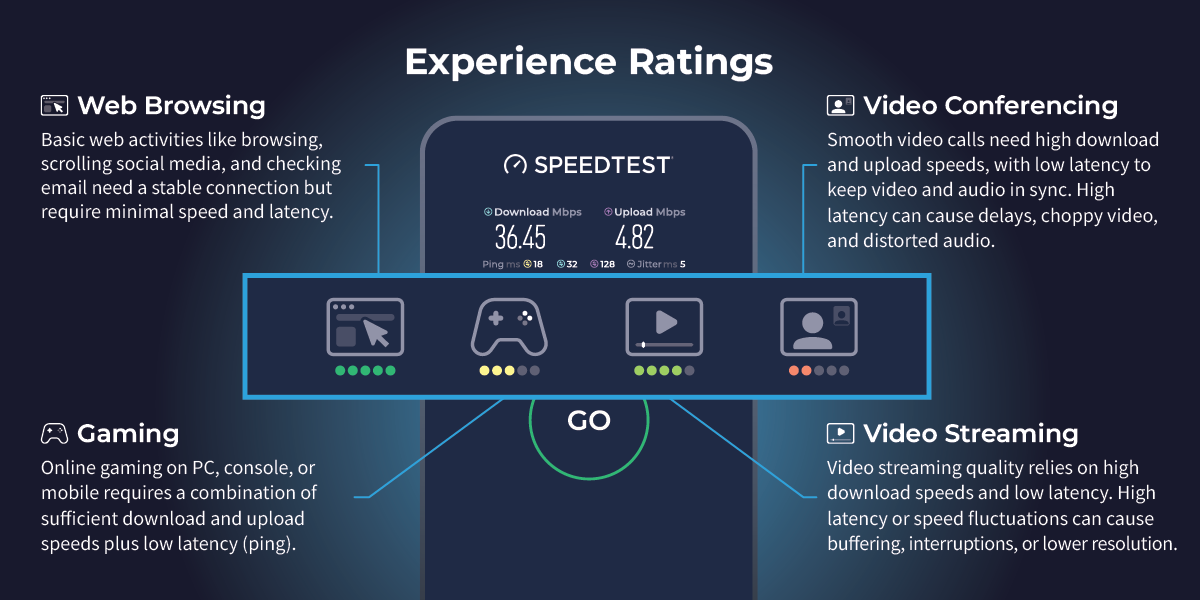
| November 3, 2025

Cruise Ship Wi-Fi Steams Ahead

Staying connected at sea can enhance the voyage, for a price.

Wi-Fi connectivity is a consumer expectation throughout the travel industry. From airports and hotels to airplanes and trains, Ookla has examined all of these just this year alone. Now we walk the gangway to the cruise ship industry to see what type of connectivity is offered on the seas.

There are any number of reasons for needing to be connected online on the cruise ship. Staying in touch with people back home directly (messaging, video calls) and sharing the experience via social media are a given. Staying up on things – sports, news – seemingly antithetical to the spirit of taking a cruise, is certainly welcome as well, including access to one’s on-shore streaming habits. 

On the cruise itself, the logistics and planning for on-board classes (Vinyasa Yoga) and on-shore activities (Top things to do in Cozumel in 6 hours) are managed online, and keeping in touch with travel companions on the same ship (wru). Of course, put-upon business professionals who are “working from helm” (shout out Virgin Voyages) appreciate a high-speed, stable connection to project their hopefully-convincing Zoom background images.

Key Takeaways

  • iPhones prevail. Over 60% of cruise passengers carry iPhones compared to 25% with Samsung Galaxy, based on Speedtest samples. This iPhone share, similar to that in the United States, reflects a relative mass-market, financially comfortable cruise line customer.
  • Older Wi-Fi limits customer experience. With 12.6% of access points on Wi-Fi 4, there is an instant opportunity to improve the quality of connectivity for passengers and crew by upgrading to a newer Wi-Fi generation.
  • Starlink is the provider of choice. Most cruise lines have equipped their ships’ connectivity with Starlink to take advantage of the speed and latency performance of low-Earth orbit satellites.

Phones and Tablets On Board

While the global market share of iPhones hovers around 20%, in the United States the Apple logo adorns just over half of the smartphones shipped in 2024 and 1H 2025, per Counterpoint Research. On cruise lines, the iPhone share of mobile device Speedtest samples is a few ticks higher than that of its U.S. share. This makes sense, with iPhones and cruises being both simultaneously mass market and higher end.

Mobile Devices – iCruise
Speedtest sample shares on select cruise lines, 1H 2025

With over 500 different device models in this data set, a fair number of Chinese manufacturers make an appearance – Honor, Huawei, OnePlus, Oppo, realme, Vivo, Xiaomi, ZTE – though small in numbers. Farther out in the long tail is the Galaxy S8+ (0.03% of devices). Launched in 2017, it is a pre-5G hold over. 

However, there are no surprises among the most popular devices being the iPhones and Galaxies released in the past couple of years.

Top 10 Devices Taking Cruises, 1H 2025 Speedtest data share of samples

DeviceShare
Apple iPhone 16 Pro Max10.2%
Apple iPhone 15 Pro Max9.7%
Apple iPhone 16 Pro5.5%
Apple iPhone 15 Pro5.3%
Apple iPhone 14 Pro Max5.1%
Samsung Galaxy S24 Ultra4.7%
Apple iPhone 14 Pro3.5%
Samsung Galaxy S23 Ultra3.4%
Apple iPhone 13 Pro Max3.1%
Apple iPhone 132.5%

Wi-Fi Doldrums

The eight-year old Samsung Galaxy S8+ from the 4G era illustrates a point about performance. Simply, old technology restricts the customer experience. The S8+ is not only on an older cellular technology, it is also an older Wi-Fi technology – Wi-Fi 5. In the meantime, Wi-Fi 6, Wi-Fi 6E and, last year, Wi-Fi 7 added new capabilities that enhance the speed and reliability of the Wi-Fi connectivity.

Among the cruise lines the mix of Wi-Fi generations is quite varied. Royal Caribbean has deployed the most Wi-Fi 6 with half (49.7%) of its Speedtest user samples on this standard. MSC and Princess are entrenched in Wi-Fi 5 (76.1% and 72.0%), while P&O has the most on older Wi-Fi.  

802.11 Standard Bearers
Speedtest sample shares by Wi-Fi Generation, 2H 2024 – 1H 2025

There were no signs of the latest generation of Wi-Fi 7, which is gaining momentum in some countries like the United States. While there are significant technological advances that would improve the Wi-Fi customer experience of the passengers with this latest technology, when we consider the immense cost of adding thousands of access points and miles of cabling to upgrade the ship , the absence of Wi-Fi 7 is understandable.  

However, swapping a Wi-Fi 4 access point for a Wi-Fi 6 access point can be done. Wi-Fi 6 median download speed was around twice as fast Wi-Fi 4 in Speedtest data. Newer technologies often bring faster speeds, and also the overall user experience is enhanced with more efficient spectrum utilization and traffic management, and an increased number of connected devices per access point. The complex infrastructure of a cruise ship and user density present a tall challenge for getting the most out of the Wi-Fi signal. (Expertise from Ookla can help with solutions found under our Ekahau business.)

Starlink Performance Floats the Boat

As mentioned, most cruise lines have moved to Starlink over the past few years for their internet connectivity. Indeed, the 1H 2025 Speedtest data results for Carnival, Costa, Holland America, P&O (all under the Carnival company), and MSC performed in such a similar range that it is clearest to present their results as a group average. This also allows us to easily compare to prior published research on in-flight Wi-Fi performance where Starlink is also the internet provider.

The Starlink cruise line Wi-Fi download speeds perform well, even though it doesn’t keep up with the Starlink in-flight Wi-Fi. Putting aside plans and policies, we can imagine that higher user density loads the cruise ship’s Wi-Fi network more than an airplane’s. Even the cruise line’s 10th percentile at 21.14 Mbps is a serviceable speed for most any application.

The upload speed story is more nuanced. While the median upload is proportional to the download comparison between the cruise lines and the airplanes, the story changes at the opposite ends. The 10th percentile at 1.74 Mbps on the cruise lines is not usable for video calling or posting the day’s images to social media. It is likely that this slow 10th percentile speed is reflecting time-of-day congestion, when heavy usage is occurring on the ships. (A topic for possible follow up investigation.) The 90th percentile for the cruise lines slightly outperforms the airplanes (42.55, 38.07 Mbps).

Latency is always interesting when it comes to satellite internet connectivity. Airplanes outperform cruise lines on the median (44, 87 ms) – literally being closer to the satellite may offer some advantage here. The 90th percentile is far worse on cruise lines, again possibly as a consequence of time-of-day congestion as well as more hops from the access point in the ship to the radio on the ship than with an airplane.

The cruise ship passenger’s Wi-Fi experience can be affected by the service package they select. There are a variety of prices and models (prepay or pay-as-you-go; for the day or for the trip) that offer increasing capabilities, such as basic, value and premium choice set. Many of these packages can cost more than a monthly mobile phone service. For example, for one of the leading cruise lines based on total passengers, the least expensive “Social” package is $18.70 per day. However, in hotels and, increasingly on airlines, the trend is toward offering free internet connectivity as an enhancement of the customer experience or loyalty perk. Norwegian Cruise Line even touts free Wi-Fi in one of its commercials, though, overall, the “free” Wi-Fi may have limited usage or it is only included only in the most expensive VIP packages. 

There Once was a Princess… 

…with a medallion. That is to say, Princess Cruise Lines offers MedallionNet® which it touts as “Unmatched Wi-Fi Experience at Sea – Fast. Reliable. Unlimited. Affordable. Now on all ships.” As we’ve noted and is stated on its site, the internet service is provided by Starlink. 

And yet, links on the site connect to a press release from 2018 about another satellite provider, SES, and an explainer video about mid-earth and geo-stationary orbits (which has a major impact on performance) of which Starlink is neither. SES has been the long-time provider, and a more recent press release from August 2024 explains that the two satellite partners support tiered service offerings. 

Noting this isn’t an attempt to call out Princess for confusing content, but instead to recognize that the cruise line industry is potentially in a phase change about how it delivers and manages customer experience on its cruises. Future generations of passengers (as in Gen-X or Millennials, not Wi-Fi 7 or 8) are digital natives with a different expectation of always-on, high-quality connectivity.

Sailing to the Other Side?

Hotels charged for poor Wi-Fi. Over the years, however, hotel Wi-Fi service went from an expensive customer pain point to a point of customer service expectation and loyalty. Airlines appear to be mid-flight on this same journey, also realizing they have a captive audience that they can entertain and monetize. When will cruise lines also reach the point of no return?


Methodology Remarks

The basic building block of this analysis is identifying Speedtest data tests related to the SSIDs (the name of the Wi-Fi network) of the cruise lines and ships. Comparing the counts of Speedtest samples in 1H 2025 with the cruise line market shares based on passenger totals found at Cruise Market Watch, we are capturing Wi-Fi performance on 80% of the cruise line market. In fact, Speedtest samples correlate with passenger market share (r = 0.75). Furthermore, where we have Speedtest samples identified on a per ship basis, these correlate with ship passenger capacity as well (r = 0.71). Netting this out, the Speedtest samples offer a strong representation based on these anchors of market share and ship size.

Still, as with in-flight Wi-Fi, cruise ships present fresh complexity different from Speedtest’s bread-and-butter fixed broadband and mobile service providers because of ships’ mobility, variety of SSID approaches (ie, one cruise line uses the same SSID on all its ships, while most use SSIDs unique to the ship), changing of internet service providers (fleet-wide upgrades to Starlink), and policies inhibiting high-data usage applications. Thus, this analysis is offered in the context of “here’s what we see” rather than a definitive census of cruise ship Wi-Fi performance.

Ookla retains ownership of this article including all of the intellectual property rights, data, content graphs and analysis. This article may not be quoted, reproduced, distributed or published for any commercial purpose without prior consent. Members of the press and others using the findings in this article for non-commercial purposes are welcome to publicly share and link to report information with attribution to Ookla.

| May 7, 2024

Assessing and Addressing Indoor Coverage Issues

In an era where staying connected is not just a convenience but a necessity, fast and reliable indoor cellular and Wi-Fi connectivity play a pivotal role for enterprises and consumers alike. In fact, according to Ericsson, up to 80% of all data traffic is consumed at indoor locations and 90% of our time is spent indoors, making good indoor cell and Wi-Fi performance more important than ever. From enabling mission-critical business applications to allowing users to binge Fallout while stuck at the airport, users expect perfect connectivity 24/7, regardless of location. 

However, achieving consistently reliable and high-speed indoor coverage isn’t as straightforward as it might sound. Obstacles like walls, windows, and various building materials can attenuate radio signals and hamper propagation, while suboptimal access point (AP) placement, improper power level configurations, and interference from nearby networks or devices can further degrade indoor connectivity performance.

Chart titled "Deploying solutions can fail if not properly planned"

To overcome these challenges, proper network planning is critical, and that’s where Ookla can help. With complementary datasets like Ekahau’s Wi-Fi performance suite and Ookla’s solutions for mobile network intelligence including Cell Analytics™ and Ookla Wind™, operators can identify and address indoor coverage issues for both cellular and Wi-Fi networks. 

Detecting Indoor Coverage Issues

Internet users often switch between Wi-Fi and cellular networks, but these transitions aren’t always as seamless as one would expect. Some users might encounter poor service while moving between networks, while others may simply switch off one network type altogether, avoiding the need to report any problems to their ISP. This compounds challenges for ISPs in identifying and addressing coverage issues, making proactive network monitoring and testing critical. 

The first step in maximizing indoor connectivity and detecting coverage issues is understanding your network’s current gaps, weak signal areas, and sources of interference or poor performance.

Evaluating Cellular Coverage with Cell Analytics

Powered by the Ookla® Speedtest® network testing platform, Cell Analytics provides unparalleled intelligence into wireless service quality, RF measurements, data usage, user density – both indoors and outdoors – cell site locations, and much more. Cell Analytics leverages billions of samples from consumer devices to show you indoor coverage gaps, weak signal areas, and buildings with good coverage but poor quality. Some key capabilities of Cell Analytics include: 

  • Assessing the performance, quality, and availability of existing networks
  • Identifying and fixing network issues faster
  • Locating opportunities for capacity expansion
  • Prioritizing network optimization and marketing efforts
  • Focusing engineering efforts where they’re needed most

Evaluating Wi-Fi Coverage with Ekahau’s Sidekick 2

Ekahau’s Sidekick 2 Wi-Fi testing and measurement device assesses your network health and provides early detection for any changes in the environment that can negatively impact your Wi-Fi network. The Sidekick 2 enables comprehensive site surveys to rapidly detect issues like:

  • Poor primary or secondary coverage 
  • Interference sources 
  • Wall attenuation sources 
  • AP placement 
  • AP power levels
  • Security vulnerabilities 

With an easy-to-use mobile app interface, the Sidekick 2 empowers anyone to collect reliable Wi-Fi data simply by walking around a facility. If you can walk a dog, you can use the Sidekick 2!

Chart titled "Leverage Ookla's tools for indoor coverage improvement"

Improving Indoor Coverage with Ookla Wind & Ekahau

Ookla Wind offers another complementary solution for identifying and improving indoor coverage via a controlled walk/drive testing solution. Using our handset-based Android app, Ookla Wind provides controlled testing of 5G, 4G, Wi-Fi, and other network types, allowing ISPs to diagnose coverage problems and validate improvements at a granular level. Some key capabilities include:

  • Walk/drive test automation with scripting
  • Integrated Speedtest SDK for real-world throughput testing
  • Cloud-based reporting and visualization of test data
  • Real-time monitoring during live events at venues like stadiums

On the Wi-Fi side, Ekahau’s software solutions are designed to simplify Wi-Fi design and optimization for anyone, whether you’re a veteran IT pro or a recently hired IT intern. Using measured survey data collected by the Sidekick 2, Ekahau’s software can help you take the next steps toward improving your indoor coverage. Let’s take a look at how Ekahau’s Optimizer and Analyzer software solutions can help solve your network woes with ease. 

Ekahau Optimizer allows you to perform incredibly accurate health check and security surveys with the Sidekick 2 and the Android or iOS device of your choice. Ekahau Optimizer automatically analyzes data from the Sidekick 2, then it identifies and makes recommendations for fixing several key issues that IT admins have to contend with on a regular basis, such as primary and secondary coverage issues, SNR problems, minimum basic rates, SSID configuration, channel widths, and more. 

Ekahau Analyzer provides another convenient solution for troubleshooting the most common network issues, including coverage problems. Connected to the Sidekick, the app validates your network’s configuration and makes it easy to visualize actual spectrum utilization and access point reporting side-by-side, view associated stations, discover rogue devices, and identify the channels your APs are operating on to improve overall Wi-Fi performance. 

Conclusion

In today’s hyperconnected world, reliable indoor connectivity is a must for both businesses and consumers alike. By combining Ookla’s crowdsourced testing and analytics capabilities with Ekahau’s powerful Wi-Fi solutions, organizations get a 360-degree view of their indoor mobile and Wi-Fi coverage and can ensure their networks deliver the seamless indoor experiences users demand.

Image linked to access to On-Demand video of the "How to Optimize Indoor Cellular and Wi-Fi Coverage webinar

From pinpointing indoor coverage gaps and identifying other issues using Cell Analytics and Ekahau to conducting controlled testing with Wind, these complementary solutions provide end-to-end indoor connectivity optimization solutions for IT admins across a broad range of industry.

To learn more about how Ookla and Ekahau solutions can be used to solve coverage problems, check out our recent webinar on-demand, “How to Optimize Indoor Cellular and Wi-Fi Coverage.” 

Ookla retains ownership of this article including all of the intellectual property rights, data, content graphs and analysis. This article may not be quoted, reproduced, distributed or published for any commercial purpose without prior consent. Members of the press and others using the findings in this article for non-commercial purposes are welcome to publicly share and link to report information with attribution to Ookla.

| October 10, 2019

We Tested 8 VPNs and Hotspot Shield is Fastest

VPNs are a key component for today’s savvy web user whether you’re concerned about online privacy or streaming the latest episode of an overseas baking show. But VPNs also have a reputation for destroying download speeds. We tested eight popular VPNs to see which rises to the top by keeping your connection fast.
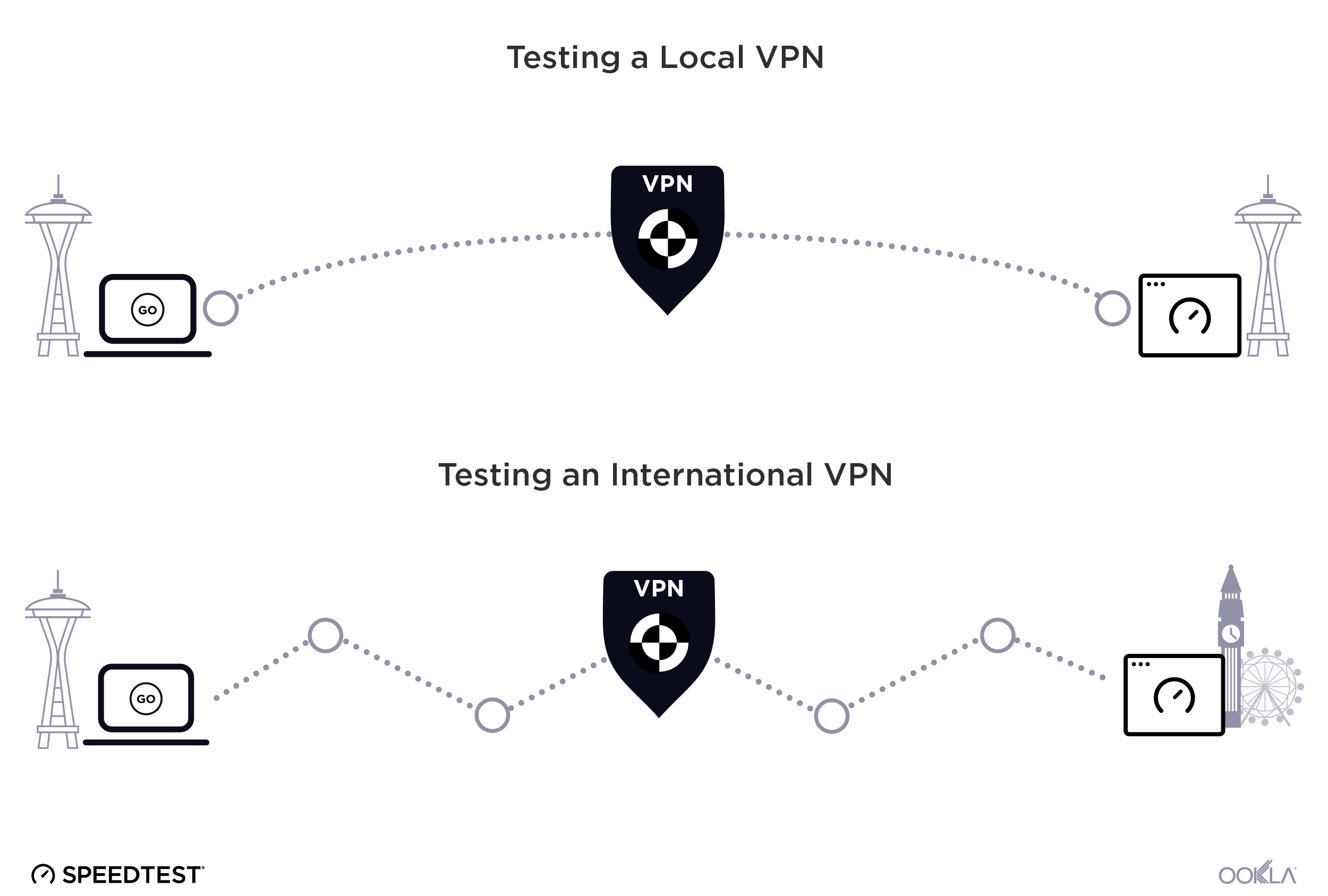
Methodology

vpn-diagram

We tested each VPN under two circumstances: local and international. A local result means we connected the VPN to our hometown (Seattle) and then ran several tests using Speedtest.net to the closest Speedtest server. This is similar to what you might expect to see if you simply turned on the VPN with automatic settings and started browsing. Your browsing would be private, but you wouldn’t enjoy any of the geographic benefits of a VPN.

To test international results, we connected each VPN to a London VPN server and ran a Speedtest to a London Speedtest server. This simulates the experience of accessing TV shows and other media outside of your home country.

The percent difference for both local and international tests is calculated against the mean of our baseline Speedtest results when no VPN was connected. Note that while you can choose between multi-connection and single-connection testing on most of our Speedtest platforms, the results outlined below used multi-connection.

All VPNs slowed our local connections

Ookla_Difference-in-Speed-When-Testing-VPN-to-Local-Server
The greater the percent difference from the baseline, the slower your connection will be. Hotspot Shield had the least impact to download speed in local testing with a decrease of 51.9%. IPVanish was second best — decreasing download speed by 66.7%. Private Internet Access was third at -70.9%, and TunnelBear had the slowest speeds with -98.3%. We should note that while IPVanish, Hotspot Shield and NordVPN have business relationships with Ookla, our results are independent of these relationships.

Hotspot Shield was actually faster than the baseline on our international tests

Ookla_Difference-in-Speed-When-Testing-VPN-to-Remote-Server-2
Our international VPN test showed Hotspot Shield in first place with a 26.2% increase in download speed when testing between Seattle and London. We spoke to our engineers to find out what allows Hotspot Shield’s technology to improve speeds internationally. Hotspot Shield funnels network TCP traffic through a transparent TCP proxy, from a location on the internet close to the device, to the remote destination. This proxy efficiently manages congestion that typically occurs at the last mile which allows for an increase in speeds versus standard routing.

All other VPNs showed the expected decrease in download speeds when testing internationally. ExpressVPN was the second fastest VPN for international connections with a 42.5% decrease in download speed. Avira was third with an 85.2% decrease. IPVanish and NordVPN followed closely behind, coming in within 1% of each other. TunnelBear, again, had the slowest speeds with a 95.3% decrease.

Now that you know which VPN is fastest, take a Speedtest next time you’re connected to a VPN to see how protecting your online privacy is impacting your speeds.

Ookla retains ownership of this article including all of the intellectual property rights, data, content graphs and analysis. This article may not be quoted, reproduced, distributed or published for any commercial purpose without prior consent. Members of the press and others using the findings in this article for non-commercial purposes are welcome to publicly share and link to report information with attribution to Ookla.