| March 27, 2023

Early Testing Shows How Fast the New Samsung Galaxy S23 Models Are

The new Samsung Galaxy S23, S23+, and S23 Ultra models launched February 17 and Ookla® is here today to see how they’ve performed over 5G against their predecessor S22 models. Our analysis looks at data from the first month after launching in 12 of the largest mobile markets with an established 5G market and the highest number of connected mobile devices during Q4 2022 according to GSMA. Previously, in October 2022, we used Speedtest Intelligence® to look at 5G performance data right after the launches of the iPhone 14 and Samsung Galaxy Z Fold4 in various countries

Note that device data differs across markets due to a variety of factors, including: 5G investments by governments and mobile operators, different 5G spectrum allocations by operator, 5G Availability, the number of and different kinds of 5G deployments, and other differences, including mobile 5G plans. Read on to learn more and see whether or not you should upgrade your Samsung S22 to a newer model.

Key takeaways:

  • The Samsung S23 models only statistically outperformed corresponding S22 models in Germany and two out of three models in the United States for 5G download speed, but the S23 looks poised to be faster as further 5G adoption and build out continues and more spectrum is allocated for 5G across the C-band and mmWave frequencies.

Key improvements to the new Galaxy S23 models

You want to know if the latest technology is worth the price of an upgrade when you’re looking for a new phone. The S23, S23+, and S23 Ultra have various upgrades, but when it comes to performance, here’s a quick list of what’s different between the new and older models. 

All Samsung Galaxy S23 vs. S22 models

  • The Samsung S23 models have a Qualcomm Snapdragon 8 Gen 2, while the Samsung S22 models have a Samsung Snapdragon 8 Gen 1
  • The S23 models have a Qualcomm Snapdragon X70 modem, while the S22 models have an X65 modem
  • The S23 models have an upgraded GPU

Samsung Galaxy S23 vs. S22 base models

  • The S23 has a bigger battery capacity at 3,900 mAh over the S22’s 3,700 mAh
  • The S23 has slightly better ultra-wide and front cameras and video recording capabilities

Samsung Galaxy S23+ vs. S22+ models

  • The S23+ has expanded storage capacity at a base level of 256 GB (which can be upgraded to 512 GB) over the S22+’s base of 128 GB
  • The S23+ has a bigger battery capacity at 4,700 mAh over the S22+’s 4,500 mAh
  • The S23+ has slightly better ultra-wide and front cameras and video recording capabilities

Samsung Galaxy S23 Ultra vs. S22 Ultra models

  • The S23 Ultra has expanded storage capacity at a base level of 256 GB (which can be upgraded to 512 GB) over the S22 Ultra’s base of 128 GB
  • The S23 Ultra has much better main camera, with up to 200 MP vs. the S22 Ultra’s maximum of 108 MP

Samsung Galaxy S23 performance in the world’s largest mobile device markets

Brazilian S22 and S23 users saw seriously fast 5G speeds (even though 5G Availability remains low)
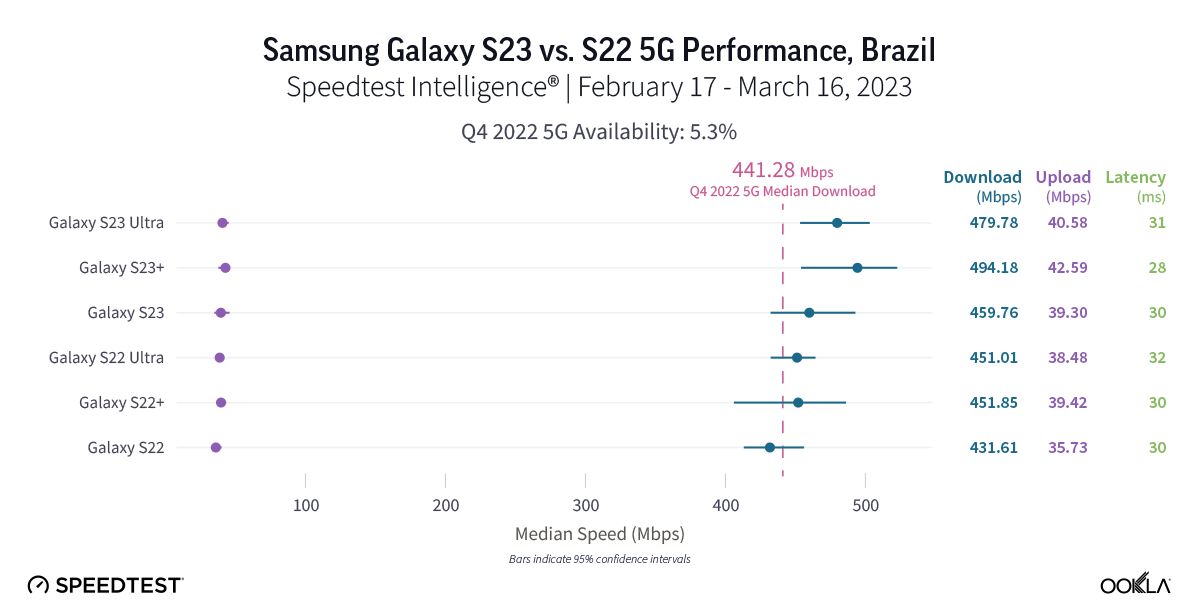
Chart of Samsung Galaxy S23 vs. S22 5G Performance in Brazil

Speedtest Intelligence shows that the new S23 models were not yet statistically faster than the older S22 models in Brazil during the first month of launch, but they did exceed the median 5G download speed in Brazil during Q4 2022. Despite that, every S22 and S23 model had blazing fast speeds in Brazil, with median 5G download speeds faster than 400 Mbps. The S22 had a median download speed of 431.61 Mbps, the S22 Ultra was at 451.01 Mbps, and the S22+ at 451.85 Mbps. While the S23 models were not statistically faster than their S22 counterparts, the S23 had a median download speed of 459.76 Mbps, the S23 Ultra at 479.78 Mbps, and the S23+ at 494.18 Mbps. 5G upload speeds showed a similar trend, with no statistically faster S22 or S23 model, but with S22 models ranging from 35.73 Mbps to 39.42 Mbps and S23 models ranging from 39.30 Mbps to 42.59 Mbps. Multi-server latency — the latency you should expect to encounter more generally when your network is not under heavy load — ranged from 28.01 ms to 31.78 ms across all models over 5G.

Recommendation: Brazilian Galaxy S22 users should consider upgrading your phone if you can get 5G access; you’re going to get fast speeds and the new features of the S23, especially the camera of the S23 Ultra, may be worth it alone.

Chinese S23 users haven’t quite seen an improved 5G experience over S22 users
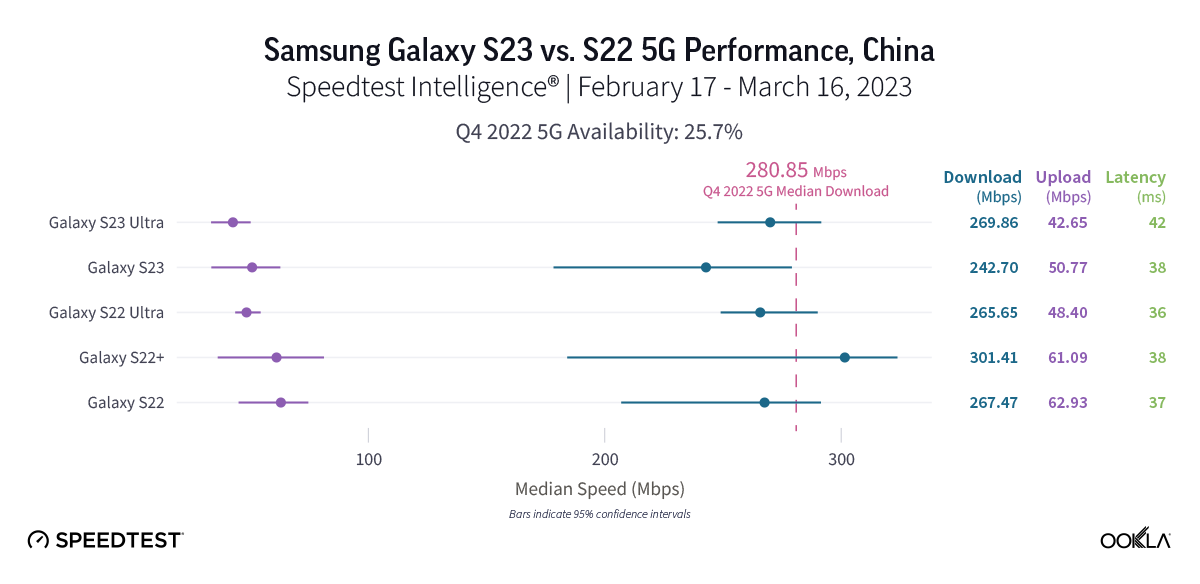
Chart of Samsung Galaxy S23 vs. S22 5G Performance in China

Data from the first month since the Samsung S23 launching illuminates that S23 models did not statistically outperform S22 models over 5G in China, and S23 models also didn’t quite exceed the Q4 2022 median 5G download speed. The S22 had a median 5G download speed of 267.47 Mbps, the S22 Ultra was similar at 265.65 Mbps, and the S22+ was at 301.41 Mbps. The S23 showed a median 5G download speed at 242.70 Mbps, while the S23 Ultra had a median download speed of 269.86 Mbps. 5G upload speeds on S22 models ranged from 48.40 Mbps to 62.93 Mbps, while the S23 and S23 Ultra were at 50.77 Mbps and 42.65 Mbps, respectively. While the S23 models showed lower median multi-server latency over 5G, there was no statistical winner between the S22 and S23 models. The S23+ did not meet the statistical threshold for inclusion in our analysis in China. 

Recommendation: Chinese Galaxy S22 users should wait to upgrade your phone until speeds improve, unless the new S23 model hardware upgrades have you wanting a new phone.

French S23 users saw promising 5G results, S22 users might want to wait to upgrade
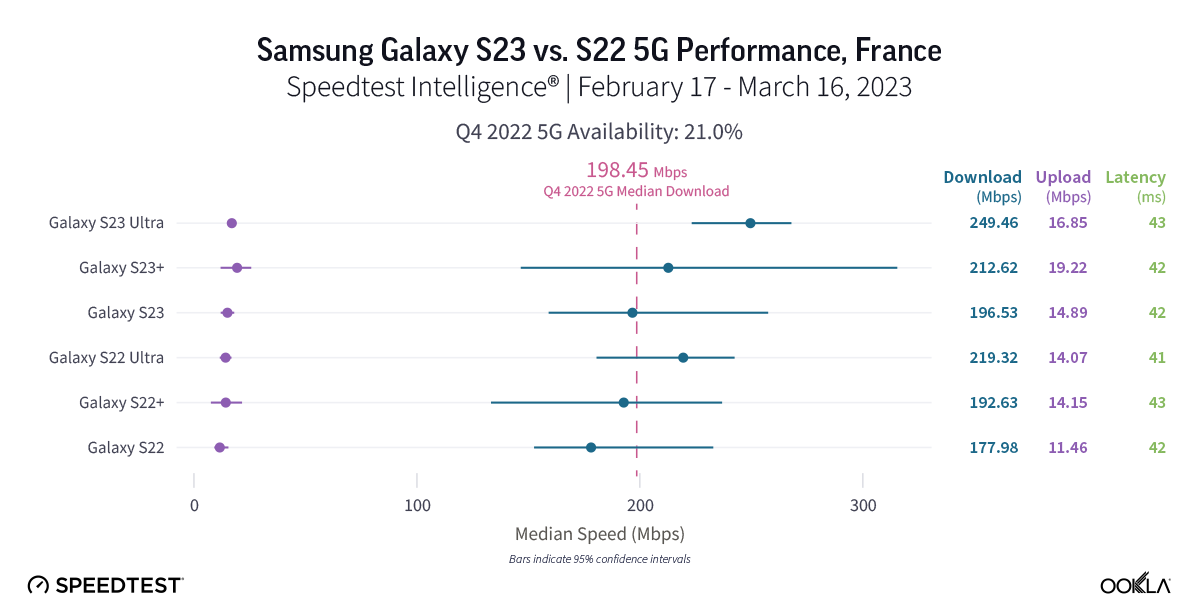
Chart of Samsung Galaxy S23 vs. S22 5G Performance in France

There was no statistically faster Samsung Galaxy S22 or S23 model over 5G in France during the first month of the S23’s release. However, median 5G download speeds for the S22 models ranged from 177.98 Mbps to 219.32 Mbps, while the S23 models ranged from 196.53 to 249.46 Mbps. 5G upload speeds showed a similar story, with no statistical winner. Upload speeds on S22 models ranged from 11.46 Mbps to 14.15 Mbps, and upload speeds on S23 models ranged from 14.89 Mbps to 19.22 Mbps. 5G multi-server latency was virtually the same for both models, which all ranged from 41.40 ms to 43.24 ms.

Recommendation: French Galaxy S22 users who want faster speeds might want to wait to upgrade your phone, but the new features of the S23 may make upgrading very tempting.

German Samsung Galaxy S22 users should feel confident upgrading to S23 models

Chart of Samsung Galaxy S23 vs. S22 5G Performance in Germany

Speedtest Intelligence reveals that German S23 users experienced faster 5G download speeds than their S22 counterparts during the first month of S23 availability across all models. The S23 outperformed the S22 for median 5G download speed, 147.26 Mbps to 112.01 Mbps, the S23 Ultra outperformed the S22 Ultra 141.56 Mbps to 124.45 Mbps, and the S23+ outperformed the S22+ 174.74 Mbps to 128.69 Mbps. Upload speeds had a bit more parity with the S22 models showing a range of 5G upload speeds from 20.47 Mbps to 26.10 Mbps, while the S23 models showed a range from 23.59 Mbps to 31.64 Mbps. Multi-server latency over 5G showed no statistical winner for either model but ranged from 36.76 ms to 38.58 ms.

Recommendation: Germany Galaxy S22 users shouldn’t hesitate to run to your operator to immediately upgrade your phone to an S23 model for faster speeds and better features.

Samsung Galaxy S23 users in Italy saw mixed 5G results after launch
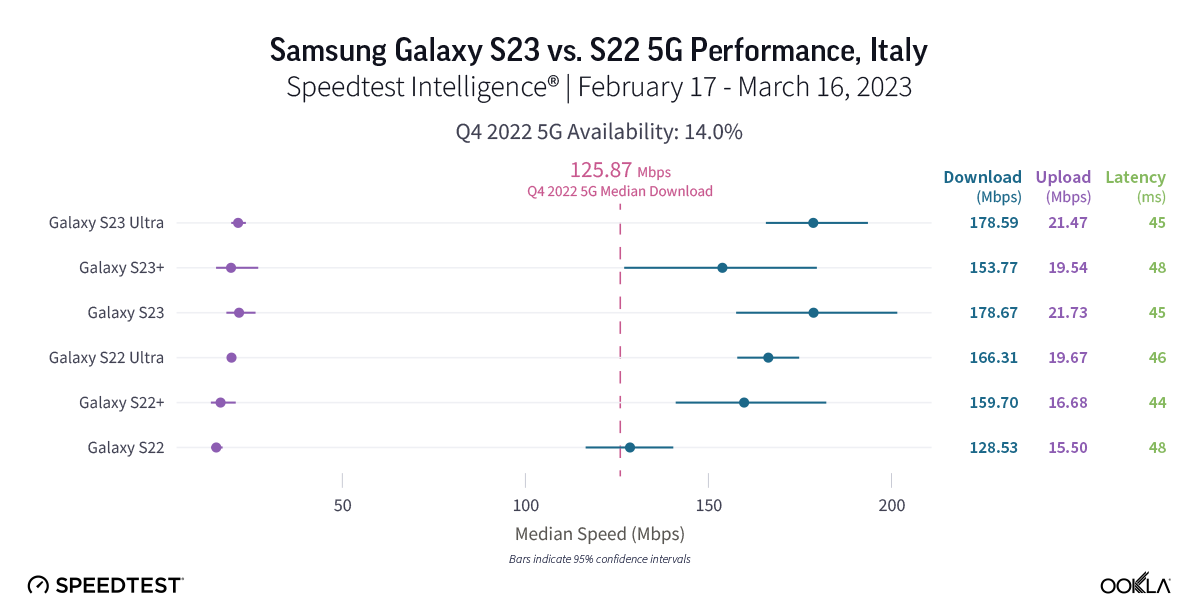
Chart of Samsung Galaxy S23 vs. S22 5G Performance in Italy

New Speedtest Intelligence data reveals that while the basic S23 model outperformed the S22 model over 5G in Italy for median download speed 178.67 Mbps to 128.53 Mbps during the first month after launch, the S23 Ultra and S23+ models didn’t statistically outperform their S22 counterparts. That held true for upload speeds as well, with the S23 recording a median 5G upload speed of 21.73 Mbps to the S22’s 15.50 Mbps, while the S23 Ultra and S23+ weren’t statistically faster than the S22 Ultra and S22+, respectively. All of the S23 and S22 models during the first month of the S23 launch, except the S22 base model, were statistically faster than the 5G median download speed in Italy during Q4 2022. Median multi-server latency showed closer parity, with S22 models ranging from 45.02 ms to 47.79 ms, and S23 models ranging from 43.50 ms to 48.24 ms.

Recommendation: Unless you want a basic Galaxy S23 model and have consistent 5G access in Italy, you might want to wait to upgrade your phone to the S23 models unless you really want the new features.

Samsung Galaxy S23 showed 5G potential in the Philippines
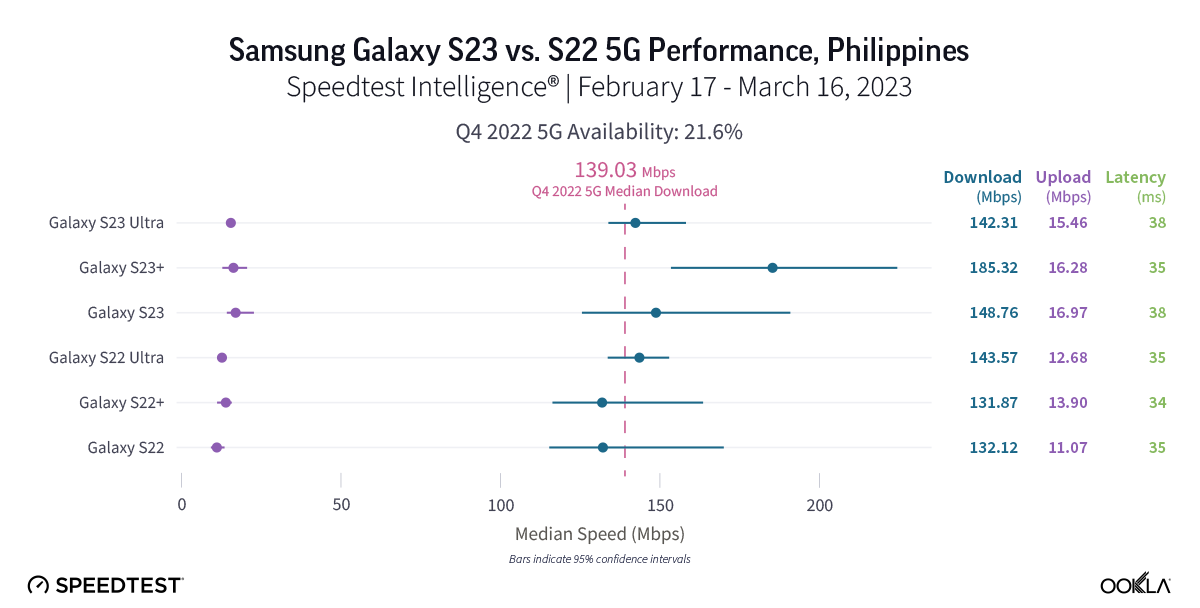
Chart of Samsung Galaxy S23 vs. S22 5G Performance in Philippines

Fresh data from Speedtest Intelligence shows that while the S23 and S23+ had faster median 5G download speeds than their S22 counterparts during the first month of the S23’s launch, there were no statistical winners between the models in the Philippines. The S23 models’ median 5G download speeds ranged from 142.31 Mbps to 185.32 Mbps, while the S22 models ranged from 131.87 Mbps to 143.57 Mbps. Median 5G upload speed for the S23 Ultra was faster than its S22 Ultra counterparts at 15.46 Mbps to 12.68 Mbps, respectively. There were no statistical winners for median multi-server latency over 5G, though the S22 models ranged from 35.42 ms to 38.39 ms, while the S23 models ranged from 34.29 ms to 35.31 ms.

Recommendation: Filippino Galaxy S22 users should upgrade their phones to the S23 models if they want new features, but shouldn’t expect faster speeds and a better experience quite yet.

Polish Samsung S23 models had a promising debut over 5G

Chart of Samsung Galaxy S23 vs. S22 5G Performance in Poland

Speedtest Intelligence data shows Poland had some of the slowest median 5G download speeds on Samsung S23 and S22 models among the countries we surveyed. While the new S23 models had a higher median 5G download speed than their counterparts during the first month after launching, there were no statistically significant faster speeds. The S23 models ranged from 83.74 Mbps to 98.99 Mbps, while the S22 models ranged from 75.70 Mbps to 80.43 Mbps. Upload speeds were similarly faster, but not statistically so, with S22 models ranging from 16.89 Mbps to 19.62 Mbps and S23 models ranging from 19.94 Mbps to 24.25 Mbps. Median multi-server latency over 5G was a mixed bag, with the new S23+ actually having a higher latency than the S22+ 44.25 ms to 38.37 ms, respectively. The other two models were too close to call.

Recommendation: Polish Galaxy S22 users can upgrade their phones to the S23 models for the new features, but might not yet experience faster 5G speeds on the new models.

Samsung S23 models in South Africa don’t live up to the hype just yet
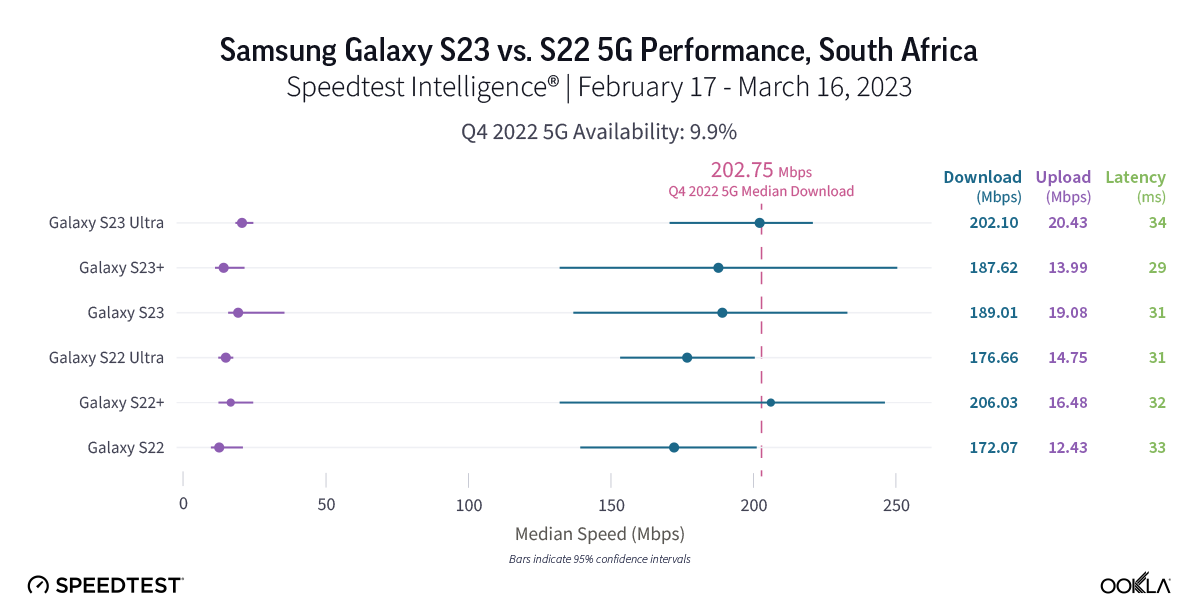
Chart of Samsung Galaxy S23 vs. S22 5G Performance in South Africa

Speedtest Intelligence reveals that the new S23 models weren’t yet statistically faster than their S22 counterparts over 5G in South Africa during the first month after launch. S22 models had median 5G download speeds that ranged from 172.07 Mbps to 206.03 Mbps, while the S23 models ranged from 187.62 Mbps to 202.10 Mbps. There was one bright note — the median 5G upload speed for the S23 Ultra was faster than the S22 Ultra 20.43 Mbps to 14.75 Mbps. Median multi-server latency showed parity over 5G for the S22 models and S23 models. The S22 models ranged from 29.06 ms to 33.75 ms, while the S23 models ranged from 31.41 ms to 32.92 ms.

Recommendation: South African Galaxy S22 users should probably wait to upgrade their phones to the S23 models if they are looking for faster 5G experience, but the S23 features may outweigh the parity in speeds between models.

South Koreans saw fast 5G speeds on the new Samsung Galaxy S23 models
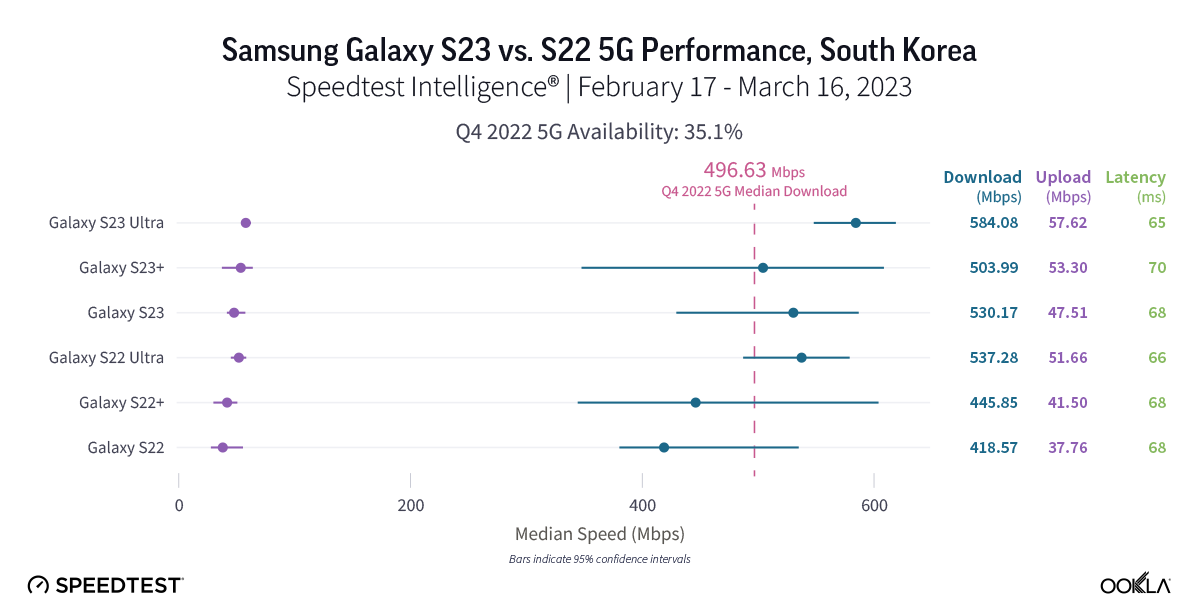
Chart of Samsung Galaxy S23 vs. S22 5G Performance in South Korea

Home to Samsung, South Korea showed some of the fastest 5G speeds on our list. Every S23 model had a faster median 5G download speed than the corresponding S22 models, but statistical winners remained elusive during the first month after launch, which we expect will probably change upon more adoption in the near future. S22 models recorded median 5G download speeds between 418.57 Mbps and 537.28 Mbps, while the S23 models ranged from 503.99 Mbps and 584.08 Mbps. Upload speeds were similarly impressive — though with no statistically faster median 5G upload speeds than another — with S22 models ranging from 37.76 Mbps to 51.66 Mbps over 5G, and S23 models ranging from 47.51 Mbps to 57.62 Mbps. Median multi-server latency over 5G showed ranges from 65.00 ms to 69.81 ms for the S22 models, and a range of 66.13 ms to 68.15 ms for the S23 models.

Recommendation: If you’re a South Korean Galaxy S22 user, you can probably expect slightly faster speeds if you upgrade to the new S23 models, but an upgrade for the new features, especially for the new S23 Ultra camera, might be more justified.

Thai Samsung Galaxy S22 and S23 users saw faster 5G speeds than the median average during Q4 2022
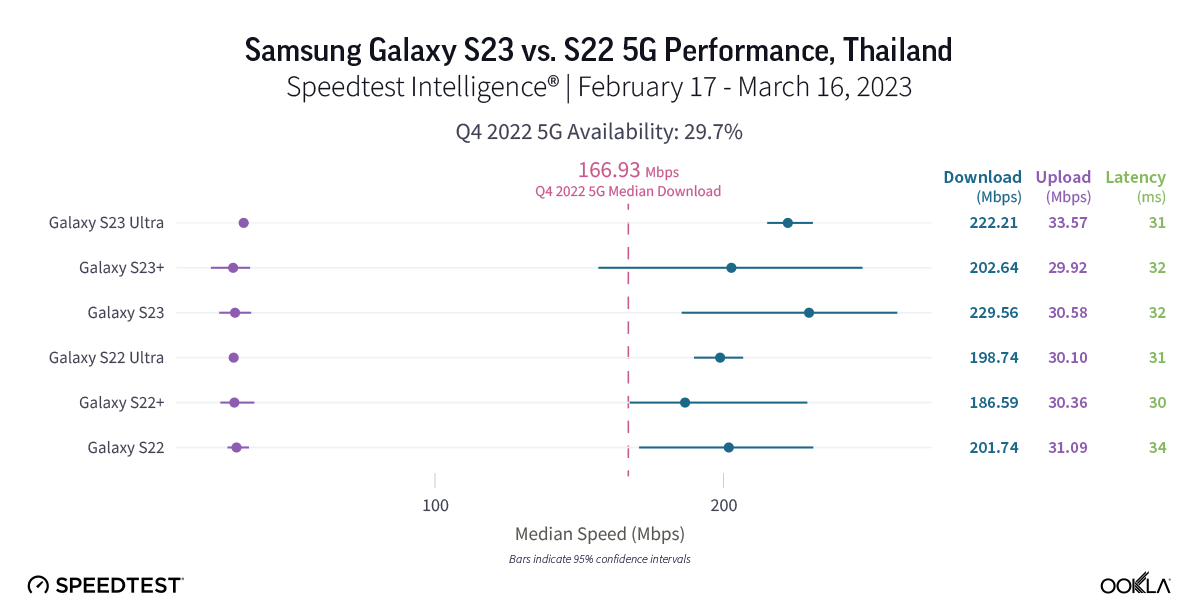
Chart of Samsung Galaxy S23 vs. S22 5G Performance in Thailand

Speedtest Intelligence shows that the Samsung Galaxy S23 Ultra was the only S23 model to achieve faster median 5G speeds than its predecessor in Thailand during the first month after launching. The S23 Ultra outperformed the S22 Ultra 222.21 Mbps to 198.74 Mbps over 5G for download speed and 33.57 Mbps to 30.10 Mbps for upload speed, respectively. The S23 and S23+ were not statistically faster, though the S23+ and S23 had median 5G download speeds of 202.64 Mbps and 229.56 Mbps, respectively. Median 5G multi-server latency showed close parity with the S22 ranging from 31.06 ms to 32.34 ms and the S23 ranging from 30.40 ms to 34.14 ms.

Recommendation: Thai Galaxy S22 Ultra users should feel confident in upgrading your phones to the S23 Ultra, especially for the new features. If you are a S22 and S22+ 5G user, you should absolutely consider upgrading, but might not yet see faster speeds.

Samsung Galaxy S23 results showed potential in the United Kingdom, but you still may want to wait to upgrade
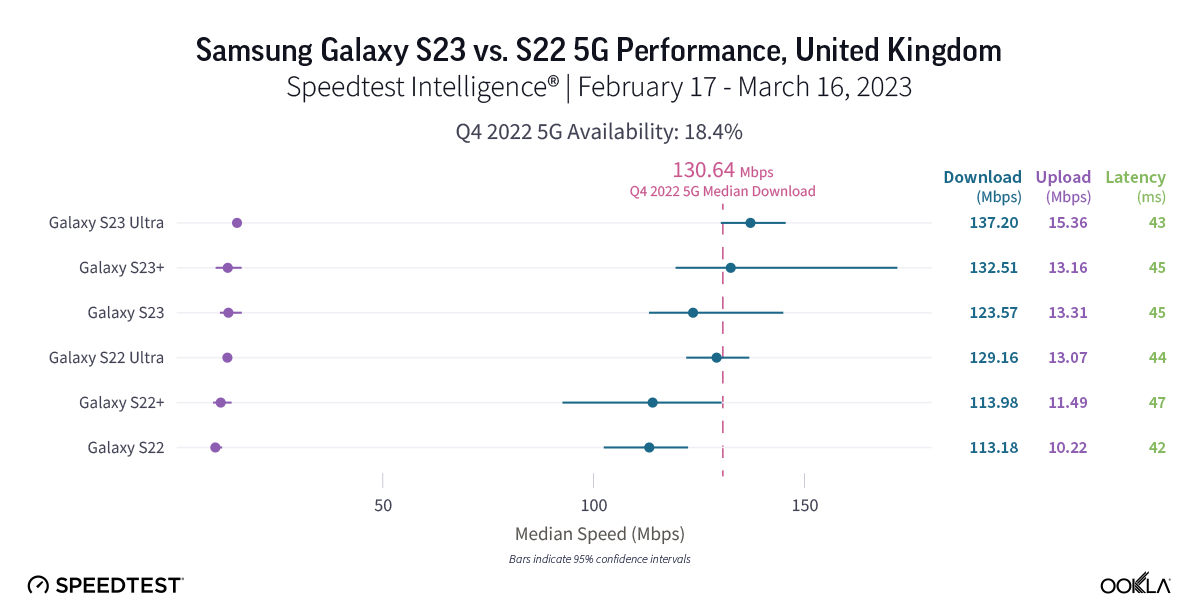
Chart of Samsung Galaxy S23 vs. S22 5G Performance in United Kingdom

New 5G data from the U.K. reveals that while the new Samsung Galaxy S23 models have higher median download speeds, the S23 models are not statistically faster than the S22 models. The S22 models had median 5G download speeds that ranged from 113.18 Mbps to 129.16 Mbps, and the S23 models ranged from 123.57 Mbps to 137.20 Mbps. 5G download speeds in the U.K. weren’t the slowest we saw among the countries we surveyed, but they were quite close to Poland’s bottom-tier results. The S23 Ultra was one stand-out performer, which had a faster median 5G upload speed than the S22 Ultra at 15.36 Mbps to 13.07 Mbps, though the other models weren’t significantly faster, but came close. Median multi-server latency over 5G was too statistically close to call, with the S22 models between 43.04 ms and 45.09 ms, and the S23 models between 41.77 ms and 46.63 ms. 

Recommendation: U.K. Samsung Galaxy S22 users should wait to upgrade their phones to the S23 models unless you’re dying for the S23’s new features. But don’t expect faster results quite yet, especially as the U.K. continues to lag behind other more mature 5G markets around the world.

If you have 5G and a Samsung Galaxy S22 in the United States, don’t hesitate to upgrade to an S23 model
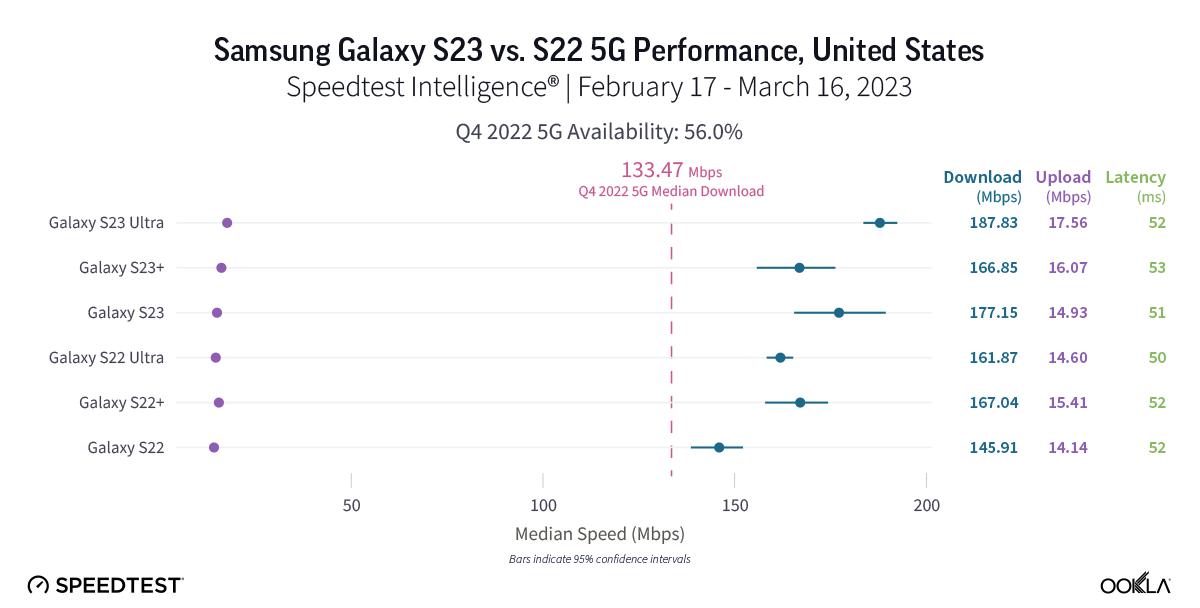
Chart of Samsung Galaxy S23 vs. S22 5G Performance in United States

New data from Speedtest Intelligence reveals that during the first month of the Samsung Galaxy S23 series’ availability, the S23 and S23 Ultra outperformed the S22 and S22 Ultra for 5G download speeds, respectively, while the S23+ and S22+ were statistically too close to call. The S23 raced ahead of the S22 177.15 Mbps to 145.91 Mbps, and the S23 Ultra was faster than the S22 Ultra at 187.83 Mbps to 161.87 Mbps. All of the S22 and S23 models outperformed the median 5G download speed in the U.S. during Q4 2022. The Samsung S23 Ultra was the only S23 model to statistically outperform its counterpart for median 5G upload speeds, with an upload speed of 17.56 Mbps to 14.60 Mbps. The S23 and S23+ were too close to call. Looking at median multi-server latency over 5G, the S23 Ultra edged ahead of its S22 Ultra counterpart 50.44 ms to 51.52, while the other S23 didn’t have a statistical leg up. 

Recommendation: U.S. Samsung Galaxy S22 users shouldn’t hesitate to upgrade to the S23 models, especially for the new features and hardware — particularly if you want the S23 Ultra’s 200 MP camera. With 5G networks increasingly getting faster, we suspect the S23 models have yet to see their full potential in the U.S., too.

The Speedtest® Android app can help benchmark your device’s 5G performance

After promising launches that have seen the Samsung Galaxy S23 models pull ever-so-slightly ahead in the U.S. and Germany, you can track how the Samsung Galaxy S23 performs on our next release of Ookla Market Reports™. If you recently upgraded your phone, be sure to download the Android Speedtest app to make sure you are getting the speeds you need along with access to video testing. We’ll be back throughout the year with fresh data on new phone launches, so if you’re considering upgrading your phone, be on the lookout for a new Ookla® device report.

Ookla retains ownership of this article including all of the intellectual property rights, data, content graphs and analysis. This article may not be quoted, reproduced, distributed or published for any commercial purpose without prior consent. Members of the press and others using the findings in this article for non-commercial purposes are welcome to publicly share and link to report information with attribution to Ookla.


| November 15, 2023

Your Black Friday/Cyber Monday Guide to iPhone 15 and Samsung Galaxy Z Fold5 and Flip5 Performance

To upgrade or not to upgrade, with Black Friday and Cyber Monday deals on the latest iPhone and Samsung devices on the horizon you may be asking yourself just that question. We analyzed data from Speedtest Intelligence® in 13 major markets to see how well the Apple iPhone 15 devices and the Samsung Galaxy Z Fold5 and Flip5 models are performing in comparison to last year’s models over 5G to help you make an informed decision. For details on performance by Samsung Galaxy S23 models, read our analysis from earlier this year. We’re especially interested in seeing if technical improvements on iPhone 15 models including support for WiFi 6E drive better performance.

Data for iPhone models is provided for the period from September 22-October 20, 2023, while data for the Samsung models is for the period from August 11-October 20, 2023. Keep in mind that device data differs across markets due to a variety of factors, including: 5G investments by governments and mobile operators, different 5G spectrum allocations, and mobile 5G plans. As many of these devices are very new, the sample counts in some countries are still low so the statistical ranges of expected performance are wider for the newer devices than the older models.

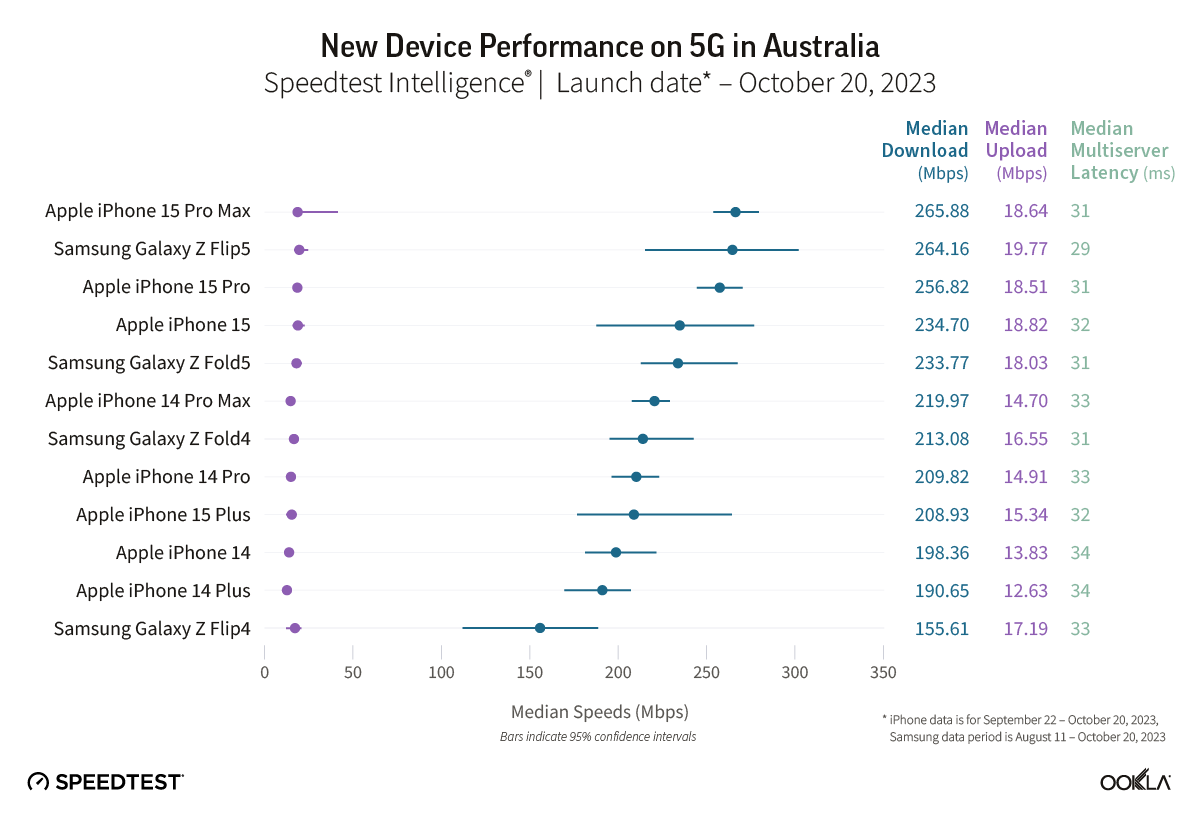
Half of models surveyed worth the upgrade in Australia

Chart of New Device Performance on 5G in Australia

In Australia, two out of four iPhone 15 models showed median 5G download speeds that were significantly faster than their iPhone 14 equivalents during the September 22-October 20, 2023 period. Speedtest Intelligence reveals the iPhone 15 Pro and the iPhone 15 Pro Max both had a 14% better download speed than their prior year counterparts. There was no statistical winner for the iPhone standard model or the iPhone Plus in Australia during this period.

The Galaxy Z Flip5 had a 30% better download speed than the Galaxy Z Flip4 during the August 11-October 20, 2023 period in Australia, while there was no statistical winner for the Galaxy Z Fold.

Recommendation: Depending on your model of choice, only half the devices surveyed merit an upgrade based on performance alone in Australia.

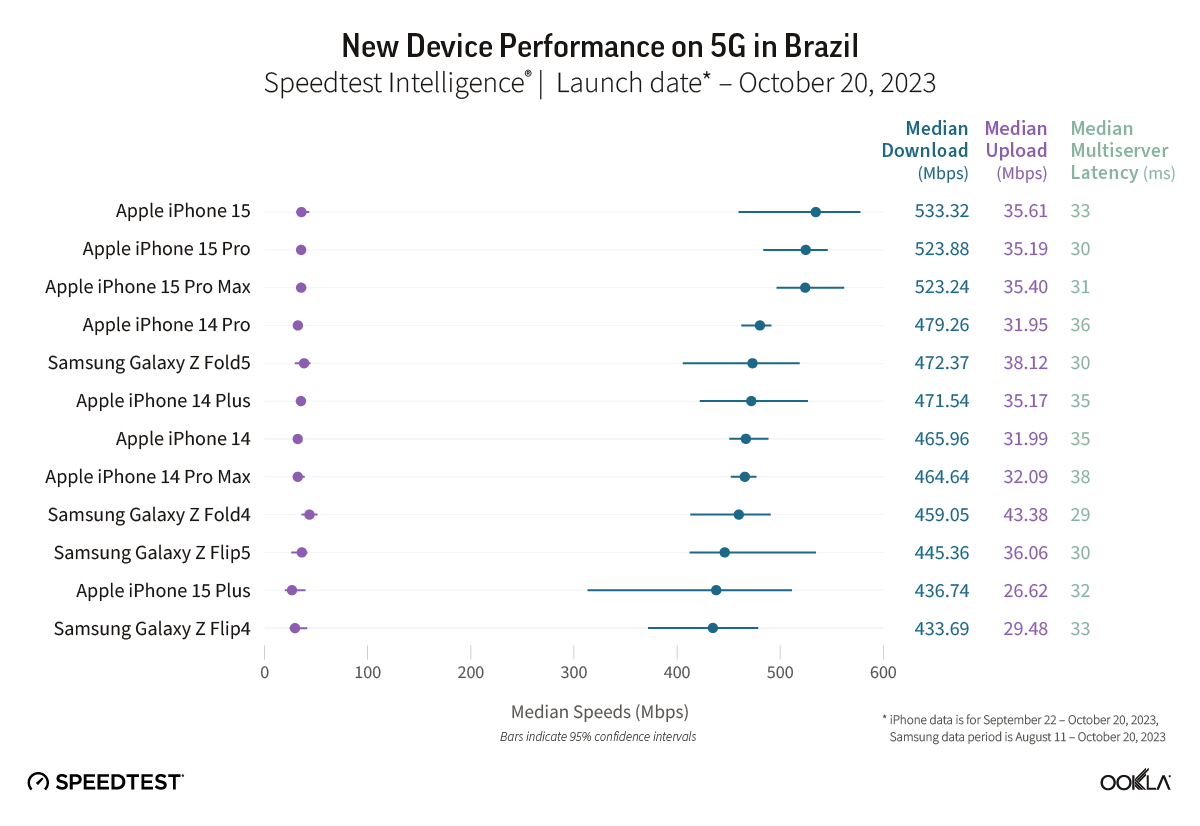
iPhones mostly worth the upgrade in Brazil

Chart of New Device Performance on 5G in Brazil

Three out of four iPhone 15 models in Brazil showed median 5G download speeds that were significantly faster than their iPhone 14 equivalents during the September 22-October 20, 2023 period. Speedtest Intelligence showed the iPhone 15 had a better download speed than the iPhone 14, with the iPhone 15 Pro Max having a 8% better download speed than the iPhone 14 Pro Max, and the iPhone 15 Pro showing a 1% better download speed than the iPhone 14 Pro. There was no statistical winner for the iPhone Plus in Brazil during this period.

There was no statistical winner for 5G median download speed during the August 11-October 20, 2023 period for the Galaxy Z Flip or the Galaxy Z Fold in Brazil.

Recommendation: iPhone users in Brazil should consider an upgrade based on performance, while Samsung Galaxy fans only need to upgrade if they are looking for feature improvements.

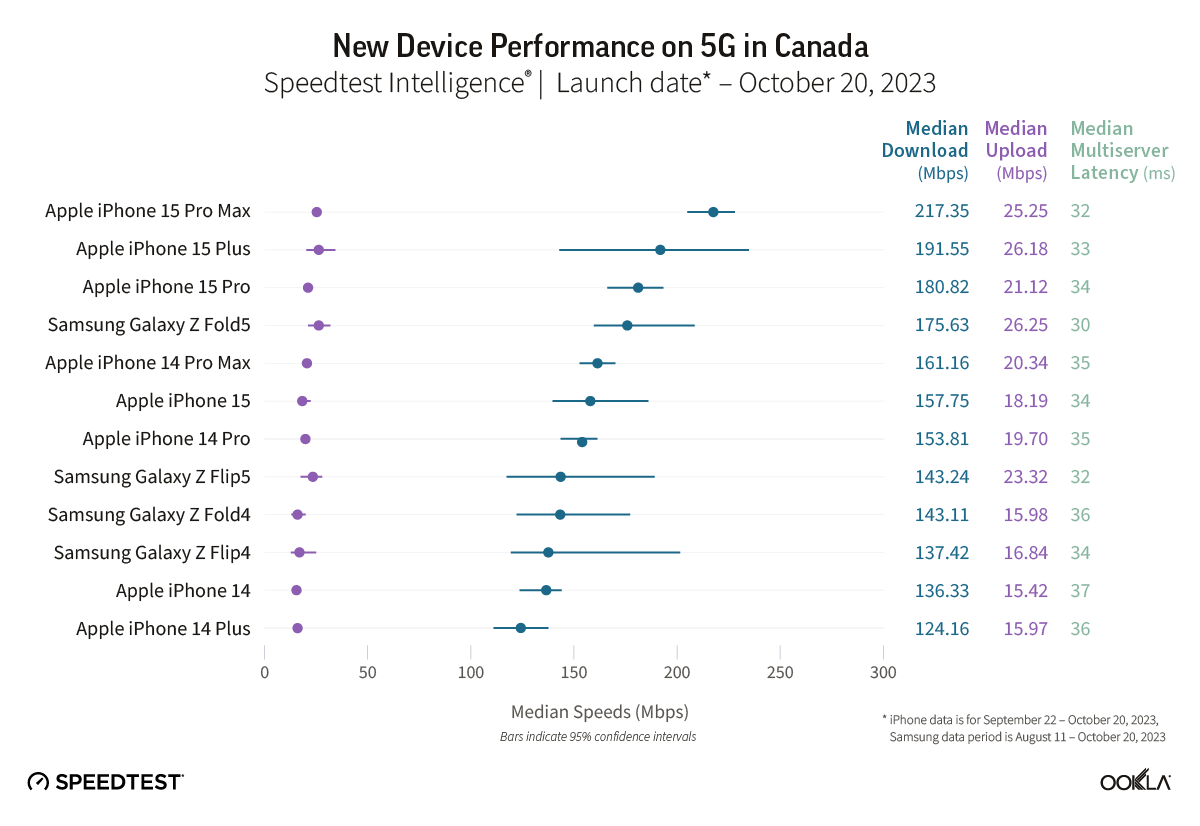
All iPhones show improvement over prior models in Canada

Chart of New Device Performance on 5G in Canada

All four iPhone 15 models in Canada showed median 5G download speeds that were significantly faster than their iPhone 14 equivalents during the September 22-October 20, 2023 period. Data from Speedtest Intelligence demonstrated the iPhone 15 had a better download speed than the iPhone 14, with the iPhone 15 Pro Max having a 26% better download speed than the iPhone 14 Pro Max, the iPhone 15 Pro Plus showed a 12% better download speed than the iPhone 14 Pro Plus, and the iPhone 15 Pro had an 8% better download speed than the iPhone 14 Pro.

The Galaxy Z Fold5 had a better download speed than the Galaxy Z Fold4 during the August 11-October 20, 2023 period in Canada, while there was no statistical winner for the Galaxy Z Flip.

Recommendation: iPhone users in Canada should consider an upgrade based on performance, while Samsung Galaxy fans should make a decision based on which model they’re considering.

Three iPhone models show decent improvement over prior versions in France

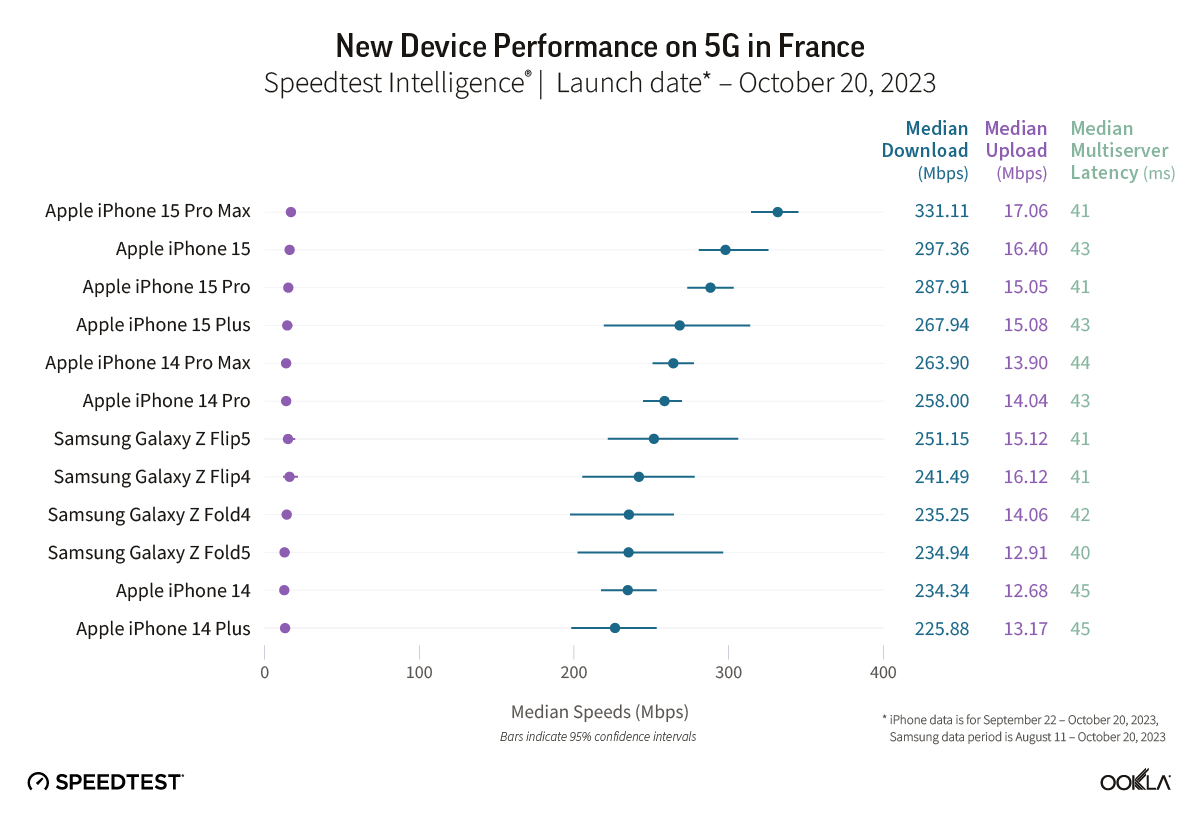
Chart of New Device Performance on 5G in France

Three out of four iPhone 15 models in France showed median 5G download speeds that were significantly faster than their iPhone 14 equivalents during the September 22-October 20, 2023 period. Speedtest Intelligence reveals the iPhone 15 and the iPhone 15 Pro Max both had 18% better download speeds than their respective prior year models. The iPhone 15 Pro had a 5% better download speed than the iPhone 14 Pro. There was no statistical winner for the iPhone Plus in France during this period.

There was no statistical winner for 5G median download speed during the August 11-October 20, 2023 period for the Galaxy Z Flip or the Galaxy Z Fold in France.

Recommendation: iPhone users in France should consider an upgrade based on performance, and Samsung Galaxy users only need to upgrade if they are looking for feature improvements.

Galaxy Z Fold5 shows some improvements in Germany

Chart of New Device Performance on 5G in Germany

Two out of four iPhone 15 models showed median 5G download speeds that were significantly faster than their iPhone 14 equivalents in Germany during the September 22-October 20, 2023 period. Speedtest Intelligence reveals slight improvements with the iPhone 15 Pro Max having a 6% better download speed than the iPhone 14 Pro Max and the iPhone 15 Pro having a 2% better download speed than the iPhone 14 Pro. There was no statistical winner for the iPhone standard model or the iPhone Plus in Germany during this period.

The Galaxy Z Fold5 had a 13% better download speed than the Galaxy Z Fold4 during the August 11-October 20, 2023 period in Germany, while there was no statistical winner for the Galaxy Z Flip.

Recommendation: Apple users won’t see major performance improvements from the new models, but the Galaxy Z Fold5 is worth the upgrade on performance alone.

India sees better performance on three iPhone models

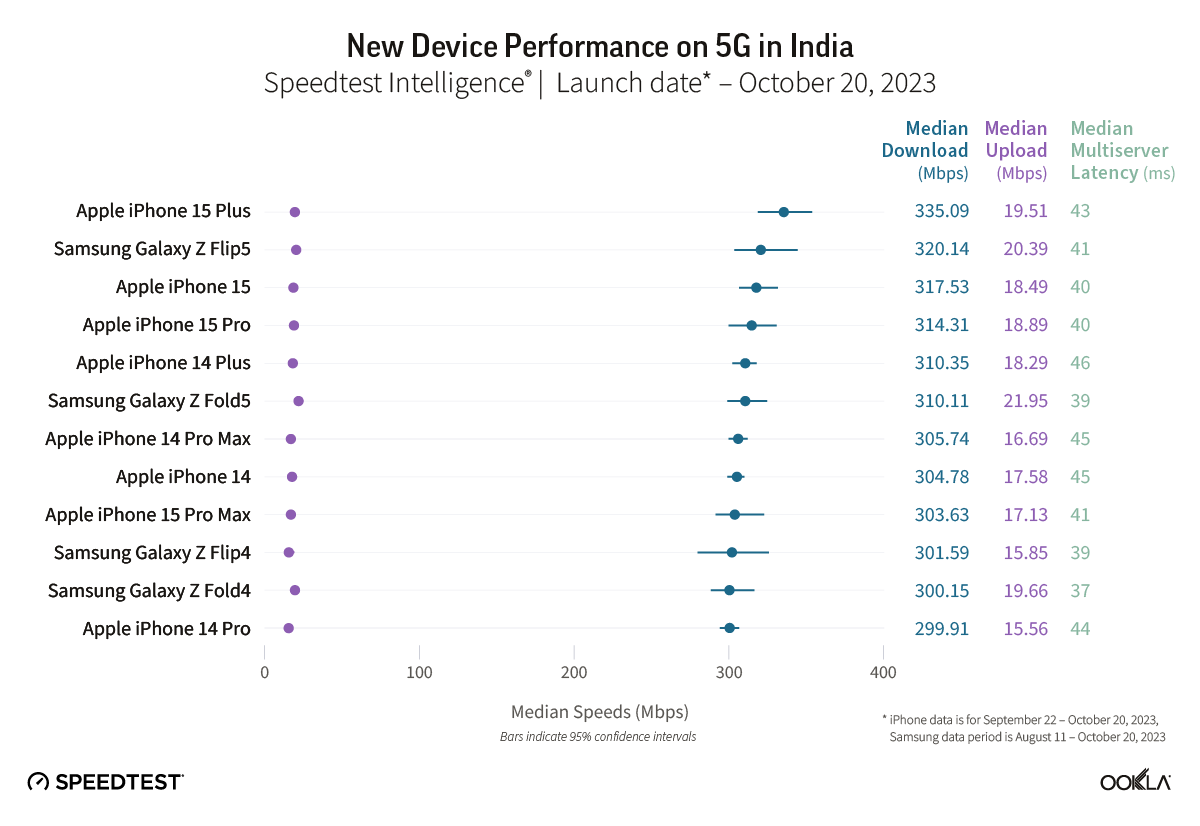
Chart of New Device Performance on 5G in India

Three out of four iPhone 15 models in India showed median 5G download speeds that were significantly faster than their iPhone 14 equivalents during the September 22-October 20, 2023 period. Speedtest Intelligence showed the iPhone 15, iPhone 15 Pro, and the iPhone 15 Plus had better speeds than their respective prior models. There was no statistical winner for the iPhone Pro Max in India during this period.

There was no statistical winner for 5G median download speed during the August 11-October 20, 2023 period for the Galaxy Z Flip or the Galaxy Z Fold in India.

Recommendation: Indian iPhone users should consider an upgrade based on performance, and Samsung Galaxy users only need to upgrade if they are looking for feature improvements.

No significant performance gains on new devices in the Philippines

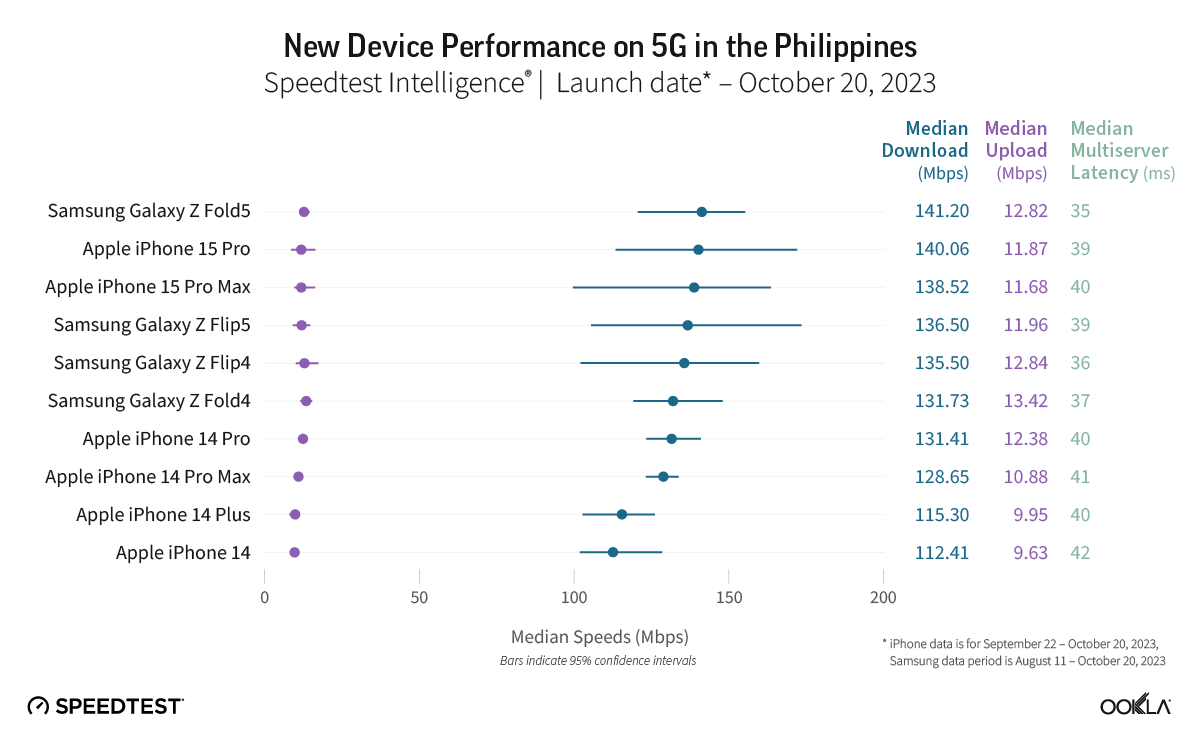
Chart of New Device Performance on 5G in the Philippines

Neither the iPhone 15 Pro nor the iPhone 15 Pro Max had a statistically better median download speed over 5G than their prior year models during the September 22-October 20, 2023 period in the Philippines. There were not enough samples to properly assess the performance of the other two iPhone models.

Likewise, there was no statistical winner for 5G median download speed during the August 11-October 20, 2023 period for the Galaxy Z Flip or the Galaxy Z Fold in the Philippines.

Recommendation: Filipino consumers looking to upgrade their phones to the latest models will have to look for reasons beyond performance.

Galaxy Z Fold5 sees performance improvement in South Korea

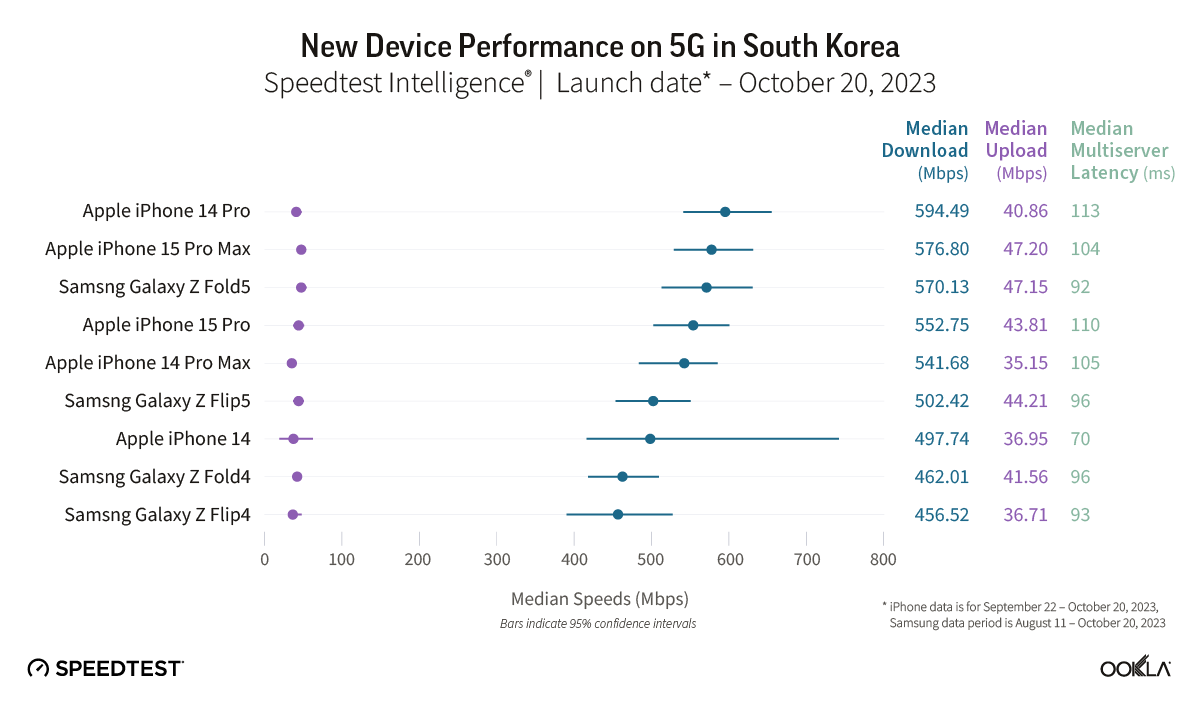
Chart of New Device Performance on 5G in South Korea

Mobile speeds in South Korea are already fast with a top 10 performance on the Speedtest Global Index™ as of September 2023. New phones may not push performance boosts, though, as Speedtest Intelligence data did not show significant increases in median download speed over 5G for the iPhone 15 Pro or the iPhone 15 Pro Max in South Korea during the September 22-October 20, 2023 period. However, the iPhone 15 Pro Max had a 16% better upload speed than the iPhone 14 Pro Max. There were not enough samples to properly assess the performance of the other two iPhone models.

On the other hand, the Galaxy Z Fold5 had a 10% better download speed than the Galaxy Z Fold4 during the August 11-October 20, 2023 period in South Korea, while there was no statistical winner for the Galaxy Z Flip.

Recommendation: If South Korean consumers are looking for better performance, upgrading from the Galaxy Z Fold4 to the Galaxy Z Fold5 is worth looking into.

Spain sees major increases in iPhone speed

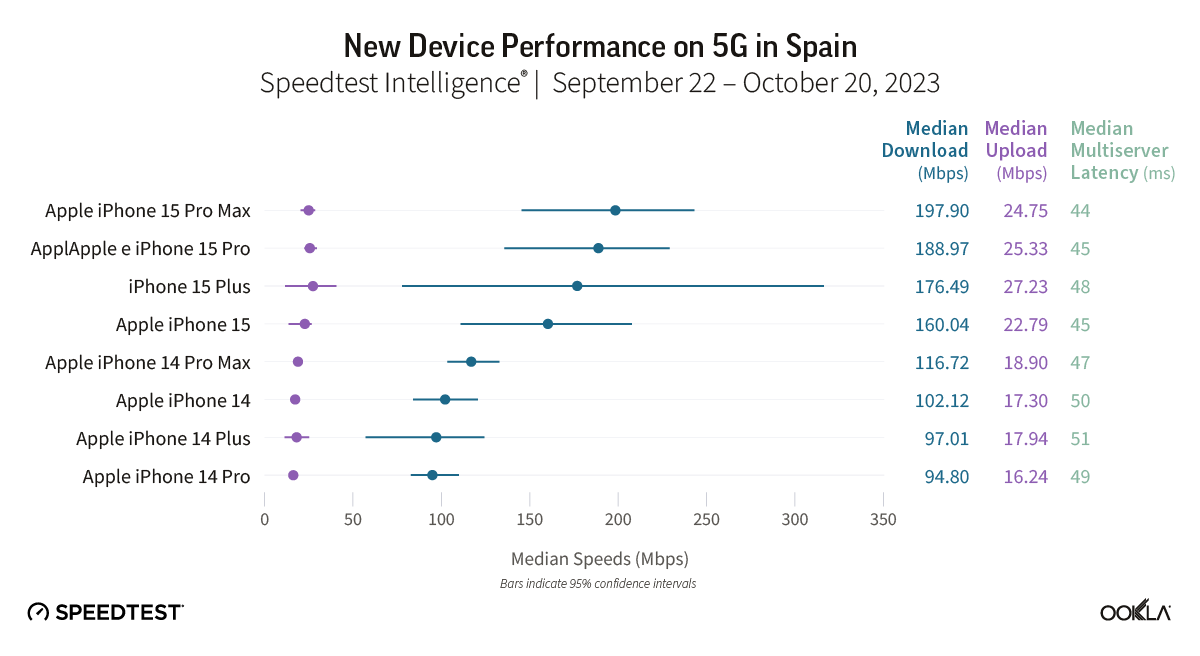
Chart of New Device Performance on 5G in Spain

Three iPhone 15 models in Spain showed median 5G download speeds that were significantly faster than their iPhone 14 equivalents during the September 22-October 20, 2023 period, and the improvements in performance were mostly greater than we saw in other countries, with the exception of the United States. Speedtest Intelligence reveals the iPhone 15 Pro had a 40% better download speed than the iPhone 14 Pro, the iPhone 15 Pro Max had a 36% better download speed than the iPhone 14 Pro Max, and the iPhone 15 had an 11% better download speed than the iPhone 14. There were not enough samples to properly assess the performance of the iPhone Plus.

There were not enough samples to evaluate the Galaxy Z Flip or the Galaxy Z Fold during the August 11-October 20, 2023 period in Spain.

Recommendation: Spanish iPhone fans should definitely upgrade their devices while Samsung users can hold off for now.

Unbeatable performance in U.A.E. makes upgrades unnecessary

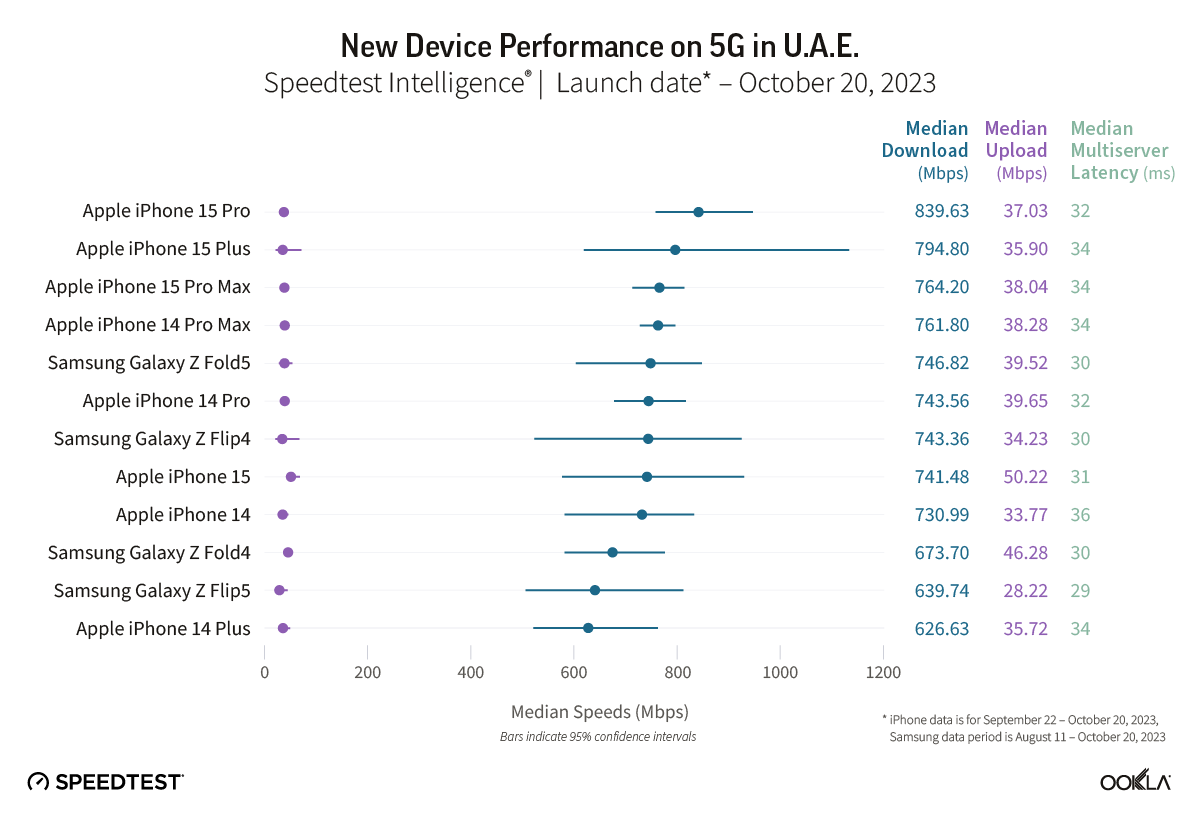
Chart of New Device Performance on 5G in U.A.E.

While Speedtest Intelligence data did not show significant increases in median download speed over 5G for the iPhone 15 Pro or the iPhone 15 Pro Max during the September 22-October 20, 2023 period, performance likely isn’t a concern in the United Arab Emirates, whose blisteringly fast download speeds topped the Speedtest Global Index™ in September 2023. There were not enough samples to properly assess the performance of the other two iPhone models.

Similarly, there was no statistical winner for 5G median download speed during the August 11-October 20, 2023 period for the Galaxy Z Fold in the U.A.E., and there were not enough samples to evaluate the Galaxy Z Flip.

Recommendation: Consumers in the U.A.E. should upgrade if they are looking for the new features on the new phone models, but upgrades for performance are unnecessary.

iPhone upgrades are the way to go in the U.K.

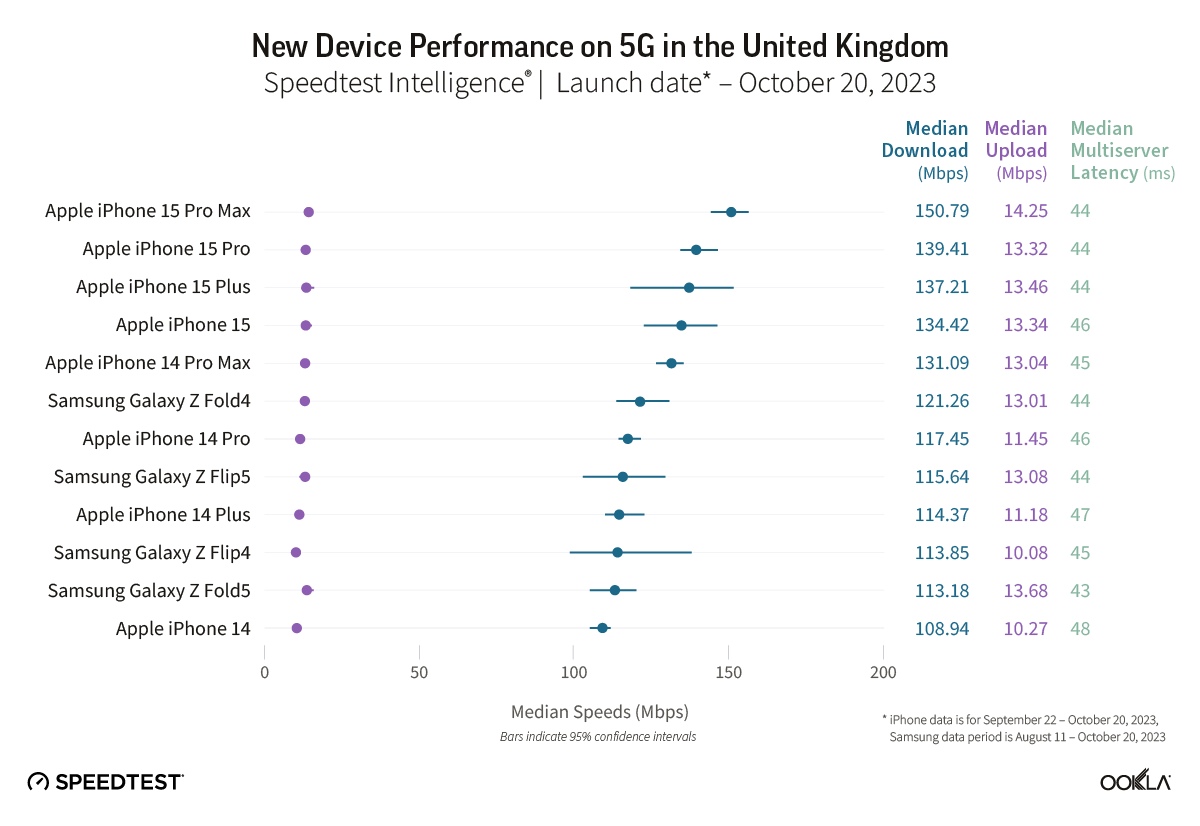
Chart of New Device Performance on 5G in the United Kingdom

All four iPhone 15 models in the United Kingdom showed median 5G download speeds that were significantly faster than their iPhone 14 equivalents during the September 22-October 20, 2023 period. Speedtest Intelligence reveals the iPhone 15 had a 16% better download speed than the iPhone 14, the iPhone 15 Pro had a 14% better download speed than the iPhone 14 Pro, iPhone 15 Pro Max had a 10% better download speed than the iPhone 14 Pro Max, and iPhone 15 Plus has a 4% better download speed than the iPhone 14 Plus. 

There was no statistical winner for 5G median download speed during the August 11-October 20, 2023 period for the Galaxy Z Flip or the Galaxy Z Fold in the U.K.

Recommendation: iPhone users in the U.K. should see performance improvements that make upgrading to the latest models worthwhile. Samsung Galaxy users only need to upgrade if they are looking for new features.

U.S. consumers see some of the highest improvements when upgrading to new iPhone models

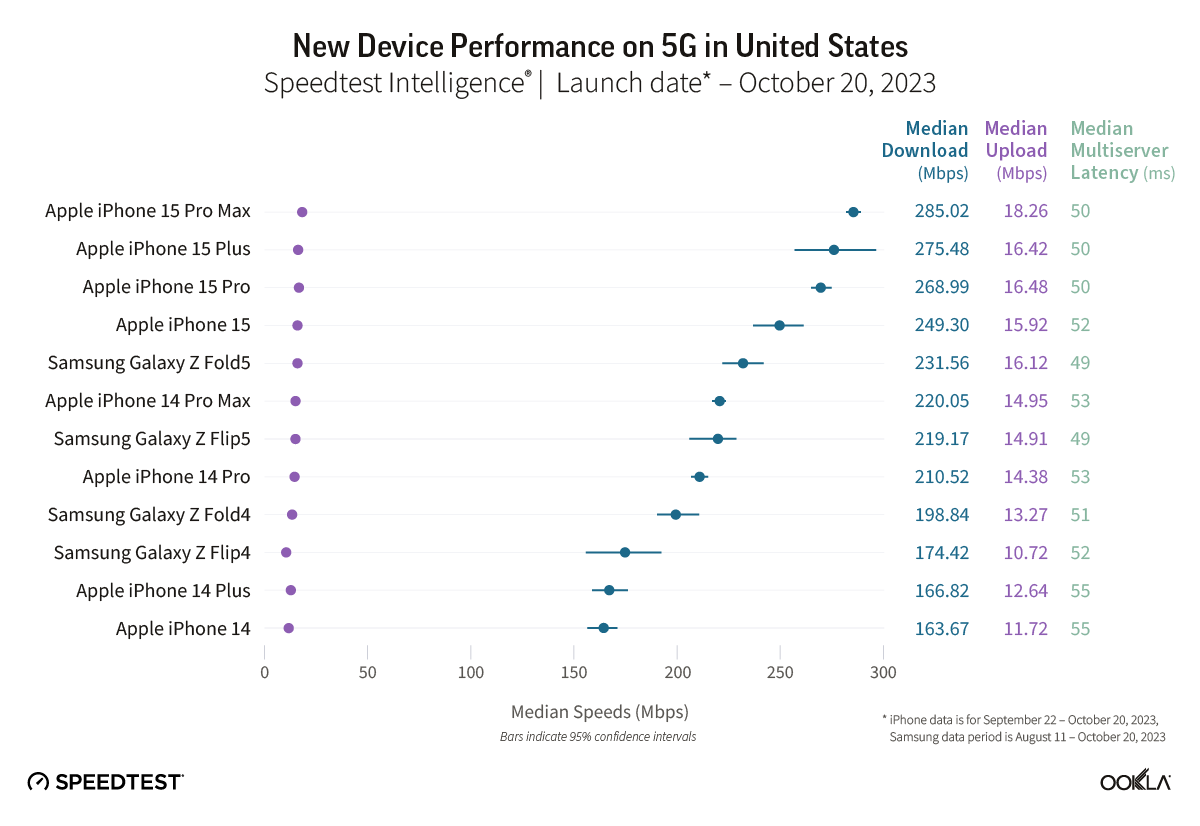
Chart of New Device Performance on 5G in United States

Not only did all four iPhone 15 models in the United States show median 5G download speeds that were significantly faster than their iPhone 14 equivalents during the September 22-October 20, 2023 period, the improvements in performance were greater than we saw in most other countries, with the exception of Spain. Speedtest Intelligence showed the iPhone 15 Plus had a 54% better download speed than the iPhone 14 Plus, the iPhone 15 had a 45% better download speed than the iPhone 14, iPhone 15 Pro Max had a 27% better download speed than the iPhone 14 Pro Max, and iPhone 15 Pro has a 25% better download speed than the iPhone 14 Pro. 

Samsung users also saw increased median download speeds over 5G when using the newer models during the August 11-October 20, 2023 period in the U.S. The Galaxy Z Flip5 had a 15% better download speed than the Galaxy Z Flip4, and the Galaxy Z Fold5 had a 10% better download speed than the Galaxy Z Fold4.

Recommendation: Upgrades for all this holiday season!

No performance boost on iPhone 15 Pro Max in Vietnam

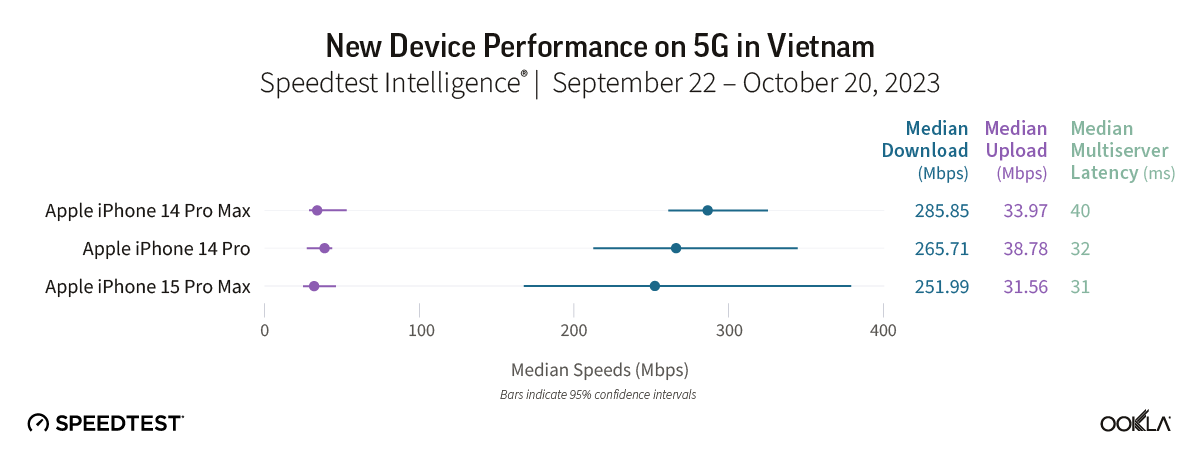
Chart of New Device Performance on 5G in Vietnam

The iPhone 15 Pro Max did not have a statistically better median download speed over 5G than the iPhone 14 Pro Max during the September 22-October 20, 2023 period in Vietnam. There were not enough samples to properly assess the performance of the other three iPhone models. Likewise, there were not enough samples to evaluate the Galaxy Z Flip or the Galaxy Z Fold.

Recommendation: Vietnamese consumers don’t need to upgrade to newer models on performance alone.

Ookla will continue evaluating device performance

We’re excited by the number of countries where mobile device performance increased with the new models and even more excited by the countries where performance is so fast that consumers can look to new modes of connectivity. Even if your country didn’t see the speed boosts you were hoping for, don’t hold back on upgrading if you want to treat yourself or a loved one based on any other number of reasons. Remember to download the iOS or Android Speedtest® app on any new devices to make sure your mobile operator is delivering the speeds you expect.

Ookla retains ownership of this article including all of the intellectual property rights, data, content graphs and analysis. This article may not be quoted, reproduced, distributed or published for any commercial purpose without prior consent. Members of the press and others using the findings in this article for non-commercial purposes are welcome to publicly share and link to report information with attribution to Ookla.
| December 18, 2019

A Global Look at Mobile Modem Market Share and Device Performance

Analysts discuss the latest devices all the time, but rarely is enough attention paid to the phone’s real powerhouse — the modem. We were interested to see how market share for modem manufacturers divides up on a global level, so we investigated device data from Speedtest IntelligenceTM during Q3 2019. We also looked at how popular phones performed in different markets, including a look at 5G phones in 5G countries.

Global modem market share

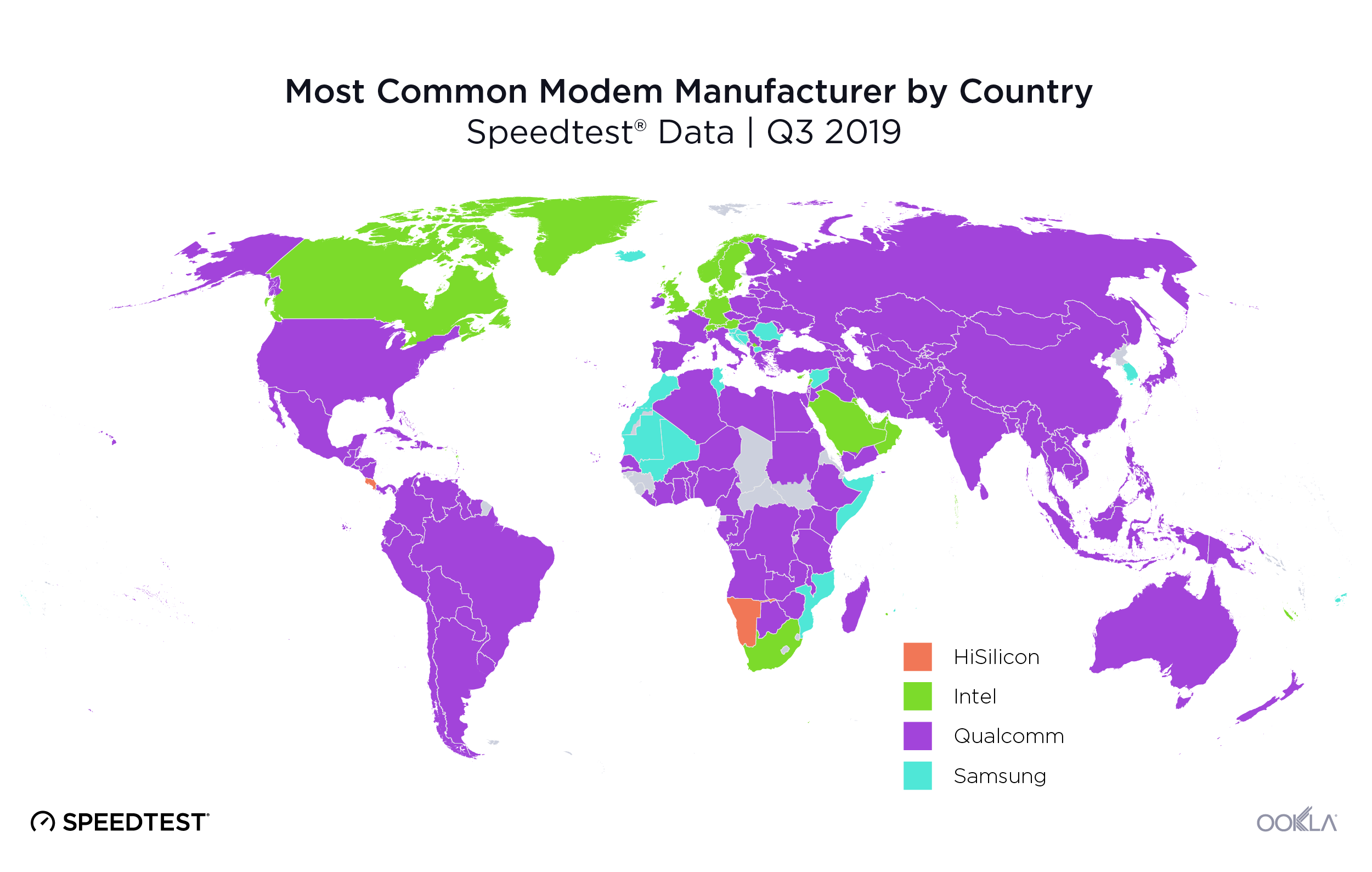
Ookla_Global-Modem-Market-Share_1219-2

Speedtest data showed Qualcomm was the most common modem manufacturer in 133 countries during Q3 2019 — the highest market share was in Hong Kong with 73.6% of the devices analyzed showing Qualcomm modems. Qualcomm’s slimmest majority was in Botswana with 25.6% of devices analyzed showing Qualcomm modems.

This is not surprising as Qualcomm chipsets power many flagship devices sold around the world. In the U.S., virtually all Android OEMs use Qualcomm-powered chipsets. The latest Qualcomm Snapdragon 855+ mobile platform with Snapdragon X24 integrated LTE modem (up to 2Gbps) powers popular devices from Samsung, LG and OnePlus. It’s worth noting that Qualcomm has multi-year licensing deals with multiple OEMs based in China, namely Vivo, OPPO, Lenovo, Xiaomi and OnePlus, providing their complete modem-to-antenna solutions for optimal RF performance. This includes valuable RF Front End (RFFE) components such as power amplifiers, envelope trackers, RF switches, filters and antenna tuners.

These OEMs also have access to Qualcomm’s first and second generation 5G modems. As of right now, Qualcomm is also the only chipset manufacturer providing modem-to-antenna solutions for 5G millimeter wave (mmWave) deployments, providing all-in-one mmWave antenna modules that contain radio transceiver, RFFE and phased array antenna.

Intel was the most common modem manufacturer in 32 counties during Q3 2019. The highest percentage of devices with Intel modems was seen in Greenland at 55.6%. Intel’s slimmest majority was in South Africa with 28.6% of devices analyzed showing Intel modems. Intel’s main customer in the smartphone space is Apple. Starting in 2016, Apple began powering some iPhone devices with Intel’s flagship LTE chipsets, and since 2018, all iPhones have Intel’s cellular chipsets.

Samsung was the most common modem manufacturer in 16 countries during Q3 2019. South Korea had the highest percentage of devices with Samsung modems at 53.8%. Samsung’s slimmest majority was in Mozambique with 29.1% of devices analyzed powered by Samsung modems. Samsung’s Exynos LTE modem is seen in variants of Samsung’s Galaxy S and Note devices. Except in the Americas and China, most of Samsung’s flagship S10 and Note 10 devices around the world are powered by Samsung’s own Exynos 982x SoC (system on a chip), with an integrated LTE Category 20 modem capable of download speeds of up to 2 Gbps.

Speedtest data showed HiSilicon as the most common modem manufacturer in two countries during Q3 2019. In Costa Rica, 32.4% of devices analyzed showed HiSilicon modems, and in Namibia that number was 27.6%. HiSilicon is a semiconductor company based in Shenzhen and fully owned by Huawei. Huawei integrates its own flagship modem into its flagship P and Mate series devices. These devices have a large user base in Europe, the Middle East and Asia.

Device performance is affected by market factors

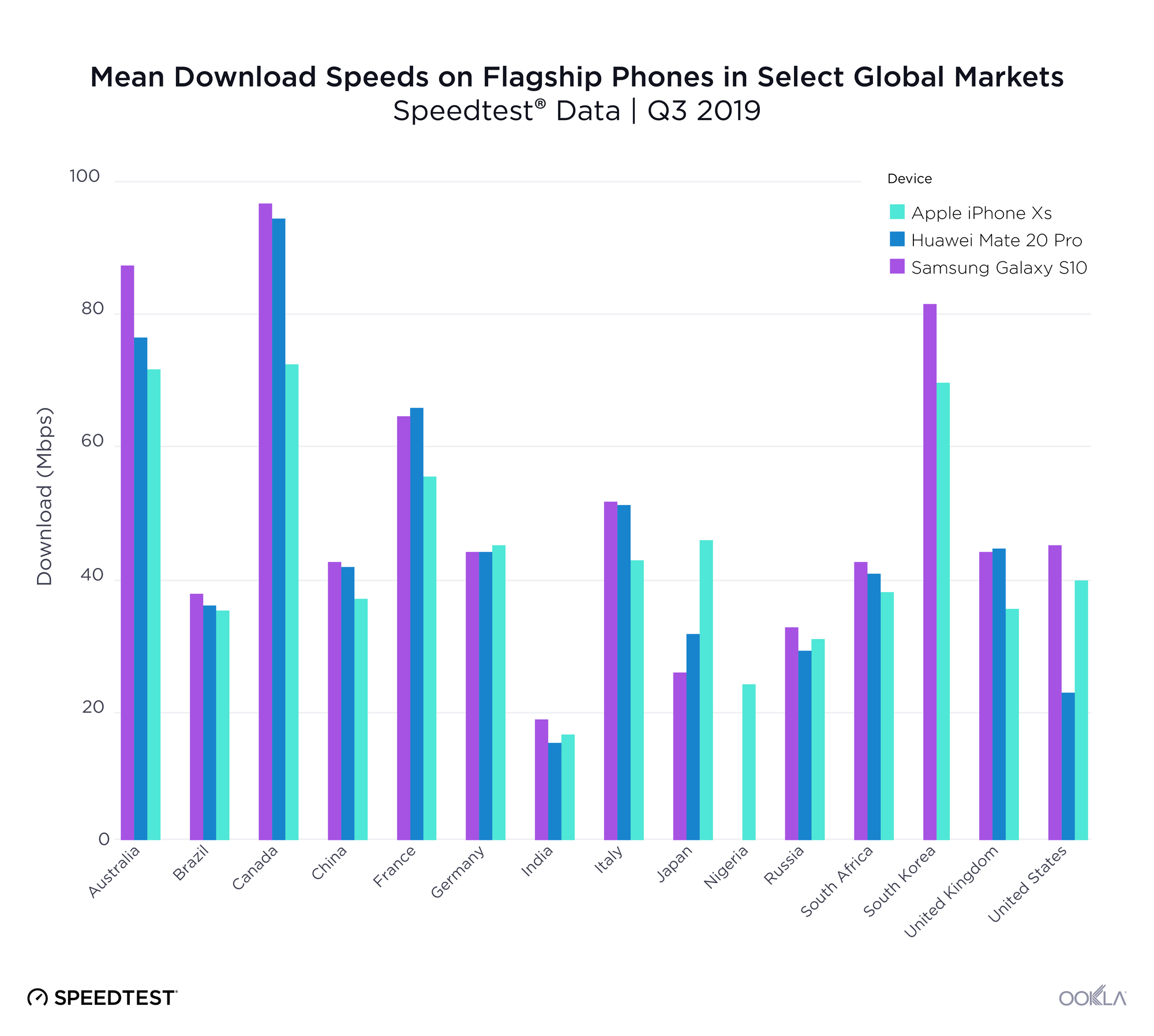
A phone’s performance is always going to depend on the conditions within its specific market. Factors affecting network performance can include: geography, cell site and population density, the amount of wireless spectrum deployed and the overall capabilities of user equipment seeded to market. Multiple factors can impact the performance of a device, including: varying degrees of RF transparency in the materials used for device chassis, variations in RF front-end and antenna design complexity and whether the baseband processor is more or less capable of handling network tasks. We used Speedtest data to analyze how three popular phones — the Apple iPhone Xs, the Huawei Mate 20 Pro and the Samsung Galaxy S10 — performed in specific markets around the world during Q3 2019. We excluded data from devices with fewer than 100 samples in a market during the period.

Mean-DL-Speeds-on-Flagship-Phones

The Samsung Galaxy S10 was the fastest of these three devices in all but five markets during Q3 2019. However, the mean download speed on the Galaxy S10 varied between 18.06 Mbps in India and 95.91 Mbps in Canada. The Huawei Mate 20 Pro showed the fastest mean download speed of these three devices in France and the U.K. during Q3 2019 and often placed second in the remaining markets on the list. Mean download speed on the Mate 20 Pro during Q3 2019 ranged from 14.57 Mbps in India to 93.66 Mbps in Canada.

Apple’s iPhone Xs was at a slight disadvantage in this comparison, as it came out in 2018 where the other devices debuted in 2019. Because the iPhone 11 was not fully seeded to markets in Q3 2019, we considered its predecessor, the iPhone Xs, in this analysis. The iPhone Xs showed the fastest mean download speed in Germany, Japan and Nigeria during Q3 2019. Mean download speeds on the iPhone Xs varied from 15.92 Mbps in India to 71.72 Mbps in Canada.

Device performance in 5G markets

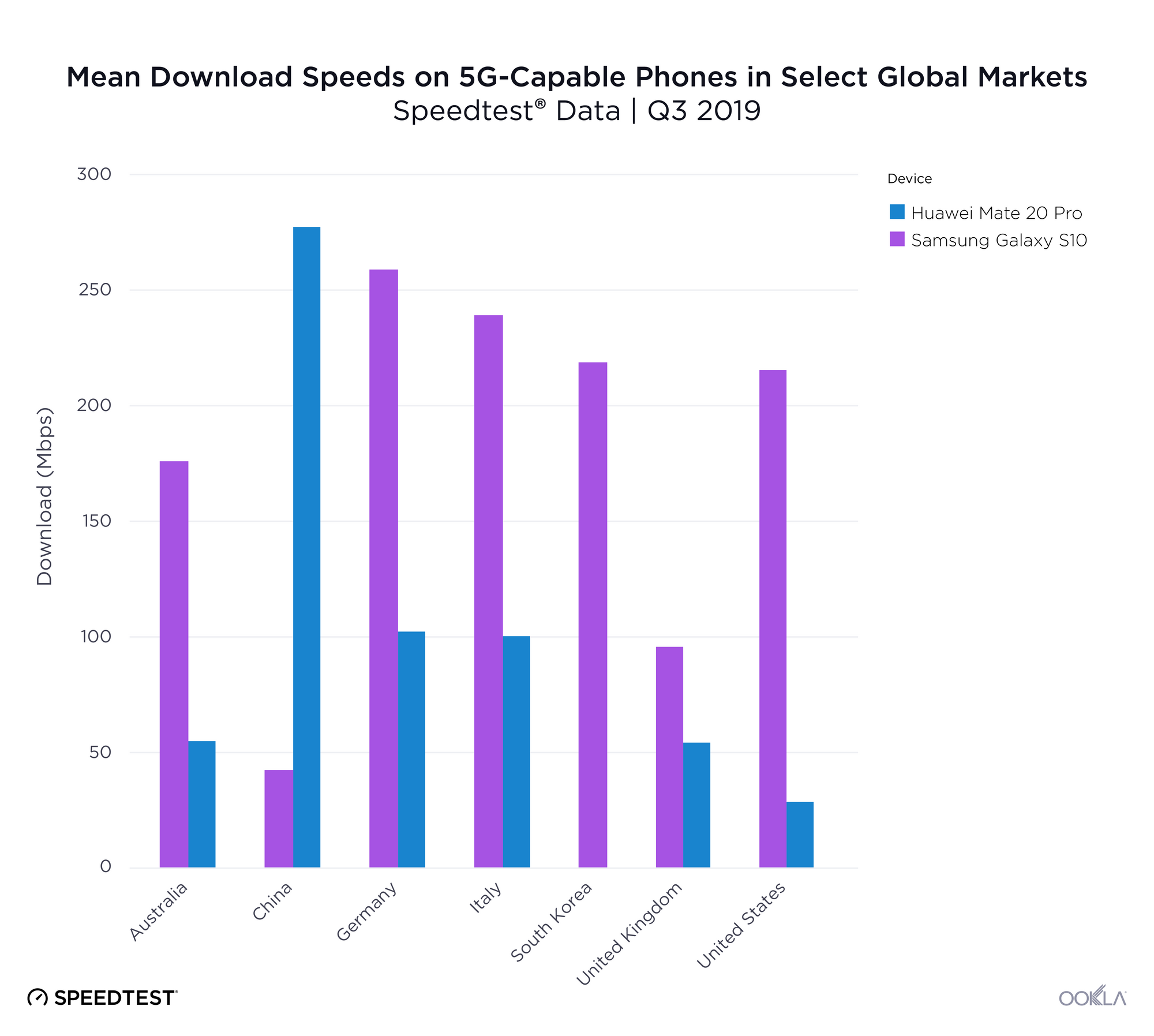
5G currently offers the pinnacle of mobile performance. We looked at 5G-capable devices in markets where 5G exists to see how download speeds compare. These results include Speedtest results on all technologies, not just 5G, which means averages also reflect consumers using 5G phones with a 4G connection.

Mean-DL-Speeds-on-5G-Phones

Both the Samsung Galaxy S10 5G and the Huawei Mate 20 X 5G showed mean download speeds in excess of 200 Mbps in some markets during Q3 2019. However, there’s clearly some difference in which devices are supported by which operators, as not all operators in 5G markets are offering 5G equally (if at all). Related, the Samsung Galaxy S10 5G models sold in the U.S. and China are powered by Qualcomm’s first-generation Snapdragon X50 5G modem, while other 5G markets receive the variant powered by Samsung’s in-house Exynos 5100 5G modem.

Mobile operators continue to incentivize consumers to upgrade to newer and more capable devices to ensure a more efficient use of spectrum assets for network operators. This leads to an improved utilization of shared resources, faster overall speeds and better quality of experience.

We’re looking forward to updating these analyses as more markets adopt 5G and as newer and even faster phones are released. For more information about how our device data can help you, contact us.

Ookla retains ownership of this article including all of the intellectual property rights, data, content graphs and analysis. This article may not be quoted, reproduced, distributed or published for any commercial purpose without prior consent. Members of the press and others using the findings in this article for non-commercial purposes are welcome to publicly share and link to report information with attribution to Ookla.
| January 14, 2021

Apple has 5G! But How Fast is the iPhone 12?


Apple’s 5G-capable iPhone 12 is the latest step in the continuous cycle of new technical specifications, new network components, new (or refarmed) radio spectrums and compatible user equipment that aim to deliver enhanced 5G user experience. At Ookla®, we are fortunate to have a front-row seat to observe these advances and we were thrilled when Apple announced its first 5G devices on October 13, 2020. Given the popularity of Apple’s devices, this release marks a major milestone on the way to 5G becoming mainstream.

iPhone 12 launch drives spikes in 5G testing

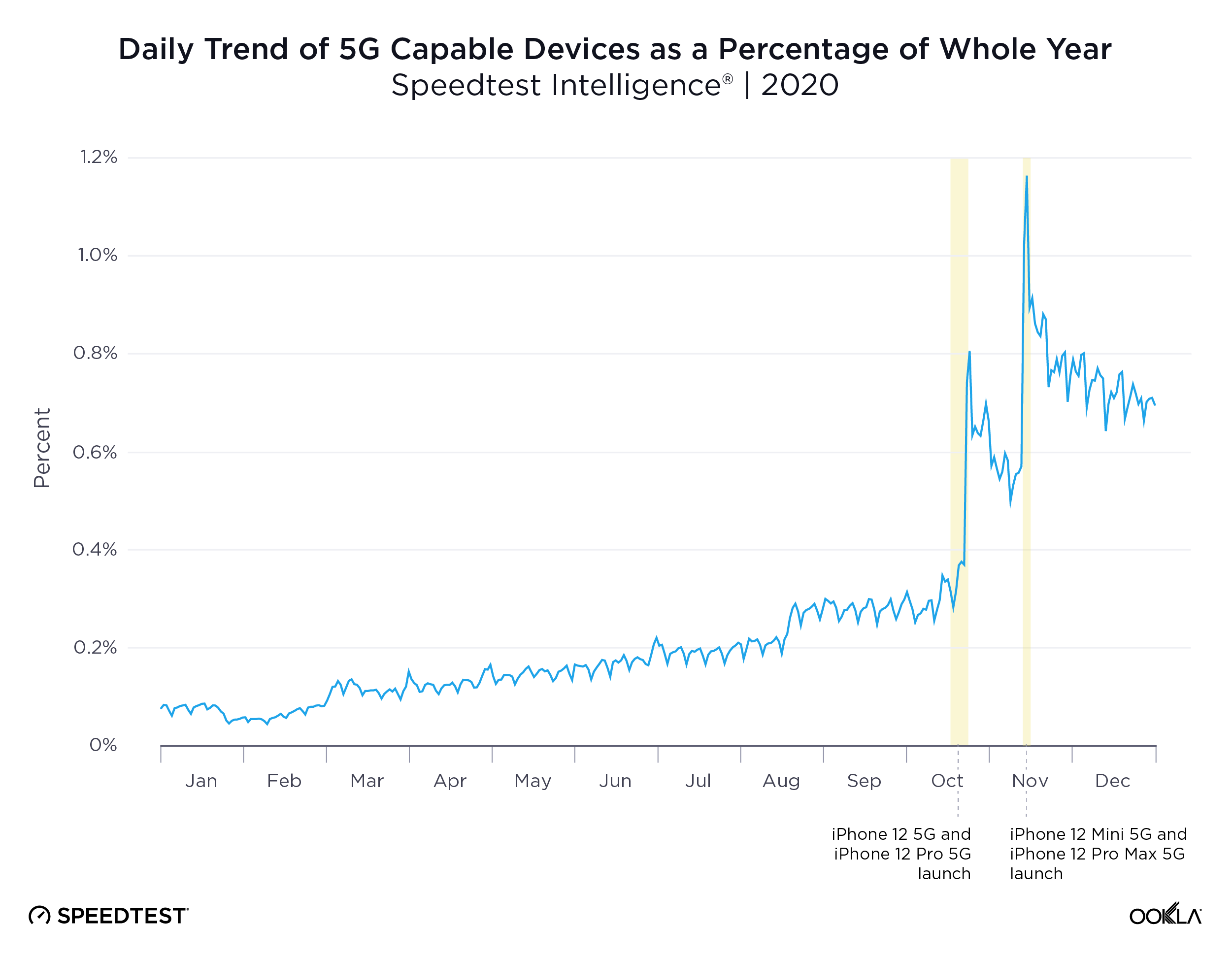
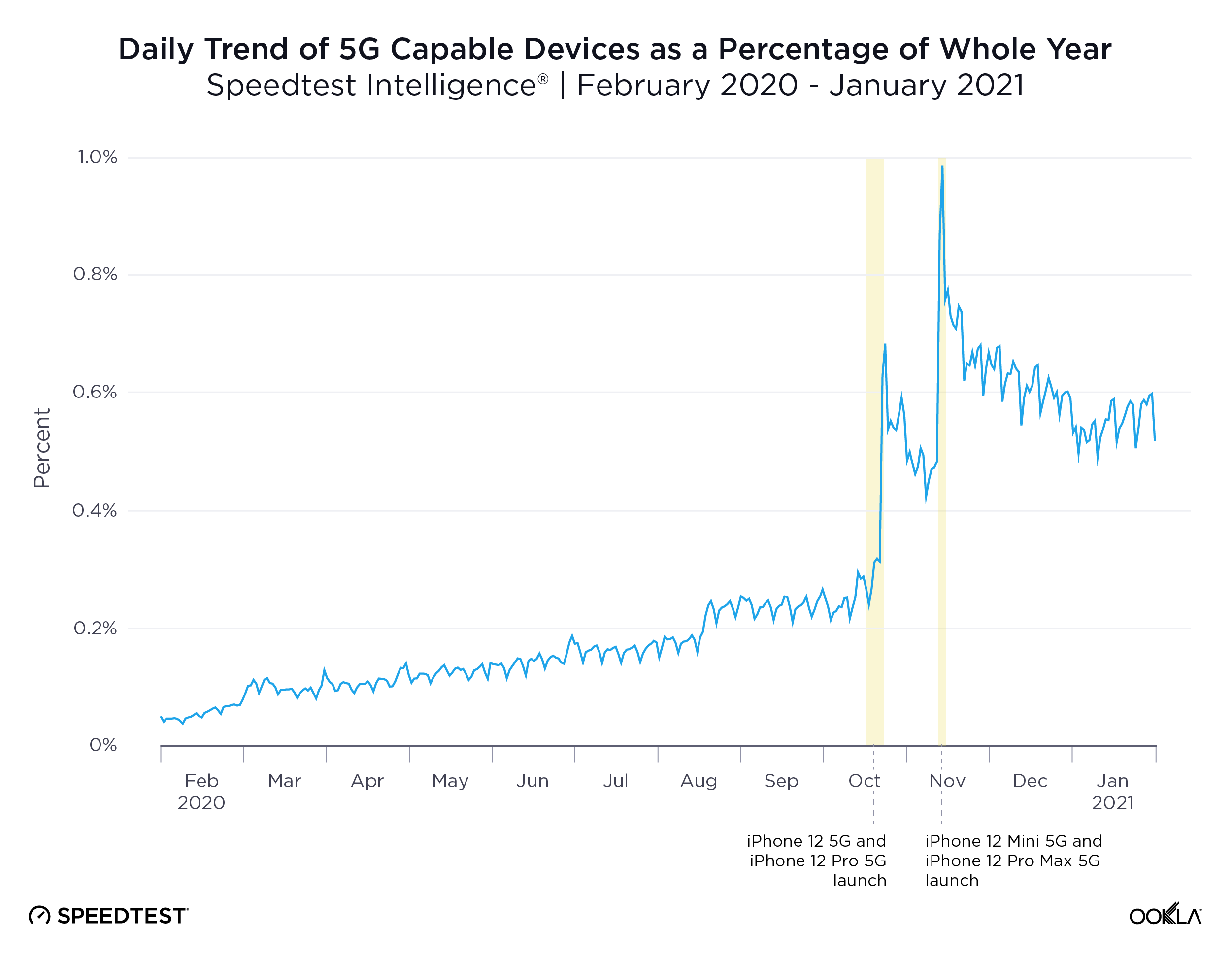
The daily count of unique devices worldwide that are capable of connecting to 5G jumped dramatically when each new iPhone 12 variant launched. We saw a 138.3% increase when comparing the day the iPhone 12 5G and iPhone 12 Pro 5G were released to the mean of the previous week. On the day the iPhone 12 Mini 5G and iPhone 12 Pro Max 5G launched, there was a further 44.3% increase over that one-day spike.

Daily-Trend_5G-Capable-Devices_Year_0121-1

Pro 5G and Pro Max 5G are the most popular iPhone 12 models

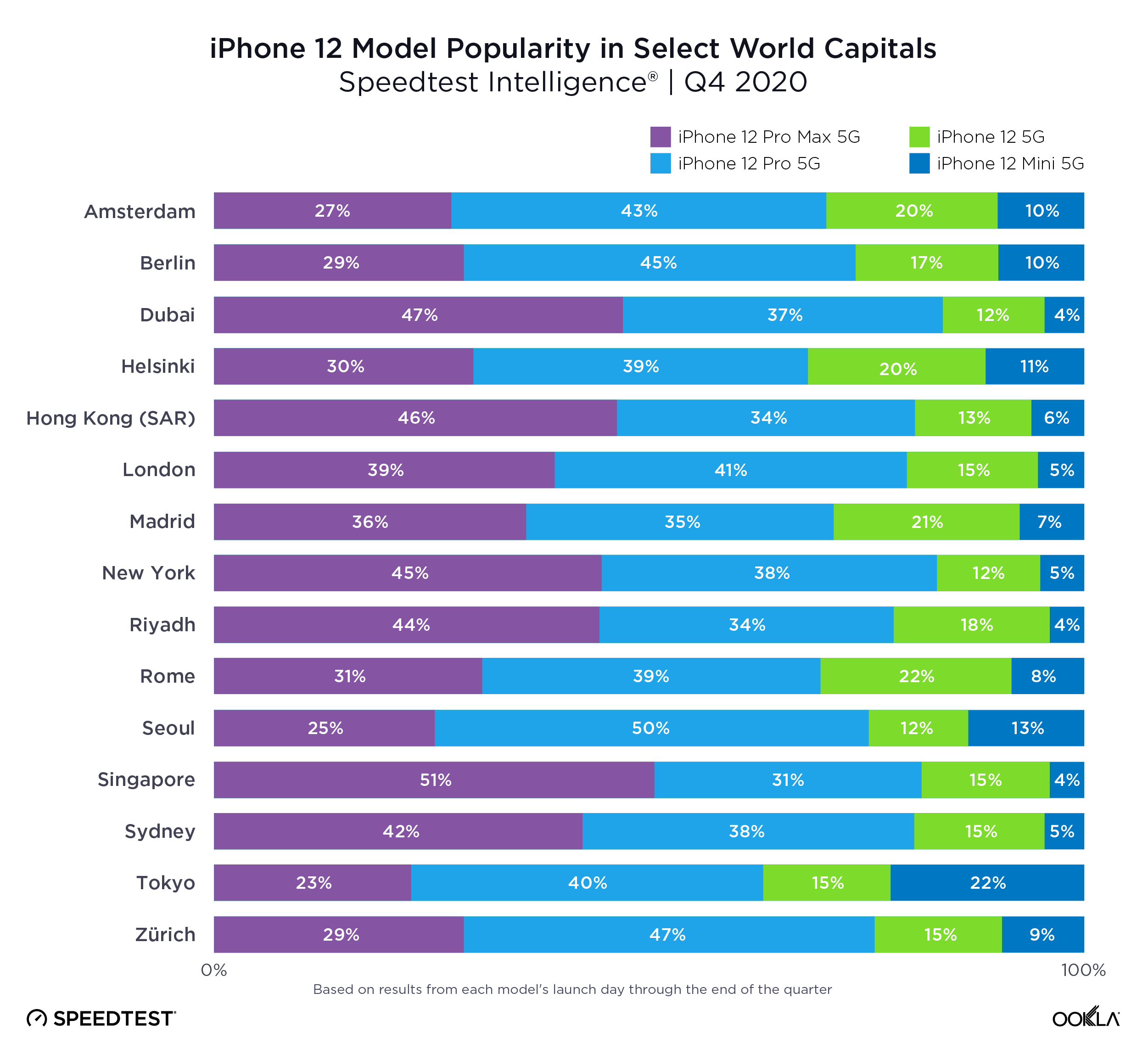
We examined Speedtest® results from the launch date of each model through the end of the year to see which iPhone 12 models are the most popular in 15 major cities across the globe. We found that most Speedtest users have opted for the “Pro” models. The iPhone 12 Pro Max 5G showed the highest number of samples among iPhone models in Singapore, Dubai, Hong Kong, New York, Riyadh and Sydney. The iPhone 12 Pro 5G showed the most samples in London, Madrid, Rome, Helsinki, Zürich, Berlin, Amsterdam, Seoul and Tokyo. While the more affordable models were less popular than the Pro models across all the cities on our list, the iPhone 12 Mini saw the most adoption in Tokyo and the iPhone 12 5G saw the most adoption in Rome.

iPhone-12-Model-Popularity_0121

Seoul tops list of iPhone 12 5G speeds

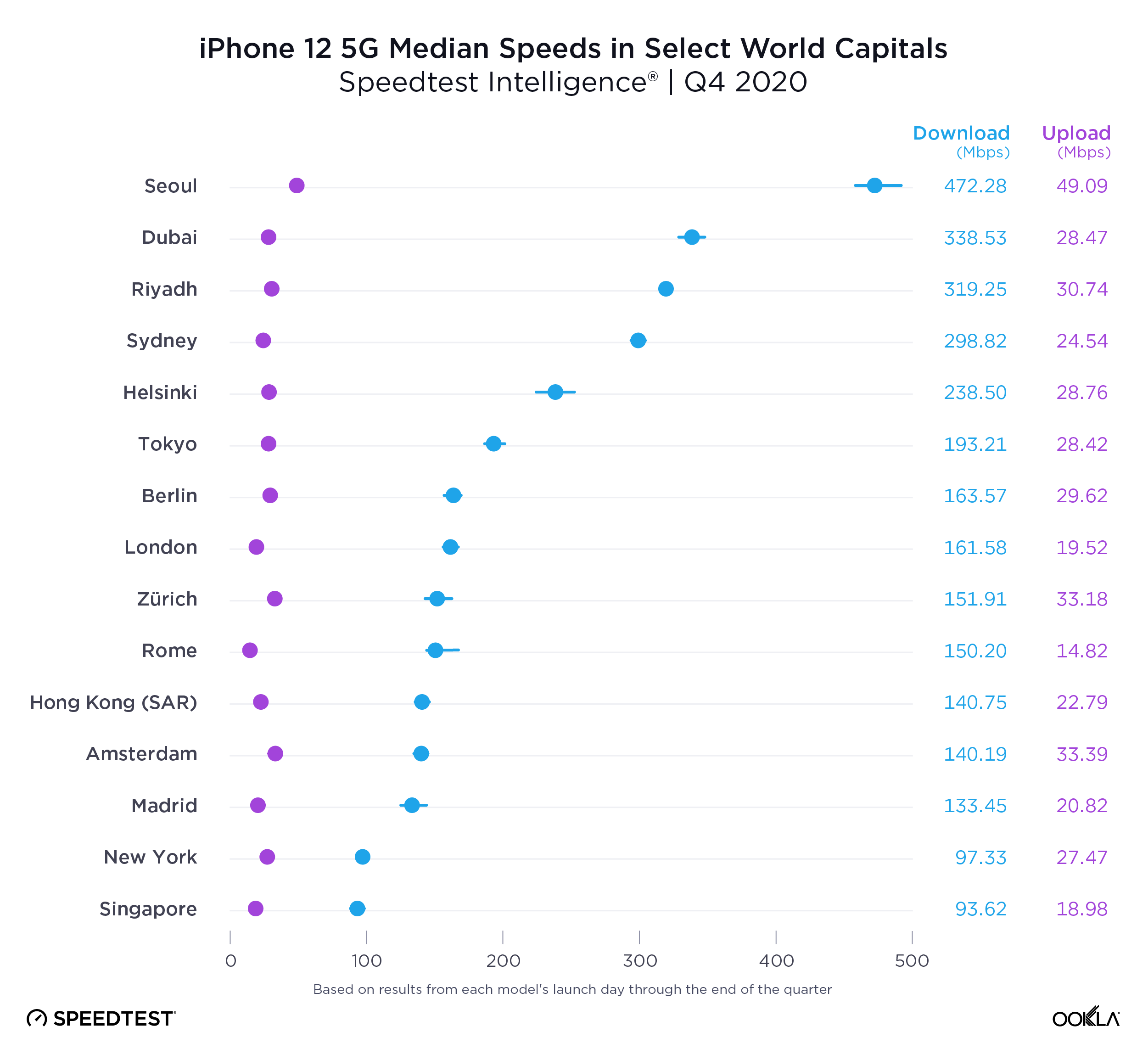
We analyzed Speedtest Intelligence® data for iPhone 12 devices in the same 15 cities and found that Seoul had the fastest median speed over 5G, followed by Dubai and Riyadh. Seoul also had the fastest upload speed by a considerable margin. This is not a surprise given reports that there are more than 100K 5G base stations in South Korea. It is interesting to note that European cities are relatively close to each other in terms of median download and upload speeds. That is good news for the 5G action plan of the European Commission and their target of having uninterrupted 5G coverage on major terrestrial transport paths by 2025.

iPhone-12-5G-Median-Speeds_0121

Each of these markets utilizes its own unique approach to 5G. Today, the United States is the only market where iPhone 12 models support 5G high-bands, namely n260 and n261. This is to support existing commercial 5G deployments in the mmWave spectrum across all three Tier 1 operators.

Elsewhere on the globe mid-band (specifically the 3300-3800 MHz range in most countries) is the most common frequency range for initial 5G roll-outs. There are several reasons for this, ranging from principles of electromagnetic wave propagation to marketing strategies. High-band frequency ranges (above 24 GHz with 400-800 MHz contiguous bandwidth) can do wonders in terms of download speeds, but due to limited propagation characteristics, it can be challenging to provide a mmWave coverage layer across entire markets. In order to mitigate this well-known challenge, operators tend to rely on the lower frequency bands for coverage and selectively deploy mmWave applications in targeted areas (such as high-traffic locations).

Depending on market dynamics and spectrum availability, most providers choose non-standalone (NSA) 5G configuration with an LTE anchor. Operators with limited amounts of FR1 spectrum tend to use dynamic spectrum sharing (DSS), a feature which allows both LTE and New Radio (NR) operation on the same slice of spectrum at the same time. This feature enables a relatively easy deployment of 5G coverage layers, and is a stepping stone to standalone 5G (5G SA). In addition to these commonly observed strategies, a few operators are considering pushing the limits of digital convergence with open radio access networks (RAN).

No matter which strategy an operator chooses, one important fact about 5G does not change: access to a trio of low, mid and high bands and a strategy for rolling out 5G SA is critical. Deployment of the 5G SA core unlocks the potential of enhanced mobile broadband (eMBB), ultra-reliable low latency communication (uRLLC) and massive machine type communications (mMTC).

Operator breakdown: iPhone 12 performance in select cities

5G deployments vary greatly from country to country, depending on spectrum allocated and the particular channel bandwidths each operator has deployed. This makes comparisons between countries difficult, as these factors directly impact the peak 5G speeds achievable in that market. However, looking at four major cities, we can see that performance by operator also varies.

iPhone-12-5G-Median-Speeds_Seoul_0121

In Seoul, the fastest city for 5G on the list above, the 3.5 GHz (Band n78) is used with 80 to 100 MHz channels per operator, and B2C mmWave (which would add a whopping 800 MHz channels per operator) is on the horizon. Here, LG U+ showed the fastest median download speed over 5G on the iPhone 12 in Seoul at 625.03 Mbps. SK Telecom was second and KT third.

iPhone-12-5G-Median-Speeds_Hong-Kong_0121

The three Hong Kong mobile operators that launched commercial 5G networks on April 1, 2020 ranked fastest for iPhone 12 5G median download speed rankings in Hong Kong. China Mobile HK, the only 5G network provider in Hong Kong that has acquired 3.3 GHz (3380-3400 MHz) and 3.5 GHz (3400-3460 MHz) continuous bandwidth spectrum was the fastest of these three at 212.77 Mbps. CSL and 3 Hong Kong were a close second and third, respectively. SmarTone, which launched its 5G network a month later, was fourth.

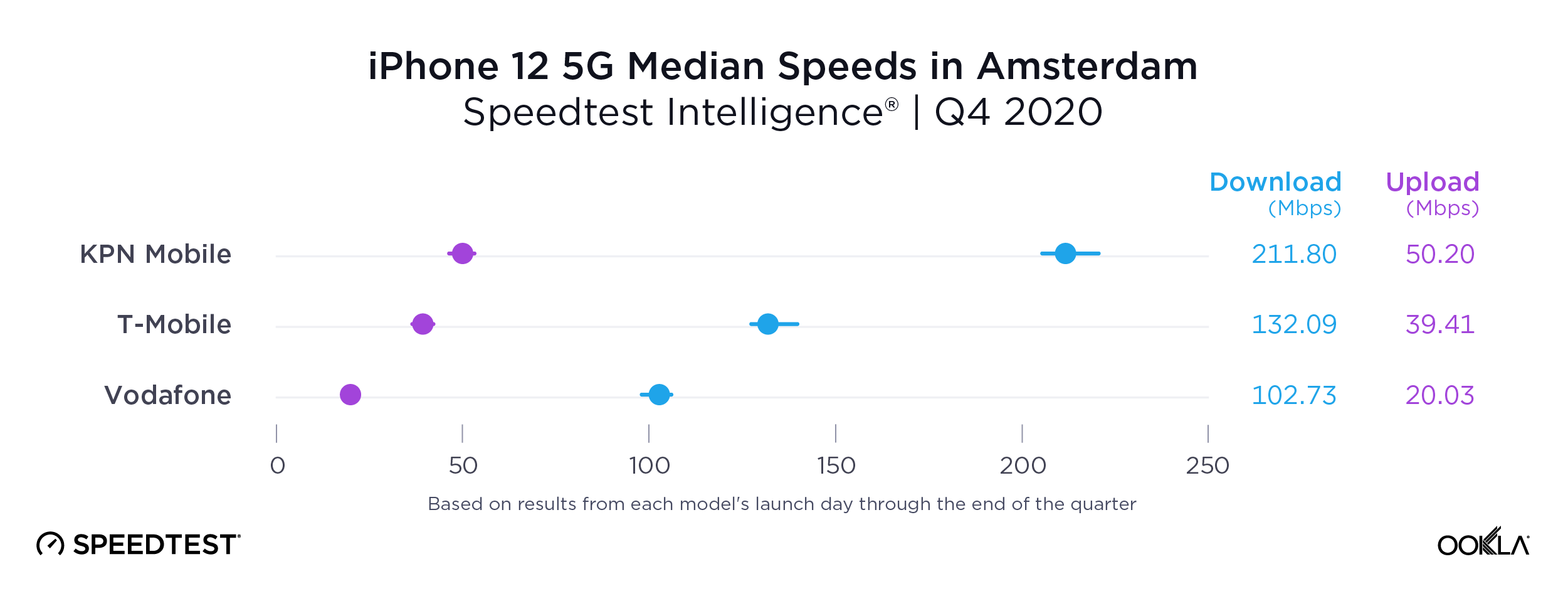
iPhone-12-5G-Median-Speeds_Amsterdam0121

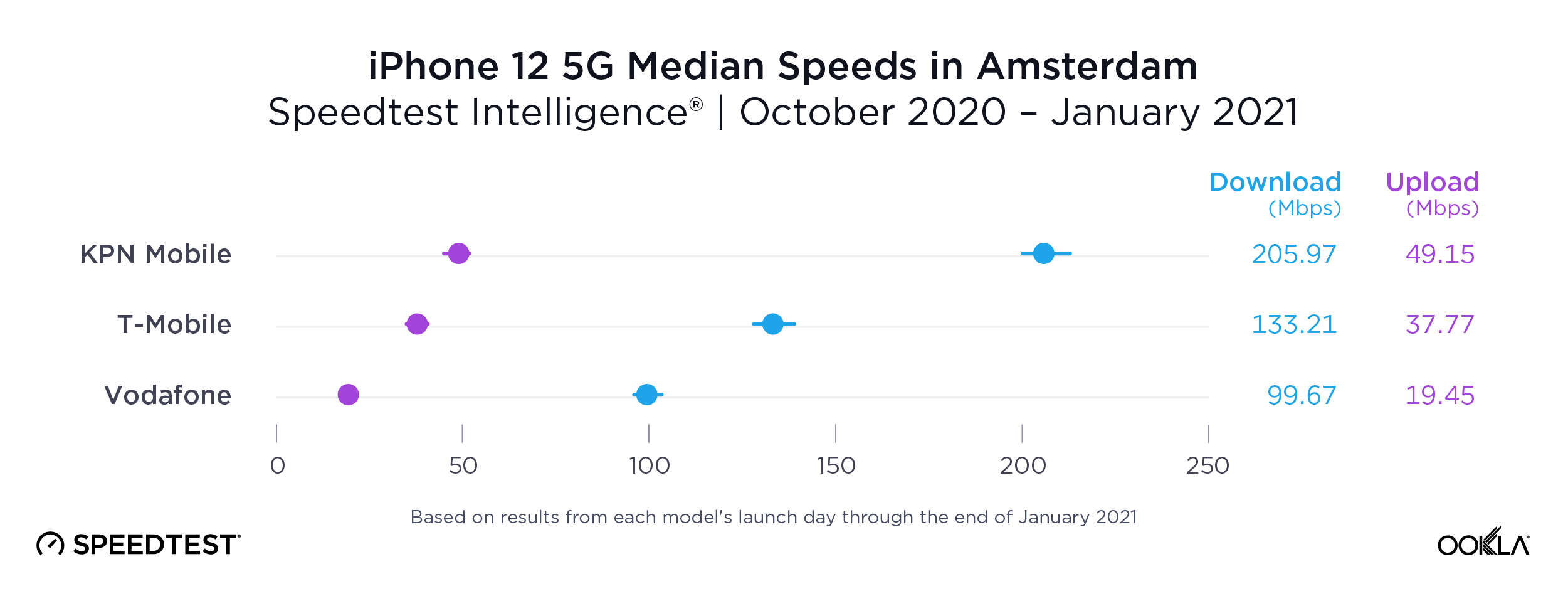
The 3.5 GHz band is not yet available in the Netherlands, but this did not slow down Dutch operators in launching their commercial 5G networks in 2020. According to Speedtest Intelligence data, KPN Mobile was comfortably at the top, with a median download speed of 211.80 Mbps over 5G using the iPhone 12 in Amsterdam during Q4 2020. T-Mobile was second and Vodafone third.

iPhone-12-5G-Median-Speeds_Madrid_0121

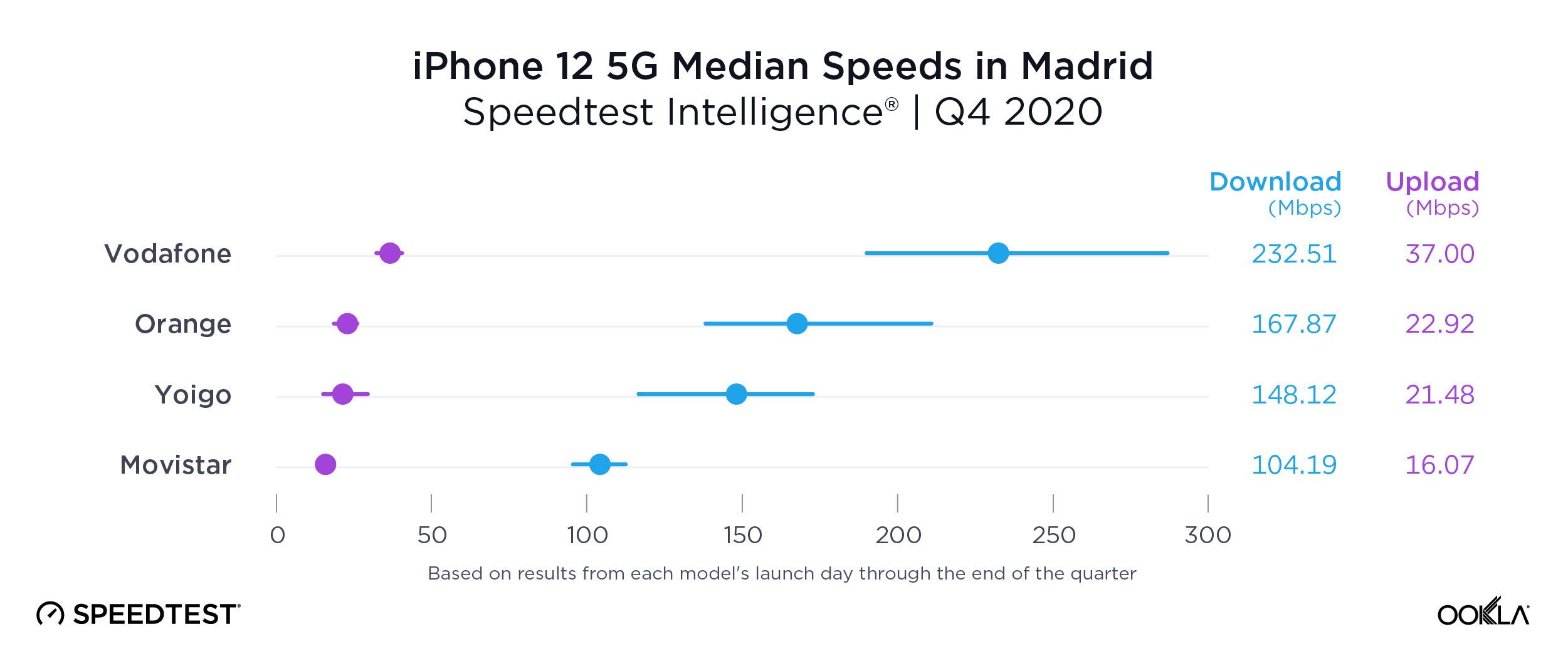
While Spanish operators currently benefit from the n78 band, the next step is expected to be the delayed addition of low bands (700 MHz). In Madrid, Vodafone showed the fastest median download speed over 5G using the iPhone 12 during Q4 2020 at 232.51. Orange was second fastest, Yoigo third and Movistar at fourth.

We will continue to monitor how Apple’s 5G-capable devices impact the global market. Contact us to learn more about how Speedtest Intelligence can help you understand the latest developments in your market.

Ookla retains ownership of this article including all of the intellectual property rights, data, content graphs and analysis. This article may not be quoted, reproduced, distributed or published for any commercial purpose without prior consent. Members of the press and others using the findings in this article for non-commercial purposes are welcome to publicly share and link to report information with attribution to Ookla.
| February 22, 2021

Revisiting iPhone 12 5G Performance Across the Globe


As we previously covered, the iPhone 12 is finally allowing Apple enthusiasts to connect to 5G. We’re back with fresh data to see how user adoption and new 5G rollouts have affected performance worldwide.

Unique 5G-capable device counts have leveled off

After the launch of various iPhone 12 models, the daily count of unique devices worldwide that are capable of connecting to 5G spiked significantly compared to the year as a whole. The daily trend of unique 5G-capable devices as a percentage of the whole year is dramatically higher than before the iPhone 12 models launched, but has remained relatively steady since December.
Daily-Trend_5G-Capable-Devices_Year_0221

Pro 5G and Pro Max 5G are the most popular iPhone 12 models

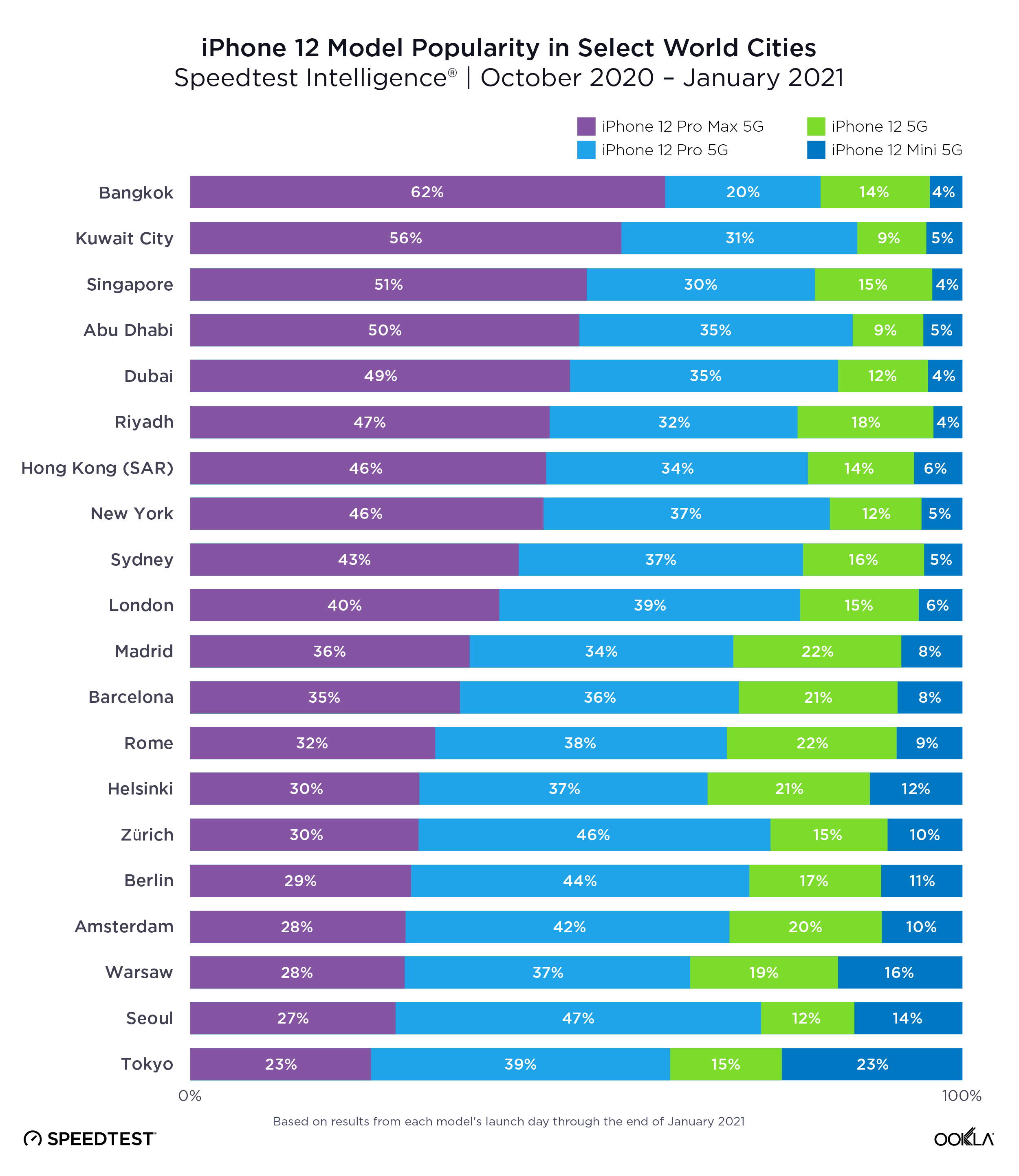
We looked again at Speedtest® results from the launch date of each model, this time including data through the end of January, to see which iPhone 12 models are the most popular. This time we added five additional cities for a total of 20 major cities across the globe. We still found that most Speedtest users have opted for the “Pro” models.

The iPhone 12 Pro Max 5G showed the highest number of samples among iPhone models in Bangkok, Kuwait City, Singapore, Abu Dhabi, Dubai, Riyadh, Hong Kong, New York, London, Madrid and Sydney. This was a change for both London and Madrid, which had previously had more samples from the iPhone 12 Pro 5G.

The iPhone 12 Pro 5G showed the most samples in Seoul, Zürich, Berlin, Amsterdam, Warsaw, Helsinki, Rome, Barcelona and Tokyo. While the more affordable models were less popular than the Pro models across all the cities on our list, the iPhone 12 Mini saw the most adoption in Tokyo and the iPhone 12 5G saw the most adoption in Rome and Madrid.
iPhone-12-Model-Popularity_0221

Seoul tops list of iPhone 12 5G speeds

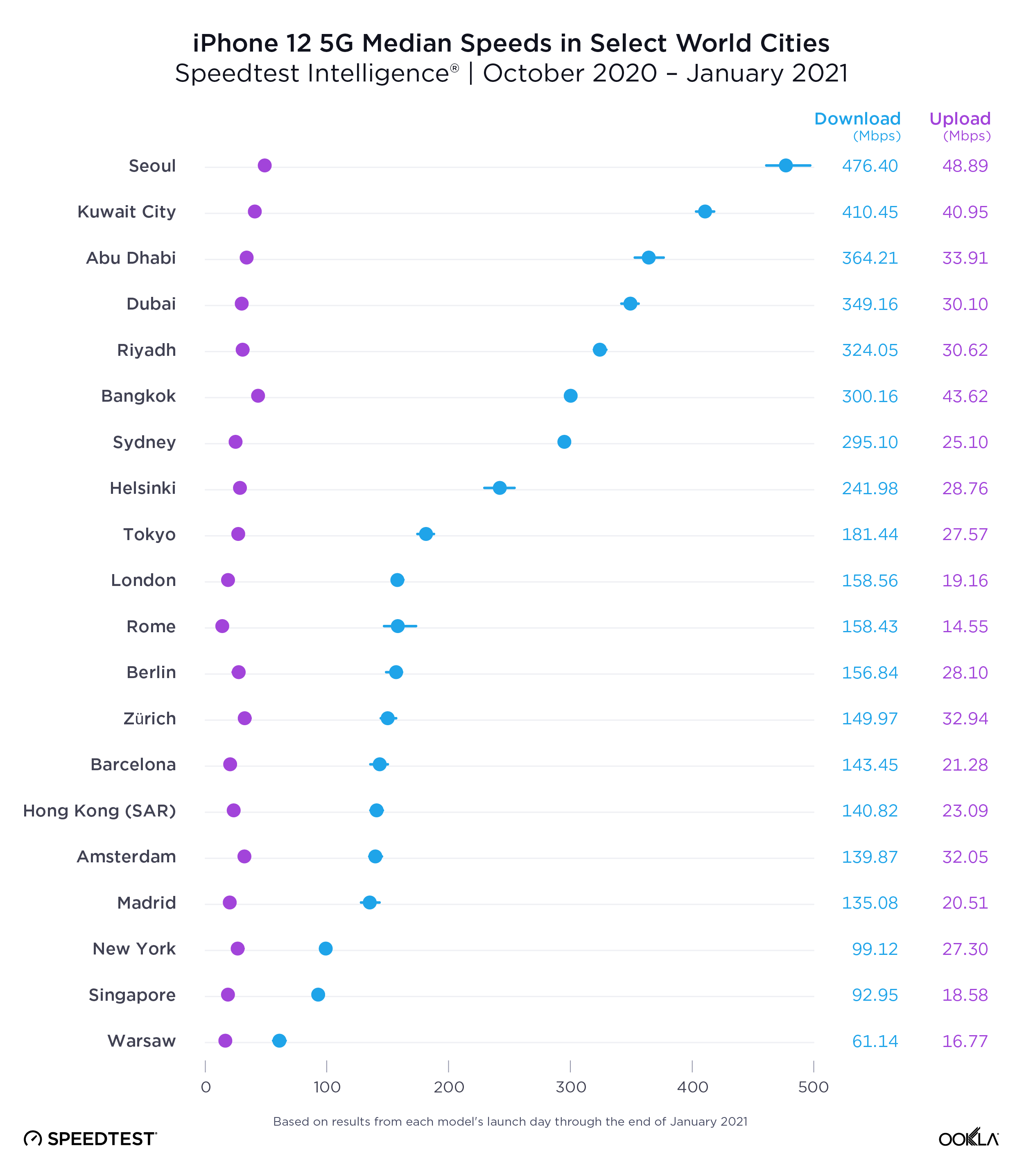
As before, we analyzed Speedtest Intelligence® data for iPhone 12 devices in these 20 cities and found that Seoul had the fastest median speed over 5G, followed by several of the major cities of the Gulf Cooperation Council (GCC), namely Kuwait City, Abu Dhabi, Dubai and Riyadh.

It is also interesting to observe that, in the highly dynamic European market where many different network rollout approaches are possible, 5G download speeds in seven of nine European cities fell between 135-160 Mbps range on the iPhone 12. Helsinki and Warsaw were the exceptions in Europe, with 241.98 and 61.14 Mbps median download speeds, respectively.
iPhone-12-5G-Median-Speeds_0221

Operator breakdown: iPhone 12 performance in select cities

We also expanded our operator analysis to 10 cities. The following charts include median 5G speeds over iPhone 12 models of top operators with sufficient samples.

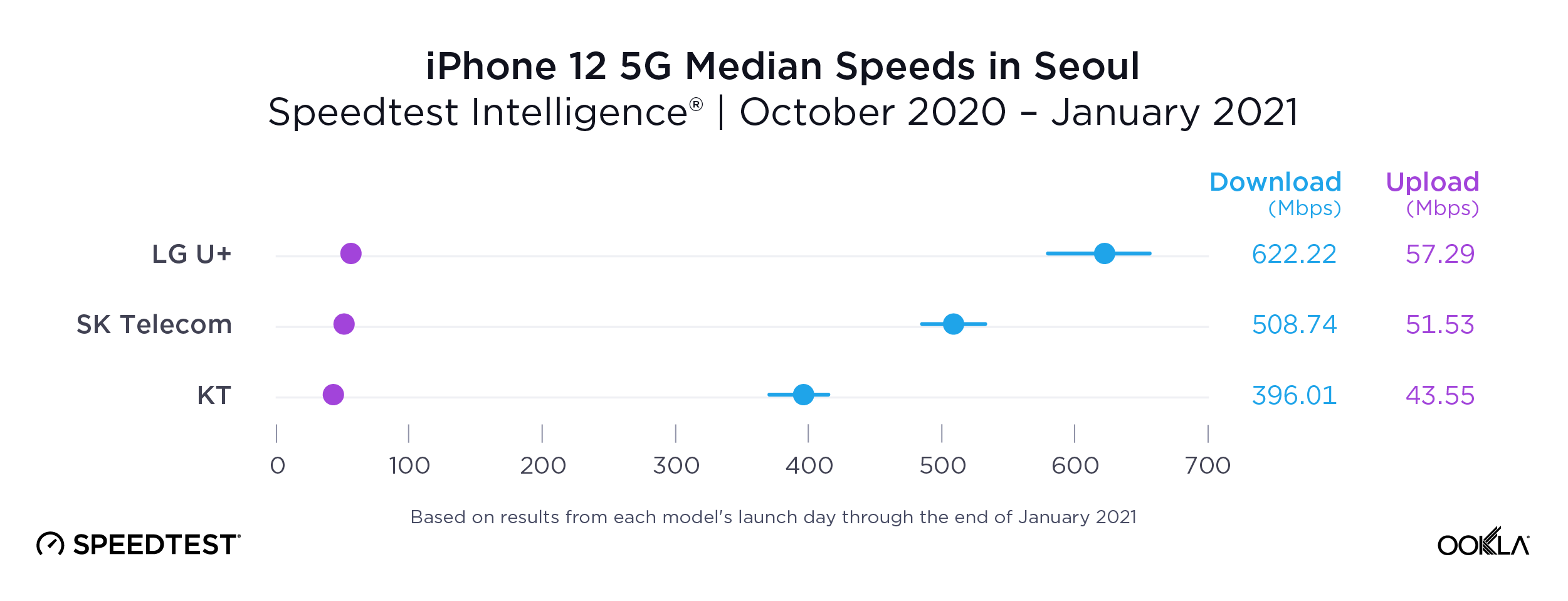
Operator rankings did not change in the four cities we previously analyzed. LG U+ in Seoul, China Mobile Hong Kong in Hong Kong and KPN Mobile in Amsterdam still had the fastest median 5G download speeds over the iPhone 12 in their local markets.
iPhone-12-5G-Median-Speeds_Seoul_0221-1

iPhone-12-5G-Median-Speeds_Hong-Kong_0221

iPhone-12-5G-Median-Speeds_Amsterdam_0221

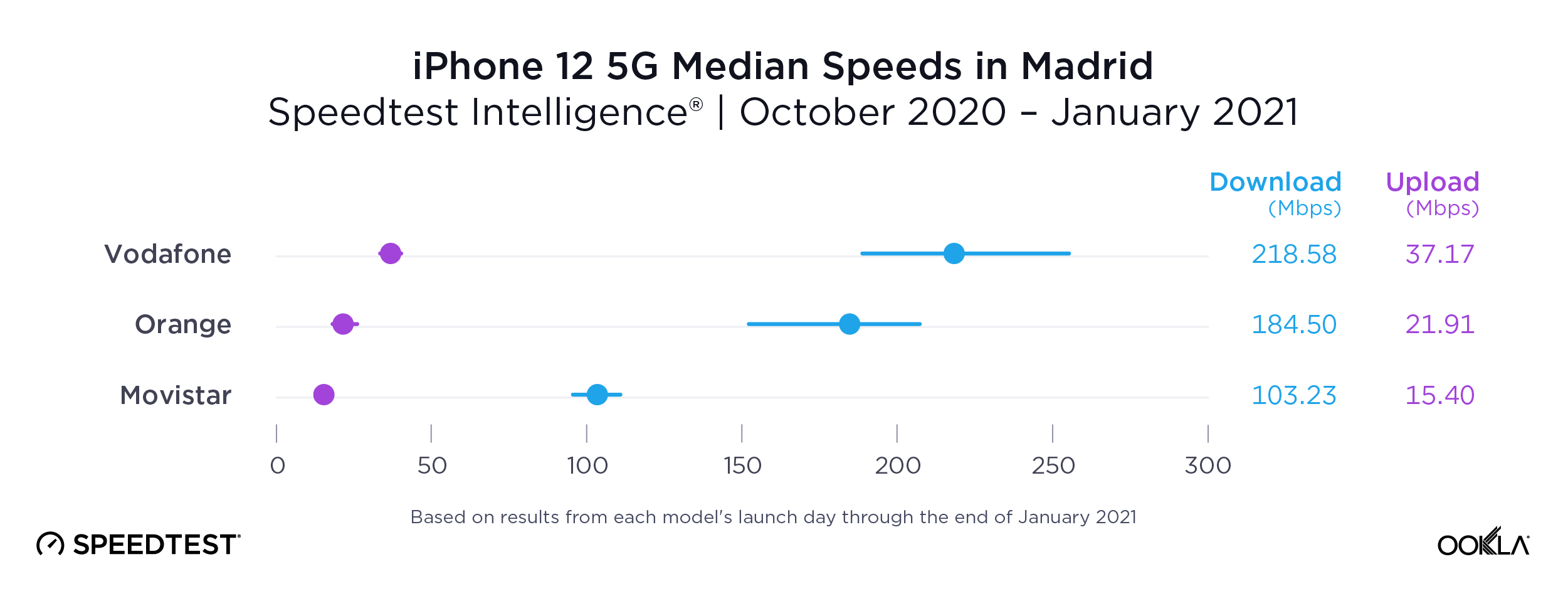
iPhone-12-5G-Median-Speeds_Madrid_0221

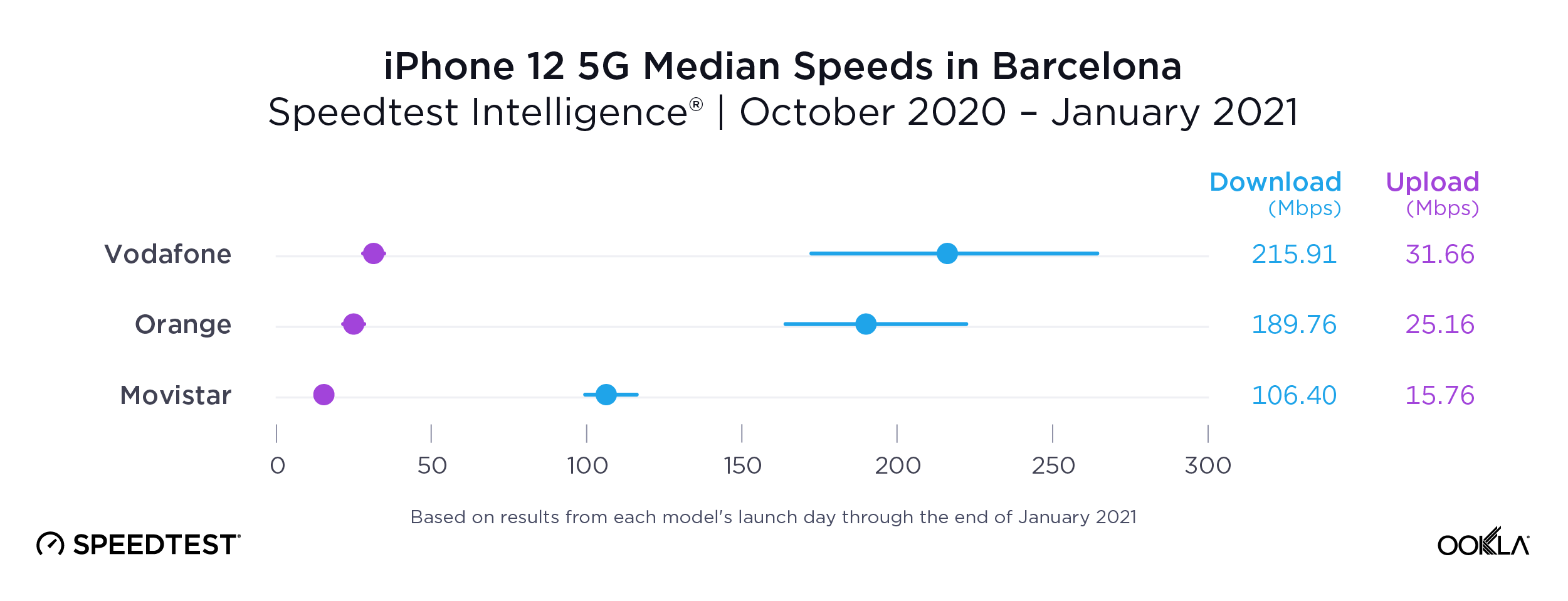
Barcelona showed similar speeds by operator to those in Madrid. We could not yet determine whether Vodafone or Orange’s 5G networks were fastest for iPhone 12, but both providers had a solid lead over Movistar in both Madrid and Barcelona.
iPhone-12-5G-Median-Speeds_Barcelona_0221

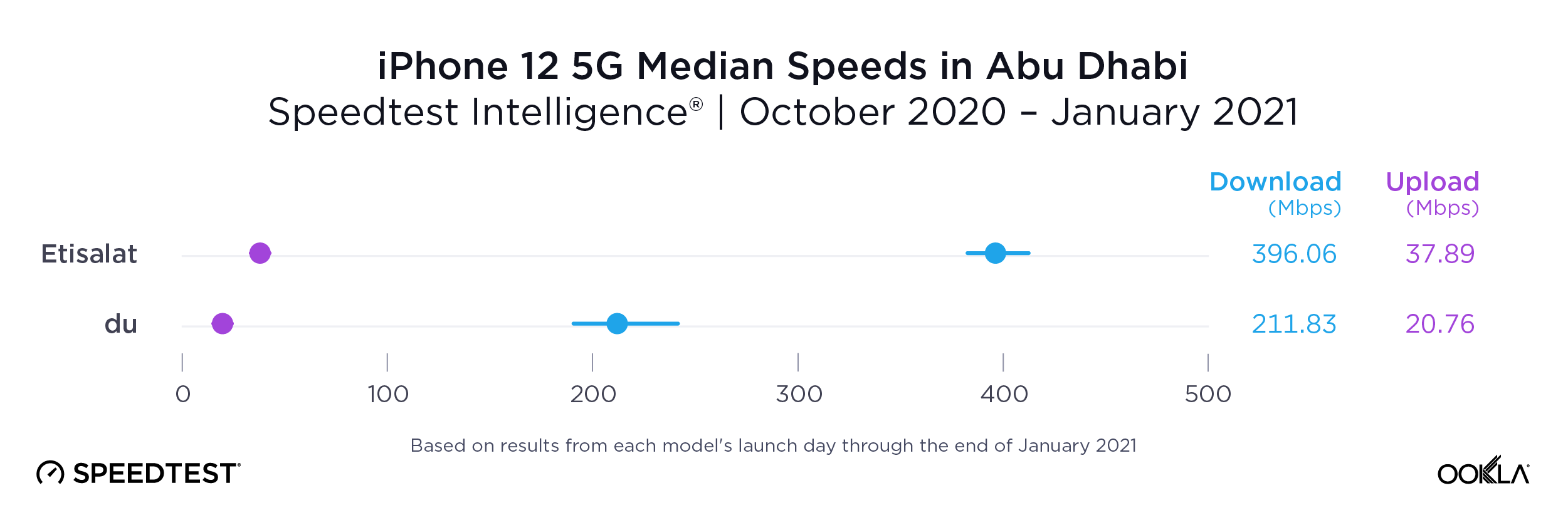
United Arab Emirates was the fastest country for mobile according to the January 2021 Speedtest Global Index. As the capital and the second most populous city in the country, Abu Dhabi contributed to this average with median 5G download speeds of 396.06 Mbps on the iPhone 12 for Etisalat and 211.83 Mbps for du.
iPhone-12-5G-Median-Speeds_Abu-Dhabi_0221

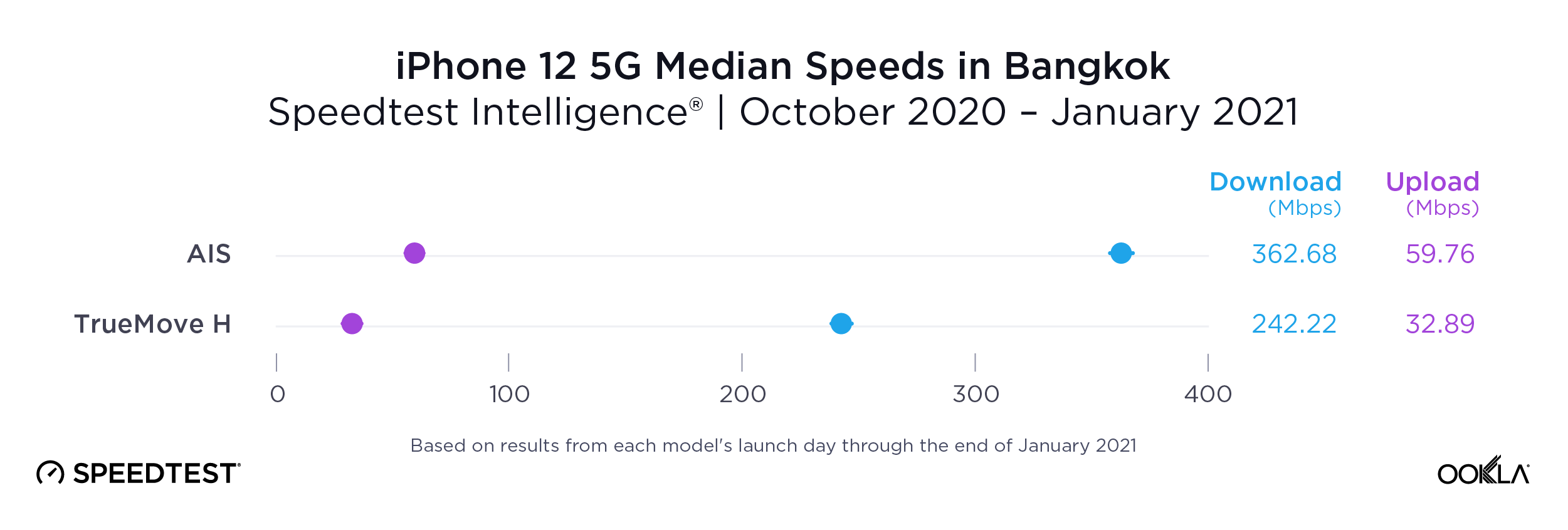
In Bangkok, AIS showed the highest median 5G download speed over the iPhone 12 at 362.68 Mbps. TrueMove H followed at 242.22 Mbps. These two operators also had the highest number of Speedtest results over iPhone 12 among all operators analyzed for this article. Another popular operator in the region, DTAC, is not included in the chart due to limited iPhone 12 5G samples.
iPhone-12-5G-Median-Speeds_Bangkok_0221

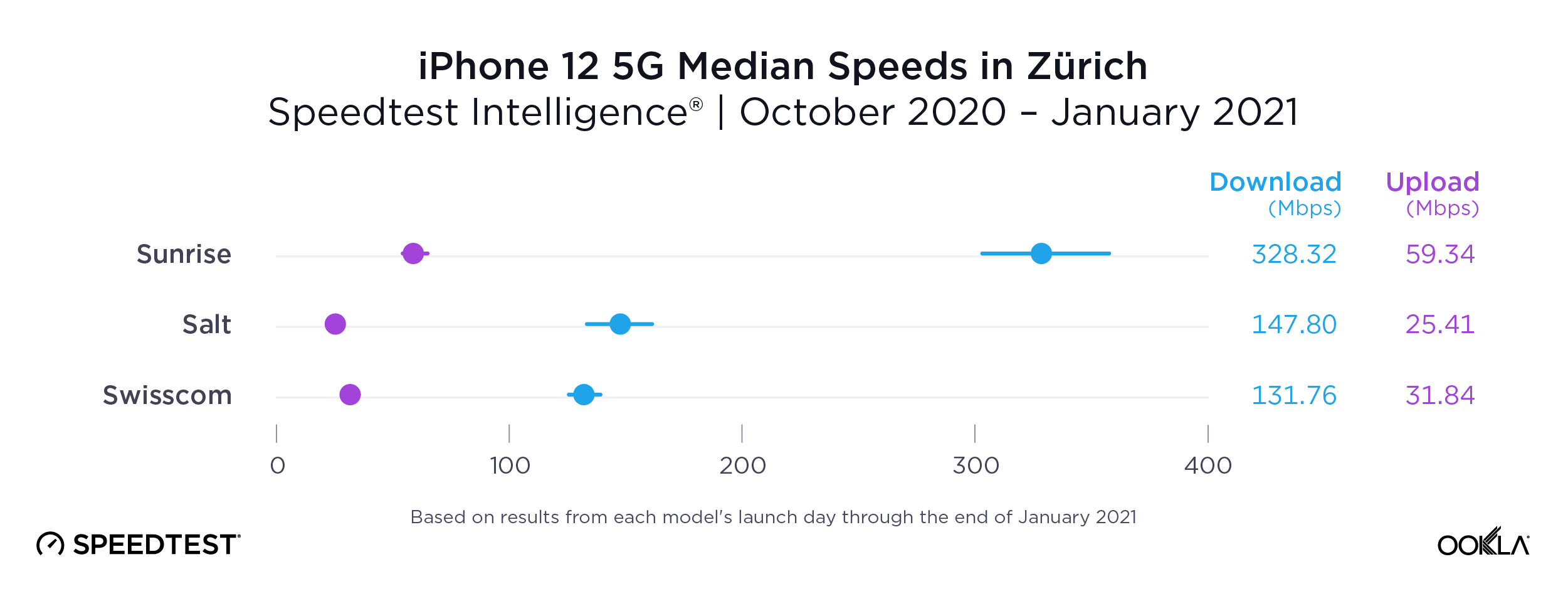
Data from Speedtest Intelligence reveals that Sunrise had the fastest median 5G download speed over iPhone 12 by a considerable margin at 328.32 Mbps.
iPhone-12-5G-Median-Speeds_Zurich_0221

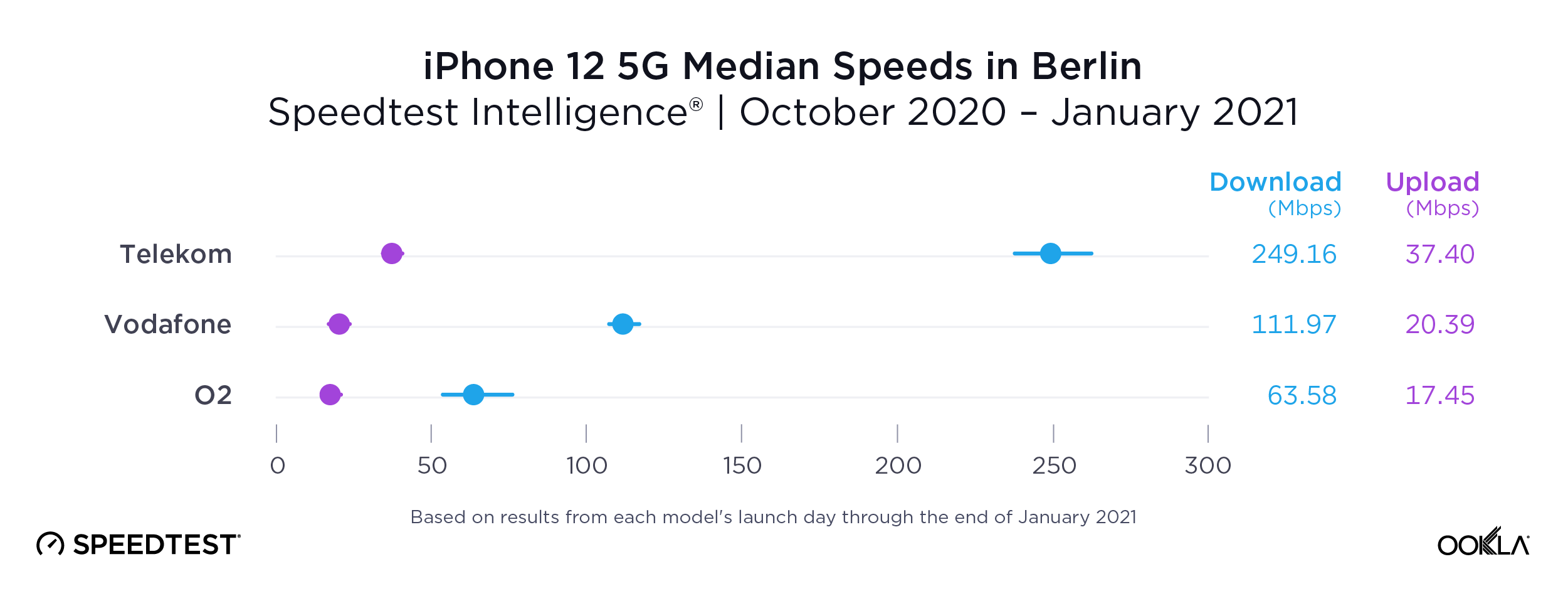
Telekom in Berlin comfortably had the fastest median 5G download speed over iPhone 12 at 249.16 Mbps.
iPhone-12-5G-Median-Speeds_Berlin_0221

As mentioned above, median 5G speeds over iPhone 12 lagged in Warsaw when compared with other European cities analyzed. This is likely due to the fact that the auction of 3.4-3.8 GHz bands did not take place as planned in Poland because of the pandemic. As of this analysis, Orange and T-Mobile’s 5G speeds for iPhone 12 devices were faster than Play, which trailed with 42.53 Mbps. We also saw 5G tests from Plus in Speedtest Intelligence, but the operator is not included in the above chart due to lack of iPhone 12 samples compared to other operators.
iPhone-12-5G-Median-Speeds_Warsaw_0221

We will continue to monitor how Apple’s 5G-capable devices impact the global market. Contact us to learn more about how Speedtest Intelligence can help you understand the latest developments in your market.

Ookla retains ownership of this article including all of the intellectual property rights, data, content graphs and analysis. This article may not be quoted, reproduced, distributed or published for any commercial purpose without prior consent. Members of the press and others using the findings in this article for non-commercial purposes are welcome to publicly share and link to report information with attribution to Ookla.
| February 14, 2018

Android or iOS, Who’s Winning Gold in the Global Speed Race?

All eyes are on South Korea this month as the world’s top athletes compete to stand on top of that all-important podium. But what we’re interested in is how their mobile networks are holding up back home. So we took a look at Speedtest results to get a global picture of the competition between Android and iOS — the operating system that powers all those Apple devices — by comparing speeds, top devices and operating systems by country.

In order to qualify for this round of analysis, countries had to show Speedtest results from at least 670 unique mobile devices during January 2018.

Who’s faster? #TeamAndroid or #TeamiOS?

You might think that speeds on Android and iOS are relatively similar within a country. Not true.

While the average country-level speeds we report in the Speedtest Global Index are a good indicator of the baseline internet speeds in a country (and how they compare with the world), there’s more to the story. From device age to market saturation, there are a lot of factors that play into potential differences in speeds experienced by users on Android versus those on iOS.

But those effects vary by country. And this is where things get really interesting.

Android’s best showings

Android devices saw a faster mean download than those on iOS in 25 of the countries we surveyed. Android download speeds were 24.9% higher than those on iOS in Iraq, 23.9% in South Africa, 19.0% in Mongolia, 17.2% in Hong Kong and 12.8% in Kuwait.

Where iOS wins

On the other hand, when iOS devices are faster, they’re a lot faster. There are 60 countries on our list where the mean download speed on iOS is more than 10% higher than that on Android. Highlights include: Thailand where mean speed for iOS results was 60.5% faster than those over Android, Nigeria (51.7%), Kenya (43.4%), Bangladesh (41.5%) and Japan (38.3%).

What devices are people really using?

Poke around the above map a little and you’ll see the list of the four most common devices we were able to identify in our results.

Apple dominates

With only 28 different models of iPhone in our results and 1,983 different types of Android phones, math is on Apple’s side when it comes to ranking for top devices. The iPhone 7 takes the top spot in 72 countries, including Brazil, Germany, Italy, Russia, Saudi Arabia and the United Kingdom. The iPhone 6 leads the list in 12 countries, including China, Malaysia and Thailand. Georgia was the only country whose most common device was the iPhone 5.

Android wins for diversity

While only 16 countries showed an Android device as the most common phone in our data, it was refreshing to see a wide number of brand names. The Samsung Galaxy S7 topped the list in Croatia, Israel and Peru. The Samsung Galaxy S7 Edge was the leading device in Honduras, Pakistan and Tunisia. The Samsung Galaxy S8 was the most popular device in Serbia.
Six countries showed the Xiaomi Redmi Note 4 as their most popular device, including Bangladesh, Belarus, Greece, India, Indonesia and the Ukraine. The Xiaomi Redmi 4X was the most common device in Kyrgyztan. In Finland the most common device in our results was the OnePlus 3T. In Algeria it was the Oppo F1s.

The diversity of manufacturers increases as we look beyond the top spot. Despite difficulty cracking the US market, the Huawei Honor 8 is the number 2 phone in Finland and two Huawei models make number 4 in Nigeria and Serbia. We also saw a lot more Samsungs in the number 3 and 4 slots.

Ookla retains ownership of this article including all of the intellectual property rights, data, content graphs and analysis. This article may not be quoted, reproduced, distributed or published for any commercial purpose without prior consent. Members of the press and others using the findings in this article for non-commercial purposes are welcome to publicly share and link to report information with attribution to Ookla.